
Don’t Let Quarantine Fees Bite Your Wallet
Why Filing a Claim for Pet Quarantine Costs More Than Most People Expect
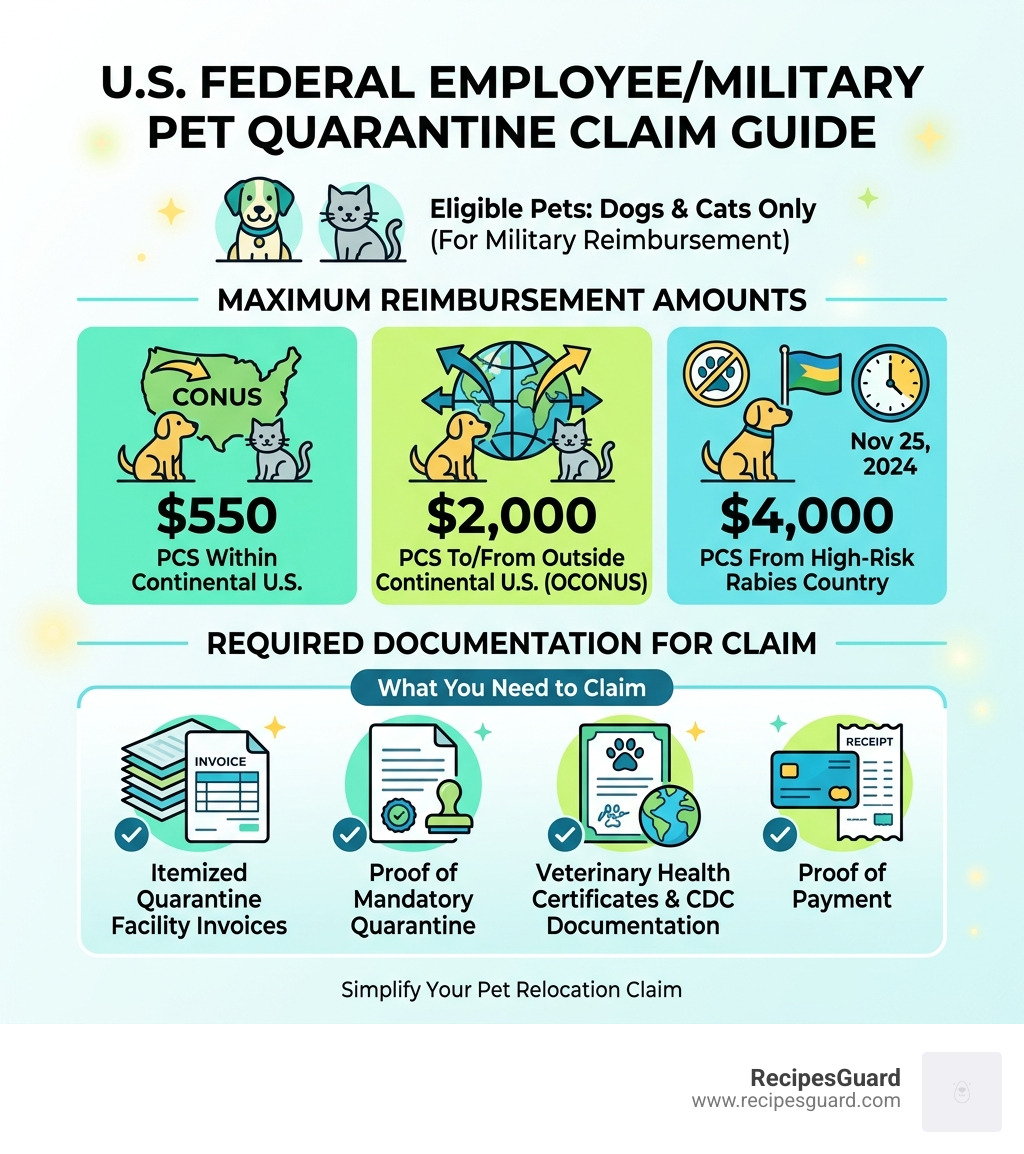
Claiming for pet quarantine can save you hundreds — sometimes thousands — of dollars when relocating internationally or completing a military PCS move. Here’s a quick breakdown of what you need to know:
Who can claim:
- U.S. military service members on PCS orders
- U.S. federal government employees relocating to a new duty station
- Eligible pets: domestic dogs and cats only (for military reimbursement)
How much you can claim:
| Situation | Maximum Reimbursement |
|---|---|
| PCS within continental U.S. (CONUS) | $550 |
| PCS to/from outside continental U.S. (OCONUS) | $2,000 |
| PCS from high-risk rabies country (from Nov. 25, 2024) | $4,000 |
What you need to claim:
- Itemized invoices from the quarantine facility
- Proof of mandatory quarantine requirement
- Veterinary health certificates and CDC documentation
- Proof of payment
Moving abroad is already stressful. Now add a pet to the mix.
Suddenly you’re dealing with microchip requirements, rabies titer tests, health certificates, and — often the biggest shock — mandatory quarantine fees that can run into the thousands of dollars before your pet even sets paw in your new home.
Whether you’re a military family navigating a PCS move, a U.S. government employee relocating overseas, or an international student trying to bring your dog along for a semester abroad, quarantine costs are rarely covered by standard travel budgets — and most people don’t realize they may be entitled to reimbursement.
The rules changed significantly in late 2024. New CDC regulations on dogs arriving from high-risk rabies countries reduced the number of approved ports of entry, which drove costs sharply higher. The Department of Defense responded by raising the reimbursement ceiling for affected service members from $2,000 to $4,000, effective November 25, 2024.
But eligibility rules are specific, documentation requirements are strict, and claim denials are common — especially when paperwork has small errors or the quarantine isn’t classified as mandatory.
This guide walks you through exactly what qualifies, what you need to document, and how to submit a successful claim.
Relevant articles related to claim for pet quarantine:
- Claim Timeline Extension Guide
- Corporate Travel Insurance Australia
Understanding Your Eligibility to Claim for Pet Quarantine
When it comes to getting money back for your furry friend’s stay in “pet hotel lockdown,” the first thing we need to look at is your status. As of April 2026, the most robust systems for reimbursement are designed for U.S. Service members and federal employees, though private insurance options for students and expats are catching up.
For military members, the rules are governed by the Joint Travel Regulations (JTR). If you are on a Permanent Change of Station (PCS) move, you are likely eligible. However, the military is very specific about who counts as a “pet.” In this context, reimbursement is strictly for domestic dogs and cats. If you’re moving a prize-winning parrot or a very confused ferret, those costs generally won’t be covered under the standard pet relocation allowance.
The reimbursement landscape changed dramatically due to Additional Reimbursement Authorized for Pet Transportation from Countries with Higher Rabies Risk. This update was a direct response to the CDC’s stricter import rules. If you are moving from a country the CDC labels as high-risk for rabies, the cost of specialized transport and mandatory quarantine can be astronomical. Thankfully, the government recognized this, increasing the potential payout to help families stay together.
Military Reimbursement Caps and Effective Dates
Timing is everything. To successfully claim for pet quarantine, you need to know which “cap” applies to your move. As of our current date in April 2026, these are the limits you should keep in mind:
- CONUS Moves: For moves within the continental United States, the reimbursement is capped at $550. This has been the standard since January 2024.
- OCONUS Moves: For moves to or from locations outside the continental U.S. (like moving from Virginia to Germany), the cap is $2,000.
- High-Risk Rabies Countries: If you are coming from a high-risk country where Patriot Express or standard commercial pet travel is unavailable, you can be approved for up to $4,000. This specific policy became effective on November 25, 2024.
It’s important to note that these figures aren’t just handed to you. They are reimbursements for actual expenses. If your quarantine only costs $300, you’re getting $300 back, not the full $550 cap.
Government Employee Miscellaneous Expense Allowance
If you aren’t in the military but work for the federal government, your path to a claim for pet quarantine looks a little different. Instead of a specific “pet allowance,” these costs are often filed under the Miscellaneous Expenses Allowance (MEA).
A landmark GAO decision (B-206538) established that mandatory pet quarantine fees are not considered “transportation” costs (which are often excluded) but are instead “conditions of entry.” Because you cannot legally establish residency in a place like Hawaii or an overseas territory without your pet clearing quarantine, these fees are viewed as an inherent cost of relocating your household.
Under the Federal Travel Regulations (FTR), if the quarantine is mandatory and required by law for the pet to enter the jurisdiction, you have a strong case for reimbursement. We always tell our student travelers and government contractors: if the law says your pet must stay in a facility to enter, save every single receipt.
How to File a Claim for Pet Quarantine Insurance Costs
Filing a claim for pet quarantine is less about the “why” and more about the “proof.” Insurance adjusters and government auditors aren’t there to take your word for it; they need a paper trail that would make a librarian proud.

The first step in any successful claim is gathering your itemized invoices. A credit card statement showing a $1,200 charge to “Animal Quarantine Facility” isn’t enough. You need a breakdown that shows the daily boarding rate, any mandatory veterinary exams performed during the stay, and the cost of required vaccinations or treatments (like screwworm checks).
Essential Documentation for a Successful Claim
To avoid the dreaded “Request for Evidence” letter, ensure your packet includes:
- Rabies Titer Results: Specifically the FAVN (Fluorescent Antibody Virus Neutralization) test results.
- ISO Microchip Records: The microchip must be implanted before the final rabies shot for many jurisdictions (like Australia or Hawaii) to recognize the timeline.
- Import Licenses: The official permit from the destination country.
- CDC Dog Import Form: For those entering the U.S., the CDC receipt is mandatory.
- USDA Endorsement: Most international health certificates must be endorsed via the VEHCS electronic system.
If you are traveling with birds, the process is even more specialized. According to the USDA’s guide on Importing Pet Birds into the United States: Federal Quarantine, birds from countries affected by Highly Pathogenic Avian Influenza (HPAI) require a 30-day stay at a federal facility. These claims require specific USDA Animal Import Center contracts.
Step-by-Step Guide to the Claim Process
We’ve helped many students and families through this, and the process generally follows these five steps:
- Verify Necessity: Ensure the quarantine was mandatory. Voluntary boarding while you look for an apartment is not reimbursable.
- Itemize Every Cent: Break down the costs into “Quarantine Fees,” “Mandatory Testing,” and “Mandatory Treatment.”
- Submit via Portal: For military members, this is usually done through the Defense Travel System (DTS). For students with private insurance, use the provider’s online claim portal.
- The “Secretarial Process”: If you are a service member whose costs exceed $2,000 (especially for high-risk countries), your claim may require “Secretarial Process” approval. This is an extra layer of high-level authorization, so expect a slightly longer wait.
- Verification: The agency or insurer will verify that the quarantine facility is an approved, registered site (like The ARK at JFK or the Mickleham facility in Australia).
Regional Quarantine Rules: Hawaii, Australia, and the UK
Different destinations have different “teeth” when it comes to their laws. Understanding these regional quirks is vital because your claim for pet quarantine will only be approved if you followed the local rules to the letter.
Hawaii is a classic example. Because the islands are rabies-free, they are incredibly strict. If you do everything right — the FAVN test, the waiting period, and the paperwork submission 10+ days in advance — you can qualify for “Direct Airport Release” for a fee of $185. If you miss that window or your paperwork is late, the fee jumps to $244, and your pet might face a 5-day-or-less stay. You can find all the updated checklists on the Animal Quarantine Information Page (Updated) | Animal Industry Division.
Specific Requirements for a Claim for Pet Quarantine in Australia
For our readers in Australia, or those moving here, the process is one of the most rigorous in the world. Australia is a “Group 3” country, meaning pets from the U.S. generally face a minimum 10-day stay at the Mickleham Post-Entry Quarantine (PEQ) facility in Melbourne.
When you file a claim for pet quarantine in Australia, you must prove:
- The pet stayed at the official Mickleham facility.
- You paid the Department of Agriculture, Fisheries and Forestry (DAFF) fees.
- All pre-export requirements were met, as outlined in the Pet Travel From the United States to Australia – USDA-Aphis guide.
Failure to have the correct rabies titer test (drawn at least 180 days before export for some categories) can lead to an extended stay, which most insurance policies will not cover if the delay was caused by owner error.
Avoiding Denials When You Claim for Pet Quarantine
Why do claims get rejected? Usually, it’s the small stuff. We see many denials because of “handwritten forms.” In 2026, most agencies (including the CDC and the UK’s APHA) require forms to be typed. If an auditor can’t read your vet’s handwriting, they will simply deny the claim.
Another common pitfall is the microchip timing. If the microchip was scanned after the rabies vaccination was given, the vaccination is often considered invalid for the purposes of avoiding or shortening quarantine. As the Put your pet in rabies quarantine – GOV.UK guidance notes, failing a travel check at the border can lead to your pet being held for up to four months — and you will be on the hook for every penny of those fees if you didn’t follow the rules.
Frequently Asked Questions about Pet Quarantine Claims
What is the maximum reimbursement for a military pet quarantine?
As of April 2026, the maximum is $550 for domestic moves (CONUS) and $2,000 for international moves (OCONUS). However, if you are moving from a CDC-designated high-risk rabies country and meet specific criteria, you may be eligible for up to $4,000.
Can I claim quarantine costs for pets other than dogs and cats?
For U.S. military PCS reimbursements, the answer is generally no; the JTR specifies domestic dogs and cats only. However, if you are a federal employee using the Miscellaneous Expenses Allowance, or a student with a specialized travel insurance policy, you may be able to claim for other animals like birds or rabbits, provided the quarantine is a mandatory condition of entry.
How do CDC high-risk rabies regulations affect my claim?
The CDC regulations implemented in late 2024 significantly limited the ports of entry for dogs from high-risk countries. This often means you have to fly your pet into a specific airport (like JFK, LAX, or Miami) that has a CDC-registered Animal Care Facility. Because these facilities are more expensive and often require at least one overnight stay, the DoD increased reimbursement limits to cover these specific, mandatory costs.
Conclusion
Navigating international pet travel is no walk in the park. Between the shifting CDC regulations and the strict requirements of rabies-free zones like Hawaii and Australia, the costs can catch even the most prepared traveler off guard.
At RecipesGuard, we specialize in making the complex simple. Whether you’re a student heading to Melbourne for a master’s degree or a military family moving across the globe, our goal is to ensure you have the tools to successfully file a claim for pet quarantine. Don’t let a missing signature or a handwritten form stand between you and a $4,000 reimbursement.
Ready to head to the Land Down Under? Get expert help with your travel insurance for students traveling to Australia and ensure your entire family — four-legged members included — makes the trip safely and affordably.
Relevant articles:
- Claim Timeline Extension Guide
- Corporate Travel Insurance Australia

My name is Bianca, and my journey into the world of fermentation and food safety began with a costly mistake. I once lost an entire season’s harvest of chili peppers because I relied on guesswork instead of science. That failure was my turning point.
