Your Printable Guide to How Long Food Actually Lasts
The Canned Food Shelf Life Chart You Actually Need (And Can Print)
A canned food shelf life chart is the fastest way to know which cans to use first — and which ones are still perfectly safe to keep. Here’s the quick version:
| Food Type | Examples | Best Quality | Safe To Eat |
|---|---|---|---|
| Low-acid canned foods | Meats, beans, corn, peas, carrots | 2-5 years | Indefinitely if seal intact |
| High-acid canned foods | Tomatoes, fruits, citrus juice | 12-18 months | Up to 2-3 years |
| Canned fish | Tuna, salmon, sardines | 3-5 years | 5+ years |
| Canned beans | Black beans, chickpeas, lentils | 3-5 years | 5+ years |
| Evaporated milk | – | 12 months | Up to 2 years |
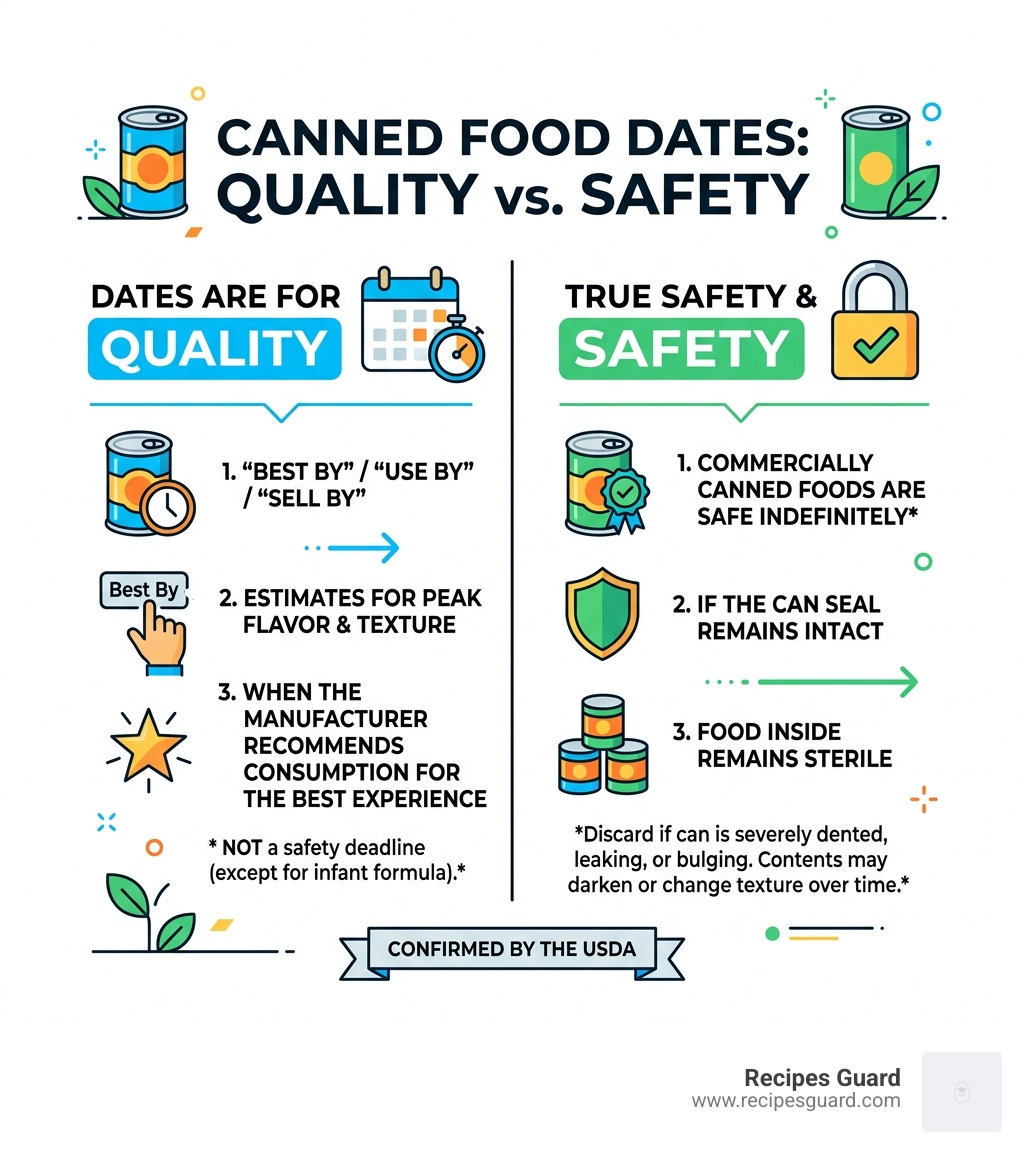
The most important thing to know: the date on a can is almost never a safety deadline. It’s a quality estimate. The USDA confirms that commercially canned foods with an intact seal are safe to eat well beyond the printed date.
That confusion around date labels is a real problem. The USDA estimates that 30% of the U.S. food supply is lost or wasted at the retail and consumer level — and a big chunk of that comes from people throwing out perfectly good canned food because of a “Best By” date they misunderstood.
Whether you’re building a long-term preservation pantry, prepping for emergencies, or just trying to stop wasting money on food you throw away too soon — this guide gives you everything in one place.
Decoding the Labels: Quality vs. Safety
As we move through 2026, the push for sustainability has made understanding food labels more critical than ever. We’ve all been there: staring at a can of green beans that “expired” three months ago, wondering if it’s a dinner ingredient or a biohazard. The truth is rooted in science, not just marketing.
Except for infant formula, federal law in the United States does not require expiration dates on food. Manufacturers voluntarily apply these dates to help consumers and retailers determine when a product is at its “peak.” This is an estimate of quality—flavor, color, and texture—rather than a hard line for safety.
- Best if Used By/Before: This is the manufacturer’s golden window. It indicates when the product will have the best flavor or quality. It is not a purchase or safety date.
- Sell-By: This date tells the store how long to display the product for inventory management. You should buy the product before this date, but you can still eat it long after it reaches your pantry.
- Use-By: This is the last date recommended for the use of the product while at peak quality. The only time this is a safety date is on infant formula, which must be discarded after this date because the nutrients can degrade, and the physical properties of the formula can change.
At Recipes Guard, we believe that understanding the science of preservation is the first step toward a resilient kitchen. If you’re moving beyond commercial cans into DIY territory, check out our Safety First: A Guide to Preserving Fermented Foods to ensure your home projects remain as safe as they are delicious.
The Ultimate Canned Food Shelf Life Chart
To keep your pantry running like a well-oiled machine, you need to distinguish between high-acid and low-acid goods. This distinction is the single most important factor in how long a can will last on your shelf.

| Category | Specific Items | Peak Quality Window | Extended Safety Window |
|---|---|---|---|
| Low-Acid Vegetables | Corn, peas, potatoes, carrots, mushrooms | 2–5 Years | 5–10+ Years |
| Canned Meats | Chicken, beef, pork, SPAM, turkey | 2–5 Years | 10+ Years |
| Canned Seafood | Tuna, salmon, sardines, clams | 3–5 Years | 5–7 Years |
| Starchy Staples | Black beans, kidney beans, lentils, chickpeas | 3–5 Years | 10+ Years |
| High-Acid Fruits | Peaches, pears, pineapple, fruit cocktail | 12–18 Months | 2–3 Years |
| High-Acid Veggies | Tomatoes, tomato sauce, sauerkraut, pickles | 12–18 Months | 2–3 Years |
| Soups & Stews | Chicken noodle, beef stew, lentil soup | 2–5 Years | 5+ Years |
How to Use This Canned Food Shelf Life Chart
Having a canned food shelf life chart is only half the battle; you also need a system to manage it. We recommend the FIFO method (First-In, First-Out). This simply means using the oldest stock first so nothing sits at the back of the shelf for a decade.
When you bring groceries home, don’t just shove them in the pantry. Use a permanent marker to write the purchase month and year on the lid in large, clear numbers. This makes it incredibly easy to see what needs to be used next without squinting at tiny manufacturer codes. For those just starting their journey into food management, our Category: Preserving Basics is a fantastic resource for learning how to organize and maintain a long-term supply.
Printable Canned Food Shelf Life Chart for Your Pantry
Organization is the enemy of waste. We suggest printing this guide and taping it to the inside of your pantry door. This is especially helpful for emergency preparedness. In a high-stress situation, you don’t want to be guessing if your food is safe.
By keeping a diverse range of shelf-stable staples—like proteins, starches, and vegetables—you ensure your family has balanced nutrition regardless of what’s happening in the world. And remember, canned goods aren’t just for emergencies! They are great time-savers for everyday meals, like adding a pop of flavor with Quick and Easy Pickled Vegetables for Every Meal.
High-Acid vs. Low-Acid: Why pH Matters
Why do tomatoes “expire” faster than corn? It all comes down to the pH level.
Low-acid foods (those with a pH greater than 4.6) include most vegetables, meats, and seafood. Because these foods aren’t acidic enough to naturally inhibit the growth of dangerous bacteria like Clostridium botulinum, they must be processed using intense heat in a pressure canner. This process creates a sterile environment that, if the seal remains intact, allows the food to stay safe almost indefinitely.
High-acid foods (those with a pH of 4.6 or lower), such as fruits and tomatoes, are different. While the acidity helps keep them safe, that same acid eventually begins to react with the metal lining of the can. Over time, this can cause changes in texture and flavor, and eventually, it can even cause the can to leak or the food to develop a metallic taste. This is why we recommend using high-acid goods within 12 to 18 months for the best experience.
If you love the “zing” of acidic foods, you might want to try making your own through fermentation. It’s a natural way to lower pH while adding probiotics. Start with something simple like our Don’t Be Afraid of the Funk with This Easy Fermented Garlic Recipe.
Safety First: When to Toss the Can
While commercially canned food is incredibly safe, nature occasionally finds a way to break through. You must be able to spot the “red flags” of spoilage.
Never taste food to see if it is safe. If a can shows any of the following signs, discard it immediately:
- Bulging or Swelling: This is the most dangerous sign. It often indicates the presence of Clostridium botulinum, which produces gas as it grows. This can lead to botulism, a serious form of food poisoning.
- Deep Dents on Seams: A dent on the side of a can is usually just cosmetic. However, a dent that crosses the top, bottom, or side seam can create microscopic holes that let bacteria in.
- Deep Rust: Surface rust that wipes off is fine. Rust that is deep enough to pit the metal or that appears near the seams is a deal-breaker.
- Leaking or Seeping: Any sign of moisture on the outside of the can that seems to be coming from inside is a sign the seal has failed.
- Spurting Liquid: If liquid “pops” or spurts out aggressively when you puncture the lid, it indicates gas pressure inside from spoilage.
- Off-Odors or Mold: Once the can is open, your nose is your best friend. If it smells “funky,” metallic in a bad way, or looks fuzzy, toss it.
Learning to trust your senses while respecting safety boundaries is a skill we emphasize in our guide on Mastering the Art of Lacto-Fermented Hot Sauce, where monitoring for “the right kind of funk” is key.
Maximizing Your Pantry: Storage Best Practices
Where you store your cans is just as important as what is in them. To hit that 5-to-10-year safety window for low-acid foods, you need to provide the right environment.
- Temperature Control: The ideal range is 50°F to 70°F (10°C to 21°C). Every 10-degree drop in temperature can actually double the chemical shelf life of your food. Avoid garages, attics, or spots near the oven where temperatures swing wildly.
- Dryness is Key: High humidity leads to rust. If you live in a damp climate, consider a dehumidifier for your pantry area.
- Darkness: Light can cause some foods to discolor and can accelerate the breakdown of vitamins, particularly Vitamin A and C.
- Off the Floor: Never store cans directly on bare concrete. Concrete can “wick” moisture, leading to rust on the bottom of the cans. Use shelves or pallets.
Proper storage doesn’t just keep food safe; it preserves the nutrition. While some vitamins like C and A might decrease by 5-20% per year, minerals and proteins remain remarkably stable for years. If you’re interested in more active ways to keep your food alive and nutritious, dive into our Category: Fermented Recipes.
Frequently Asked Questions about Canned Food
Is it safe to eat canned food 5 years past the date?
For low-acid foods like canned meats, corn, or beans, the answer is generally yes, provided the can is in pristine condition. You may notice that the color has faded or the texture is softer than a fresh can, but the food remains sterile and safe to consume. High-acid foods like tomatoes, however, should likely be discarded after 2-3 years as the quality degrades significantly.
Are dented cans from the grocery store safe to buy?
We call this the “finger test.” If the dent is small, has smooth edges, and is located on the main body of the can (away from the top or bottom rims and the side seam), it is usually safe. If the dent is sharp, creased, or touches a seam, leave it on the shelf. Grocery stores often sell these in “scratch and dent” bins, but for long-term storage, it’s better to pay full price for an uncompromised seal.
How long does canned food last once opened?
Once the seal is broken, the “indefinite” safety window slams shut. Treat opened canned food like fresh leftovers.
- High-acid (fruits/tomatoes): 5–7 days in the fridge.
- Low-acid (meats/veggies): 2–3 days in the fridge.
- Canned fish: 1–2 days. Pro Tip: Never store an open tin can in the fridge. The iron and tin can leach into the food once exposed to air. Transfer the contents to a clean glass or plastic container first.
Conclusion
Reducing food waste is one of the most impactful 2026 pantry goals you can set. By using a canned food shelf life chart, understanding the difference between quality and safety dates, and practicing proper storage, you can save money and ensure your family is always well-fed.
At Recipes Guard, we’re passionate about helping you master the art of the kitchen, from the simplest pantry organization to the most complex fermentation projects. Ready to take the next step in your preservation journey? Master the basics of long-term food storage and turn your pantry into a powerhouse of nutrition and safety.