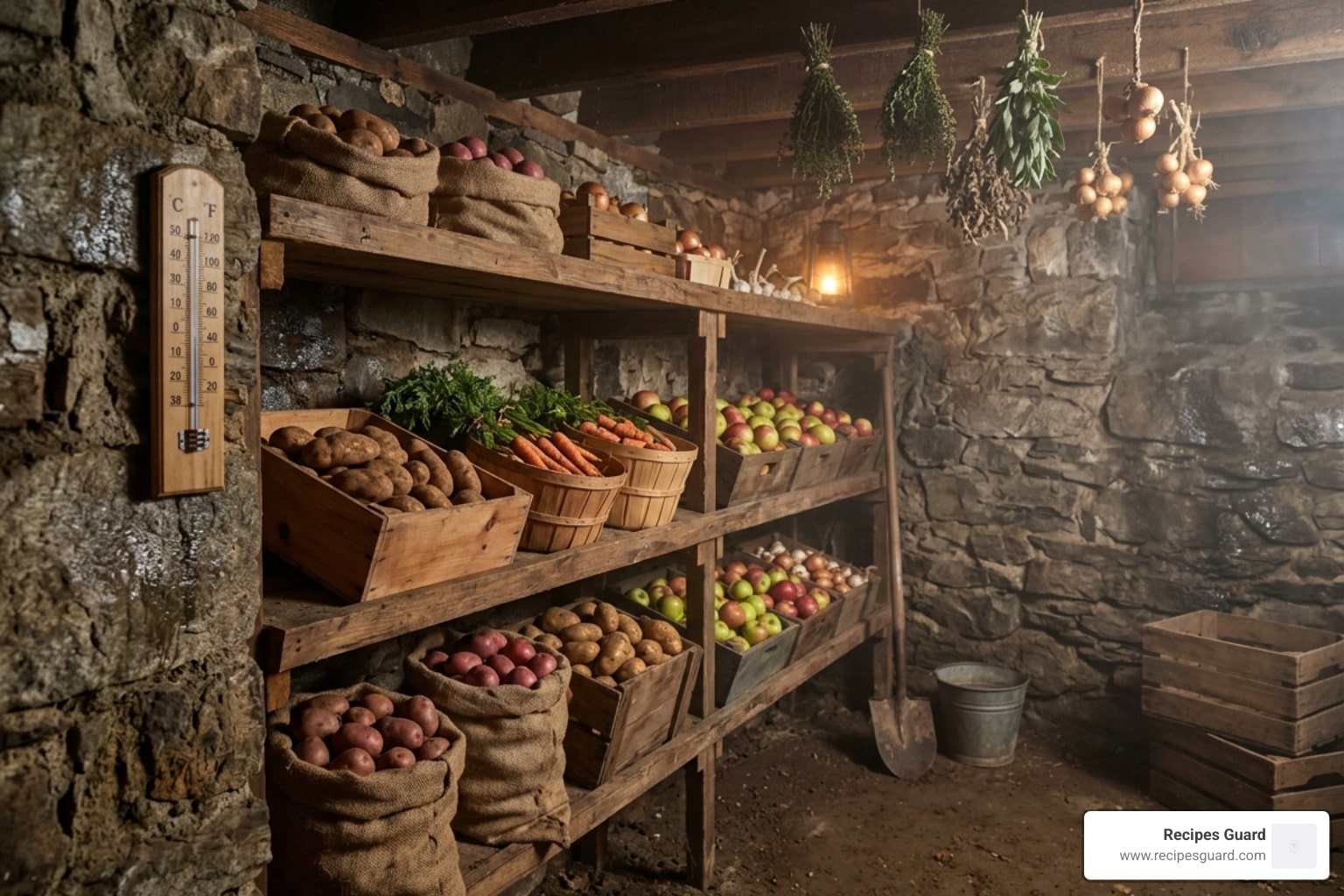
A Guide to Ideal Root Cellar Temperatures for Winter Storage
Why Root Cellar Temperature Makes or Breaks Your Winter Storage
Root cellar temperature is the single most important factor in keeping your harvest fresh through winter — and the ideal range is 32°F to 40°F (0°C to 4.5°C).
Here’s a quick reference so you can act on this right away:
| Produce Type | Ideal Temperature | Humidity |
|---|---|---|
| Root crops (carrots, beets, parsnips) | 32°F – 40°F | 90-95% |
| Potatoes, cabbage, apples | 32°F – 40°F | 80-90% |
| Onions, garlic | 32°F – 50°F | 60-70% |
| Winter squash, sweet potatoes | 50°F – 60°F | 55-60% |
Not all produce wants the same conditions. Getting the temperature right — and pairing it with the right humidity — is what separates a cellar full of crisp vegetables in March from a pile of rot.
Think of it this way: cold slows everything down. It slows the natural breakdown of sugars, slows mold growth, and slows the release of ethylene gas that causes produce to ripen and spoil faster. But too cold, and your carrots freeze solid and turn to mush.
The good news? You don’t need a purpose-built underground vault to make this work. Many home spaces — basement corners, unheated rooms, even attics in cold climates — can hit that sweet spot with the right setup.
This guide walks you through exactly what temperatures your stored produce needs, how to achieve them without complicated equipment, and how to troubleshoot when things go wrong.
What is the Ideal Root Cellar Temperature for Food Preservation?
When we talk about the “sweet spot” for a root cellar, we are aiming for a range between 32°F and 40°F (0°C to 4.5°C). This range is essentially the gold standard for most traditional storage crops. Keeping your cellar within these bounds mimics the conditions of a professional refrigerator but utilizes the earth’s natural cooling properties instead of electricity.
At these temperatures, the biological processes of your vegetables slow down significantly. According to Root Cellars: Types of Root Cellars and Storage Tips | The Old Farmer’s Almanac, maintaining this range is the most effective way to prevent spoilage and inhibit the growth of microorganisms that cause decay. If you are new to this, we recommend starting with our more info about preserving basics to understand how temperature interacts with food safety.
The Science of Cold Storage and Shelf Life
Why does cold work so well? It comes down to respiration. Even after they are pulled from the ground, your vegetables are still “breathing.” They take in oxygen and release carbon dioxide and heat. High temperatures speed up this respiration, causing the plant to consume its stored energy (sugars and starches) quickly.
There is a fascinating rule of thumb in food science: for every 18°F increase in temperature, the respiration rate of produce roughly doubles. This means that a carrot stored at 50°F will lose its quality twice as fast as one stored at 32°F! By keeping your root cellar temperature low, you are effectively putting your vegetables into a state of suspended animation. This metabolic slowing preserves the crisp texture and nutritional value of your harvest for months rather than weeks.
Why Humidity Must Pair with Temperature
Temperature is only half the battle. In a root cellar, humidity is the “silent partner” that keeps everything succulent. Most root crops are about 80% to 95% water. If the air in your cellar is too dry, that water evaporates, leaving you with shriveled, rubbery carrots and woody beets.
For most crops, we aim for 85% to 95% relative humidity. However, you must be careful; high humidity paired with rising temperatures is a recipe for mold. This is why we use a hygrometer alongside our thermometer. Monitoring these levels ensures you don’t cross the “dew point,” where condensation forms on the surface of your produce. If you find yourself with an abundance of vegetables that you can’t quite fit into your cellar’s humidity zones, you might consider making Quick and Easy Pickled Vegetables for Every Meal as a delicious backup.
Temperature Zones for Different Fruits and Vegetables
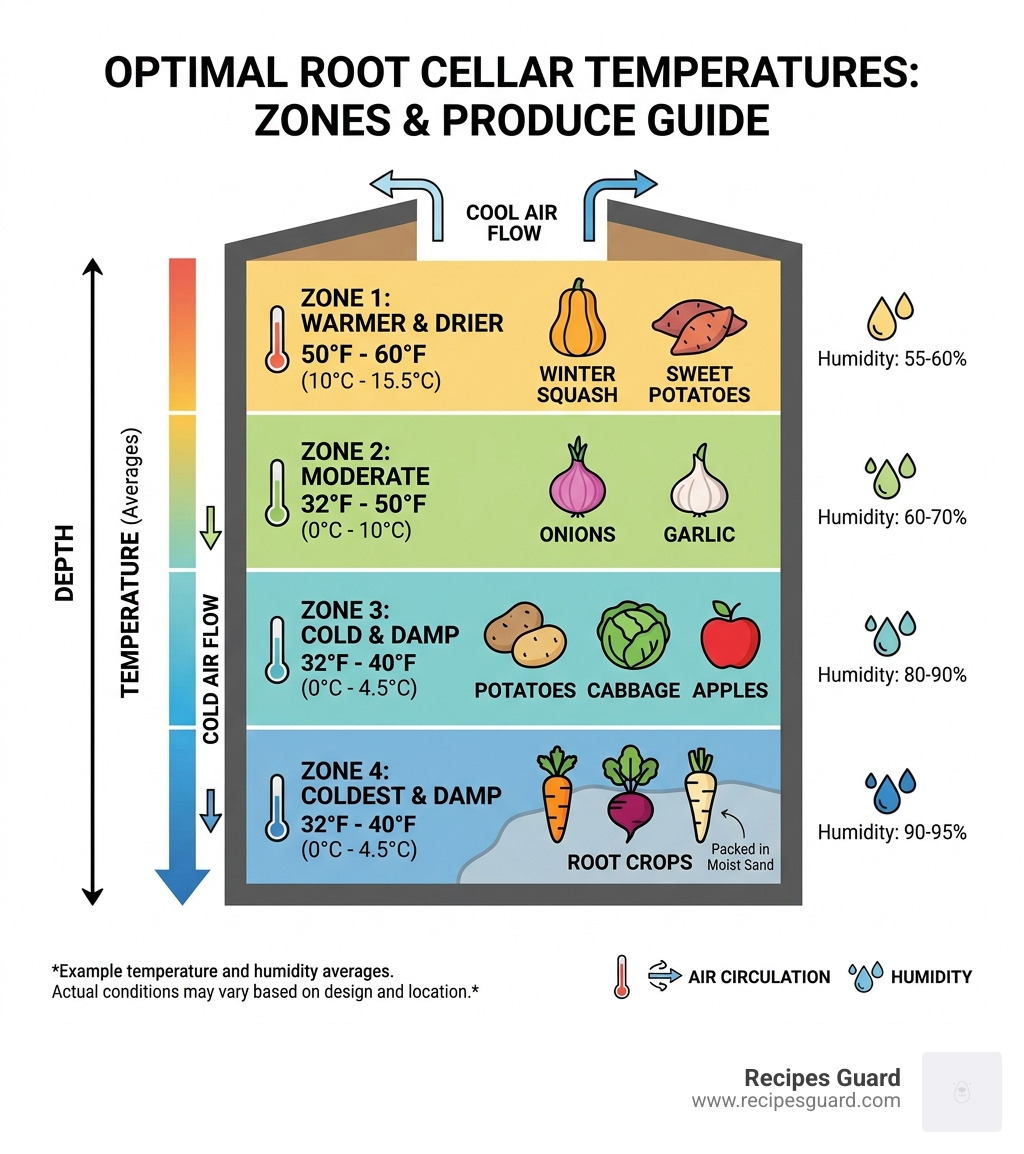
One of the biggest mistakes beginners make is assuming the entire root cellar should be one uniform environment. In reality, a successful cellar is managed in “zones.” Because heat rises and cold air sinks, you can actually create different microclimates within a single room.
| Crop Category | Ideal Temp | Humidity | Best Storage Method |
|---|---|---|---|
| Root Crops | 32-40°F | 90-95% | Damp sand or sawdust |
| Potatoes | 38-40°F | 80-90% | Dark bins or burlap bags |
| Alliums | 32-50°F | 60-70% | Hanging mesh bags |
| Squash/Pumpkins | 50-60°F | 50-60% | Single layer on shelves |
Cold and Moist Zone: 32°F to 40°F
This is the “basement” of your cellar — the coldest, dampest spot, usually right on the dirt floor or the lowest shelves. This zone is perfect for carrots, beets, parsnips, and cabbage. These crops love moisture so much that many homesteaders pack them in crates of damp sand or peat moss to maintain that 95% humidity level.
If you are storing cabbage here, be aware that it has a strong odor. Some prefer to wrap cabbage in newspaper to contain the scent. Interestingly, this cold zone is also where many of us store our ferments. If you’ve been experimenting with preservation, Don’t Be Afraid of the Funk with This Easy Fermented Garlic Recipe to see how these cold-loving flavors develop over time.
Cool and Dry Zone: 32°F to 50°F
Onions and garlic are the rebels of the root cellar world. While they like it cool, they absolutely despise high humidity. If you put an onion in a 95% humidity zone, it will likely sprout or rot within weeks.
Instead, we look for a spot with better air circulation and lower humidity (around 60-70%). Hanging them in mesh bags or braiding them allows air to flow around each bulb, preventing moisture buildup. This zone is often found higher up on shelves or closer to the ventilation intake where the air is slightly drier.
Warm and Dry Zone: 50°F to 60°F
If you put a butternut squash in a 34°F root cellar, it will suffer from “chilling injury.” This manifests as soft spots and a rapid breakdown of the flesh. Winter squash, pumpkins, and sweet potatoes actually prefer temperatures that we would consider “room temperature” in a cool house.
These crops need a “warm and dry” zone. An unheated bedroom, a high shelf in a basement, or even a kitchen cupboard against an exterior wall can work perfectly. These items are the perfect snacks for long winter nights. If you find your squash is starting to turn, you can always learn How to Save Your Salty Snacks by incorporating them into preserved treats.
How to Maintain and Monitor Your Root Cellar Temperature
Achieving stability is the name of the game. The earth is a giant heat sink; once you go about 10 feet (3 meters) deep, the ground temperature stays a fairly constant 52°F year-round. A well-designed root cellar uses this geothermal stability and then “borrows” cold air from the winter nights to drop the temperature down into the 30s.
According to this Monitoring and Tuning a Root Cellar: 40–60°F Guide, the key is thermal mass. Using materials like concrete, stone, or even earth-filled bags helps the cellar “hold” the cold, preventing the temperature from swinging wildly when you open the door.
Achieving the Perfect Root Cellar Temperature in Home Spaces
Not everyone can dig a 10-foot hole in their backyard. We often have to get creative with the spaces we already have.
- Basements: The northeast corner of a basement is typically the coldest. By partitioning off a small area with insulated walls and adding a vent to the outside, you can create a highly effective cellar.
- Attics: In late autumn (around November in the Northern Hemisphere), attics often reach that 32-45°F range. However, they can be prone to temperature swings, so monitoring is vital.
- Bulkhead Doors: Many older homes have concrete stairs leading to a basement. Insulating the outer door and using the stairs as “shelves” can provide a range of temperature zones.
The Impact of Root Cellar Temperature on Fermented Foods
As experts in fermentation, we love root cellars for more than just raw veggies. A root cellar is an ideal environment for aging ferments like sauerkraut or kimchi. The lactic acid fermentation process (expressed as C6H12O6 → 2C3H6O3) produces a stable, tangy product, but the speed of that fermentation is temperature-dependent.
Storing your crocks in the root cellar slows down the bacteria once the initial ferment is complete, allowing the flavors to mellow and mature without becoming overly sour or mushy. Always remember: Safety First: A Guide to Preserving Fermented Foods requires keeping your crocks in a cool, dark place to maintain the integrity of the live cultures.
Ventilation and Ethylene Gas Management
Ventilation serves two purposes: temperature control and gas management. As produce respires, it releases heat. Without airflow, your cellar will slowly warm up. We recommend a two-vent system: one low-intake pipe to bring in cool air and one high-exhaust pipe to let warm air escape.
The second reason for ventilation is ethylene gas. Some fruits, specifically apples and pears, are ethylene powerhouses. This gas is a ripening hormone. If you store apples right next to your carrots, the ethylene will cause the carrots to turn bitter and the potatoes to sprout prematurely. If possible, isolate your apples in their own chamber or store them near the exhaust vent so the gas is whisked away. This kind of careful environmental control is also key when Mastering the Art of Lacto-Fermented Hot Sauce, where gas buildup can affect the final flavor profile.
Troubleshooting Temperature and Humidity Fluctuations
Even the best-built cellar needs “tuning” as the seasons change. In the spring of 2026, as the ground begins to thaw, you’ll need to be more aggressive with night-venting to keep the interior cool. Conversely, in the dead of a deep freeze, you might actually need to add a tiny bit of heat to prevent your pipes from freezing.
Signs Your Temperature is Too High or Too Low
Your produce will tell you if the root cellar temperature is off before your thermometer does:
- Too High: Potatoes will start to sprout, and onions will feel soft. You might see fuzzy mold growing on the surface of your crates.
- Too Low: If the temperature dips below 32°F, you risk freezing. Frozen potatoes turn sweet and then rot quickly once thawed. Apples will become “mealy” and lose their crunch.
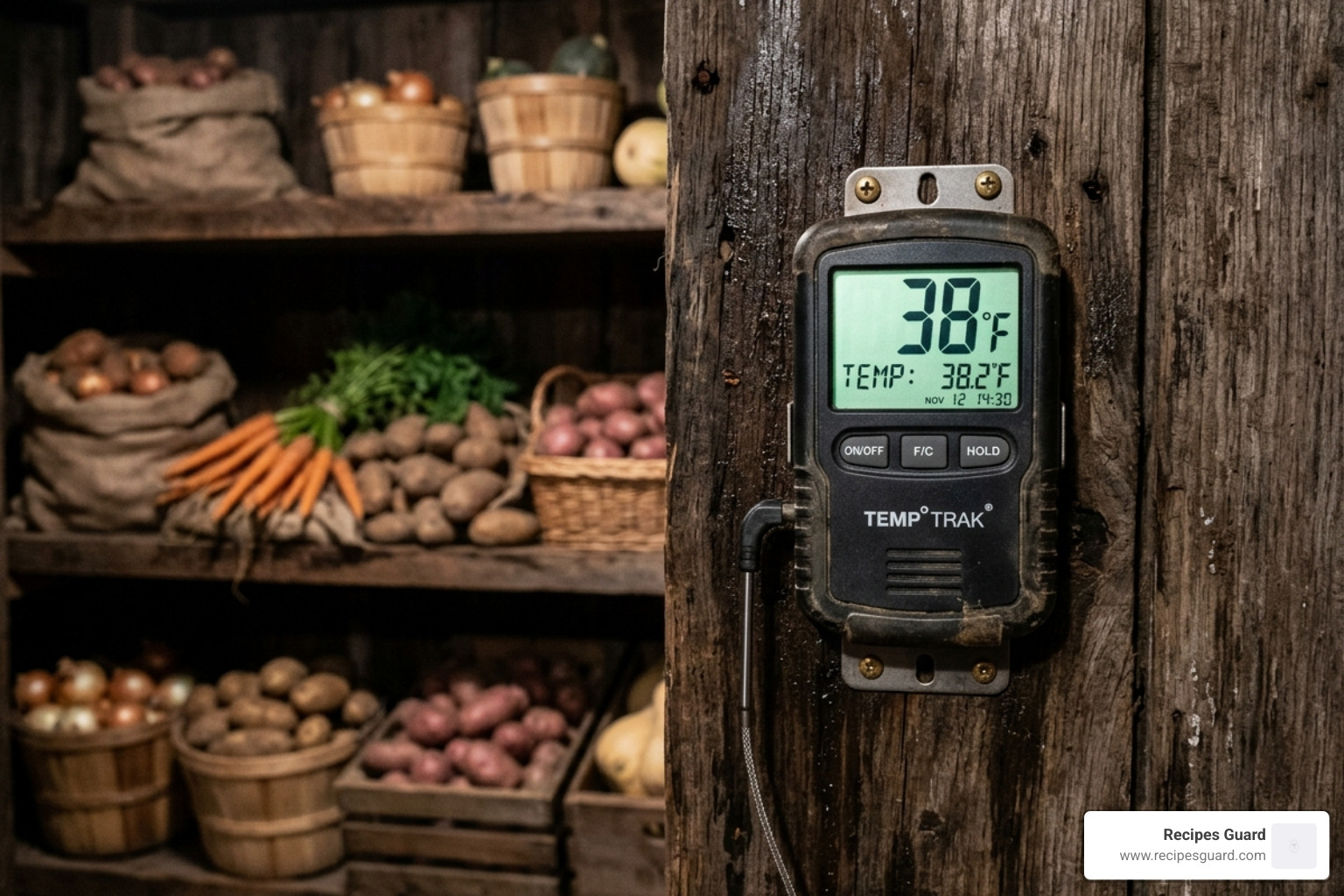
We suggest keeping a daily log during the first few weeks of the season. A max-min thermometer is an inexpensive tool that tells you exactly how cold it got in the middle of the night while you were sleeping.
Correcting Dryness and Excess Moisture
If your hygrometer shows that the air is too dry, don’t panic. You can easily raise humidity by:
- Sprinkling water directly onto a dirt or gravel floor.
- Placing pans of water in front of your intake vents.
- Hanging damp burlap bags near your produce.
If the cellar is too wet (evidenced by water dripping from the ceiling), you need to increase ventilation. In extreme cases, buckets of calcium chloride (a desiccant) can help pull moisture out of the air.
Frequently Asked Questions about Root Cellar Temperature
How deep must a cellar be for a stable root cellar temperature?
For true geothermal stability, 10 feet (3 meters) is the magic number. However, most backyard cellars are successful at 5 to 8 feet deep, provided they have enough “earth cover” on top. The goal is to get below the frost line of your specific region to ensure the ground doesn’t freeze around your storage bins.
Can I store apples and potatoes together?
It is generally discouraged. Apples release ethylene gas which encourages potatoes to sprout. If you must store them in the same room, put the apples on the highest shelf near the exhaust vent and keep the potatoes in the lowest, coldest corner in breathable bags.
What happens if my root cellar drops below 32°F?
When vegetables freeze, the water inside their cells expands and ruptures the cell walls. This destroys the texture of the food. If a cold snap is coming, you can use a simple 100-watt incandescent light bulb (not an LED!) as a safe heat source to keep the room just above freezing.
Conclusion
As we look toward the winter of 2026, mastering root cellar temperature is a powerful step toward food independence. There is a profound sense of security in knowing that your family has access to fresh, crisp produce all winter long without relying on a grocery store supply chain.
Whether you are retrofitting a basement corner or digging a traditional hillside cellar, the principles remain the same: keep it cold, keep it damp, and keep the air moving. If you’re ready to take your food preservation to the next level, Explore our Fermented Recipes to see how your cellar-stored crops can be transformed into probiotic powerhouses. And for those just starting their journey, Master your food storage with our Preserving Basics Guide for more expert tips. Happy cellaring!