
How to File a Student Health Insurance Claim Without the Headache
What Every Student Needs to Know About Filing an Emergency Health Claim
Emergency claim student health situations can hit fast — and the paperwork that follows can feel just as overwhelming as the emergency itself.
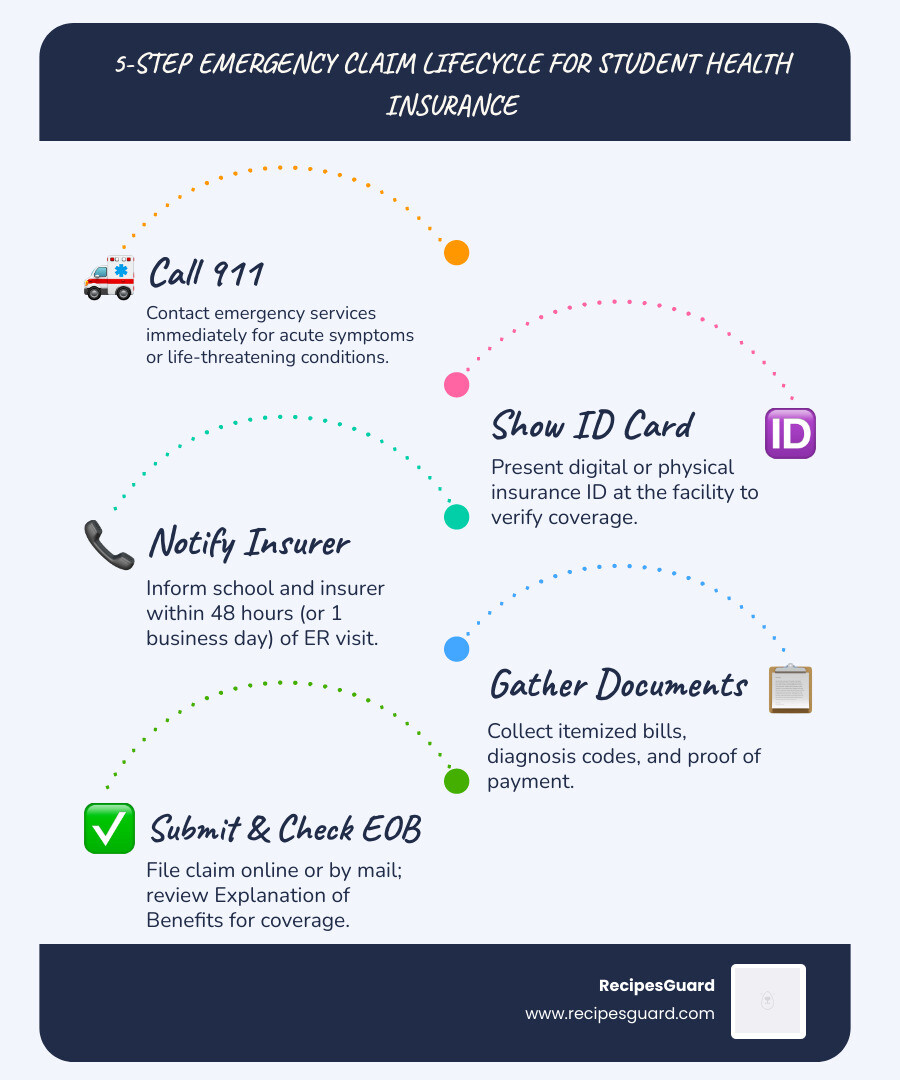
Here is a quick overview of how to handle it:
- Call 911 (or local emergency services) and get treated immediately
- Show your insurance ID card at the facility — digital or physical
- Notify your insurer and school within 48 hours of the ER visit (some plans require just one business day)
- Gather your documents — itemized bill, diagnosis codes, proof of payment
- Submit your claim via your insurer’s online portal or by mail
- Check your Explanation of Benefits (EOB) to verify what was covered and what you owe
A medical emergency is stressful enough on its own. But for students — especially those studying far from home — the insurance process that follows can feel like a second crisis.
You may not know which forms to fill out. You might not be sure what your plan actually covers. And if you paid out of pocket overseas, you are probably wondering if you will ever see that money again.
The good news: most student health plans do cover emergency care, 24/7, anywhere in the world. The key is knowing the right steps to take — and taking them quickly.
This guide walks you through the entire process, from the moment an emergency happens to the moment your claim is resolved.
Defining an Emergency Claim for Student Health
Before we dive into the “how-to,” we need to talk about the “what.” In insurance, not every urgent situation is a “medical emergency.” Understanding the difference can save you hundreds, if not thousands, of dollars.
Understanding the Prudent Layperson Standard
In the insurance industry, providers often use what is called the “prudent layperson standard.” This is a fancy way of saying that if a reasonable person with average medical knowledge would believe that their life or health is in serious jeopardy, it counts as an emergency.
You don’t need to be a doctor to justify an emergency claim student health filing. If you are experiencing severe pain, acute symptoms, or believe that waiting for a regular appointment would cause you permanent harm, you should head to the ER. This standard protects you from being penalized if your “heart attack” turns out to be severe indigestion—as long as a reasonable person would have made the same call.
In-Network vs. Out-of-Network Coverage Limits
When a crisis hits, you should go to the nearest hospital. However, once you are stabilized, the “network” becomes very important. Many student plans, such as those utilizing the Aetna national network, provide access to over 1 million providers and 5,400 hospitals.
Staying in-network keeps your costs down. For instance, some university plans have an in-network out-of-pocket maximum of $4,200 for an individual. If you go out-of-network, those costs can skyrocket. For a deeper dive into these nuances, check out our guide on Mastering The Emergency Medical Student Claim Process.
| Feature | Urgent Care | Emergency Room |
|---|---|---|
| Typical Cost | $50 Copay | $150 Copay |
| Wait Time | 15–60 Minutes | 2–6 Hours |
| Severity | Minor cuts, flu, sprains | Chest pain, major trauma, difficulty breathing |
| Availability | Extended business hours | 24/7/365 |
According to Emergency care and stabilization definitions, stabilization is the point where medical treatment ensures that no material deterioration of your condition is likely to occur if you are moved or discharged.
Immediate Steps During a Medical Crisis
When the unthinkable happens, your priority is survival, not paperwork. In Australia, your first point of contact is always 000 (or 911 globally). For mental health crises, the 988 Suicide & Crisis Lifeline provides immediate, confidential support.
Once you arrive at the facility, you must identify yourself as a student covered under your specific health program. This is critical for Claims Assistance and Provider Submission. If you are conscious and able, tell the admissions desk exactly which insurance you have.
Accessing Your ID Card for an Emergency Claim Student Health
Gone are the days when you had to carry a plastic card in your wallet (though it doesn’t hurt!). Most modern insurers provide digital ID cards through their member portals or mobile apps. We recommend taking a screenshot of your ID card and saving it in a “Medical” folder on your phone or adding it to your mobile wallet. This ensures that even if you don’t have Wi-Fi in the hospital, you have proof of coverage ready to go. For more tips on handling these “oops” moments, see The Klutzs Guide To Student Accident Medical Claims/.
Notifying Your School and Insurer
This is the step most students miss: the notification deadline. Many student health plans require you to report an emergency room visit within one business day or 48 hours of admission.
If you are admitted as an inpatient (meaning you stay overnight), you or a representative must call the insurer for “precertification.” This is a mandatory process where the insurance company reviews the necessity of your hospital stay. Failing to notify them can lead to a reduction in benefits or even a total denial of the claim. For international students in Australia, International Students: What Do I Do If I’m Taken to Hospital? provides specific local advice on hospital protocols.
Gathering Documentation for Your Claim
Once the dust settles, it’s time to play detective. You need a paper trail to ensure your emergency claim student health is paid correctly.

You will need:
- Itemized Bills: A summary of every single charge (aspirin, bandages, X-rays).
- Diagnosis Codes: These are numerical codes (like ICD-10) that tell the insurer exactly what was wrong.
- Accident Questionnaires: If your injury was caused by an accident (like a car crash or a fall), the insurer will want to know the details to see if another party is responsible.
- HIPAA Release Forms: This allows the insurance company to talk to your doctors.
If you are looking for a comprehensive list of what to keep, our Your Essential Guide To Overseas Student Accident Claims/ is a great resource. You can also look at how other institutions handle this, such as Making a health insurance claim at Lund University.
Filing an Emergency Claim Student Health for International Services
If you are an international student or a student studying abroad, things get slightly more complex. Most foreign hospitals will require you to pay upfront. When this happens, you must get a receipt with a “Paid in Full” notation.
Ensure all documents are in English or accompanied by a certified translation. If the bill is in a foreign currency, the insurer will usually convert it based on the exchange rate on the date of service. For many student visas, there are strict requirements, such as a minimum of $100,000 in medical benefits per accident. For more details on navigating these global waters, see The International Student Guide To Emergency Claims And Evacuations/ and the Making a claim at McGill University resource.
The Role of the Explanation of Benefits (EOB)
A few weeks after your claim is submitted, you will receive an Explanation of Benefits (EOB). Important: An EOB is not a bill. It is a document that shows:
- How much the provider charged.
- The “negotiated rate” the insurance company actually pays.
- How much of your deductible or copay was applied.
- The final amount you owe the provider.
Always compare your EOB to the bill you receive from the hospital. If the numbers don’t match, don’t pay until you’ve called your insurer. For Overseas Student Health Cover (OSHC) specifics, refer to How To Claim on Your OSHC Policy.
Navigating the Reimbursement Process
If you had to pay out-of-pocket, you’ll want your money back as soon as possible. Most student insurers now offer online portals where you can upload photos of your receipts and submit your claim in minutes.
Handling Out-of-Pocket Payments
When submitting for reimbursement, we recommend linking your bank account to the insurance portal for direct deposit. This is much faster than waiting for a check in the mail. Typically, once a claim is submitted with all the correct documentation, it takes about three weeks to process.
If you are a student in New Zealand or Australia, you might find that some campus clinics offer “direct billing,” where they bill the insurer directly so you never have to pay a cent upfront. Check the Making a claim at Victoria University of Wellington page for an example of how this works.
Coordination of Benefits for Dual Coverage
Are you covered by your school’s plan and your parents’ plan? This is called “dual coverage.” You cannot “double dip” and get paid twice for the same injury, but the two plans can work together to cover almost 100% of your costs. This process is called Coordination of Benefits (COB). You’ll need to tell both insurers about each other so they can decide who pays first (the “primary” payer) and who pays second.
Frequently Asked Questions about Student Health Claims

What happens if an emergency leads to inpatient admission?
If you are moved from the ER to a hospital bed for an overnight stay, many plans will waive your emergency room copay. However, this is when precertification becomes vital. Ensure the hospital’s billing department has your insurance info so they can get the stay authorized.
How do I file an emergency claim student health for a sports injury?
Sports injuries often require an “Accident Form” in addition to the standard claim. The insurer wants to verify if the injury happened during an intercollegiate or club sport, as some plans have different coverage limits for athletics. You will need specific diagnosis codes for sprains, fractures, or concussions.
Are mental health crises covered under emergency claims?
Yes. Mental health is health. If you are experiencing a behavioral health emergency, the same “prudent layperson” rules apply. Use the 988 lifeline for immediate support. Most student health plans cover emergency psychiatric evaluations and stabilization just like they would a broken leg.
Conclusion
Filing an emergency claim student health doesn’t have to be a headache. By acting quickly, keeping your receipts organized, and understanding your EOB, you can ensure that a medical crisis doesn’t turn into a financial one.
At RecipesGuard, we specialize in providing students with step-by-step tutorials to navigate the complex world of insurance. Whether you are studying in Melbourne or abroad, we are here to advocate for your financial recovery.
For more guides and claim-filing support, visit us at https://www.recipesguard.com/. Stay safe, stay informed, and let us handle the paperwork!

My name is Bianca, and my journey into the world of fermentation and food safety began with a costly mistake. I once lost an entire season’s harvest of chili peppers because I relied on guesswork instead of science. That failure was my turning point.
