
Don’t Let a Hospital Bill Ruin Your Semester Abroad
When a Medical Emergency Abroad Becomes a Financial Crisis
Filing an overseas insurance claim student situation can feel overwhelming — especially when you’re sick, far from home, and unsure what your policy actually covers.
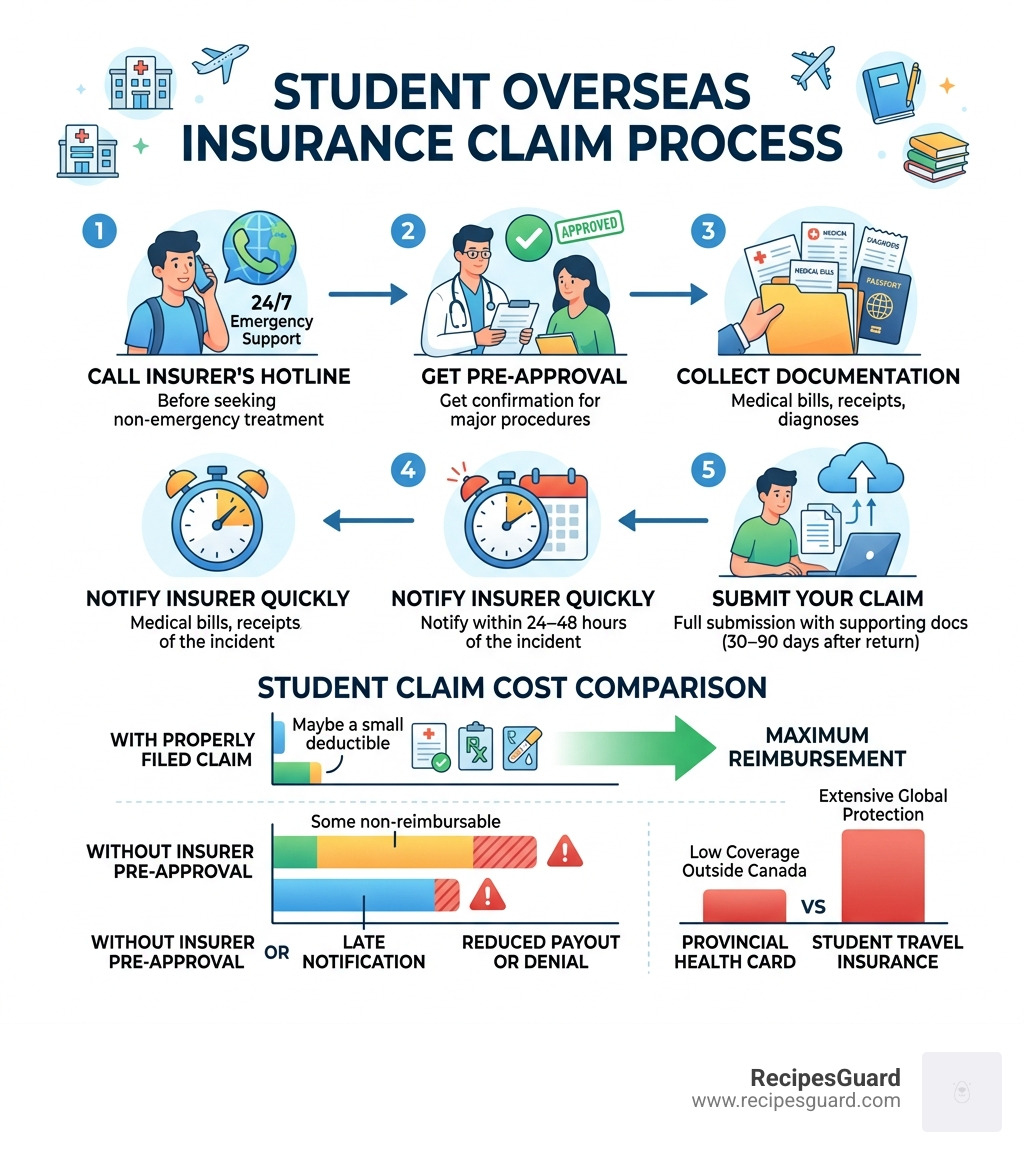
Here’s a quick overview of how to file a student insurance claim abroad:
- Call your insurer’s 24/7 emergency hotline immediately — before seeking non-emergency treatment
- Get pre-approval for any procedures that aren’t life-threatening emergencies
- Collect all documentation: medical bills, receipts, diagnosis notes, and proof of departure
- Notify your insurer within 24–48 hours of the incident
- Submit your full claim with supporting documents within 30–90 days of returning home
Study abroad is one of the most valuable experiences a student can have. But it comes with real financial risk that most students don’t think about until something goes wrong.
Consider this: a single emergency room visit in the United States or Europe can cost thousands of dollars. A medical evacuation from a remote location can run well over $50,000. And here’s what catches most Canadian students off guard — your provincial health card covers little to no medical costs outside Canada.
That gap between what you expect to be covered and what you’re actually covered for can turn a minor injury into a major financial crisis.
The good news? Student travel insurance exists specifically to protect you from this. And if you already have a policy, knowing how to file a claim correctly can mean the difference between a full reimbursement and a denied or reduced payout.
Why Student Travel Insurance is Essential for Your Global Education
When you’re packing your bags for a semester in Melbourne or a year in London, insurance feels like just another box to tick. But for us at RecipesGuard, we see it as your financial safety net. Unlike standard vacation insurance, student policies are built for the long haul. They cover emergency medical care, trip cancellations, and even baggage loss, but they also include “student-specific” perks like tuition protection. If a medical emergency forces you to drop out of your semester, these plans can reimburse your non-refundable tuition fees.
In Australia, for example, the government takes this very seriously. Most international students are required to maintain Overseas Student Health Cover (OSHC) for the duration of their stay. This isn’t just a suggestion; it’s a visa requirement. Without it, you could be facing a massive bill for something as simple as a GP visit or a prescription.
Furthermore, medical evacuations are no joke. If you are hiking in a remote area and need an air ambulance, the cost can easily exceed $50,000. Comprehensive student plans often provide up to $2 million or even $5 million in coverage, ensuring that a physical accident doesn’t lead to a lifetime of debt.

The Gap Between Provincial Health and International Costs
Many Canadian students assume their Government Health Insurance Plan (GHIP) travels with them. While your provincial card might cover a tiny fraction of costs in another province, it offers almost zero protection once you cross international borders. Even within Canada, reimbursement caps for inter-provincial travel are often much lower than the actual cost of care in a different territory. If you end up in a hospital abroad, the government will not pay your medical bills. You are expected to pay up-front, which is why having a plan that offers direct billing or quick reimbursement is vital.
Is Insurance Mandatory for International Study?
The short answer is: almost always. While the Canadian government doesn’t strictly require travel health insurance for a study permit, your Designated Learning Institution (DLI) certainly will. Most universities won’t even grant you a Letter of Acceptance or allow you to enroll until you show proof of coverage. Additionally, many countries require proof of insurance as a condition of entry for your student visa. It’s a gatekeeper to your education.
Understanding Your Coverage: Eligibility, Limits, and Common Exclusions
Before you can file an overseas insurance claim student report, you need to know if you’re actually eligible. Most plans are available for students up to age 54, covering outbound students (Canadians going abroad), inbound students (international students coming to Canada), and national students (those studying in a different province).
Here is a quick look at how different plan types stack up:
| Feature | Standalone Student Policy | Bundled Tour Operator Plan |
|---|---|---|
| Medical Limit | Often up to $5 Million | Usually $1 Million |
| Tuition Protection | Included in most premium plans | Varies by provider |
| Deductibles | Frequently $0 | May have small fees |
| Flexibility | High (choose your dates) | Fixed to the tour dates |

Common Exclusions to Watch For
No policy covers everything. The most common “gotcha” is the pre-existing condition exclusion. Most insurers require a “stability period” (usually 90 days) where you’ve had no new symptoms or changes in medication. If you’ve recently changed your asthma inhaler or started a new prescription, that condition might not be covered.
Other common exclusions include:
- High-risk sports: Skydiving, bungee jumping, and professional athletics are usually out.
- Substance abuse: Injuries sustained while under the influence of drugs or alcohol are almost never covered.
- Routine care: Standard check-ups or elective surgeries aren’t part of “emergency” travel insurance.
- Pregnancy: Most plans exclude childbirth or complications within 9 weeks of the due date.
Who Qualifies for Student Coverage?
To qualify, you generally need to be enrolled in a full-time or part-time program at an accredited school. Interestingly, many plans extend coverage to “dependents,” which can include spouses and children (including foster children) under age 21 (or 26 if they are also full-time students).
Step-by-Step Guide to Filing an Overseas Insurance Claim Student
This is where the rubber meets the road. If you find yourself in a hospital in Auckland or a clinic in Paris, follow these steps to ensure your overseas insurance claim student process goes smoothly. For more specific university-led advice, you can check out resources like Making an insurance claim.
- The 48-Hour Rule: You (or someone on your behalf) must contact the insurer’s emergency assistance center within 24 to 48 hours of the incident. Failure to do this can result in a 30% reduction in your payout.
- Seek Pre-Approval: For anything other than a life-or-death emergency, call first. The insurer needs to approve major tests (like MRIs or CAT scans) and surgeries.
- Direct Billing vs. Reimbursement: In many cases, the insurer can coordinate with the hospital to pay the bill directly. If not, you’ll need to pay out-of-pocket and claim it back later.
Documentation Checklist for Your Overseas Insurance Claim Student
To get paid, you need proof. We recommend keeping a digital folder of everything. You will need:
- Medical reports: A document from the doctor stating your diagnosis.
- Original receipts: Itemized bills showing exactly what you paid for.
- Proof of departure: Your flight itinerary showing when you left your home country.
- Police reports: Essential if you are claiming for theft or a traffic accident.
- Physician recommendations: If you need to fly home early, you need a doctor’s written note saying you are unfit to continue your studies.
Common Mistakes When Filing an Overseas Insurance Claim Student
Don’t let a simple error cost you thousands. The most common mistake is unauthorized treatment. If you decide to get a voluntary procedure or see a specialist without calling the hotline first, you might be on the hook for the whole bill.
Another pitfall is missing deadlines. Most insurers require you to notify them within 90 days and submit the final paperwork within 6 months. Finally, be honest. Fraud warnings are real; any attempt to inflate a claim can lead to a total denial and even impact your student visa status.
Managing Changes: Extensions, Trip Breaks, and Cancellations
Life happens. Maybe your research project gets extended, or you want to fly home for Christmas.
- Extensions: If your semester is lengthened, you can usually extend your policy (up to a 365-day total) as long as you request it before your current policy expires.
- Trip Break Benefit: Some student plans allow you to return home for a short visit without “killing” your policy. You won’t be covered while you’re at home, but the insurance automatically kicks back in when you return to your study destination. You must get approval from the assistance center before you fly home to use this benefit.
Handling Trip Cancellations and Interruptions
If your school closes due to a natural disaster or a family emergency requires you to head home, “Trip Interruption” coverage is your best friend. This can cover the cost of a last-minute flight and even reimburse you for the portion of the semester you missed. During the 2026 travel landscape, many plans also include specific COVID-19 protocols, covering quarantine costs if you test positive while abroad.
Frequently Asked Questions about Student Insurance
Is there a deductible for student insurance claims?
Most dedicated student plans offer a $0 deductible. This is a huge advantage over standard travel insurance, where you might have to pay the first $250 or $500 of every claim. However, always check your “Certificate of Insurance” to be sure.
Can I extend my insurance if my semester is lengthened?
Yes, but don’t wait until the last day. Most companies require you to call their toll-free assistance number at least 5-10 days before expiry. You must still meet the eligibility criteria and not have had any major medical changes since the policy started.
What happens if I visit home during my studies?
Check if your plan has a Trip Break Benefit. If it does, your coverage is “paused” while you are in your home country. You won’t get a refund for those days, but you won’t have to buy a brand-new policy when you head back to school. Remember: you must call for approval before you leave your study destination!
Conclusion
At RecipesGuard, we believe that your focus should be on your grades and your new cultural experiences, not on how you’re going to pay for an unexpected hospital stay. Navigating an overseas insurance claim student situation doesn’t have to be a nightmare if you follow the steps: call early, document everything, and understand your exclusions.
By securing a student-focused policy and following our step-by-step claim filing tutorials, you’re buying more than just insurance — you’re buying peace of mind. For More info about insurance claim services, visit us today and ensure your semester abroad is remembered for the right reasons.

My name is Bianca, and my journey into the world of fermentation and food safety began with a costly mistake. I once lost an entire season’s harvest of chili peppers because I relied on guesswork instead of science. That failure was my turning point.
