
Claiming Quarantine Costs for Fun and Profit
What International Students Need to Know About Quarantine Cost Claims
A quarantine cost claim student situation can hit hard and fast — one positive COVID-19 test, one government travel restriction, and suddenly you’re facing hundreds or even thousands in unexpected hotel bills.
Here’s a quick answer to what your options are:
How students can claim quarantine costs:
- University bursaries — Many UK universities offered direct reimbursements or tuition fee discounts for mandatory hotel quarantine costs (e.g., up to £2,285 at Bangor University, £500 at UCL)
- University hardship/expense funds — General pandemic cost funds (e.g., University of Manchester’s COVID-19 Expense Support Fund, capped at £2,000 per student)
- Travel insurance claims — Some policies (like the University of Illinois’s Gallagher plan) covered up to $2,000 for government-mandated quarantine over 14 days
- Tax deductions — Business travelers and some self-employed students could deduct quarantine costs; personal travelers generally could not (per CRA guidelines)
- Dispute resolution — In some cases, billing errors were resolved by contacting the relevant authority directly — or, as one Erasmus student in Malta found, through media attention after being wrongly issued a €1,200 hotel bill
The key word throughout all of these options is “mandatory.” If your quarantine was government-required, your chances of recovery are much higher than if it was precautionary.
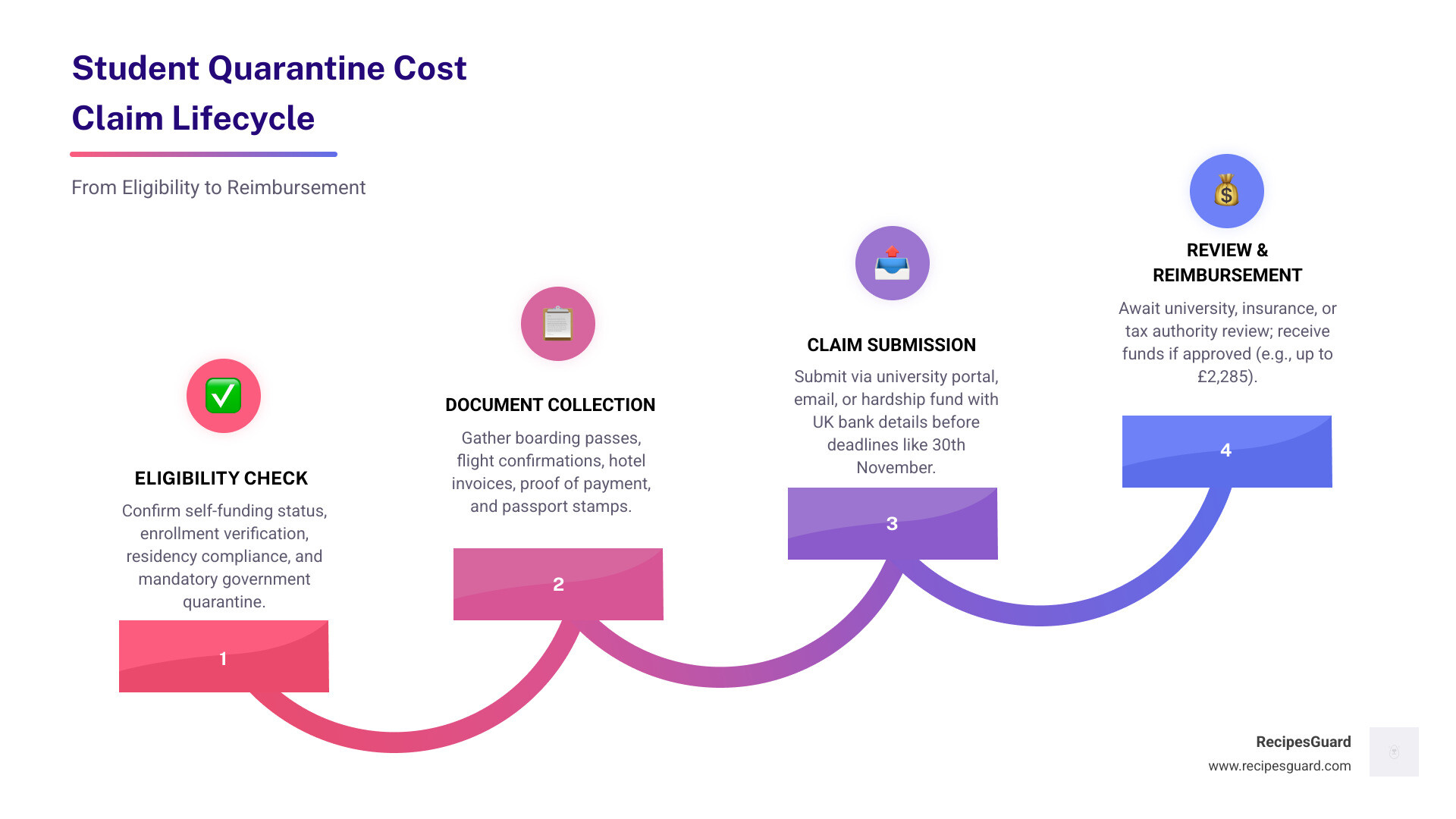
Most claims require the same core documents: flight confirmation, hotel invoice, proof of payment, and passport entry stamp. University funds typically also require proof of enrollment and a UK bank account.
The landscape of available support funds has shifted significantly since 2021 — many university-specific programs are now closed. But understanding how they worked helps you know what to look for, ask for, and document if a similar situation arises.
Quarantine cost claim student vocabulary:
- study visa claim filing
- delayed visa claim process
- flight delay compensation claim
How to Successfully Navigate a Quarantine Cost Claim Student Process
Navigating reimbursements can feel like trying to solve a Rubik’s cube in the dark. As we look back from April 2026, the complexity of the pandemic-era travel rules remains a significant lesson in financial preparation. To successfully file a quarantine cost claim student application, we must first understand the framework of “risk lists.”

During the height of travel restrictions, countries were categorized into red, amber, and green lists. These designations dictated whether you could isolate at home or if you were forced into a government-mandated hotel. For students, this wasn’t just a matter of convenience; it was a massive financial hurdle.
Mandatory isolation in a managed hotel facility often cost upwards of £2,285 for a 10-day stay. Because these were government mandates, many institutions stepped in to provide “Support with quarantine costs.” However, the process was never as simple as handing over a receipt. You had to prove that your stay was legally required and that you had no other choice.
Eligibility Requirements for a Quarantine Cost Claim Student
Before we even look at the paperwork, we need to talk about eligibility. Most universities and insurance providers had strict “gatekeeper” rules.
- Self-Funding Status: Many bursaries were specifically reserved for self-funding students. If you were sponsored by a government body or a private company that already covered travel expenses, you were often excluded from university-specific funds.
- Tuition Payments: To claim a bursary, students generally had to have paid at least 50% of their tuition fees or have an active, approved payment plan in place.
- Academic Engagement: You couldn’t just take the money and run. Universities like Bangor required students to maintain residency compliance and show active academic engagement. If you withdrew from your course shortly after receiving a reimbursement, the university often reserved the right to reverse the payment.
- Enrollment Verification: You usually had to be a “new” or “continuing” student who was physically present on campus by a specific registration deadline.
Essential Evidence for Your Quarantine Cost Claim Student
We cannot stress this enough: documentation is the lifeblood of your claim. If you don’t have the receipt, it basically didn’t happen in the eyes of an insurance adjuster or a university bursar. According to the Arrangements for Quarantine and Testing – Durham University guidelines, the burden of proof lies entirely with the student.
You will need to gather:
- Boarding Passes and Flight Confirmations: These prove your date of arrival and the country you departed from.
- Hotel Invoices: This must be a formal invoice from the government-approved quarantine facility, not just a credit card “pending” notification.
- Passport Stamps: A copy of your entry stamp confirms you actually entered the country on the date claimed.
- PCR Test Receipts: Many funds also covered the mandatory Day 2 and Day 8 testing packages.
University Bursaries and Institutional Support Funds
When the world went into lockdown, universities realized that international students were their lifeblood—and those students were suddenly facing bankruptcy-level hotel bills. In response, several institutions created bespoke funds.
| University | Support Type | Maximum Amount | Key Condition |
|---|---|---|---|
| Bangor University | Quarantine Bursary | £2,285 | Red-list arrivals; applied as tuition discount |
| Durham University | Full Reimbursement | Full Cost | Includes hotel package and mandatory tests |
| UCL | Grant Contribution | £500 | Must be enrolled and from a red-list country |
| Manchester | Expense Support Fund | £2,000 | For “unforeseen” costs; capped per student |
| Brighton | Direct Reimbursement | £875 | For hotel costs; £100 for PCR tests |
These figures represent the massive scale of institutional support. For instance, Bangor University’s £2,285 reimbursement was designed to cover the entire cost of a standard 10-day mandatory hotel stay. Meanwhile, the University of Manchester offered a more flexible COVID-19 Expense Support Fund that could cover anything from quarantine to the purchase of hard-copy learning materials when digital versions weren’t available.
Deadlines and Submission Methods
Timing is everything. Most of these funds had “hard” deadlines. For example, many claims for the 2021/22 academic year had to be submitted by November 30th. If you missed the window, the funds were often reallocated to other hardship grants.
Submission methods varied by school:
- MyBangor Portal: Students used the internal request center to upload documents.
- Email Submissions: Manchester required students to email
funding@manchester.ac.ukwith a specific subject line: “Quarantine Hotel Cost.” - UK Bank Accounts: This was a major sticking point. Almost all UK universities refused to pay reimbursements into overseas bank accounts. Students had to arrive, clear quarantine, open a local bank account, and then provide those details to receive their funds.
- Retrospective Claims: Some universities allowed students to claim for costs incurred months prior, provided they had the receipts to back them up.
Insurance Coverage and Private Policy Claims
If your university didn’t offer a bursary, your next line of defense was travel insurance. However, standard travel insurance rarely covered “mandatory arrival quarantine” because it was considered a “known event” or a predictable cost of travel.
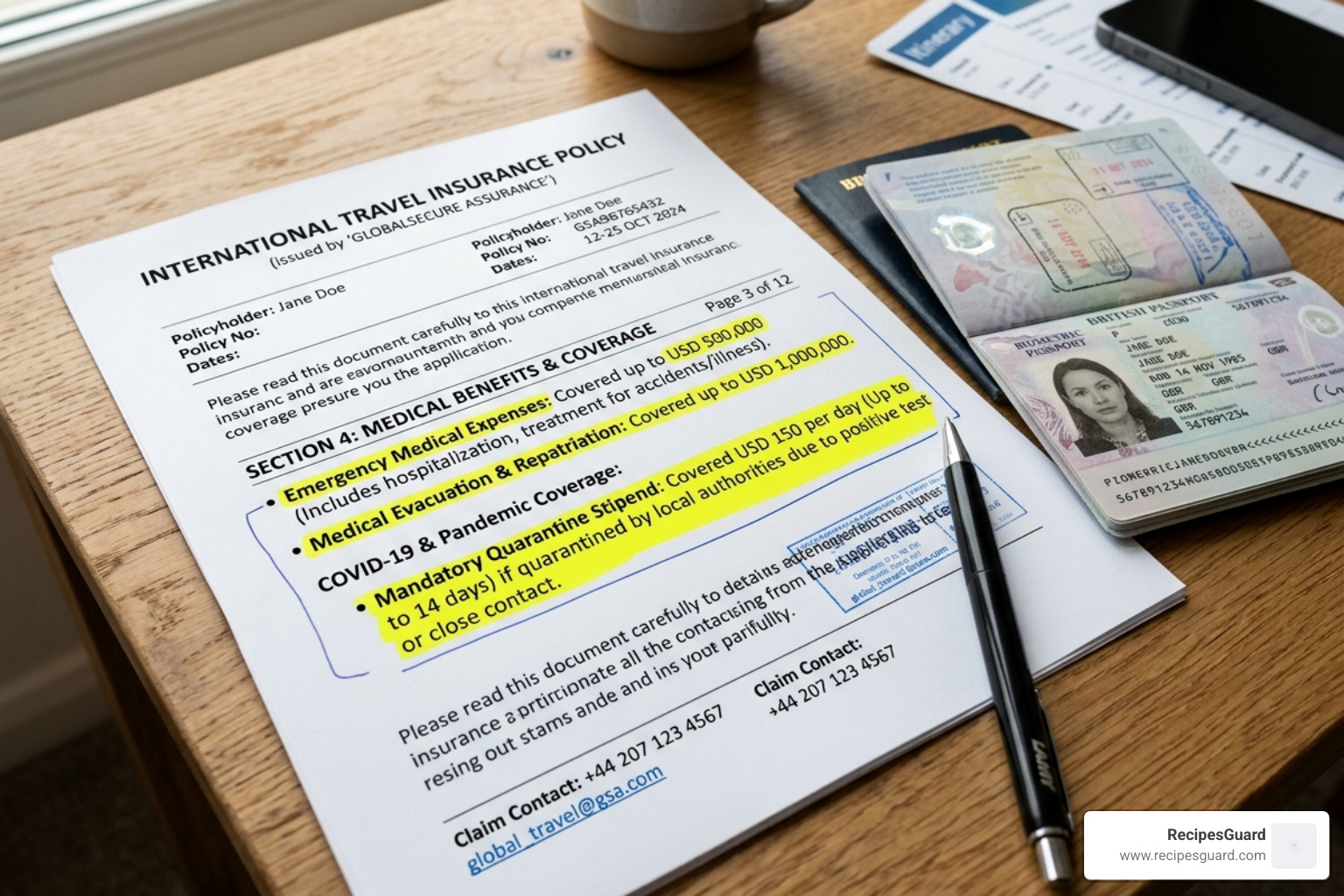
Specific policies, like the Gallagher insurance used by the University of Illinois, provided a more robust safety net. This policy included a quarantine benefit of up to $2,000 for a duration of up to 14 days.
What was covered under these private policies?
- Lodging and Meals: Daily stipends for food and a roof over your head.
- Physician Mandates: Most insurance claims required a “Physician’s Mandate.” This means a doctor had to officially order you to isolate due to exposure or a positive test.
- Communicable Diseases: While COVID-19 was the primary focus, these policies often extended to other diseases like monkeypox.
- Non-refundable Travel: If your quarantine caused you to miss a flight home, insurance might cover the change fees.
Exclusions and Non-Reimbursable Costs
We have to be the bearer of bad news here: not everything is claimable. Insurance companies are experts at finding reasons to say “no.”
Common exclusions included:
- Precautionary Quarantine: If you chose to stay in a hotel just to be safe, but weren’t legally required to, you were on your own.
- Family Members: Most student policies only covered the student. If your parents traveled with you and had to quarantine, their costs were rarely reimbursable under a student policy.
- At-Home Tests: Official claims usually required a PCR test administered by a professional. A photo of a plastic lateral flow test from your bathroom sink rarely made the cut.
- Pre-existing Conditions: If you traveled against medical advice or had a condition that made you high-risk, some insurers used this to deny claims related to illness-induced isolation.
Tax Deductibility and Government Rebates
Can you get the taxman to pay for your hotel stay? The answer is: maybe, but probably not.
According to CRA guidelines and general tax principles, quarantine hotel costs for personal travel (which includes most study-abroad trips) are generally not deductible as medical expenses. The only exception is if the travel was specifically for medical treatment not available locally, and the quarantine was an inseparable part of that medical journey.
However, if you were a student who was also working as a self-employed consultant or traveling for a specific business purpose, you might have had a case. Under the Income Tax Act, business travelers can sometimes deduct quarantine costs as “reasonable expenses incurred to earn income.”
The PCR Test Loophole: In some jurisdictions, COVID-19 tests could be claimed as a medical expense tax credit, but only if they were prescribed by a qualified medical practitioner. Government-mandated tests for travel usually didn’t count because they were a “regulatory requirement” rather than a “medical necessity.”
Real-World Case Studies and Dispute Resolution
Real-world examples show that sometimes, the system fails, and you have to fight back.
Consider the case of an Erasmus student in Malta. Enora Besnier was finishing her studies when she tested positive. She was whisked away to a luxury hotel and later hit with a €1,200 bill. The hotel insisted she pay; she insisted she didn’t have the money.
The resolution? Student faced with €1,200 quarantine hotel bill now told she won’t have to pay. After media intervention and pressure on the Malta Tourism Authority, it was clarified that students already residing in the country (foreign residents) should not be billed the same way as tourists arriving without documents.
Lessons from the frontline:
- Billing Errors: Always double-check if you are being charged the “tourist rate” or the “resident rate.”
- Payment Plans: If you truly cannot pay, some booking services like CTM offered 12-month payment plans for those who could prove financial hardship.
- Authority Contact: Don’t just talk to the hotel front desk. Contact your university’s international office or the local tourism authority.
Frequently Asked Questions about Student Quarantine Claims
Can I claim quarantine costs if I am an international student returning home?
Generally, university bursaries were designed for students arriving to study. If you were returning to your home country for a holiday, most universities would not cover those costs. However, if you were an international student returning home to participate in a mandatory university-led program, you might still be required to carry university-approved insurance (like the Gallagher policy) which could offer some protection.
What happens if my university bursary claim is denied?
If your quarantine cost claim student application is rejected, your first step should be to check the “reason for refusal.” Often, it’s simply a missing document or an overseas bank account issue. If the refusal is based on eligibility, you can look into your university’s “Financial Assistance Fund” (FAF) or “Hardship Fund.” These are means-tested and look at your overall financial situation rather than just the quarantine event.
Are PCR testing costs included in the standard quarantine reimbursement?
It depends on the institution. Durham University and the University of Brighton explicitly included PCR test reimbursements (up to £200 and £100 respectively). However, the University of Manchester’s specific Quarantine Hotel Cost Support Fund explicitly excluded PCR tests, though students could try to claim them through a separate general expense fund.
Conclusion
At RecipesGuard, we know that being an international student is expensive enough without the added “quarantine tax.” Whether you are looking back at a past debt or preparing for future travel, the secret to a successful quarantine cost claim student process is meticulous record-keeping and a clear understanding of the difference between “precautionary” and “mandatory.”
We specialize in student-focused, step-by-step claim filing tutorials to ensure you don’t leave money on the table. From navigating university portals to understanding the fine print of insurance stipends, our goal is your financial security.
More info about student insurance services

My name is Bianca, and my journey into the world of fermentation and food safety began with a costly mistake. I once lost an entire season’s harvest of chili peppers because I relied on guesswork instead of science. That failure was my turning point.
