
When Things Go Wrong Down Under: What You Need to Know About Your Insurance Claim
Making an australia working holiday insurance claim is something most backpackers never plan for — but many end up needing to do.
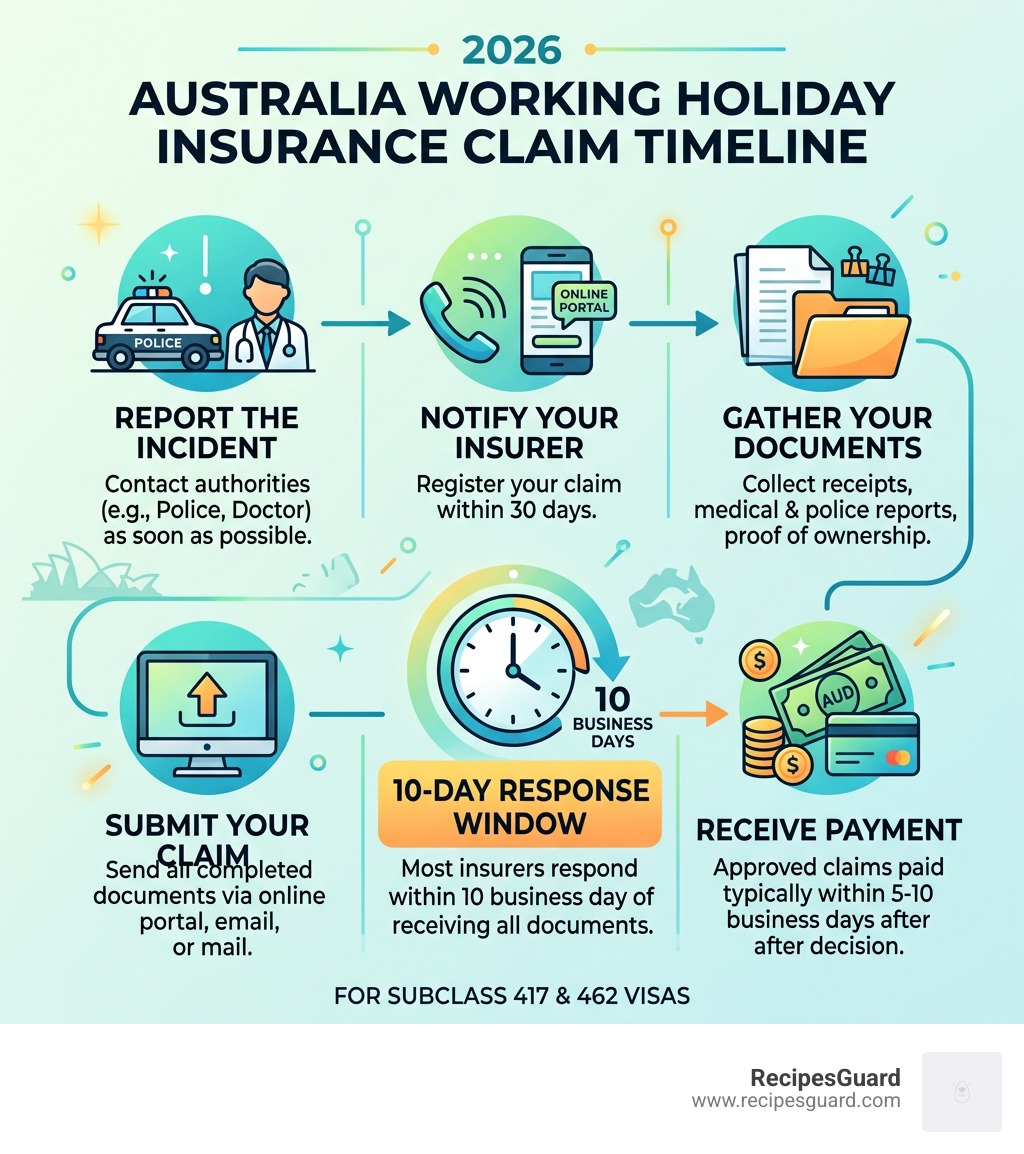
Here’s a quick overview of how it works:
- Report the incident — contact police (for theft) or a doctor (for medical issues) as soon as possible
- Notify your insurer — call or go online to register your claim; do this within 30 days of the incident where possible
- Gather your documents — receipts, medical reports, police reports, and proof of ownership
- Submit your claim — use your insurer’s online portal, email, or mail
- Wait for a response — most insurers respond within 10 business days of receiving all documents
- Receive payment — approved claims are typically paid within 5–10 business days after the decision
Australia is an incredible place to work and travel. But it’s also expensive when something goes wrong. A single hospital visit can cost thousands of dollars out of pocket if you’re not covered properly.
Whether you’re on a Subclass 417 or Subclass 462 visa, you are financially responsible for any healthcare or loss costs you incur. Private health insurance or travel insurance isn’t always legally required for your visa — but the Australian government strongly recommends it, and for good reason.
Think about it this way: one chiropractor visit and an x-ray after a minor injury can easily run over $800 AUD. A serious accident or emergency? Far more.
The claims process doesn’t have to be stressful — if you know what to do before, during, and after an incident.
Understanding Your Coverage: Travel vs. Health Insurance
Before you can successfully file an australia working holiday insurance claim, you need to understand which “bucket” your coverage falls into. In Australia, working holiday makers typically juggle two types of protection: Travel Insurance and Overseas Visitor Health Cover (OVHC).
While they might seem interchangeable, they serve very different purposes. Travel insurance is your safety net for the “unexpected and external”-think stolen cameras, cancelled flights, or emergency medical evacuations. OVHC, on the other hand, functions more like traditional health insurance. It helps cover the costs of everyday medical needs, such as GP visits, prescription medications, and elective hospital procedures.
| Feature | Travel Insurance | Overseas Visitor Health Cover (OVHC) |
|---|---|---|
| Best For | Short-term emergencies, theft, and trip delays. | Long-term stays, routine GP visits, and hospital stays. |
| Medical Scope | Emergency treatment only. | Emergency and non-emergency (GP, specialists). |
| Property | Covers luggage and personal tech. | No property coverage. |
| Medicare | No link to Medicare. | Can help cover gaps if you have Medicare access. |
A common point of confusion is the Reciprocal Health Care Agreement (RHCA). Australia has agreements with several countries (like the UK, Ireland, and New Zealand) that allow visitors to access “medically necessary” treatment through Medicare. However, this is not a substitute for insurance. Medicare for visitors often excludes things like ambulance rides, dental, and private hospital costs. You can read more about Australia’s public health system on Medicare (Australia)).
If you’re unsure which one you need, check out our guide on How to Pick the Best Insurance for Your Aussie Working Holiday.
Mandatory Requirements for Subclass 417 and 462
While the Subclass 417 (Working Holiday) and Subclass 462 (Work and Holiday) visas don’t always mandate insurance as a strict condition for entry (unlike some student visas), the Australian Department of Home Affairs still expects you to maintain “adequate health insurance.”
If your visa includes Condition 8501, you must maintain insurance for the duration of your stay. For those whose policies must meet the “minimum level of health insurance,” the per-person, per-annum benefit must not be less than AUD $1,000,000. Without this, you could be held personally liable for staggering private patient costs in a public hospital. To understand the nitty-gritty of these expenses, read our tutorial on How to Handle Medical Bills Down Under.
Essential Steps for an Australia Working Holiday Insurance Claim
In May 2026, the claims landscape is more digital than ever. Gone are the days of mailing thick envelopes of paper to a basement office in Sydney. Most modern providers use a 24/7 online portal where you can upload photos of your receipts directly from your phone.

When an incident occurs, time is of the essence. You should aim for a 30-day registration window. This means you “register” the claim with your insurer shortly after the event, even if you don’t have every single receipt yet. Most insurers also have a hard deadline for a 60-day notification after your policy’s return date. If you wait six months to tell them about a stolen phone, your claim will likely be denied.
For a deeper dive, see our Step-by-Step Guide to Filing Your Working Holiday Claim.
Immediate Actions After an Incident
What you do in the first 24 hours often determines if your australia working holiday insurance claim gets approved or rejected.
- For Theft or Loss: You must report the incident to the local police (or the relevant transport authority if it happened on a bus or plane). Most insurers require a written police report obtained within a 7-day reporting window.
- For Medical Emergencies: If your expenses are likely to exceed $2,000 AUD or you require hospitalization, you must contact your insurer’s 24/7 emergency assistance team immediately. They can often arrange for direct billing, meaning they pay the hospital so you don’t have to.
- Financial Consent: Always ask for “informed financial consent” before treatment. This is a document from the doctor or hospital outlining what the costs will be, which helps you avoid “gap fees” that your insurance might not cover.
Mastering the paper trail is key. Learn How to Gather Evidence for Your Travel Insurance Claim Like a Pro to ensure you don’t miss a beat.
Filing an Australia Working Holiday Insurance Claim for Medical Costs
Medical claims are the most common type for working holiday makers. Whether it’s a “flat white” burn from your cafe job or a surfing mishap in Byron Bay, the process remains similar.
When you visit a GP, you will usually pay the bill upfront. Ensure you get an itemized invoice (not just a credit card receipt). The invoice should show the Medicare Benefit Schedule (MBS) item numbers, the date of service, and the provider’s details.
If you find yourself stuck with a bill you can’t pay, our guide on Navigating Medical Claims for Overseas Visitors provides expert tips on dealing with Australian clinics.
Documentation Required for a Successful Claim
The “Golden Rule” of insurance: if it isn’t documented, it didn’t happen. To secure a successful australia working holiday insurance claim, you need to be an expert record-keeper.

We recommend keeping a dedicated folder (digital or physical) for the following:
- Original Bills and Receipts: Essential for reimbursement.
- Medical Reports: A note from the doctor explaining your diagnosis and treatment.
- Proof of Ownership: For property claims, you need to prove you actually owned the item. This can be an original purchase receipt, a bank statement, or even a photo of you with the item.
- Translation Services: If your original documents aren’t in English, most Australian insurers require a certified translation. Many providers offer interpreting services to assist with the process.
For help with the specific forms you’ll encounter, check The Ultimate Guide to the Australia Student Medical Claim Form.
Claiming for Lost or Stolen Property
When claiming for that expensive laptop or smartphone, be prepared for depreciation and sub-limits. Most policies won’t pay the “new” price for a three-year-old phone. They calculate the value based on the item’s age and wear and tear.
Furthermore, almost every policy has a “sub-limit” for electronics. Even if you have $10,000 in total luggage cover, your policy might only pay out a maximum of $1,000 for any single electronic item.
If your luggage has gone missing at the airport, follow the steps in Where is My Bag: A Guide to Lost Bag Claims in Australia.
Avoiding Common Pitfalls and Denied Claims
Nothing ruins a holiday like a rejected claim. Most denials happen because of small details buried in the Product Disclosure Statement (PDS).
One major pitfall is waiting periods. If you buy a policy today, you usually can’t claim for “extras” like dental or optical for the first 2 to 6 months. For major things like pregnancy or pre-existing conditions, the waiting period is typically 12 months.
Another trap for working holiday makers is the manual labor exclusion. Many travel insurance policies exclude injuries sustained while performing “high-risk” manual labor. If you’re working on a construction site or using heavy machinery on a farm, you need to ensure your policy specifically covers these activities.
We’ve summarized these traps in The Ultimate Student Guide to Navigating Insurance Claims.
Common Reasons an Australia Working Holiday Insurance Claim is Denied
- Unreported Theft: If you didn’t get a police report within 24–48 hours, the insurer will likely say “no.”
- Business Liability: Standard travel insurance does not cover you if you cause damage while working. If you’re a delivery driver and hit a car, your travel insurance won’t pay for the car—that’s what employer or vehicle insurance is for.
- Intoxication: If you were injured while under the influence of alcohol or non-prescription drugs, your claim will almost certainly be denied.
- High-Risk Activities: Skydiving, scuba diving, or riding a scooter without a helmet often require an “adventure pack” add-on.
For more on getting your money back, see Getting Your Money Back and How to Claim Student Insurance Australia.
Frequently Asked Questions about Australia Working Holiday Claims
How long does it take to process a claim in 2026?
In 2026, the industry standard for a “first response” is 10 business days. Once you submit all requested documents, the claims team will provide an outcome within another 10 business days. If approved, payment usually hits your Australian bank account via direct debit within 5–10 business days. You can track progress through your insurer’s dedicated online portal or mobile application.
Can I claim for injuries sustained while working on a farm?
This is tricky. If the injury is purely medical, your OVHC might cover the hospital bill. However, travel insurance often excludes “work-related incidents.” In Australia, your employer is legally required to have Workers’ Compensation insurance. If you’re injured on a farm doing “specified work” for your visa extension, the farm’s insurance should technically be the primary payer.
What should I do if my claim is rejected?
Don’t panic! You have the right to an internal dispute resolution. Contact your insurer’s internal dispute resolution or complaints team. They must respond within 30 days. If you’re still not happy, you can escalate the case to the Australian Financial Complaints Authority (AFCA), which provides free, independent dispute resolution for consumers.
Conclusion
At RecipesGuard, we know that navigating the Australian insurance system can feel like trying to find your way through the Outback without a map. But by staying organized, reporting incidents immediately, and understanding the difference between your health and travel coverage, you can ensure your australia working holiday insurance claim is handled smoothly.
Australia is a land of adventure, and while “sh!t happens,” it doesn’t have to end your trip. Keep your receipts, stay safe on the job, and always read the fine print before you head off on your next Great Aussie Road Trip.
For more step-by-step tutorials, visit our guide on How to Successfully Claim Your Overseas Student Insurance or explore our full resource library at https://www.recipesguard.com/.
Need to file a claim right now? Most Australian insurers provide an online portal or mobile app to start your claim immediately. Check your policy documents for the specific link to your provider’s claims page.

My name is Bianca, and my journey into the world of fermentation and food safety began with a costly mistake. I once lost an entire season’s harvest of chili peppers because I relied on guesswork instead of science. That failure was my turning point.
