
What to Do When Your Visa is Denied and You Want Your Money Back
What a Visa Refusal Really Costs You (And What You Can Do About It)
Making a claim for visa refusal expenses is possible through your travel insurance policy — if you act quickly and have the right documentation.
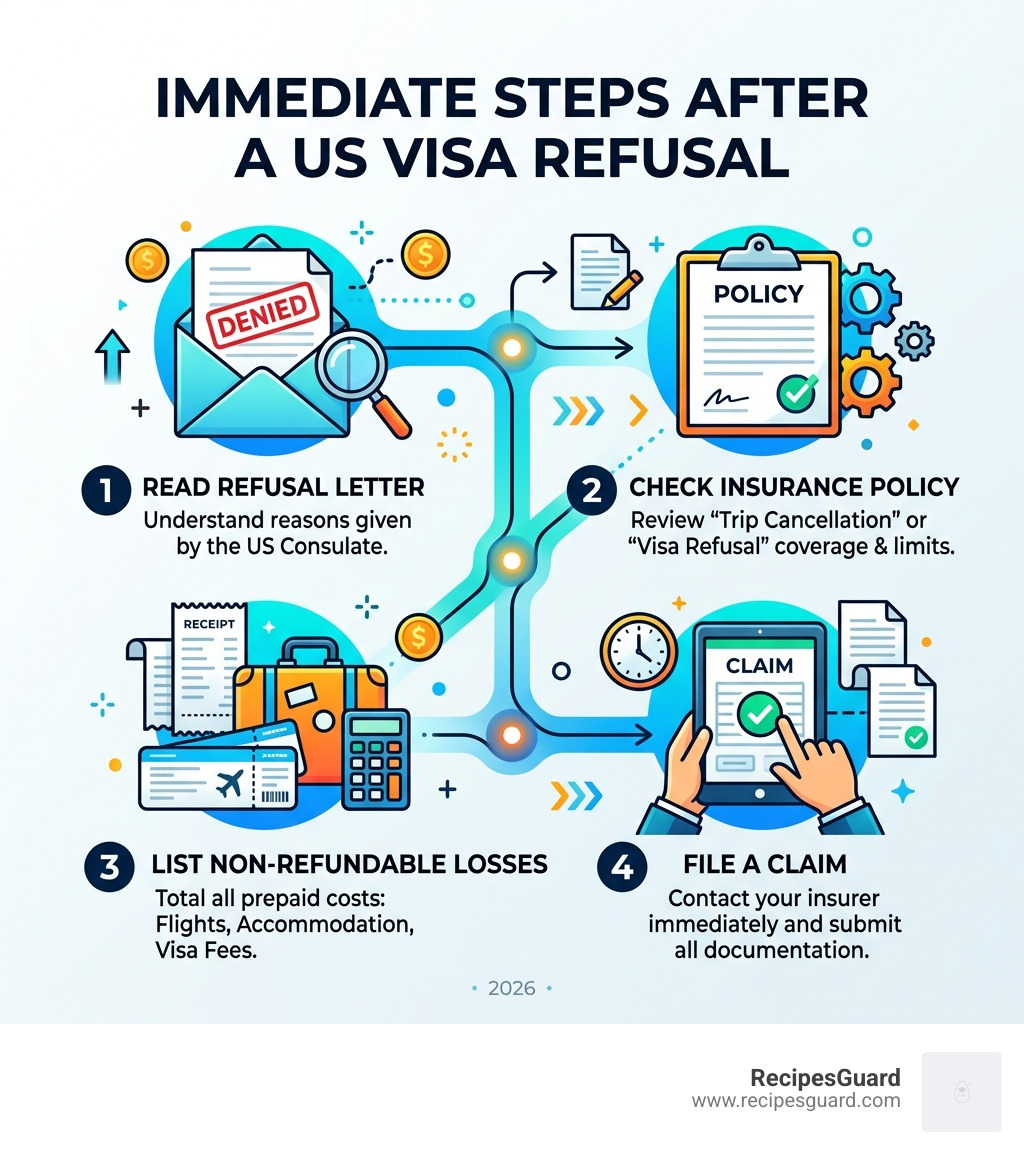
Here’s a fast overview of what to do:
- Get your refusal letter — you’ll need it for any insurance claim
- Check your travel insurance policy for “trip cancellation” or “visa refusal” coverage
- List all non-refundable costs — flights, accommodation, visa fees
- Contact your insurer and start your claim as soon as possible
- Submit your documents — refusal letter, proof of payment, booking confirmations
More than 2.5 million US visa applications are denied every year. For international students, that number isn’t just a statistic — it’s a financial gut punch.
Think about it: you’ve paid for flights, booked accommodation, and paid a non-refundable visa application fee. Then a consular officer hands you a refusal letter. The trip is off. The money, however, doesn’t come back automatically.
The stress is real. So is the confusion. Most people don’t know whether to reapply, appeal, or file an insurance claim — or all three.
This guide walks you through each option clearly, so you can recover your money and figure out your next move without wasting time or making costly mistakes.
Basic claim for visa refusal terms:
- schengen visa insurance australia
- best insurance for working holiday visa australia
- claim timeline extension guide
Immediate Actions After a US Visa Refusal

When you walk out of that interview room with a refusal letter in your hand, it feels like the world has stopped. But in the eyes of the law and your insurance provider, the clock has just started ticking. The very first thing we recommend is: do not throw that letter away.
This letter is the “golden ticket” for your claim for visa refusal. It contains the specific legal reason for your denial, usually cited as a section of the Immigration and Nationality Act (INA). Without this document, your insurance company won’t even look at your file, and you won’t know how to fix your application for next time.
One of the hardest pills to swallow is that visa application fees are generally non-refundable. According to the U.S. Embassy & Consulates in the United Kingdom, the fee you pay is for the processing of the application, not the visa itself. Whether the answer is “yes” or “no,” the government has done the work, so they keep the cash. This is why having a backup plan through insurance is vital for students on a budget.
If you find yourself in this situation, you might feel like you’re in a holding pattern. For more on how to manage the emotional and logistical “limbo” that follows, check out our guide on The Waiting Game: A Guide to Visa Delays and Revocations.
Understanding Section 214(b) and 221(g)
Most refusals aren’t a “permanent ban” from the country; they are often based on two specific sections of the law.
- Section 214(b) – Immigrant Intent: This is the most common reason for a denial. Under U.S. law, every applicant is “guilty until proven innocent” of wanting to stay in the U.S. permanently. If the officer thinks you don’t have enough “strong ties” (like a job, family, or property) to your home country, they will refuse the visa. To overcome this, you don’t necessarily need more documents; you need to prove a stronger reason to return home.
- Section 221(g) – Incomplete Application: Think of this as a “pause” button. It means you are missing a document or the government needs to do more “administrative processing.” You usually have one year to provide the missing info without paying a new fee.
For those dealing with more complex humanitarian or refugee-related denials, the Request for Review Tip Sheet | USCIS provides official guidance on how to ask for a second look, though these cases are handled very differently from standard student or tourist visas.
Common Mistakes to Avoid Post-Refusal
We see it all the time: an applicant gets a “no,” runs home, and reapplies the very next day with the exact same information. This is a recipe for a second refusal. Unless your circumstances have changed significantly, the result will likely be the same.
Another huge mistake is providing false information or “doctoring” documents to try and fix the reason for the first refusal. This can lead to a permanent bar from the country for misrepresentation. If you believe the decision was a simple policy error and you are applying from within a jurisdiction like the UK, you might look into Visa and immigration reconsideration requests – GOV.UK, but for most US consular decisions, “reconsideration” isn’t an option — you just have to reapply.
How to File a Successful Claim for Visa Refusal Expenses
Now, let’s talk about getting your money back. While the embassy won’t refund your fee, a good travel insurance policy might. This is where the term claim for visa refusal becomes your best friend.
Most travel insurance policies include “Trip Cancellation” benefits. Historically, many policies excluded visa refusals, but in 2026, many student-focused insurers in Australia have started including specific clauses for visa denials, provided the refusal wasn’t caused by your own delay or criminal history.
To keep your travel budget intact, you need to prove that the refusal was “unforeseen.” If you applied for your visa after you were supposed to travel, or if you knew you were ineligible, the claim will be denied. Check out our detailed breakdown on how to Claim for Visa Fees and Keep Your Travel Budget Intact.
Using Travel Insurance to Claim for Visa Refusal Costs
Not all insurance is created equal. For international students, standard “holiday” insurance often isn’t enough. You need a policy that understands the student visa process.
When you file a claim for visa refusal, the insurer will look for:
- The Policy Date: Did you buy the insurance before you received the refusal? (It must be a “yes”).
- The Reason for Refusal: Was it a “standard” 214(b) refusal, or was it because you submitted forged documents? (Insurers won’t pay for fraud!).
- Non-refundable Costs: They will only pay for what you can’t get back from the airline or hotel.
For a deep dive into the specifics for students, read The International Student’s Guide to Navigating an Insurance Claim (Student Visa). If your travel plans also involved car rentals or other bookings, you might find our guide on Mastering the Visa Insurance Claim Process for Delays and Rentals helpful.
Step-by-Step Guide to Your Claim for Visa Refusal
Ready to file? Follow these steps to ensure you don’t get rejected by your insurer:
- Gather the “Big Three”: You need your original insurance certificate, the official visa refusal letter, and the receipts for everything you paid for.
- Request Refunds from Vendors First: Most insurers require you to try and get a refund from the airline or hotel first. Save the emails where they say “No, this is non-refundable.”
- Fill out the Claim Form: Be honest and clear. Use the exact reason listed in your refusal letter.
- Submit within the Deadline: Most Australian insurers require claims to be filed within 30 to 60 days of the “loss event” (the date of the refusal).
For more tips on the paperwork side of things, see Visa Claims 101: Navigating the Process for International Students.
Reapplying vs. Appealing: Navigating the Legal Paths
Once you’ve started the insurance process, you need to decide if you’re going to try for the visa again. It’s important to understand that in the U.S. system, there is no formal “appeal” for a non-immigrant visa refusal like a student visa. Your only path is to reapply and start fresh.
| Feature | Reapplication | Appeal / Waiver |
|---|---|---|
| Best For | 214(b) refusals (Lack of ties) | 212(a) refusals (Ineligibility) |
| Cost | New application fee | Legal fees + Form fees (e.g., I-601) |
| Wait Time | Standard interview wait times | Months to years |
| Success Basis | New evidence of ties to home | Legal proof that a “bar” should be lifted |
If you are dealing with an immigrant visa denial or a more complex legal issue, the Consular Visa Denial and Appeal Process – USCIS Guide explains how cases can sometimes be reviewed by the Board of Immigration Appeals (BIA). However, for most students, this isn’t the path. If you’re looking at European or Irish jurisdictions, the rules change significantly — for instance, Appeal a negative decision – Immigration Service Delivery shows that Ireland allows for a free appeal process within two months.
When to Seek a Waiver of Ineligibility
Sometimes, a visa is refused because of a “permanent” problem, like a past criminal conviction or a medical issue. This falls under Section 212(a) of the INA. In these cases, you might be eligible for a “Waiver of Ineligibility.” This is essentially asking the U.S. government to “forgive” the issue and let you in anyway.
Applying for a waiver is a heavy legal lift. You usually need to file Form I-601. For those looking at UK-based refusals, the Visa refusals and appeals – GOV.UK page provides a good overview of how the British system handles these complex ineligibility issues.
The Australian Context: Appeals and Reviews
Since we are based in Australia, we have to mention how things work locally. If you apply for an Australian visa and it is refused, you might have the right to a merits review by the Administrative Review Tribunal (ART).
Unlike the U.S. system, where the consular officer’s word is final, the ART can actually overturn a decision if they believe the Department of Home Affairs made a mistake. This is common for visitor visas or student visas where the applicant is already in Australia or has a sponsor. To see if your specific refusal is eligible for this, check out Can You Appeal an Australian Visitor Visa Refusal?.
Strengthening Your Reapplication Strategy
If you decide to reapply (which most students do), you can’t just “try harder” at the interview. You need better evidence. The consular officer is looking for “strong ties” to your home. In 2026, this means more than just a letter from your parents.
Consider gathering:
- Employment Verification: A letter from a current employer showing you have a job waiting for you.
- Property Deeds: Proof that you own assets in your home country.
- Bank Statements: Showing a consistent history of funds, not just a large deposit made the day before the interview.
- Family Certificates: Proving you have deep roots and responsibilities at home.
For those in Victoria, Victoria Legal Aid offers excellent resources on how to structure your case.
Proving Strong Ties to Your Home Country
“Ties” are the invisible strings that pull you back to your home country. Consular officers look for “social and economic” commitments. If you are a student, this includes showing that your course of study makes sense for your career path in your home country. If you’re studying something that has no job market at home, the officer might suspect you plan to stay in the U.S. or Australia forever.
Sometimes, even with great evidence, things go wrong. If you find yourself disputing an insurance claim because they don’t believe your “ties” were strong enough to warrant a “valid” refusal, check out The Art of the Appeal: Navigating Travel Insurance Claim Disputes.
When to Consult an Immigration Attorney
We always say: if your refusal letter mentions “fraud,” “misrepresentation,” or a “permanent bar,” do not try to fix this yourself. You need professional help. An immigration attorney with 15+ years of experience can help you determine if a waiver is possible or if the consular officer made a legal error. While attorneys can’t “guarantee” a visa, they can ensure your next application doesn’t have the same holes as the first one.
Frequently Asked Questions about Visa Denials
How long does administrative processing take after a 221(g) refusal?
This is the “how long is a piece of string” question. Administrative processing can take anywhere from a few weeks to several months. In 2026, most cases are resolved within 60 days, but some can take much longer if they involve complex background checks. You can usually track your status online using your DS-160 confirmation number.
Can I get a refund for my visa application fee?
Generally, no. As mentioned by the U.S. Department of State and various embassies, the fee is for the adjudication process. It is non-refundable regardless of whether the visa is granted or denied. This is why a claim for visa refusal through travel insurance is often the only way to see that money again.
How does a previous refusal affect future applications?
A refusal isn’t a “black mark” that dooms you forever, but it is a part of your permanent record. The next officer will see the previous denial and will likely start the interview by asking: “What has changed since your last application?” If you can’t answer that clearly, you’re likely to get another refusal.
Conclusion
At RecipesGuard, we know that a visa refusal feels like a dead end, but it’s often just a detour. Whether you are reapplying for a US visa or navigating the Australian Administrative Review Tribunal, the key is to stay organized and act fast.
By filing a claim for visa refusal with your insurance provider, you can at least recover the financial loss of your flights and fees, giving you the “reset button” you need to try again. If you’re a student heading Down Under, make sure you’re protected with the right Travel Insurance for Students Traveling to Australia.
Don’t let a “no” at the embassy ruin your future. Get your documents in order, file your claim, and get back to planning your journey!

My name is Bianca, and my journey into the world of fermentation and food safety began with a costly mistake. I once lost an entire season’s harvest of chili peppers because I relied on guesswork instead of science. That failure was my turning point.
