
Don’t Let Canceled Flights Ground Your Budget
When “Cancelled” Appears on the Departure Board, Are You Protected?
Flight ticket cancellation insurance is a type of travel protection that reimburses your prepaid, non-refundable trip costs if you have to cancel before you depart for a covered reason — like sudden illness, a family emergency, or severe weather.
Here’s a quick summary of what you need to know:
- What it covers: Non-refundable flights, hotels, tours, and other prepaid expenses canceled due to qualifying events
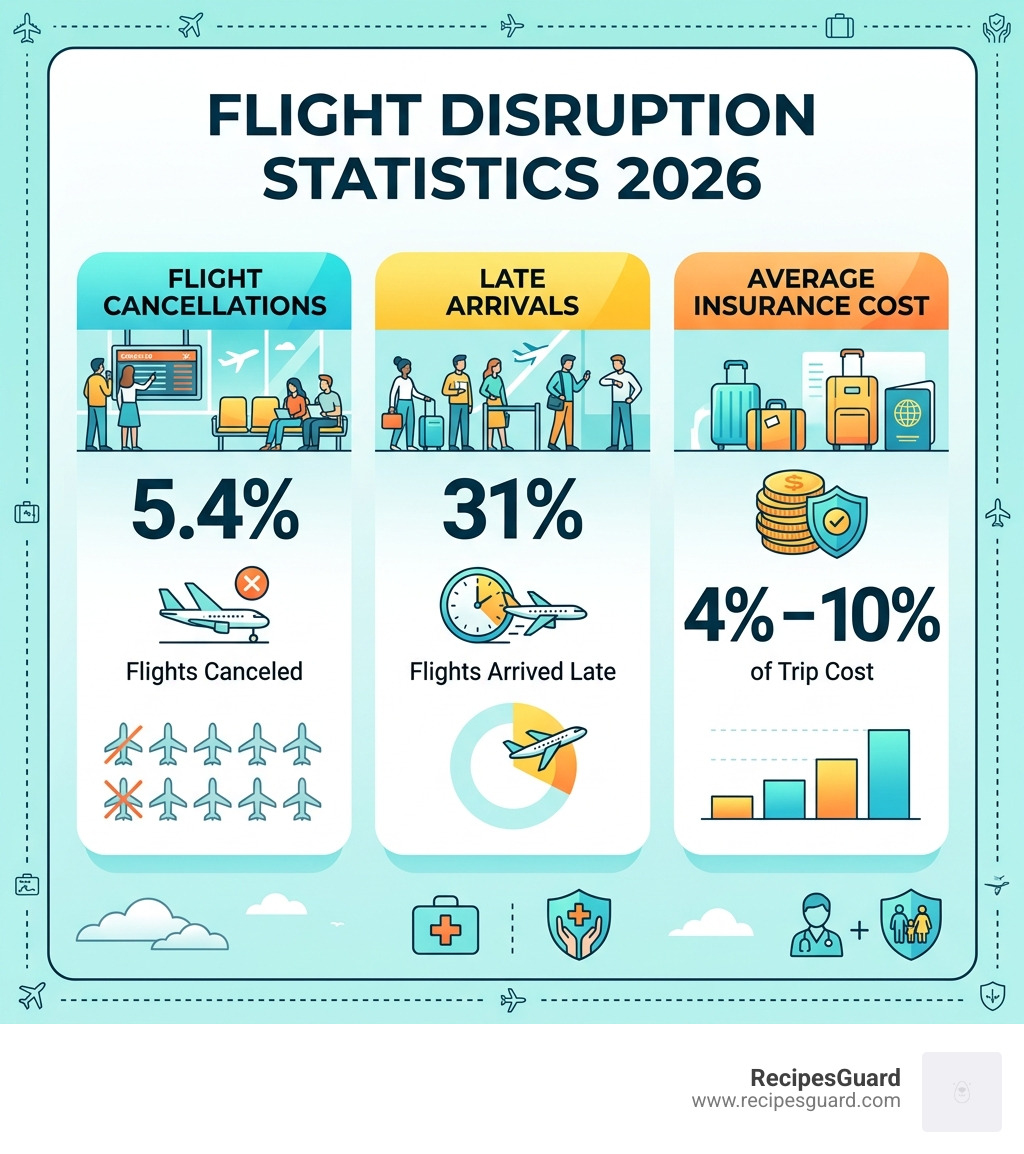
- What it costs: Typically 4%–10% of your total trip cost
- What it doesn’t cover: Simply changing your mind (unless you have Cancel for Any Reason add-on)
- When to buy it: As early as possible — ideally within days of your first trip payment
- Who needs it most: Anyone with non-refundable bookings, especially international travelers and students studying abroad
Think about this: roughly 1 in 20 flights gets canceled, and nearly a third of all flights arrive late. If your ticket is non-refundable, a single unexpected event — a medical diagnosis, a family crisis, a natural disaster — can mean losing hundreds or even thousands of dollars with no recourse.
For international students especially, the stakes are even higher. You’re often booking expensive long-haul flights months in advance, with rigid academic schedules and limited financial backup. A canceled trip without insurance isn’t just stressful — it can be a serious financial hit.
Flight cancellation insurance exists to close that gap. It sits between what airlines are legally required to refund and what you’ve actually paid.
Basic flight ticket cancellation insurance terms:
- cancellation insurance policy
- if you have travel insurance can you cancel a flight
- trip cancellation insurance for any reason
Understanding Flight Ticket Cancellation Insurance
At its core, flight ticket cancellation insurance acts as a financial safety net for your travel investment. When we book a flight, especially those budget-friendly international fares, the tickets are often “non-refundable.” This means if you can’t make it to the airport, the airline keeps your money.
Insurance changes that dynamic. It is a benefit typically found within a comprehensive travel insurance policy that reimburses your prepaid, non-refundable expenses if you must cancel your trip for a “covered reason.” We often see travelers confuse this with a simple refund policy, but there is a distinct difference. A refund comes from the airline; an insurance payout comes from a provider after you’ve proven that an unforeseen event stopped you from flying.
For many of us, the flight is just the beginning. A cancellation often triggers a domino effect on hotel reservations, prepaid tours, and rental cars. Comprehensive plans are often designed to look at the “total trip cost” rather than just the seat on the plane.
If you’re wondering about the mechanics of getting your cash back, you should check out our guide on How To Get Your Money Back After A Flight Cancellation/. It breaks down the hierarchy of who to call first and how to leverage your policy.

What Does Flight Ticket Cancellation Insurance Typically Cover?
The “covered reasons” are the heart of your policy. These are the specific, unforeseen events that the insurance company agrees are valid excuses for not traveling. While every policy is a bit different, most standard plans in the Australian market include:
- Sudden Illness or Injury: If you, your travel companion, or a close family member gets sick or injured and a doctor confirms you are unfit to travel.
- Death in the Family: The passing of a close relative is almost universally covered.
- Severe Weather: If a hurricane, bushfire, or flood makes your destination uninhabitable or grounds all flights.
- Mechanical Breakdown: If the airline’s equipment fails and they cannot get you to your destination within a certain timeframe (usually 24 hours).
- Jury Duty or Legal Subpoena: If the government demands your presence in court during your travel dates.
- Natural Disasters at Home: If your primary residence is made uninhabitable by a fire or flood just before you leave.
Understanding these triggers is vital. We’ve put together a detailed list of Covered Trip Cancellation Reasons You Need To Know/ to help you navigate the fine print.
Common Exclusions and Non-Covered Situations
Insurance is designed for the unforeseen. This means “foreseeable events” are generally excluded. If you buy a policy on Tuesday for a flight on Friday, but a major hurricane was named on Monday, you won’t be covered for weather-related cancellation because the event was already known.
Other common exclusions include:
- Changing Your Mind: Simply deciding you’d rather stay home or go somewhere else.
- Fear of Travel: General anxiety about safety or health at a destination (unless specific government advisories change).
- Government Advisories: Some policies exclude cancellations based on “Do Not Travel” warnings if the warning was in place when you bought the policy.
- Foreseeable Work Conflicts: If you knew about a big meeting before booking, you likely won’t be reimbursed for canceling to attend it.
- Pre-existing Medical Conditions: Unless you have a specific waiver, illnesses you were already being treated for are often excluded.
For a deeper dive into what might trip you up, see our resource on Understanding Policy Exclusions and Limitations.
Trip Cancellation vs. Trip Interruption
It’s a common mistake to think these two terms are interchangeable. In flight ticket cancellation insurance, timing is everything.
Trip Cancellation happens before you leave. It covers the 100% of the non-refundable costs you lose because you never made it to the airport.
Trip Interruption happens after your journey has begun. If you are halfway through your trip and have to fly home early because of an emergency, trip interruption kicks in. Interestingly, interruption coverage often pays out more than cancellation—sometimes up to 125% of the trip cost. Why? Because it needs to cover the unused portion of your trip plus the often-expensive cost of a last-minute one-way flight back home.
| Feature | Trip Cancellation | Trip Interruption |
|---|---|---|
| When it starts | Before departure | After departure |
| Standard Payout | 100% of prepaid costs | 100% – 125% of costs |
| Typical Reason | Sickness, weather, jury duty | Sickness, family emergency at home |
| Unused portions | Full refund of all bookings | Pro-rated refund of unused days |
To see how these work in tandem to protect your entire itinerary, read The Ultimate Guide To Trip Cancellation And Interruption/.
Maximizing Flexibility with Cancel for Any Reason (CFAR)
Standard insurance is great, but it can feel restrictive. What if you just don’t feel safe traveling? What if your best friend backs out and you don’t want to go alone? For these “subjective” reasons, you need Cancel for Any Reason (CFAR) coverage.
CFAR is an optional add-on that does exactly what it says on the tin. It allows you to cancel for literally any reason, even “I just don’t feel like it today,” and still get a portion of your money back. However, there are three golden rules to CFAR:
- The Window: You must usually purchase CFAR within 14-21 days of your initial trip deposit.
- The Payout: You won’t get 100% back. Most plans reimburse between 50% and 75% of your costs.
- The Deadline: You must cancel your flight at least 48 to 72 hours before your scheduled departure. You can’t call from the boarding gate and claim CFAR.
CFAR can be a useful upgrade for travelers who want extra flexibility and peace of mind. We also have a dedicated guide: Cfar Travel Insurance Because Life Happens And Plans Change/.

When to Consider CFAR for Your Flight Ticket Cancellation Insurance
CFAR isn’t necessary for every $200 domestic hop, but it’s a lifesaver for:
- High-Value Trips: If you’ve spent $5,000 on a dream holiday, losing 25% (the part CFAR doesn’t cover) is much better than losing 100%.
- Uncertain Schedules: If you’re a student waiting on internship news or a professional with an unpredictable boss.
- Travel Anxiety: If you’re worried about shifting political climates or health news that hasn’t reached “official” warning levels yet.
For more on this, check out Cancel For Any Reason Your Ticket To A Stress Free Refund/.
How to File a Claim and Get Your Money Back
Filing a claim can feel like a part-time job, but it doesn’t have to be. The key is documentation. Insurance companies don’t just take your word for it; they need a “paper trail.”
Here is the step-by-step process we recommend:
- Cancel with the Airline First: Before you talk to the insurer, cancel your flight. Get a written confirmation of the cancellation and a statement of any refund or credit they gave you.
- Gather Your Proof: If you canceled for medical reasons, you need a physician’s statement. If it was weather, a news report or airline notice.
- Proof of Payment: Keep your original receipts and credit card statements.
- Submit Online: Most modern providers have portals to speed this up.
We’ve simplified this entire headache into a Step By Step Guide How To Successfully Claim Your Trip Cancellation Refund/.
Special Considerations for International Students
At RecipesGuard, we have a soft spot for students. We know that studying abroad is a massive financial and emotional investment. Students face unique risks that regular travelers don’t:
- Exam Schedule Changes: If a professor moves a final exam, you might miss your flight.
- Visa Delays: If your student visa doesn’t arrive in time, you can’t board that plane.
- University Housing Issues: Sudden changes in term dates can throw a whole itinerary into chaos.
Because of these specific needs, we’ve developed the Flight Cancelled Here Is Your Student Insurance Survival Guide/ and a guide on How Students Can Claim Cash For Missed International Flights/.
Frequently Asked Questions about Flight Ticket Cancellation Insurance
How much does flight cancellation insurance cost?
On average, you should expect to pay between 4% and 10% of your total trip cost. For a $2,000 trip, that’s about $80 to $200. While that might seem like a lot when you’re already spending big, consider the alternative: losing the full $2,000. Comprehensive plans that include medical and baggage protection often average out to about $31 per day.
For a breakdown of what determines these prices, see our analysis on Average Costs of Flight Protection Plans.
Does flight insurance cover COVID-19 related cancellations?
In 2026, COVID-19 is generally treated like any other illness. Most policies will cover you if you personally contract the virus and have a PCR test or a physician’s confirmation that you are too ill to fly. However, “fear of catching COVID” or “general lockdowns” are usually not covered under standard policies. You would need a plan with an “Epidemic Coverage Endorsement” or a CFAR add-on for that level of protection.
Check out Standard Health and Epidemic Coverage Terms for more specific wording.
When is the best time to purchase flight cancellation insurance?
The best time is the day you book your flight. Many of the most valuable benefits — like the Pre-existing Medical Condition Waiver and the Cancel for Any Reason (CFAR) option — are only available if you buy the insurance within a 14 to 21-day window of your initial trip deposit.
If you wait until two days before you fly, you can still get a policy, but it won’t cover nearly as much. Learn more at How To Cancel Your Trip Without Losing Your Shirt/.
Conclusion
Navigating flight ticket cancellation insurance doesn’t have to be a solo mission. Whether you are an international student heading home for the holidays or a traveler embarking on a once-in-a-lifetime adventure, protecting your budget is just as important as packing your bags.
5.4% of flights are cancelled, and 31% face significant delays. The odds are high enough that “hoping for the best” isn’t a strategy—it’s a gamble. At RecipesGuard, we are dedicated to providing student-focused tutorials and step-by-step advisory to ensure that when life happens, your bank account doesn’t suffer.
Don’t let a grounded plane ground your finances. For more expert advice and claim-filing secrets, visit us at https://www.recipesguard.com/. Safe travels!

My name is Bianca, and my journey into the world of fermentation and food safety began with a costly mistake. I once lost an entire season’s harvest of chili peppers because I relied on guesswork instead of science. That failure was my turning point.
