
The Aussie Student Tutorial for Travel Insurance Claims
Every Australian Travel Claim You Need to Know (And How to Get Your Money Back)
Australia travel claim tutorial searches usually mean one thing: you spent money you didn’t expect to, and you want it back.
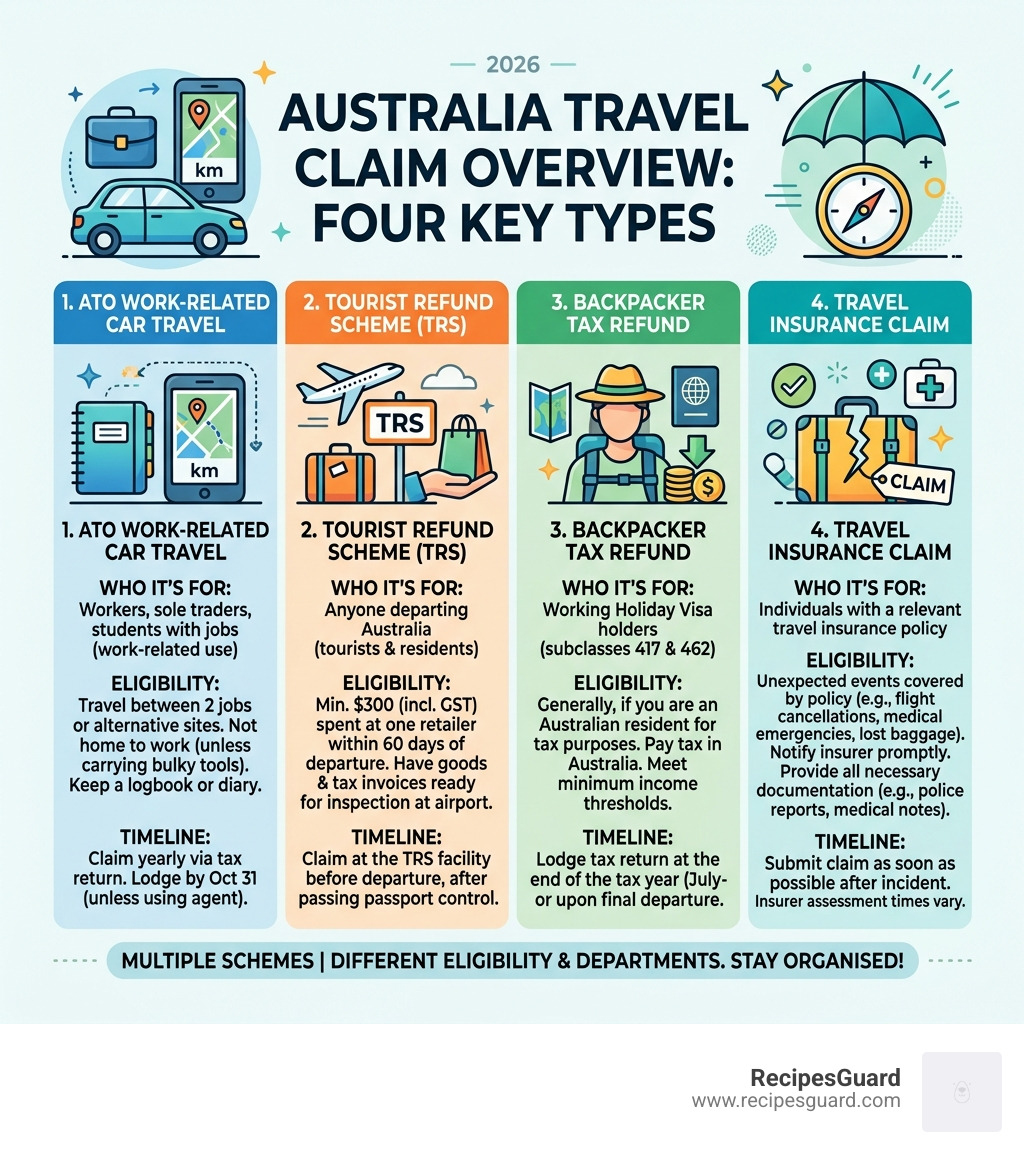
Here’s a quick overview of the main types of travel claims available in Australia:
| Claim Type | Who It’s For | Potential Return |
|---|---|---|
| Work-related car travel (ATO) | Workers, sole traders, students with jobs | 88c per km, up to 5,000 km |
| Tourist Refund Scheme (TRS) | Anyone departing Australia | ~$100 per $1,100 spent |
| Backpacker tax refund | Working Holiday Visa holders | Average $2,600 |
| Travel insurance claim | Policyholders | Varies by cover and incident |
| DVA medical travel | Veterans | Full reimbursement of approved costs |
Australia has several separate reimbursement systems, and they don’t talk to each other. The ATO handles tax-related claims. The Australian Border Force runs the GST refund scheme at airports. Your insurer manages travel insurance. The DVA has its own portal for veterans.
Most students only know about one or two of these — and miss out on the rest.
If you’re an international student dealing with an unexpected medical bill, a cancelled flight, or just finishing up a working holiday, there’s a good chance money is owed to you right now. You just need to know where to look and what to submit.
This guide walks through every major claim type, step by step.
Claiming Work-Related Travel: The ATO Australia Travel Claim Tutorial
If you are a student working a part-time job or running a small side hustle as a sole trader, you might be leaving money on the table. The Australian Taxation Office (ATO) allows you to claim deductions for car travel that is directly related to your work. However, there is a golden rule: you generally cannot claim the cost of driving from home to work and back.
Exceptions only apply if you are carrying bulky tools (like a cello or heavy construction equipment) that cannot be safely stored at your workplace. Beyond that, you can claim for travel between two separate jobs, or travel from your workplace to an alternative site (like a client’s office).
For the 2025/2026 tax year, the ATO has set specific rates and methods for these claims.
| Feature | Cents per KM Method | Logbook Method |
|---|---|---|
| Claim Limit | Up to 5,000 km per vehicle | No limit on kilometres |
| Rate | 88 cents per kilometre | Based on actual costs |
| Receipts | Not required for the km themselves | Required for all expenses (fuel, etc.) |
| Record Keeping | Diary of work trips | 12-week logbook + all receipts |
| Best For | Occasional work travel | Heavy business/work use |
Using the Cents per KM Method in an Australia Travel Claim Tutorial
As of April 2026, the current rate is 88 cents per kilometre. This is the “low-stress” version of a travel claim. It is designed to cover everything—fuel, insurance, and even the wear and tear (depreciation) on your car.
To use this method:
- Check Eligibility: Your vehicle must be a “car,” defined as a motor vehicle designed to carry a load of less than one tonne and fewer than nine passengers.
- Calculate Your Distance: You can claim a maximum of 5,000 business kilometres per car. If you drive 2,000 km for work, your deduction is $1,760.
- Keep a Diary: While you don’t need receipts for petrol, the ATO may ask you to show how you calculated your kilometres. A simple diary or app log showing the dates and purposes of your work trips is sufficient.
Mastering the Logbook Method: An Australia Travel Claim Tutorial
If you are a delivery driver or your work requires constant travel, the logbook method is often more lucrative. This method allows you to claim the actual percentage of your car’s running costs.
- The 12-Week Rule: You must keep a logbook for a continuous 12-week period that represents your typical usage.
- Validity: Once established, this logbook is valid for five years, provided your driving patterns don’t change significantly.
- The Math: If your logbook shows that 60% of your travel is for work, you can claim 60% of your fuel, registration, insurance, and even interest on your car loan.
- Documentation: You must keep every single receipt for fuel, oil, and repairs. You should also record your odometer readings at the start and end of the financial year.
Getting Your GST Back: The Tourist Refund Scheme (TRS)
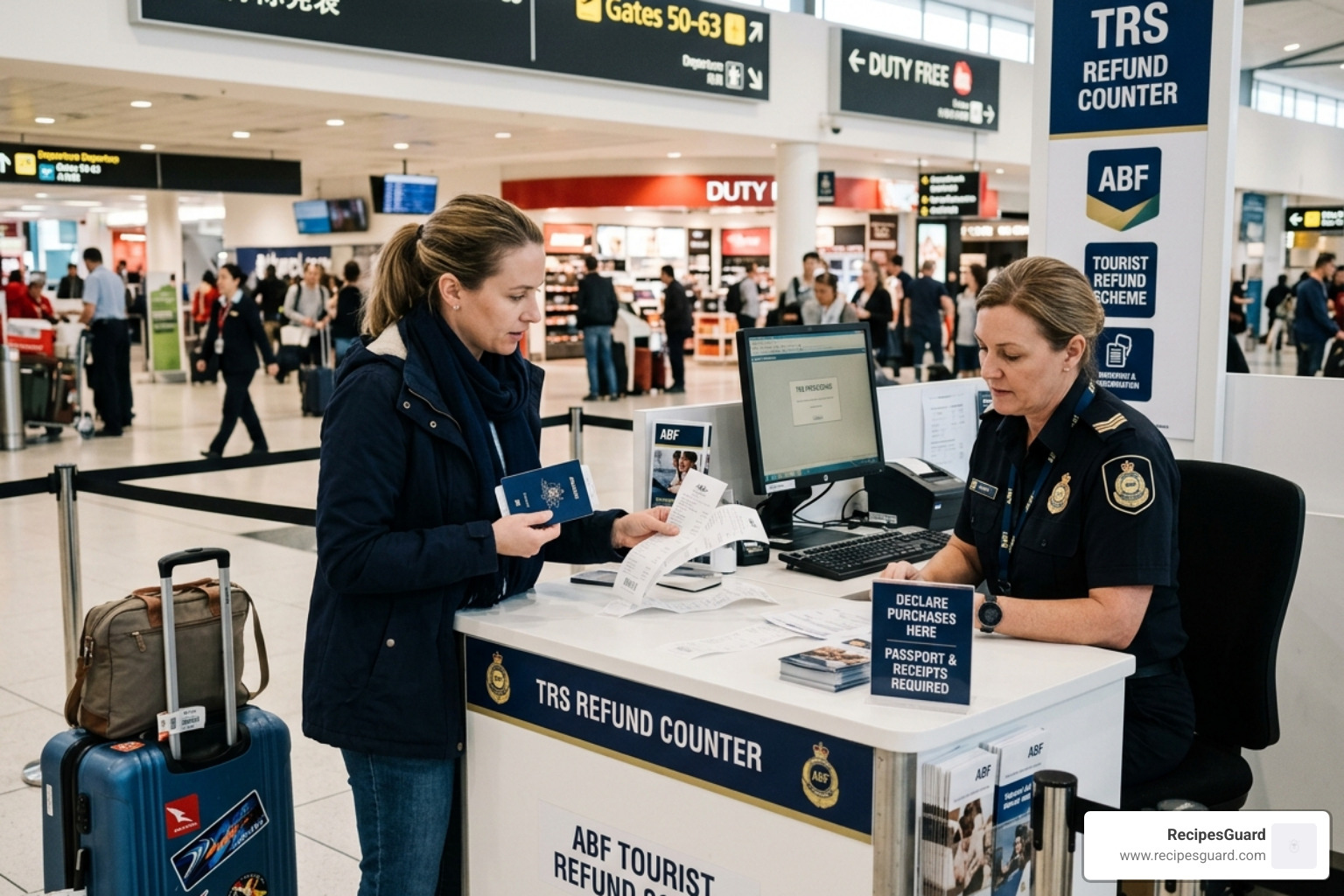
Students often head home during the semester break or after graduation. If you’ve bought a new laptop, iPhone, or designer gear to take back with you, you can claim a refund of the 10% Goods and Services Tax (GST) you paid.
The rules are simple but strict:
- The $300 Rule: You must spend at least $300 (including GST) at a single retailer. This can be across multiple invoices, as long as they share the same Australian Business Number (ABN).
- The 60-Day Rule: You must have purchased the items within 60 days of your departure from Australia.
- The Invoice: For purchases over $1,000, your name and address (or passport number) must be printed on the invoice to prove it was you who bought it.
Step-by-Step TRS Airport Process
Don’t wait until you get to the airport to start your australia travel claim tutorial journey. Use the “My TRS Claim” app or web portal to pre-enter your details.
- Pre-Log Online: Enter your flight details, the ABN of the retailers, and the invoice amounts into the app. This generates a QR code.
- Oversized/Liquid Goods: If you are claiming for things like wine (subject to Wine Equalisation Tax) or bulky items that must be checked in, you must visit the Australian Border Force (ABF) office before you check your bags. They need to sight the goods and stamp your invoices.
- The TRS Counter: After you pass through immigration and security, find the TRS counter.
- Present Documents: Show the officer your goods (unless they were checked in and stamped), your original paper tax invoices (digital copies are usually rejected!), your passport, and your boarding pass.
- Timing: You must complete your claim at least 30 minutes before your flight’s scheduled departure (60 minutes for cruises).
Tax Refunds for Backpackers and Working Holidaymakers
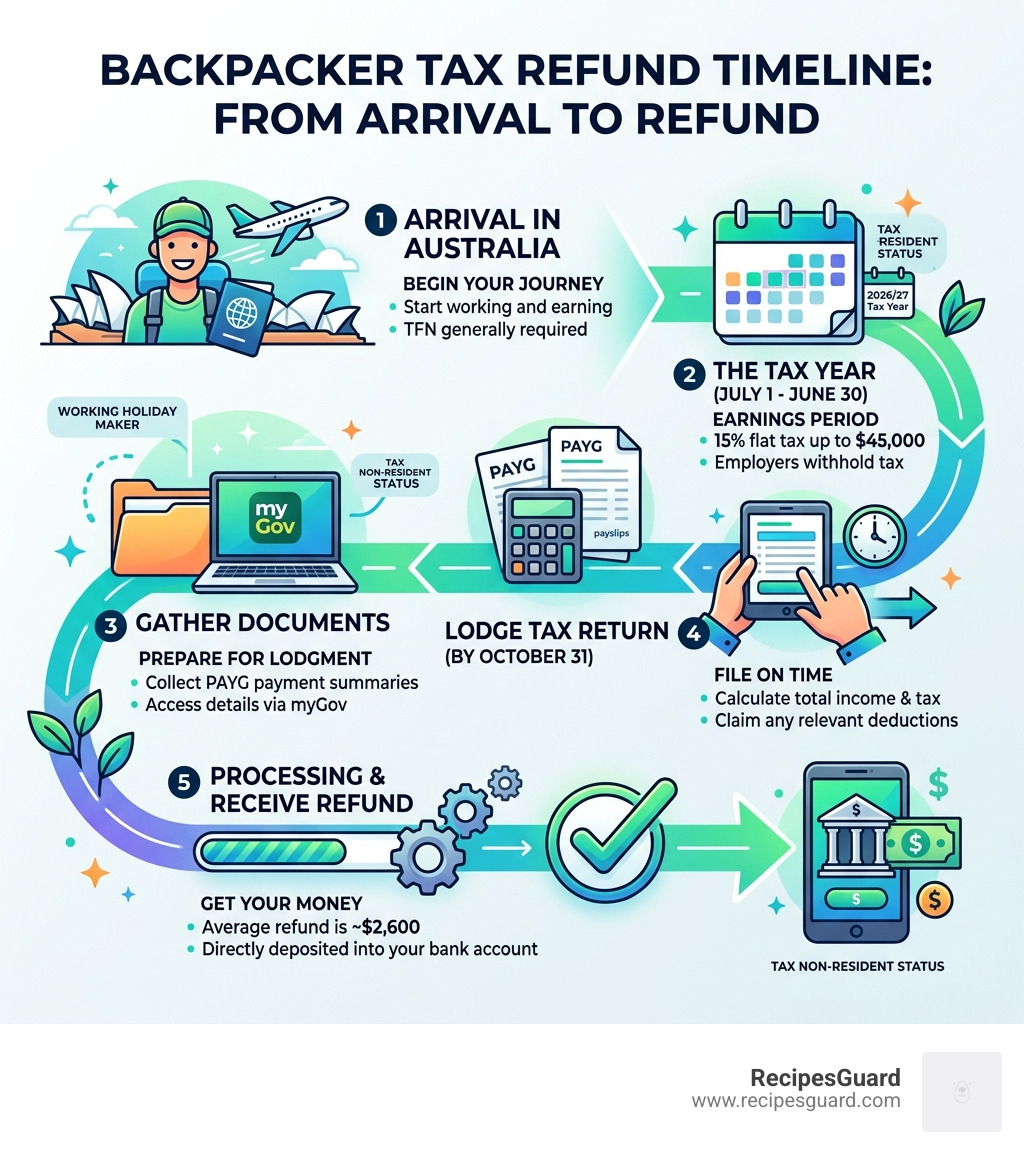
If you’ve been studying while on a Working Holiday Visa (subclass 417 or 462), or if you’re a backpacker finishing your year, you are likely owed a significant refund. The average refund is approximately $2,600.
Because you are typically considered a “non-resident” for tax purposes, you are taxed at a flat rate of 15% on everything you earn up to $45,000. If your employer withheld tax at a higher “foreign resident” rate, you’ll get that difference back.
The Timeline:
- The Tax Year: Runs from July 1st to June 30th.
- The Deadline: You must lodge your tax return by October 31st.
- What You Need: Gather your PAYG summaries (now usually available via myGov) and your final payslips.
Step-by-Step Travel Insurance Claims for Students

At RecipesGuard, we see students struggle most with insurance claims because they lose their paperwork. Whether it’s a medical emergency, a stolen laptop, or a flight cancelled by a storm, the process is manageable if you stay organized.
First Steps in an Emergency:
- Call for Help: Most insurers have a 24/7 emergency assistance line. If your medical expenses are likely to exceed $2,000, you must contact them immediately.
- Report Theft Quickly: If something is stolen, you usually have 24 to 48 hours to report it to the local police or transport provider. Without a written report, your claim will likely be denied.
Essential Documentation for Common Claims
To ensure your australia travel claim tutorial ends in a payout rather than a rejection letter, you need to provide “proof of loss” and “proof of ownership.”
- Medical Claims: You need the medical certificate from the doctor, a list of all medications prescribed, and the original invoices.
- Lost or Stolen Items: Insurers want to see that you actually owned the item. Bank statements, photos of you with the item, or original receipts work best. That insurers apply depreciation—they pay you what the item is worth today, not what you paid for it three years ago.
- Flight Delays: Get a letter from the airline explaining why the flight was delayed or cancelled. This is vital for claiming “additional expenses” like hotel stays or meals.
- The Excess: Most policies have an “excess” (usually between $100 and $250). This is the amount you pay out of pocket before the insurance kicks in.
DVA Travel Reimbursements via MyService
While most students won’t use this, it’s vital for our veteran community. If you are a veteran traveling for DVA-approved medical treatment, you can claim reimbursements through the MyService portal via myGov.
- What’s Covered: Private vehicle kilometres, parking, tolls, public transport, and even flights or accommodation if the treatment is far from home.
- Bulk Claims: You can submit up to 50 different expenses in a single claim.
- Details Needed: You’ll need the date of the appointment, the name of the medical provider, and the condition being treated.
Frequently Asked Questions about Australia Travel Claims
How long does it take to process a travel claim?
For travel insurance, you can generally expect to hear back within 10 business days. For tax refunds from the ATO, it’s usually 10 to 30 days. TRS refunds are paid into your bank account or credit card within 60 days. All payments are typically made in Australian dollars.
What are common exclusions to avoid?
The biggest “claim killer” is unattended luggage. If you leave your bag on a café chair while you go to the bathroom and it gets stolen, you are likely not covered. Other exclusions include reckless behavior (excessive alcohol consumption), pre-existing medical conditions you didn’t declare, or traveling to a country with a “Do Not Travel” government warning.
Can I claim if I don’t have the original receipt?
It’s harder, but not impossible. For insurance, you can use bank statements, credit card records, or even high-quality photos of the item to prove ownership. For the TRS, however, the rules are ironclad: no original paper invoice, no refund.
Conclusion
Navigating Australian travel claims doesn’t have to be a headache. Whether you’re tracking your work kilometres for the ATO, scanning receipts for a GST refund at the airport, or filing an insurance claim for a missed flight, the key is documentation.
At RecipesGuard, we specialize in helping students navigate these hurdles so you can focus on your studies and your travels. By following this australia travel claim tutorial, you’re ensuring that your budget stays intact and you get back every cent you’re entitled to. Stay safe, keep your receipts, and don’t let your hard-earned money stay in someone else’s pocket!
More info about student travel claim services

My name is Bianca, and my journey into the world of fermentation and food safety began with a costly mistake. I once lost an entire season’s harvest of chili peppers because I relied on guesswork instead of science. That failure was my turning point.
