
Protect Your Stuff with the Best Student Room Insurance
Why Every Student Should Do a Student Content Insurance Comparison Before Term Starts
A quick student content insurance comparison reveals that not all policies are built the same — and the differences can cost you hundreds when something goes wrong.
Here’s a fast snapshot of what to look for:
| Feature | What to Compare |
|---|---|
| Coverage type | Dorm-only vs. off-campus vs. worldwide |
| Excess | Compulsory + voluntary (typically £50–£250) |
| Single-item limit | Usually £1,000–£2,500 per item |
| Accidental damage | Often an add-on, not standard |
| Personal possessions | Items outside the home (laptops, phones) |
| New-for-old cover | Full replacement vs. depreciated value |
| Annual cost | Basic policies start around £20–£75/year |
Student life comes with a lot of firsts. For most, it’s also the first time managing your own finances — without much help.
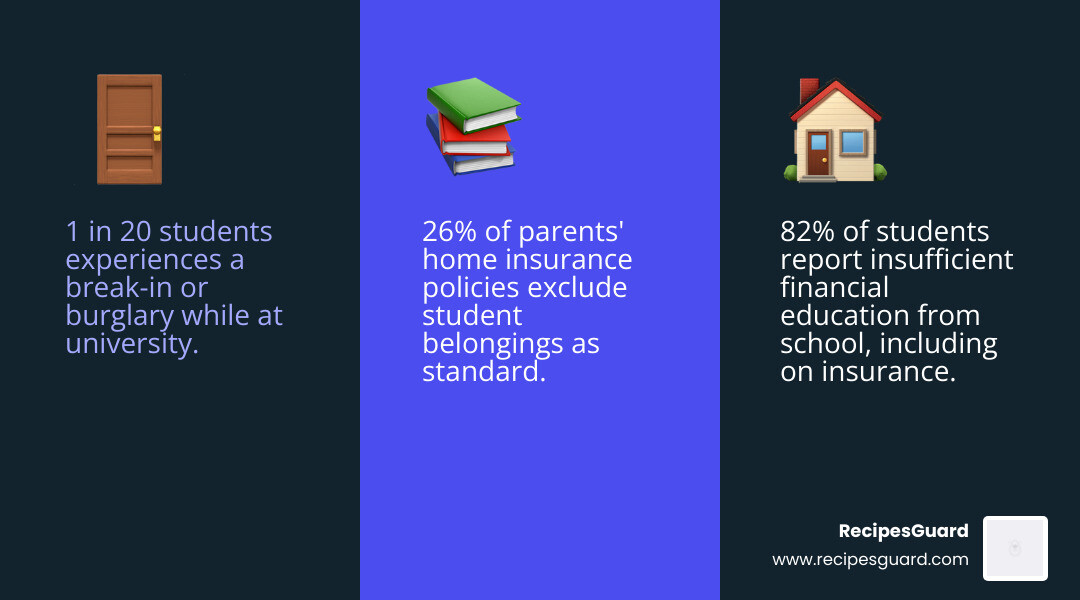
In fact, according to the Save the Student Money Survey, 82% of students say school never gave them enough financial education, including on topics like insurance. And yet, around 1 in 20 students experiences a break-in or burglary while at university.
Your laptop. Your phone. Your textbooks. All sitting in a shared house or dorm room, often with people you barely know.
That’s a lot of risk for someone on a tight budget.
What makes this harder is that many students assume they’re already covered — either by their university halls or their parents’ home insurance. But 26% of parents’ home insurance policies don’t cover student belongings as standard. And university hall block insurance, where it exists, often caps out at £2,000–£5,000 total, with single-item limits as low as £250.
If your laptop alone costs more than that, you can see the problem.
This guide breaks down the key providers, what they actually cover, and how to find the best protection for your stuff — without overpaying.
Student content insurance comparison word list:
- Australian student insurance claims
- claim injury student travel
- illness claim student travel
Why You Need a Student Content Insurance Comparison
As we head into April 2026, the cost of tech and textbooks is higher than ever. Whether you are studying in Sydney, Melbourne, or Brisbane, your room is likely a treasure trove of electronics. Performing a student content insurance comparison isn’t just about finding the lowest price; it’s about making sure your financial safety net actually catches you.
Many students mistakenly believe that their landlord’s insurance covers their personal belongings. It doesn’t. Landlord insurance (or buildings insurance) only covers the physical structure of the property—the walls, the roof, and perhaps the fixed appliances. If a pipe bursts and ruins your gaming PC, the landlord gets a new floor, but you’re left with a very expensive paperweight unless you have your own contents cover.

Standard Home Insurance vs. Student Content Insurance Comparison
You might wonder why you can’t just jump on a standard home insurance policy. The reality is that standard policies are designed for families or homeowners. They often have high deductibles (the amount you pay out of pocket) that can exceed the value of a single stolen item, like a $600 bicycle.
Student-specific policies are tailored for communal living. They understand that you might be living with three strangers and that your “home” is technically a single locked room. These policies often offer lower deductibles—sometimes as low as $25 or $100—making it actually feasible to claim for a cracked phone screen or a stolen backpack.
Furthermore, standard policies often exclude “walk-in theft” in shared accommodation. If there’s no sign of forced entry because a housemate left the front door unlocked, a standard policy might reject your claim. Specialized student insurance is much more likely to have clauses that protect you in these unique university scenarios.
Coverage for Dorms vs. Off-Campus Housing
Where you live changes what you need. If you are in university-owned halls of residence, you might have some “block insurance” included in your rent. However, this is usually very basic. It might only cover your items while they are physically inside your room with the door locked.
If you move off-campus into a private rental, the risks change. You’ll likely need “renters insurance,” which includes personal liability. This is crucial if you accidentally cause damage to the property—like starting a small kitchen fire while making late-night noodles—or if someone trips over your laptop charger and gets injured.
| Feature | University Dorms | Off-Campus Apartment |
|---|---|---|
| Primary Risk | Theft in communal areas | Burglary and liability |
| Typical Coverage | Limited to room-only | Full apartment + liability |
| Liability Included? | Rarely | Usually mandatory/recommended |
| Living Expenses? | Provided by Uni | Covered by insurance (ALE) |
What Your Policy Typically Covers (and What It Doesn’t)
When you look at a student content insurance comparison, you’ll see a list of “covered perils.” This is insurance-speak for the things that can go wrong, such as fire, flood, theft, and vandalism.
Most student policies will cover:
- Laptops and Tablets: The backbone of your studies.
- Smartphones: Including protection against theft or loss.
- Textbooks: Those pricey medical or law books add up quickly.
- Clothing and Furniture: Everything you brought from home.

However, there is a big difference between “standard” cover and “accidental damage” cover. Standard cover might pay out if your laptop is stolen during a break-in (forced entry). But if you simply knock a cup of coffee onto your keyboard, you aren’t covered unless you have an accidental damage add-on.
Calculating Your Sum Insured for a Student Content Insurance Comparison
One of the biggest mistakes students make is under-insuring their stuff. To get an accurate student content insurance comparison, you need to know the “sum insured.” This is the total value of everything you own.
Don’t just guess. Walk around your room and list every item, from your bedsheets to your headphones. Look up the current retail price to replace them new. This is called “new-for-old” cover, and it’s what we always recommend. If you have an old laptop that gets stolen, you want enough money to buy a brand-new equivalent, not the $50 it was worth on the second-hand market.
Always round your total up to the nearest $500. It’s better to pay an extra dollar a month in premiums than to be caught short during a claim.
Common Exclusions to Watch Out For
No policy covers everything. Here are the “gotchas” you need to watch for:
- Unoccupied Periods: Most policies become invalid if you leave your room empty for more than 30 consecutive days (like during summer break).
- Cosmetic Damage: A scratch on your phone case or a dent in your desk won’t be covered if the item still works.
- Wear and Tear: If your laptop battery eventually dies of old age, that’s on you.
- Unattended Items: If you leave your phone on a table in the library to go grab a coffee and it disappears, most insurers will call that negligence and refuse to pay.
How to Save Money on Your Student Premiums
We know every cent counts when you’re a student. The average cost for student contents insurance is often quoted around $58.25 annually (or roughly $4.85 per month), but there are ways to drive that down even further.
- Pay Annually: Most insurers charge interest if you pay monthly. Paying the full year upfront can save you about 10%.
- Increase Your Voluntary Excess: If you agree to pay more toward a claim (say, $250 instead of $100), your monthly premium will drop. Just make sure you actually have that $250 in a savings account!
- Security Upgrades: Installing an approved lock on your bedroom door or having a registered alarm system can lead to discounts.
- Joint Policies: If you live in a shared house and really trust your housemates, a joint policy can be cheaper. However, be careful—if one housemate makes a fraudulent claim, it could ruin the insurance record for everyone on the policy.
Navigating the Claims Process and Excess
The moment something goes wrong is when you’ll be glad you did your research. If you need to make a claim, the process usually involves two types of “excess”: Compulsory (set by the insurer) and Voluntary (set by you). You must pay both before the insurer pays out.
For example, if you claim $1,000 for a stolen laptop and your total excess is $200, the insurer will send you $800.
At RecipesGuard, we specialize in making this part easy. We provide step-by-step tutorials on how to gather the right evidence so your claim isn’t rejected. You will typically need:
- A Crime Reference Number: If your stuff was stolen, you must report it to the police within 24 hours.
- Proof of Purchase: Receipts, bank statements, or even photos of you with the item.
- Photos of Damage: If it’s a broken window or a leaked pipe, take photos immediately.
Frequently Asked Questions about Student Insurance
Does contents insurance cover items outside the home?
Standard policies usually only cover items while they are inside your room. To protect your laptop in lectures or your phone at the pub, you need to add “personal possessions cover” or “worldwide protection.” This is essential for students who are always on the move.
What are the key security requirements for a valid claim?
Most insurers require “reasonable care.” This means locking your bedroom door every time you leave, even if you’re just going to the kitchen. In shared houses, they often require specific types of locks (like five-lever mortice deadlocks) to be present on external doors.
Is my laptop covered if I spill coffee on it?
Only if you have accidental damage cover. This is usually an optional extra, but for students who live on caffeine and late-night study sessions, it is often the most valuable part of the policy. It also covers things like dropping your phone on a concrete floor or knocking over a TV.
Conclusion
As we look toward the rest of 2026, being an “unlucky” student shouldn’t have to mean being a “broke” student. A student content insurance comparison is the best way to ensure that a single moment of bad luck—a stolen bag or a burst pipe—doesn’t derail your entire semester.
At RecipesGuard, we believe that insurance shouldn’t be a mystery. Our goal is to provide you with the tools to handle the “what ifs” of university life with confidence. From understanding the fine print to our famous step-by-step claim filing tutorials, we are here to help you protect your investment in your future.
Don’t wait for something to go missing. Take ten minutes today to compare your options and get the peace of mind you deserve.
More info about student insurance claim guides

My name is Bianca, and my journey into the world of fermentation and food safety began with a costly mistake. I once lost an entire season’s harvest of chili peppers because I relied on guesswork instead of science. That failure was my turning point.
