
How to Get the Best Luggage Compensation Payouts
Why Insurance for Luggage Can Make or Break Your Trip
Insurance for luggage is a layer of financial protection that kicks in when your bags are lost, delayed, stolen, or damaged during travel — and knowing your options can mean the difference between a minor inconvenience and a major financial hit.
Here’s a quick look at the main sources of luggage compensation available to travelers:
| Coverage Source | What It Covers | Typical Limit |
|---|---|---|
| Airline liability | Lost, delayed, or damaged bags | Up to $3,800 (domestic) / ~$1,780 (international) |
| Travel insurance | Loss, delay, theft, damage | $750–$2,500+ per person |
| Premium credit cards | Lost or delayed bags | Up to $3,000 per person (e.g., Chase Sapphire Reserve) |
| Homeowners/renters insurance | Stolen or damaged valuables | Varies; deductible usually applies |
Airlines mishandle roughly 6 out of every 1,000 bags, and over 33 million bags are mishandled globally each year. Most delayed bags are reunited with their owners within a few days — but when they aren’t, the costs add up fast.
If you’re a student traveling abroad for the first time, the claims process can feel overwhelming. Which coverage applies first? What counts as proof? How long do you have to file?
This guide walks through every option — clearly and in order — so you know exactly how to get the most money back when something goes wrong with your luggage.
Discover more about insurance for luggage:
- Australia student luggage insurance
- Delayed bag compensation Australia
- Lost bag claim Australia
Understanding Your Rights and Insurance for Luggage
When we talk about insurance for luggage, it is important to distinguish between what an airline owes you by law and what a private insurance policy protects you for. In April 2026, the landscape of traveler rights continues to be governed by a mix of local Department of Transportation (DOT) regulations and international treaties.
Airline Liability and DOT Regulations
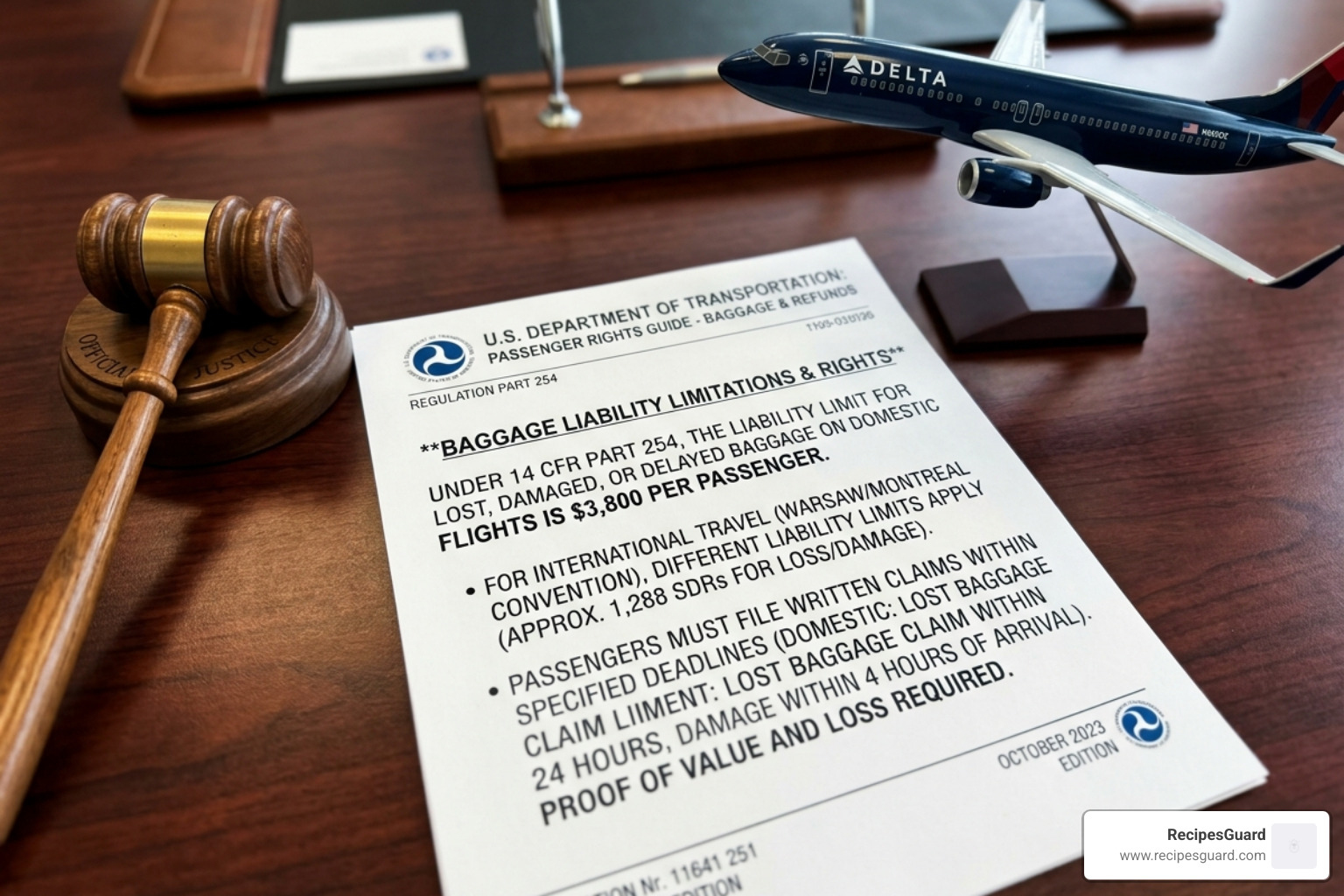
If an airline loses or damages your bag, they are legally required to compensate you. For domestic flights within Australia and many other regions, liability limits can reach up to $3,800. However, for most international journeys, the Montreal Convention sets the limit at approximately $1,780 USD (this figure is adjusted every five years to account for inflation).
It is a common misconception that airlines will simply cut you a check for the maximum amount. Airlines typically pay based on the actual cash value of your items, not what it would cost to buy them brand new today. This means they factor in depreciation. If that designer suitcase you bought three years ago is lost, the airline will only pay what a three-year-old used suitcase is worth.
The Role of Secondary Coverage
Most private insurance for luggage found in travel policies is “secondary.” This means you must first exhaust your claims with the airline (the “common carrier”). Once the airline pays their limit, your travel insurance kicks in to cover the remaining gap, up to your policy’s maximum.
Lost vs. Delayed: Different Types of Insurance for Luggage
Not all luggage issues are the same, and your insurance treats them differently:
- Baggage Delay: This covers you when your bag is eventually found but didn’t arrive with you. Most policies require a waiting period of 6 to 12 hours before you can start spending. Once that window passes, you can be reimbursed for “essential items”—think toiletries, a change of clothes, and pajamas.
- Baggage Loss/Damage: This covers bags that are officially declared lost (usually after 5–14 days), stolen, or physically broken.
To truly back up what you pack, comprehensive insurance for luggage is vital. While the airline might cover the basics, travel insurance often includes higher total limits and covers theft that happens outside the airport, such as from your hotel room or a rental car.
High-Value Items and Limits in Insurance for Luggage
If you are traveling with a $2,000 laptop and $1,500 worth of jewelry, a standard baggage policy might leave you disappointed. Most plans have a per-item limit, often capped between $250 and $500 per article.
If you’re a student carrying expensive professional equipment or high-end electronics, we recommend looking into optional baggage upgrades. These “bundles” can increase your per-item limits and provide specific protection for business or sporting equipment that standard plans often exclude.
Comparing Coverage Sources: Travel Insurance, Credit Cards, and Homeowners Policies
You might already have insurance for luggage without realizing it. Let’s look at how different sources compare to help you maximize your protection.
| Feature | Airline Liability | Travel Insurance | Premium Credit Card | Homeowners/Renters |
|---|---|---|---|---|
| Max Limit | ~$1,780 (Intl) | $750 – $3,000 | $3,000 | Varies (often high) |
| Theft Coverage | Only while in their care | Anywhere during trip | Anywhere during trip | Off-premises theft |
| Delay Benefit | Essential expenses | $100 – $250 per day | $100 per day | None |
| Primary/Secondary | Primary | Usually Secondary | Secondary | Secondary |
Premium Travel Cards
Cards like the Chase Sapphire Reserve® or American Express Platinum® offer impressive baggage protection. For example, some cards provide up to $3,000 per person for lost luggage and specific delay benefits (e.g., $100 a day for up to five days if delayed more than six hours). The catch? You usually must have paid for the entire trip with that specific card.
Homeowners and Renters Insurance
Your home insurance often includes “off-premises” coverage. If your bags are stolen from a hotel in Melbourne, your home policy might cover it. However, keep an eye on your deductible. If your deductible is $1,000 and your lost items are worth $1,200, it might not be worth filing a claim and risking a premium increase.
Step-by-Step Guide to Maximizing Your Payout
Getting the best payout requires a disciplined approach to documentation. We’ve helped thousands of students at RecipesGuard navigate this, and the secret is always in the paperwork.
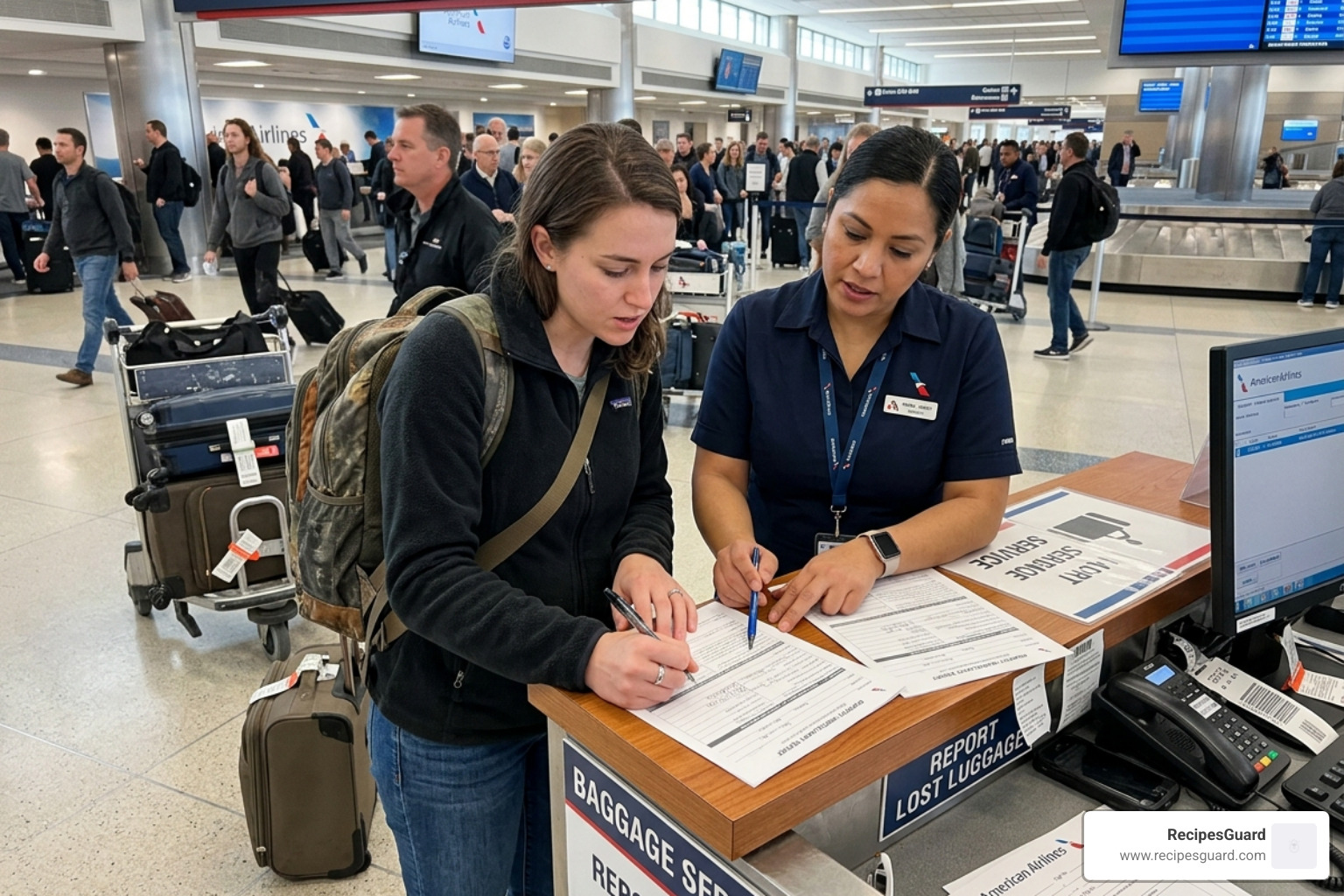
- File a PIR Immediately: Before you leave the airport, go to the airline’s baggage service desk and file a Property Irregularity Report (PIR). This is the “gold standard” of evidence. If you leave the airport without this, your chances of a successful claim drop significantly.
- Observe the 24-Hour Rule: Most airlines and insurance providers require you to report theft or loss to the authorities (police or hotel management) within 24 hours to obtain a written report.
- Keep Every Receipt: If your bag is delayed, keep every single receipt for replacement purchases. Avoid “luxury” upgrades—if you buy a $400 silk shirt when a $40 cotton one was available, the insurer may deny the claim as “unreasonable.”
- Sequential Claims: File with the airline first. Get their settlement letter. Then, take that letter to your travel insurance provider to claim the difference.
- Photo Evidence: Take a photo of the contents of your suitcase while packing. This serves as a visual inventory and proof of ownership for items you might not have original receipts for.
Common Exclusions and Pitfalls to Avoid
Even the best insurance for luggage has a “fine print” section that can trip you up.
Common Exclusions
- Cash and Currency: Almost no policy covers lost cash. Keep your money in a neck wallet or on your person.
- Perishables and Perfumes: If your expensive cologne leaks or your snacks rot, don’t expect a payout.
- High-Risk Tech: Drones and professional-grade camera gear often require a specific rider or “scheduled” coverage.
- Unattended Bags: If you leave your suitcase on a cafe chair while you go to the bathroom and it gets stolen, the insurer will likely label this as negligence and deny the claim.
Policy Pitfalls
Many travelers don’t realize that baggage delay coverage often only applies to the outward leg of your trip. If your bags are delayed on the flight home, insurers assume you already have your toiletries and spare clothes at your house, so they won’t pay for new ones.
Frequently Asked Questions about Luggage Protection
How long must a bag be missing before it is considered lost?
Airlines typically consider a bag officially “lost” after 5 to 14 days. Until that window closes, it is technically just “delayed.” Once the airline declares it lost in writing, you can transition your claim from a delay claim to a total loss claim.
Will insurance cover my laptop or expensive jewelry?
Yes, but only up to the per-item limits (usually $250–$500). If your laptop is worth $2,000, you will only receive the capped amount unless you purchased an upgrade. Furthermore, many insurers require original receipts for any item valued over $150. Without a receipt, they may cap the payout at a much lower “no-receipt” limit.
Is baggage insurance worth the extra cost?
For a $5,000 trip, comprehensive travel insurance usually costs between 4% and 8.9% of the total trip cost ($198–$447). Considering this includes medical emergencies and trip cancellation alongside luggage protection, the “peace of mind” factor is high. If you are a student traveling with your entire life in a suitcase, the protection against total loss is almost always worth the investment.
Conclusion
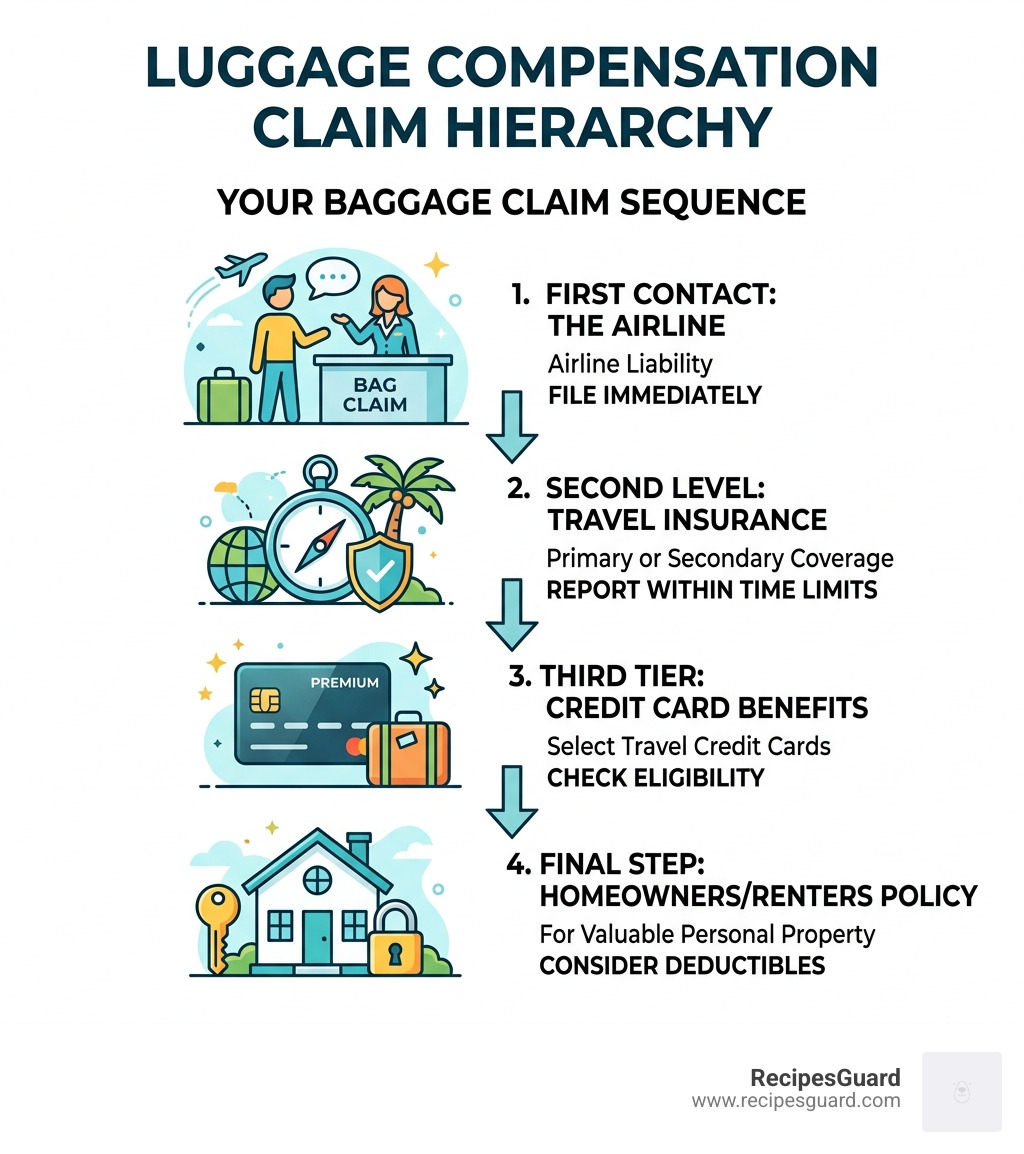
Losing your luggage doesn’t have to ruin your travel experience. By understanding the hierarchy of claims—starting with the airline, moving to your travel insurance, and utilizing credit card perks—you can recover a significant portion of your losses.
At RecipesGuard, we specialize in helping students navigate these complex waters. We know that when you’re studying abroad in Australia, your luggage isn’t just “stuff”—it’s your textbooks, your laptop, and your connection to home. Our step-by-step claim filing tutorials are designed to take the stress out of the process, acting as your advocate to ensure you get the compensation you deserve.
Don’t leave your belongings to chance. Get expert help with your travel insurance claims and travel with the confidence that we’ve got your back.
References for further reading:
- Baggage and Personal Effects Insurance
- Back up what you pack with our baggage insurance for travel
- Baggage Travel Insurance Benefits | World Nomads USA
- Luggage insurance
- Baggage & Personal Effects Insurance Coverage | Travel Insured
- Baggage Insurance | Allianz Partners
- Travel Insurance for Luggage and Personal Effects
- Travel insurance for luggage and personal effects
- Travel insurance for luggage and personal effects – NIB

My name is Bianca, and my journey into the world of fermentation and food safety began with a costly mistake. I once lost an entire season’s harvest of chili peppers because I relied on guesswork instead of science. That failure was my turning point.
