
How to Navigate Your University Health Insurance Plan
Why Understanding Medical Insurance Student Steps Can Save You From a Financial Crisis
Medical insurance student steps are something every college student needs to understand before a health emergency catches them off guard.
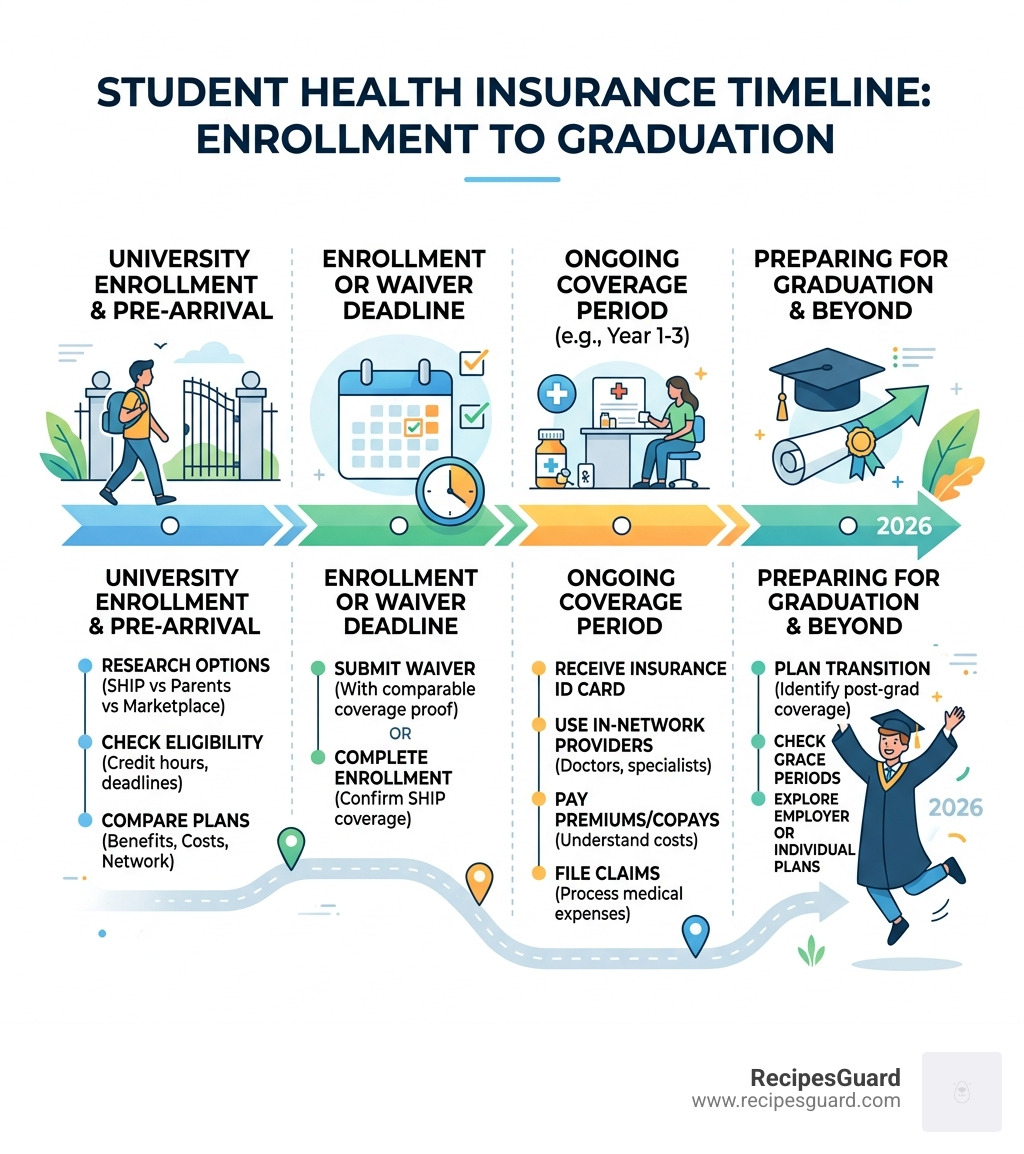
Here’s a quick overview of how to get covered:
- Check your school’s plan — See if your university offers a Student Health Insurance Plan (SHIP) and whether enrollment is automatic or opt-in.
- Review your options — Compare the school plan against staying on a parent’s plan, Marketplace coverage, or Medicaid.
- Confirm eligibility — Check deadlines, credit hour requirements, and whether you qualify for subsidies based on income.
- Enroll or waive — Either enroll in your school’s plan or submit a waiver with proof of comparable coverage by the deadline.
- Carry your insurance card — Once enrolled, keep your ID card (physical or digital) ready for every medical visit.
Getting health insurance as a student can feel overwhelming. There are deadlines, waiver forms, income rules, and visa requirements — and the stakes are high.
Consider this: a 2023 Federal Reserve report found that 23% of U.S. adults faced unexpected medical expenses, with a median cost between $1,000 and $1,999 in a single year. And around 28% of adults skipped medical treatment entirely because of cost.
For students — especially those studying abroad or navigating an unfamiliar healthcare system — the risks are even greater.
The good news? Most students have more options than they realize. Around 54% stay on a parent’s plan, while nearly 21% rely on a university-sponsored plan as their primary coverage. Others qualify for free or low-cost Medicaid, Marketplace subsidies, or employer plans.
This guide walks you through each step clearly, so you can get the right coverage without the confusion.
Simple medical insurance student steps word guide:
- medical claim student guide
- medical expenses student australia
- student claim hospital expenses
Understanding Your Medical Insurance Student Steps and Options

When we look at the landscape of student healthcare in April 2026, the variety of choices can be dizzying. However, the first of many medical insurance student steps is simply identifying which “bucket” of coverage you fall into. For the majority of domestic students, the primary source of insurance—about 54%—is a parent’s or guardian’s plan.
The Affordable Care Act (ACA) changed the game by allowing young adults to stay on their parents’ health insurance plans until they turn 26. This applies even if you are married, living away from home, or financially independent. However, there are limitations. If your parent’s plan is a localized HMO and you are moving across the country for university, you might find that your “network” doesn’t follow you, leaving you with coverage that only works for emergencies.
For those who can’t or choose not to stay on a parental plan, the university itself often steps in. Student Health Insurance Plans (SHIP) are offered by 91% of public universities and 77% of private institutions. These plans are specifically designed for the student lifestyle, often integrating directly with on-campus health centers.
Beyond these, you have the Health Insurance Marketplace and government programs like Medicaid. According to Health Care Coverage Options for College Students | HealthCare.gov, students can apply for coverage through the Marketplace and may qualify for lower costs based on their income and household size.
Evaluating University-Sponsored Health Plans (SHIP)
A university-sponsored SHIP is often the most convenient path. These plans typically offer “Gold” or “Platinum” level coverage, meaning they cover a high percentage of medical costs. In the 2023-24 academic year, the average cost for these plans was $2,924 at public schools and $3,874 at private institutions.
Why choose a SHIP? We often recommend them because they provide:
- On-campus access: Many plans waive deductibles or co-pays if you use the university’s own health center.
- Mental health support: Most SHIPs include robust mental health benefits, which is crucial given the stresses of university life.
- Essential Benefits: As noted in Health Insurance for College Students: How It Works, these plans must cover “essential health benefits,” including emergency services, hospitalizations, and prescription drugs.
Medicaid and Marketplace Medical Insurance Student Steps
If your income is limited—which, let’s be honest, is the case for most of us during our uni years—you might qualify for Medicaid or Marketplace subsidies. Medicaid is a public program that offers low-to-no-cost coverage. Eligibility is usually tied to the Federal Poverty Level (FPL). For example, in states that have expanded Medicaid, individuals earning up to 138% of the FPL may qualify.
When applying, your “household size” matters. If your parents claim you as a tax dependent, their income is usually counted. However, if you are independent, only your income (from part-time jobs or internships) counts. This distinction is one of the most vital medical insurance student steps to get right. You can find a detailed breakdown in this Step-by-Step Guide To Applying For Medicaid As A College Student.
| Feature | SHIP (University Plan) | Marketplace (ACA) | Medicaid |
|---|---|---|---|
| Average Annual Cost | $2,900 – $3,900 | Varies by subsidy | $0 – Very Low |
| Network | Broad/National | Local/Regional | State-specific |
| Ease of Enrollment | Automatic/High | Moderate | Complex |
| Best For | Out-of-state students | Students with income | Low-income/Independent |
How to Apply for and Waive Coverage
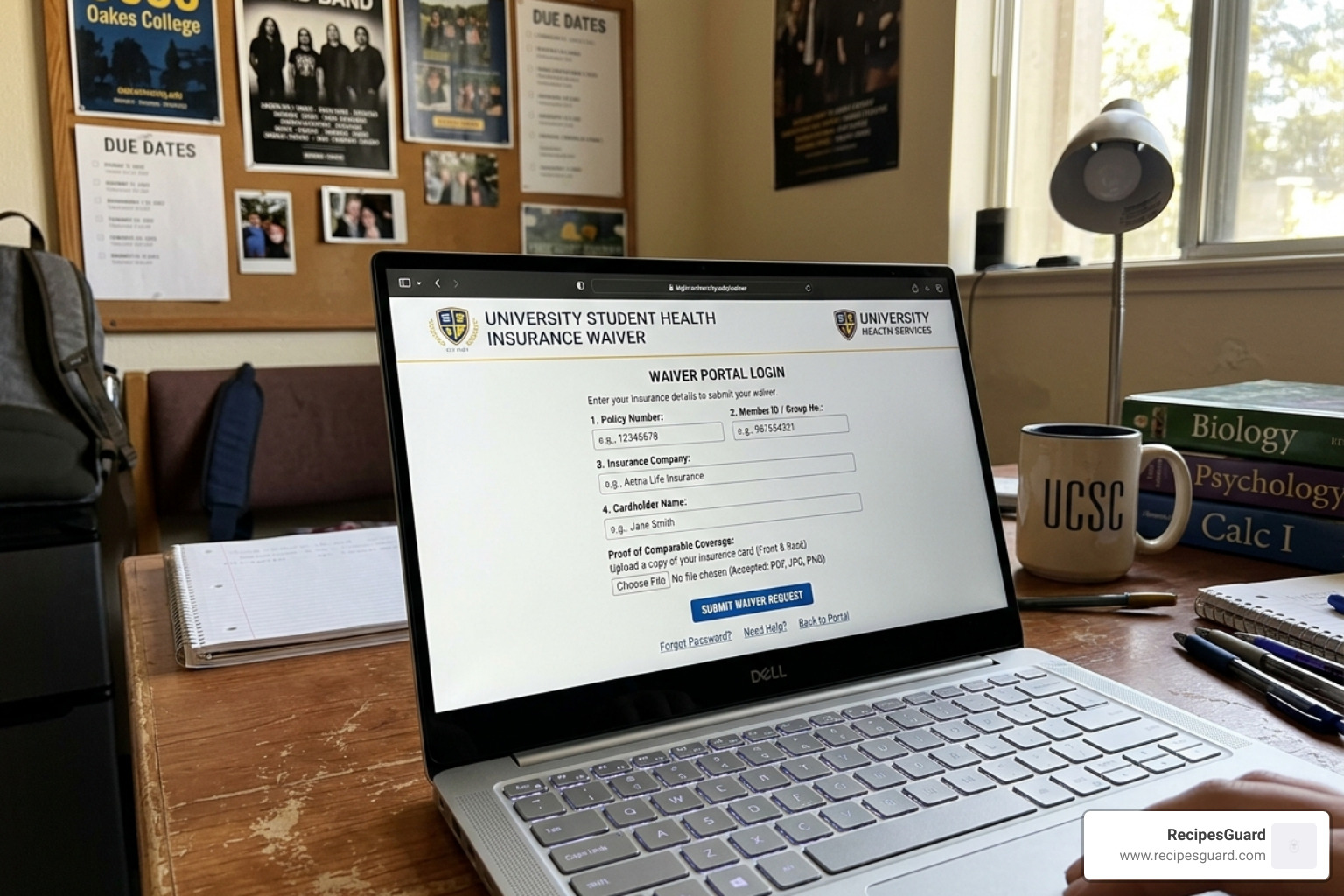
Many universities operate on a “hard waiver” system. This means they automatically bill you for the university health plan unless you proactively “waive” it by proving you have “comparable coverage.”
If you already have insurance through a parent or an employer, you must submit your policy details to the university’s insurance portal before the deadline. For example, at many institutions, the Fall semester waiver deadline falls in early September. If you miss this date, you could be stuck paying thousands of dollars for a plan you don’t actually need.
The Student Health Insurance – Massachusetts Health Connector highlights that in some regions, like Massachusetts, health insurance is actually a legal mandate for students enrolled at least 75% of full-time.
To successfully waive coverage, your existing plan usually needs to meet these benchmarks:
- Local Network: You must have access to non-emergency doctors near your campus.
- No Caps: The plan cannot have annual or lifetime limits on essential benefits.
- Emergency Care: It must provide coverage for emergency services in the university’s state.
Navigating Medical Insurance Student Steps for International Visas
For our friends coming from abroad, the medical insurance student steps are even more rigid. If you are on an F-1 or J-1 visa, your insurance isn’t just about health—it’s about staying legal. The U.S. Department of State mandates specific insurance levels for J-1 visa holders, including coverage for medical evacuation and repatriation of remains.
If you are an Australian student studying locally or heading abroad, you’ll encounter the Overseas Student Health Cover (OSHC) – Study Australia system. OSHC is a mandatory requirement for international students in Australia. It helps you pay for medical and hospital care while you’re studying “Down Under” and contributes towards most prescription medicines and ambulance cover.
Managing Your Plan and Filing Claims
Once you have your insurance, the work isn’t over. You need to know how to use it. The most important rule? Stay in-network. Insurance companies negotiate lower rates with specific doctors and hospitals. If you go “out-of-network,” you might find yourself paying 50% of the bill—or even the whole thing.
Here is a quick guide to the terms you’ll see on your Explanation of Benefits (EOB):
- Deductible: The amount you pay out-of-pocket before the insurance kicks in.
- Co-pay: A flat fee (like $20) you pay at the time of service.
- Coinsurance: Your share of the costs (e.g., you pay 20%, they pay 80%) after the deductible is met.
We at RecipesGuard specialize in helping students navigate the often-confusing world of claims. Whether you are dealing with OSHC in Australia or a SHIP in the US, the process usually involves submitting an itemized bill and a claim form. According to the Overseas Student Health Cover (OSHC) guidelines, most claims are processed within 2 to 4 weeks.
Don’t forget preventive care. Under most modern plans, things like annual check-ups, flu shots, and certain screenings are covered at 100% with no co-pay. Using these services is the best way to avoid the “unexpected medical expenses” that plague 23% of adults.
Frequently Asked Questions about Student Health Insurance
Can I stay on my parent’s plan after turning 26?
The general rule is that coverage ends when you turn 26. However, there’s a bit of a “grace period” for Marketplace plans. If you are on a parent’s Marketplace plan, you can usually stay on it until December 31st of the year you turn 26. For employer-based plans, coverage typically ends at the end of your birth month. Losing this coverage is considered a “Qualifying Life Event,” which allows you to enroll in a new plan outside of the standard Open Enrollment period.
Do student loans and grants count as income for Medicaid?
This is a common concern, but we have good news! In most cases, student loans, grants, and scholarships used for tuition and required fees do not count as taxable income. Therefore, they do not affect your eligibility for Medicaid or Marketplace subsidies. Only wages from a job (like work-study or a local cafe gig) are counted toward the income thresholds.
What constitutes “comparable coverage” for a university waiver?
To waive your school’s plan, your private insurance must be “comparable.” This usually means it must be ACA-compliant, provide local access to doctors (not just emergency rooms), and have a deductible that isn’t sky-high. Most university portals will have a checklist. If your plan is from another country (excluding some OSHC arrangements), universities generally will not accept it as comparable coverage because it’s too difficult to verify and bill.
Conclusion
Navigating medical insurance student steps might feel like a second major, but it’s one of the most important investments you’ll make in your future. From choosing between a SHIP and a parental plan to mastering the art of the waiver, being proactive is the key to avoiding medical debt.
At RecipesGuard, we are committed to helping you bridge the gap between having insurance and actually getting your money back when you need it. If you’re feeling stuck on a claim or need a hand understanding your OSHC benefits, visit us for more info about insurance claim guides.
Your Final Enrollment Checklist:
- [ ] Confirm your university’s health insurance requirement status.
- [ ] Locate your current insurance ID card (if staying on a parent’s plan).
- [ ] Check if your current doctors are “in-network” near your campus.
- [ ] Submit your waiver by the deadline if you aren’t using the school plan.
- [ ] Download your insurance provider’s app for easy access to your digital ID card.
Stay healthy, stay covered, and focus on what really matters—your education!

My name is Bianca, and my journey into the world of fermentation and food safety began with a costly mistake. I once lost an entire season’s harvest of chili peppers because I relied on guesswork instead of science. That failure was my turning point.
