
Cancel for Any Reason: Your Ticket to a Stress-Free Refund
Understanding Travel Insurance Refund for Any Reason
When we talk about a travel insurance refund for any reason, we are specifically referring to an optional benefit known as Cancel For Any Reason (CFAR). While standard travel insurance is built to protect you against catastrophic events—like a sudden medical emergency or a hurricane hitting your destination—CFAR is built for the “what-ifs” of life.
At its core, CFAR is an upgrade to a comprehensive travel insurance policy. It acts as a safety net for any situation that isn’t explicitly listed as a “covered peril” in your base plan. Whether you’ve had a falling out with your travel companion, your pet got sick, or you simply decided you’d rather stay home and study for finals, CFAR allows you to walk away from your trip with a significant portion of your money back.
Typically, this coverage provides a reimbursement of 50% to 75% of your insured, nonrefundable, prepaid costs. It is important to remember that CFAR is not a standalone policy; you cannot buy it by itself. It must be attached to a primary comprehensive plan that includes trip cancellation benefits. For more details on how these policies work, you can explore our guide on Understanding Policy Refundability and CFAR.
How CFAR Differs from Standard Coverage for a Travel Insurance Refund for Any Reason
The biggest point of confusion for many travelers, especially students booking their first major international trip, is the difference between “Trip Cancellation” and “Cancel For Any Reason.”
- Standard Trip Cancellation: This covers 100% of your nonrefundable costs, but only for specific reasons listed in the policy. These usually include things like serious illness, injury, death of a family member, or a natural disaster making your destination uninhabitable. If your reason isn’t on that list, you get $0 back.
- Cancel For Any Reason (CFAR): This covers any reason. If you want to cancel because you’re worried about political unrest that hasn’t reached the level of a “covered event,” or if you just have a change of heart, CFAR triggers. The trade-off is that it only reimburses a percentage (usually 75%) rather than the full 100%.
Think of standard insurance as protection for things you can’t control, and CFAR as protection for things you can control (or things the insurance company hasn’t thought of yet).
Eligibility Requirements for a Travel Insurance Refund for Any Reason
CFAR is a powerful tool, but it comes with strict “house rules.” If you miss even one of these requirements, you likely won’t be able to claim a travel insurance refund for any reason.
- The Purchase Window: This is the most critical rule. You must usually purchase the CFAR upgrade within 14 to 21 days of making your very first trip payment (like a flight deposit or program fee). If you wait until you’ve paid off the whole trip months later, you’ve likely missed the boat.
- Insure 100% of Trip Costs: To qualify for CFAR, most insurers require you to insure the full amount of your prepaid, nonrefundable trip expenses. You can’t just insure the flight and leave out the hotel if you want CFAR to apply to both.
- The 48-Hour Rule: You generally cannot use CFAR for a last-minute “no-show.” Most policies require you to cancel your trip and notify your travel suppliers at least 48 hours (sometimes 72 hours) before your scheduled departure.
- Geography: In Australia, availability and terms may vary based on the specific underwriter. Always check the Product Disclosure Statement (PDS) to ensure CFAR is available for your specific itinerary.
The Financials: Costs and Reimbursement Scenarios
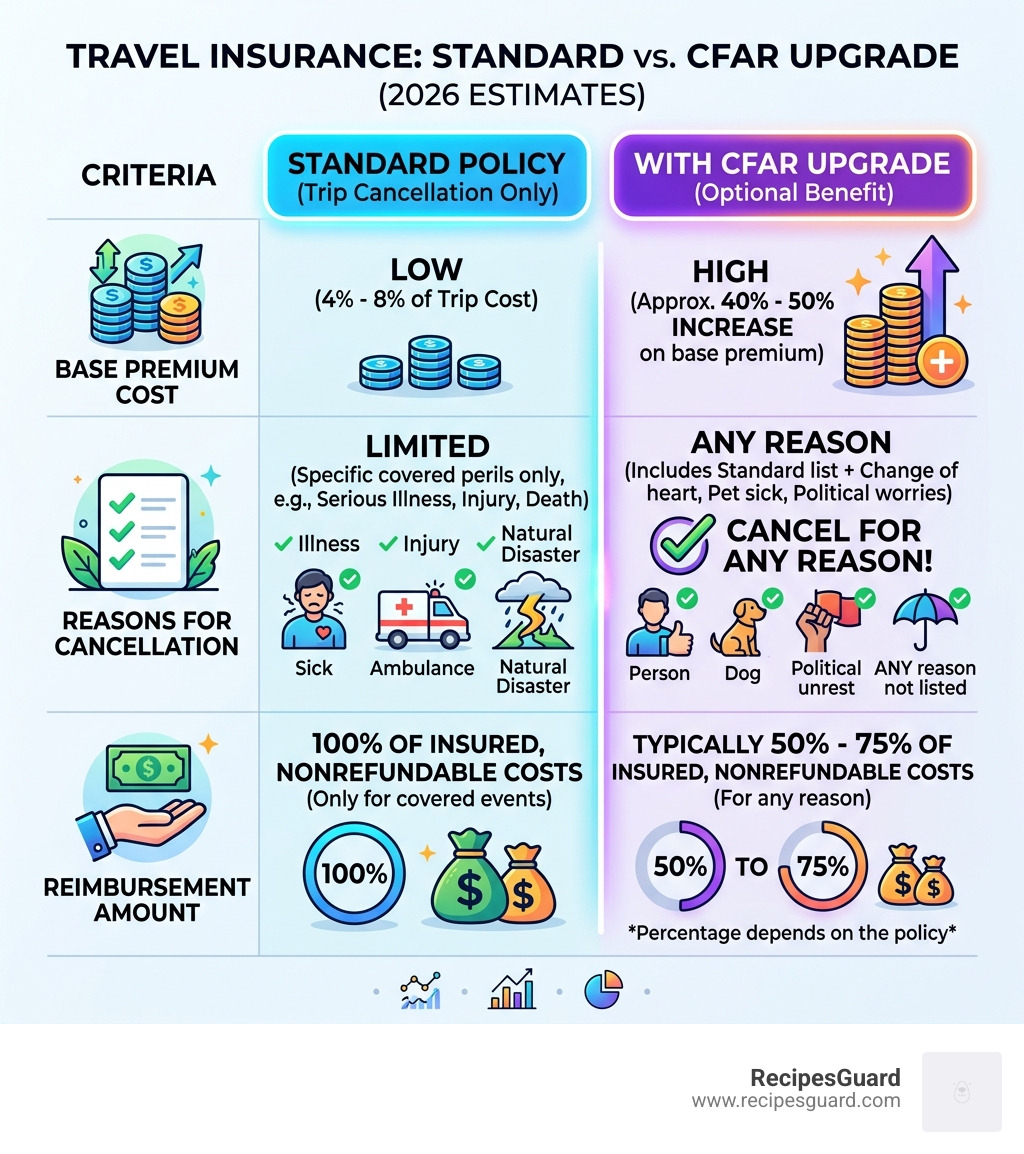
Adding a travel insurance refund for any reason to your plan isn’t cheap. In the insurance world, flexibility is a premium commodity. Based on current data for 2026, adding CFAR typically increases your base premium by 40% to 50%.
To put this into perspective, a standard comprehensive travel insurance policy usually costs between 4% and 8% of your total trip cost. When you add the CFAR upgrade, that total cost jumps to roughly 6% to 12% of your trip’s value.
Let’s look at a real-world scenario for a student on a $5,000 study abroad program:
- Base Trip Cost: $5,000
- Standard Insurance Premium: $300 (6%)
- CFAR Upgrade Cost: $150 (50% increase on premium)
- Total Insurance Cost: $450
- CFAR Reimbursement (75%): $3,750
- Net Recovery: $3,300 (Reimbursement minus the insurance cost)
While you lose $1,700 in this scenario, it is much better than losing the full $5,000. For many, this “net recovery” is the difference between being able to afford a future trip or losing their travel budget entirely. You can find more about these upgrades at Protect yourself with any reason cancellation travel insurance.
Exclusions and Limitations to Watch For
Even with “Any Reason” in the name, there are still things that won’t be refunded. We want to make sure you aren’t caught off guard during the claims process.
- Refundable Amounts: If your airline gives you a cash refund for your ticket, you cannot claim that same amount from your insurance. CFAR only covers the nonrefundable portion.
- Loyalty Points and Miles: CFAR generally does not reimburse the “value” of frequent flyer miles or credit card points used to book a trip. It may, however, cover the cash fees and taxes paid on those bookings, or the redeposit fees charged by the airline to get your points back.
- Pandemic Exclusions: While CFAR allows you to cancel because you are afraid of a pandemic, standard trip cancellation (the 100% reimbursement part) often excludes epidemics. This makes CFAR even more valuable in the post-2020 world.
- Supplier Credits: If a tour operator gives you a voucher for a future trip instead of a refund, many insurers consider that “reimbursed.” You usually cannot keep the voucher and get the CFAR cash.
Premium Refunds and the “Free Look” Period
What if you buy a travel insurance policy and then realize your credit card already provides similar coverage? Or perhaps your trip was canceled by the provider before you even had a chance to use the insurance?
This is where the “Free Look” period—also known as a cooling-off period—comes into play. Most travel insurance providers offer a window, typically 10 to 15 days from the date of purchase, during which you can cancel the insurance policy itself and receive a full refund of your premium.
This is a “Money Back Guarantee” for the insurance product. However, there are two major conditions:
- You must not have started your trip.
- You must not have filed a claim.
If you meet these criteria, you can get your insurance money back and look for a different plan that better fits your needs. To learn more about the steps to do this, check out How to Cancel Your Travel Insurance Policy.
Canceling After the Free Look Period
Once the 10-15 day window closes, getting a refund on your insurance premium becomes much harder. Most policies are considered “earned” at this point, meaning the insurer has already taken on the risk of your trip.
However, some insurers in Australia may offer a pro-rated return of the premium if the trip is canceled well in advance, though this is often at the insurer’s discretion and may involve administrative fees. If you find yourself in this position, we recommend calling your provider to discuss “policy modifications” rather than a flat cancellation. Sometimes, you can apply the premium toward a future trip instead of losing it.
Step-by-Step: Filing a Successful CFAR Claim

At RecipesGuard, we specialize in student-focused, step-by-step claim filing tutorials. Filing for a travel insurance refund for any reason is a bit different than a standard claim because you don’t have to prove why you canceled—you just have to prove that you did cancel and that you lost money.
Here is our recommended process:
- Cancel with the Suppliers First: Before you talk to the insurance company, you must cancel with your airline, hotel, or tour operator. Ask them for a written confirmation of the cancellation and a statement showing exactly how much of your money is nonrefundable.
- Gather Your “Paper Trail”: Collect every receipt, invoice, and confirmation email related to the trip.
- Notify the Insurer: Log into your insurer’s online portal. You will need to select “Cancel For Any Reason” as the claim type.
- Complete the Claim Form: Be honest and thorough. Even though the reason doesn’t matter for the payout, they will still ask for a brief explanation for their records.
- Submit Documentation: Upload all your files. The faster you provide the proof, the faster you get paid.
Documentation Needed for Approval
To ensure your claim isn’t delayed or denied, you need a complete “Evidence Kit.” We suggest keeping digital copies of:
- The Original Trip Invoice: Showing the total cost and the date of the first deposit.
- Proof of Payment: Credit card statements or bank transfers showing the money left your account.
- Cancellation Confirmation: An email or letter from the travel supplier confirming the booking is dead.
- Refund Statement: Documentation showing how much (if any) the supplier refunded you.
- Proof of Notice: Evidence that you canceled at least 48 hours before the trip began.
Is CFAR Worth It? Alternatives and Scenarios
For many students, the extra 50% premium for CFAR feels like a heavy lift. However, there are specific scenarios where we believe it is absolutely worth the investment:
- High-Value Trips: If you are spending $10,000 on a year-long study abroad program in Melbourne, losing that money would be devastating. CFAR is a small price to pay for that level of protection.
- Uncertain Schedules: If your university hasn’t finalized your exam dates or if you’re waiting on a visa that might be delayed, CFAR is the only way to book with confidence.
- Health Concerns: If you have a pre-existing condition that might flare up (but doesn’t meet the strict “Pre-existing Condition Waiver” requirements of standard plans), CFAR provides an alternative path to a refund.
Alternatives to CFAR: If CFAR is too expensive, consider these options:
- Fully Refundable Bookings: Sometimes paying a bit more for a “Flexible” airline ticket is cheaper than buying a standard ticket + CFAR insurance.
- Credit Card Insurance: Some high-end credit cards offer trip cancellation, but be warned: they almost never cover “any reason.” They function like standard insurance.
- Interruption for Any Reason (IFAR): This is the “sister” to CFAR. While CFAR covers you before you leave, IFAR covers you if you need to come home early for a reason not covered by the base plan. Some premium plans bundle these together.
Top Provider Terms for 2026
As we look at the landscape in April 2026, the market has become very competitive. Some “Ultimate” tier plans now offer up to 80% reimbursement for CFAR, though these often come with a higher price tag and a requirement that the trip must be booked at least 31 days in advance.
Others have capped the total trip cost they will cover under CFAR at $10,000 per person. If you are planning an ultra-luxury gap year, you may need to look for specialized high-limit providers.
Frequently Asked Questions about CFAR
Can I add CFAR to my policy months after booking?
In almost all cases, no. The “purchase window” (14–21 days after your first deposit) is a hard deadline. If you are already two months into your planning, you likely cannot add CFAR to a new or existing policy.
Does CFAR cover trips booked with airline miles?
Generally, CFAR will not pay you the “cash value” of your miles. It will only reimburse the cash you actually spent, such as taxes, port fees, or the fees charged by the airline to redeposit those miles into your account.
What happens if I cancel less than 48 hours before my trip?
If you cancel within the 48-hour window, the CFAR benefit usually expires. At that point, you can only receive a refund if your reason for canceling is one of the “covered perils” (like a sudden hospitalization) under your standard trip cancellation benefit.
Conclusion
Navigating travel insurance refund for any reason can feel like studying for a complex exam, but it’s one of the most important financial lessons a traveler can learn. By understanding the strict timelines, the 75% reimbursement typical of the industry, and the importance of the 48-hour cancellation rule, you can protect your hard-earned travel budget.
At RecipesGuard, we are dedicated to making this process simple for students and young travelers. Whether you are heading across the outback or across the ocean, our step-by-step tutorials are designed to help you file claims with confidence and get your money back where it belongs—in your pocket.
For more guides on protecting your journey and mastering the claims process, visit RecipesGuard. Safe travels!

My name is Bianca, and my journey into the world of fermentation and food safety began with a costly mistake. I once lost an entire season’s harvest of chili peppers because I relied on guesswork instead of science. That failure was my turning point.
