
How Trip Cancellation Interruption Saves Your Vacation
When Plans Fall Apart: What Trip Cancellation Interruption Actually Covers
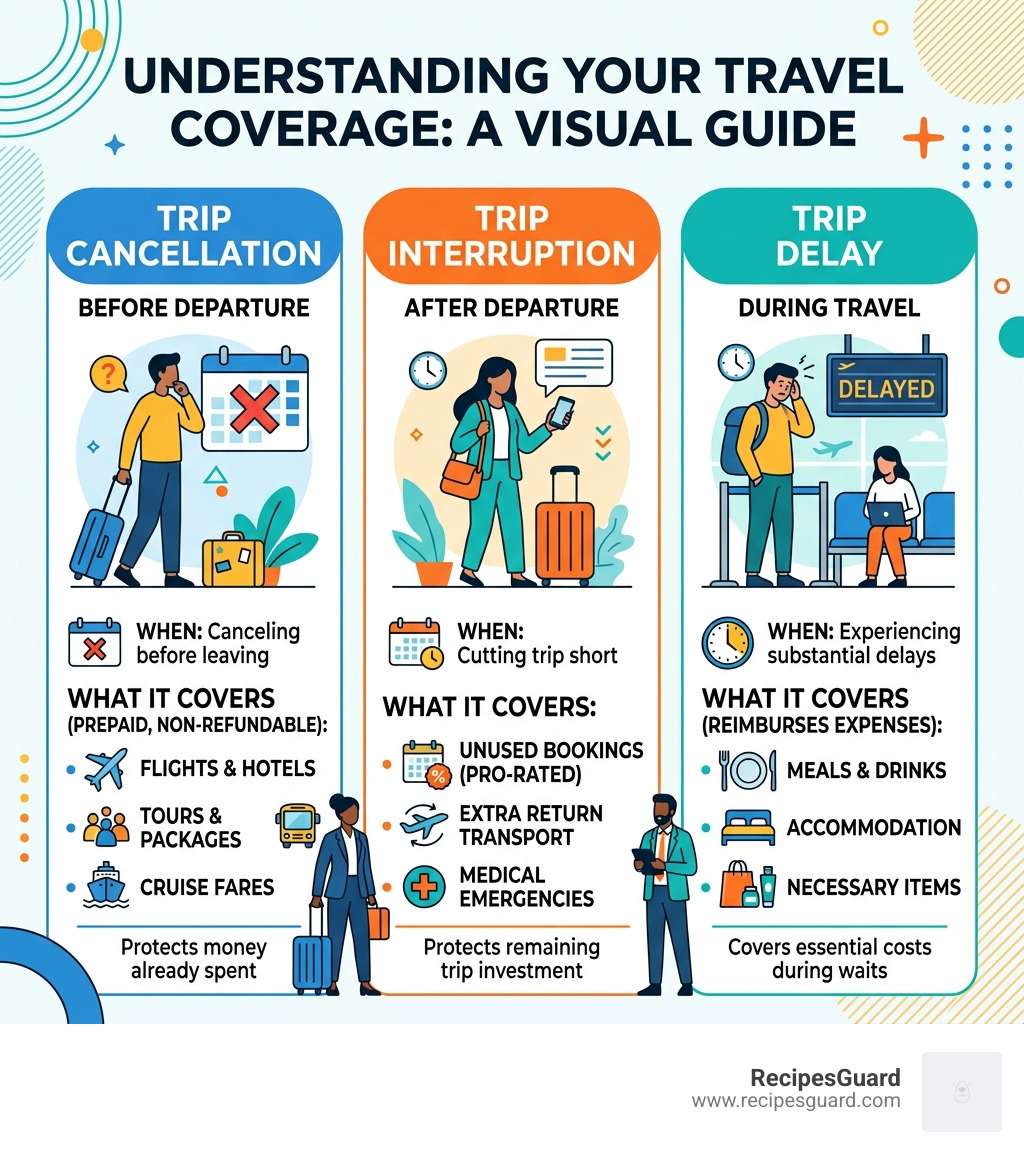
Trip cancellation interruption is a type of travel insurance protection that reimburses your prepaid, non-refundable travel costs when something unexpected forces you to cancel before you leave — or cut your trip short after it has already started.
Here’s the quick breakdown:
| Coverage Type | When It Applies | What It Covers |
|---|---|---|
| Trip Cancellation | Before departure | Non-refundable flights, hotels, tours |
| Trip Interruption | After departure | Unused bookings + extra return transport |
| Trip Delay | During travel | Meals, accommodation during a delay |
These protections matter most when you have real money on the line — think prepaid flights, hotel deposits, cruise fares, and tour packages that won’t be refunded if something goes wrong.
For international students studying abroad, the stakes are even higher. A medical emergency, a family crisis back home, or a natural disaster can unravel months of planning in hours. And without coverage, you’re absorbing every dollar of that loss yourself.
The uncomfortable truth: most airlines only compensate for delays they cause. If a storm cancels your flight, a family member is hospitalized, or you fall seriously ill, you’re often on your own — unless you have trip cancellation interruption coverage in place.
A combined plan typically costs 4% to 10% of your total prepaid, non-refundable trip cost. For a $5,000 trip, that’s roughly $250–$500 — a small price compared to losing everything.
This guide walks you through exactly how these coverages work, what they pay for, what they don’t, and how to actually file a claim successfully.
Key terms for trip cancellation interruption:
- cancel for any reason plan
- holiday insurance cancellation due to illness
- student travel claim process
Understanding Trip Cancellation Interruption Coverage
When we talk about trip cancellation interruption, we are looking at two distinct phases of your journey. Imagine you’ve booked a dream month-long internship in Tokyo for July 2026. You’ve paid for your flights, a dorm deposit, and a language intensive course.
Trip Cancellation is your “pre-game” protector. It kicks in from the moment you buy the policy until the second you step out your door to head to the airport. If you break your leg two days before your flight, trip cancellation covers those non-refundable deposits.
Trip Interruption is your “mid-game” protector. It starts the moment your journey begins. If you’re two weeks into your Tokyo stay and receive news that a parent has been hospitalized back in Australia, trip interruption helps cover the cost of a last-minute flight home and reimburses you for the two weeks of housing and classes you’ve already paid for but won’t use.
Defining Trip Cancellation Interruption for Students
For the student community, travel isn’t just a holiday; it’s an investment in a future career. We know that academic emergencies are real. Perhaps your university extends the semester unexpectedly, or a required exam is rescheduled, clashing with your departure. Standard policies might not always cover “I have to study,” but specialized student-focused riders often do.
Budget-conscious planning is the hallmark of student life. Losing $2,000 on a canceled study abroad program isn’t just a bummer; it can mean the difference between graduating on time or taking an extra semester because you can’t afford to re-book. We also see many students concerned about financial aid. If your trip is funded by a grant that requires completion of the program, an interruption could lead to a “repayment” nightmare. Trip cancellation interruption acts as a safety net for these specific academic risks.
Reimbursable Expenses Under Trip Cancellation Interruption
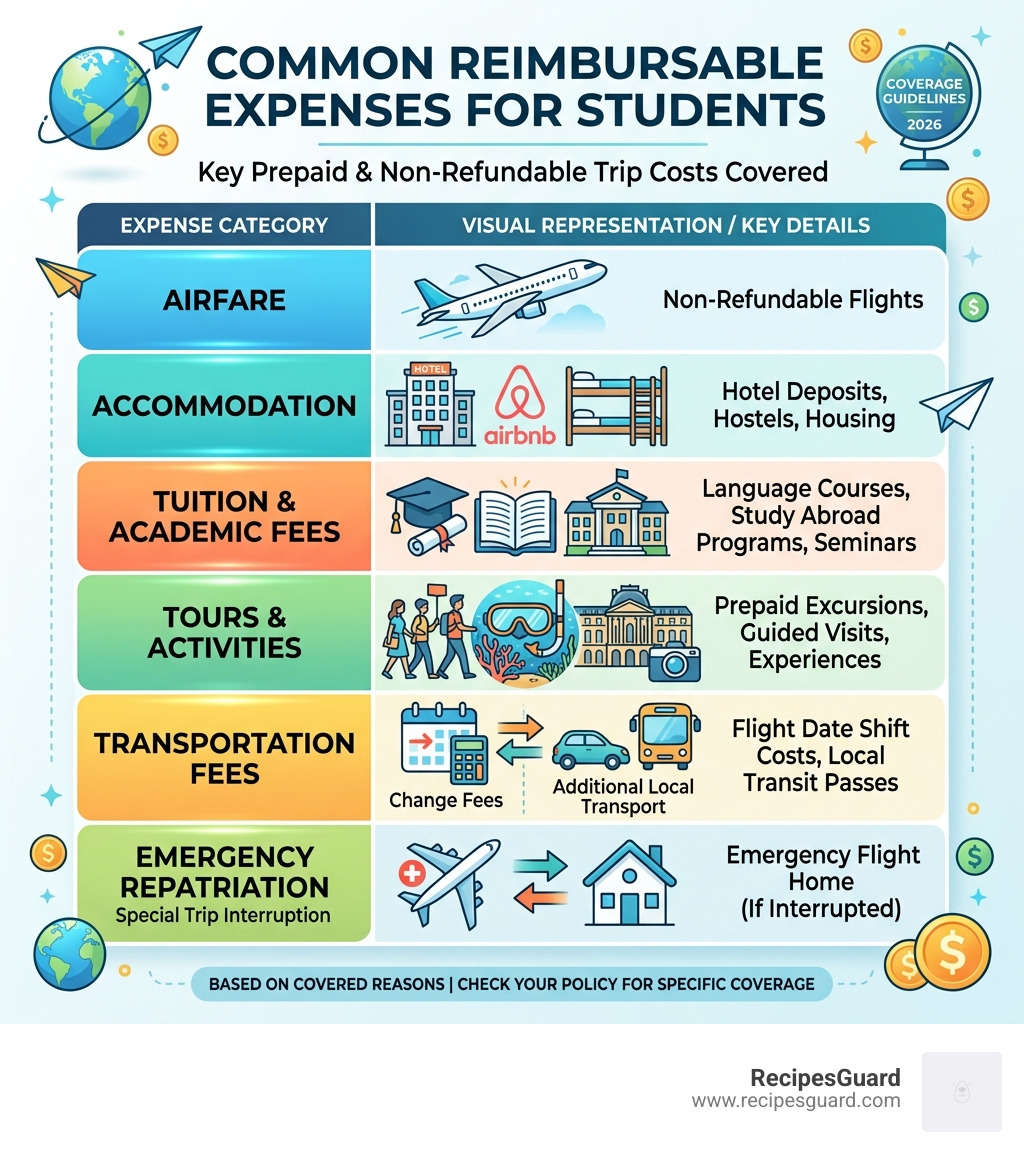
What exactly can you get your money back for? Generally, if it’s prepaid and non-refundable, it’s on the list.
- Airfare: The big one. Even “non-refundable” tickets can be reimbursed under a covered claim.
- Accommodation: Hotel deposits, Airbnb bookings, or student hostel fees.
- Tours and Activities: That prepaid snorkeling trip in the Great Barrier Reef or a guided tour of the Louvre.
- Change Fees: If you don’t cancel entirely but need to shift your dates due to a covered reason, insurance often covers the airline’s hefty change fees.
- Additional Transportation: This is specific to trip interruption. If you need to catch up to a tour that moved on without you because of a delay, or if you need an emergency flight home, the “extra” cost (often up to 150% of the original trip cost) is covered.
Common Covered Reasons and Key Exclusions
Insurance companies aren’t in the business of covering “I just don’t feel like going anymore” (unless you have a specific upgrade we’ll discuss later). To get a payout, the reason for the cancellation or interruption must be “covered” and “unforeseen.”
Common Covered Reasons include:
- Sudden Illness or Injury: A doctor must certify that you (or your traveling companion) are unfit to travel.
- Death of a Family Member: This usually extends to immediate family, even if they weren’t traveling with you.
- Natural Disasters: If a hurricane renders your destination uninhabitable or a bushfire closes the area.
- Jury Duty or Subpoenas: If the Australian legal system calls, you usually have to answer.
- Military Reassignment: For those serving, unexpected deployment or leave revocation is a standard covered reason.
- Carrier Stoppage: If the airline or train line goes on strike or has a complete mechanical breakdown for a prolonged period (usually 12–24 hours).
Exclusions in Trip Cancellation Interruption Policies
It is vital to read the fine print because exclusions can be tricky. We’ve seen many claims denied because the traveler didn’t realize their situation was a “known event.”
- Pre-existing Conditions: If you’ve been treated for a heart condition in the 60–180 days before buying insurance, any flare-up that causes a cancellation might be excluded. However, many policies offer a “Pre-existing Condition Waiver” if you buy the insurance within 14–21 days of your first trip payment.
- Fear of Travel: If there is a protest in a city or a news report about a virus, but no official government “Do Not Travel” warning is issued, “fear” is not a covered reason.
- Foreseeable Events: You can’t buy insurance for a hurricane that has already been named and is heading toward your destination.
- Mental Health: Unless specifically stated, some basic policies exclude cancellations due to mental health struggles unless they result in hospitalization.
- Professional Sports and High-Risk Activities: If you’re traveling to compete in a professional rugby match or go BASE jumping, standard trip cancellation interruption won’t cover injuries sustained during those activities.
The Role of Cancel for Any Reason (CFAR) Upgrades
If you want the ultimate peace of mind, you look for “Cancel for Any Reason” (CFAR) coverage. This is exactly what it sounds like. Want to cancel because your cat looks sad? CFAR has you covered.
However, it comes with caveats:
- Higher Premiums: Expect to pay 40% to 50% more for the policy.
- Partial Reimbursement: CFAR typically only pays back 50% to 75% of your non-refundable costs.
- Time-Sensitive: You usually must purchase this within a very short window (often 14–21 days) of your initial trip deposit.
- The 48-Hour Rule: You must cancel at least 48 hours before your scheduled departure.

Credit Card Benefits vs. Standalone Policies
Many of us carry premium credit cards or high-tier bank cards. These often come with “free” travel insurance. But is it enough?
Primary vs. Secondary Trip Cancellation Interruption
The biggest distinction is between Primary and Secondary coverage.
Secondary coverage (common with credit cards) means you must first exhaust all other avenues for a refund. You must ask the airline for a voucher, ask the hotel for a refund, and check if any other insurance applies. Only then will the credit card company step in to cover the “leftovers.” This can make the claim process much longer and more tedious.
Primary coverage (common with standalone policies from specialized travel insurance providers) means you file with them first. They pay you out directly and then they deal with the airlines or other providers behind the scenes.
Other Credit Card Limitations:
- Coverage Limits: Cards often cap payouts at $5,000 to $10,000 per trip. If you’re on a $20,000 luxury graduation tour, you’re under-insured.
- Eligibility: You must usually pay for the entire trip on that specific card. If you used points for the flight and the card for the hotel, you might have zero coverage.
- Age Restrictions: Many credit card policies have strict age limits, often reducing benefits or cutting them off entirely once you hit 65 or 70.
Additional Protections Often Included
While we are focusing on trip cancellation interruption, these policies usually come as a bundle with other “goodies”:
- Baggage Delay: Reimburses you for essentials (toiletries, a change of clothes) if your bag is late by 6–12 hours.
- Lost Luggage: Pays the depreciated value of your suitcase and its contents if the airline loses it forever.
- Emergency Evacuation: This is the big-ticket item. If you need a medevac helicopter off a mountain in New Zealand, this can save you $50,000+.
- Travel Accident Insurance: Often called “Accidental Death and Dismemberment,” it provides a payout to your beneficiaries if the worst happens while on a common carrier (plane, train, bus).
How to File a Successful Insurance Claim
This is where we at RecipesGuard specialize. Filing a claim isn’t just about filling out a form; it’s about building a case.
The 72-Hour Rule: Most policies require you to notify your travel suppliers (airline, hotel) and the insurance company within 72 hours of the event occurring. If you wait a week to tell them you’re canceling, they may reduce your payout because you didn’t give the travel provider a chance to resell your spot.
Step-by-Step Claim Filing:
- Documentation is King: Keep every receipt. If the airline cancels your flight, get a “Flight Cancellation Letter” from the gate agent or via email.
- The Physician’s Statement: If you’re canceling for medical reasons, the insurance company will provide a specific form for your doctor to sign. It must state that you are medically unfit to travel on the dates of the trip.
- Proof of Loss: You need to show that you actually paid for the trip and that the provider refused to refund you. This usually requires a credit card statement and an email from the hotel/airline confirming their “no refund” policy.
- Notification of Suppliers: Show proof that you canceled your bookings as soon as the emergency happened.

Frequently Asked Questions about Trip Insurance
What is the difference between trip delay and trip interruption?
Think of trip delay as a “pause” button and trip interruption as a “stop” or “rewind” button. Trip delay covers you if you’re stuck at the airport for 12 hours and need a meal and a hotel for the night. You’re still going on the trip; it’s just starting late. Trip interruption applies when you have to abandon the trip entirely or miss a significant portion (usually 50% or more) and need to head home or skip ahead to a later part of the itinerary.
When should I buy insurance to cover pre-existing conditions?
Timing is everything. To get the “Pre-existing Condition Waiver,” you generally need to buy the insurance within 14 to 21 days of your very first trip payment (like that initial flight booking or tour deposit). You also must be medically stable and fit to travel at the time you buy the policy. You can’t buy insurance while you’re already in the hospital and expect it to cover the trip you’re missing.
Do credit card travel benefits have age limits?
Yes, and they are surprisingly low. Many Australian credit card insurance policies begin to limit coverage once the cardholder reaches 65 or 70 years of age. If you are a mature-age student or traveling with grandparents, always check the “Guide to Benefits” for your specific card. Standalone policies are usually much more flexible with age, though premiums do increase as you get older.
Conclusion
Navigating trip cancellation interruption can feel like studying for a final exam you didn’t prepare for. But it doesn’t have to be. Whether you are a student heading off on a gap year or an international scholar moving to Australia for a degree, protecting your travel investment is a non-negotiable part of modern travel.
At RecipesGuard, we believe that no student should lose their hard-earned savings to a flight cancellation or a medical hiccup. We provide the step-by-step tutorials and claim-filing guides you need to ensure that if the unexpected happens, your bank account doesn’t take the hit.
Don’t leave your future to chance. Protect your student travels by staying informed and choosing the right coverage for your unique journey. Safe travels!

My name is Bianca, and my journey into the world of fermentation and food safety began with a costly mistake. I once lost an entire season’s harvest of chili peppers because I relied on guesswork instead of science. That failure was my turning point.
