The Complete Guide to Dehydrating Strawberries
Why Dehydrating Strawberries in a Dehydrator Is One of the Best Ways to Preserve Them
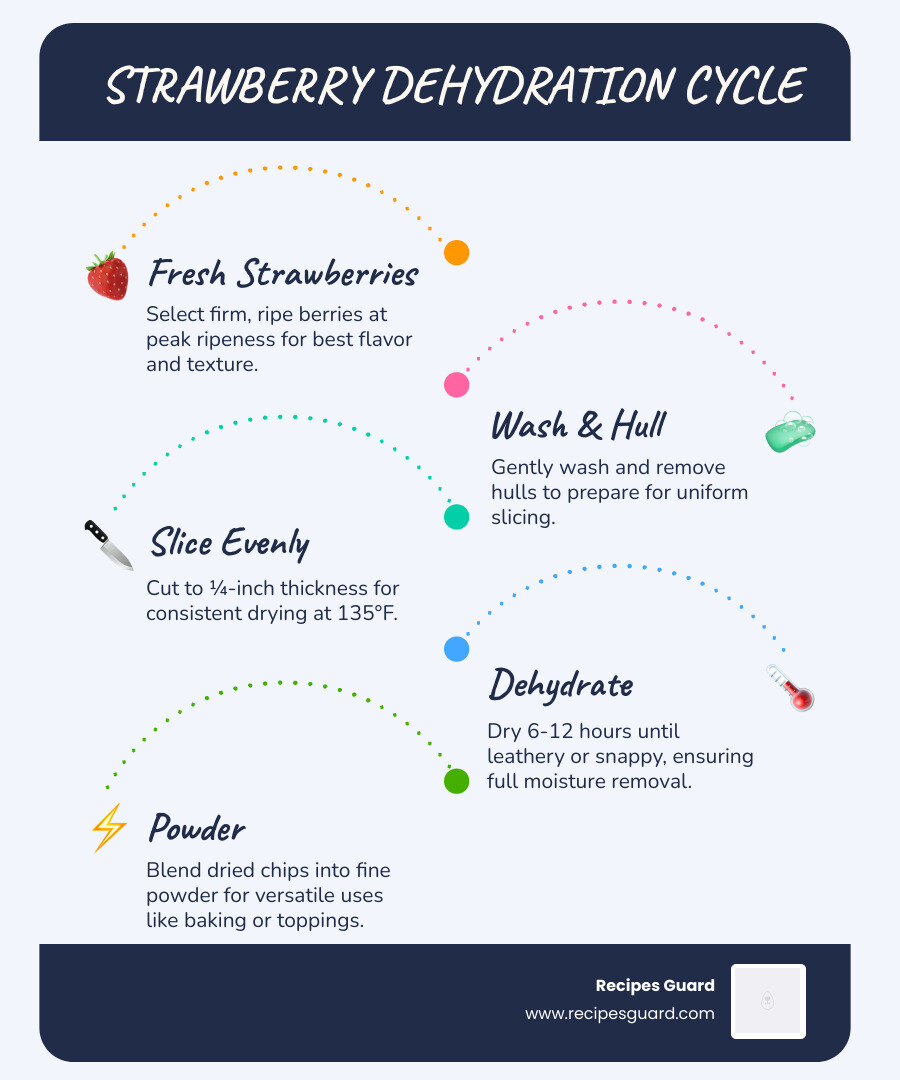
Dehydrating strawberries in a dehydrator is simple: wash, hull, and slice fresh strawberries to ¼-inch thick, arrange them in a single layer on dehydrator trays, and dry at 135°F (57°C) for 6–12 hours until leathery or snappy dry.
Quick steps at a glance:
- Wash and hull strawberries
- Slice to ¼-inch thickness
- Arrange on dehydrator trays with space between slices
- Set dehydrator to 135°F (57°C)
- Dry for 6–12 hours, checking for a leathery texture
- Cool completely, then condition in jars before storing
Strawberries are one of the easiest fruits to dehydrate. There’s no blanching required, no pre-treatment needed, and once they’re on the trays, the process is almost entirely hands-off.
The payoff is real. Fresh strawberries go bad within days. Properly dehydrated and stored strawberries can last up to a year. And the flavor? Dehydration concentrates the natural sweetness, making them taste more intense than fresh.
Three pounds of fresh strawberries fills about five dehydrator trays and yields roughly three pint jars of dried fruit — a significant return for minimal effort.
Whether you want a healthy grab-and-go snack, a pantry staple for baking, or a base for homemade strawberry powder, the dehydrator method gives you consistent, reliable results every time.
Selecting and Preparing Fruit for Dehydrating Strawberries in Dehydrator
As we head into the peak of the 2026 strawberry season, the first step to success is choosing the right fruit. At Recipes Guard, we always emphasize that the quality of your finished product is only as good as the produce you start with.
For dehydrating strawberries in dehydrator units, you want berries that are at their prime—shiny, firm, and red all the way to the top. Avoid berries with mushy spots or white/green shoulders; they won’t have the sugar content needed for that “better than candy” flavor.
The “Dirty Dozen” and Proper Washing
Strawberries consistently top the “Dirty Dozen” list for pesticide residues. Unless you are picking them from your own organic garden, we recommend a thorough wash.
A simple water wash is okay, but a vinegar soak is better for removing residues and lingering mold spores. Use a solution of two parts water to one part white vinegar. Let them sit for a few minutes, then rinse under cold water.

Hulling and Slicing Techniques
Once washed, you need to remove the green leafy tops (the hulls). You can use a paring knife to cut a small circle around the stem, or use the “straw method”: push a reusable straw through the bottom tip of the strawberry all the way up until the hull pops off.
Pro Tip: Don’t throw those tops away! We love using them to make strawberry top vinegar. Simply submerge the tops in a jar of white balsamic or rice wine vinegar for a week for a fruity salad dressing base.
Best Practices for Slicing and Pre-Treatment
Uniformity is the golden rule of dehydration. If one slice is paper-thin and the next is a chunky wedge, they will dry at different rates, leading to a storage nightmare.
- Thickness: Aim for 1/4-inch (6 mm) slices.
- Tools: For lightning-fast prep, use an egg slicer. It creates perfectly uniform slices in one motion.
- Patting Dry: This is a step many beginners skip. Use a clean kitchen towel or a salad spinner to remove as much surface moisture as possible. This can shave an hour or more off your total drying time.
- Pre-treatment: Unlike apples or pears, strawberries do not require lemon juice or citric acid to maintain their color. They naturally stay a beautiful, vibrant red. We also advise against water-blanching, as it leaches out the water-soluble Vitamin C we want to keep.
The Step-by-Step Process for Dehydrating Strawberries in Dehydrator
Now that your fruit is prepped, it’s time to let the machine do the work. Dehydrating strawberries in dehydrator trays is a low-and-slow process that rewards patience.
Setting Up the Trays
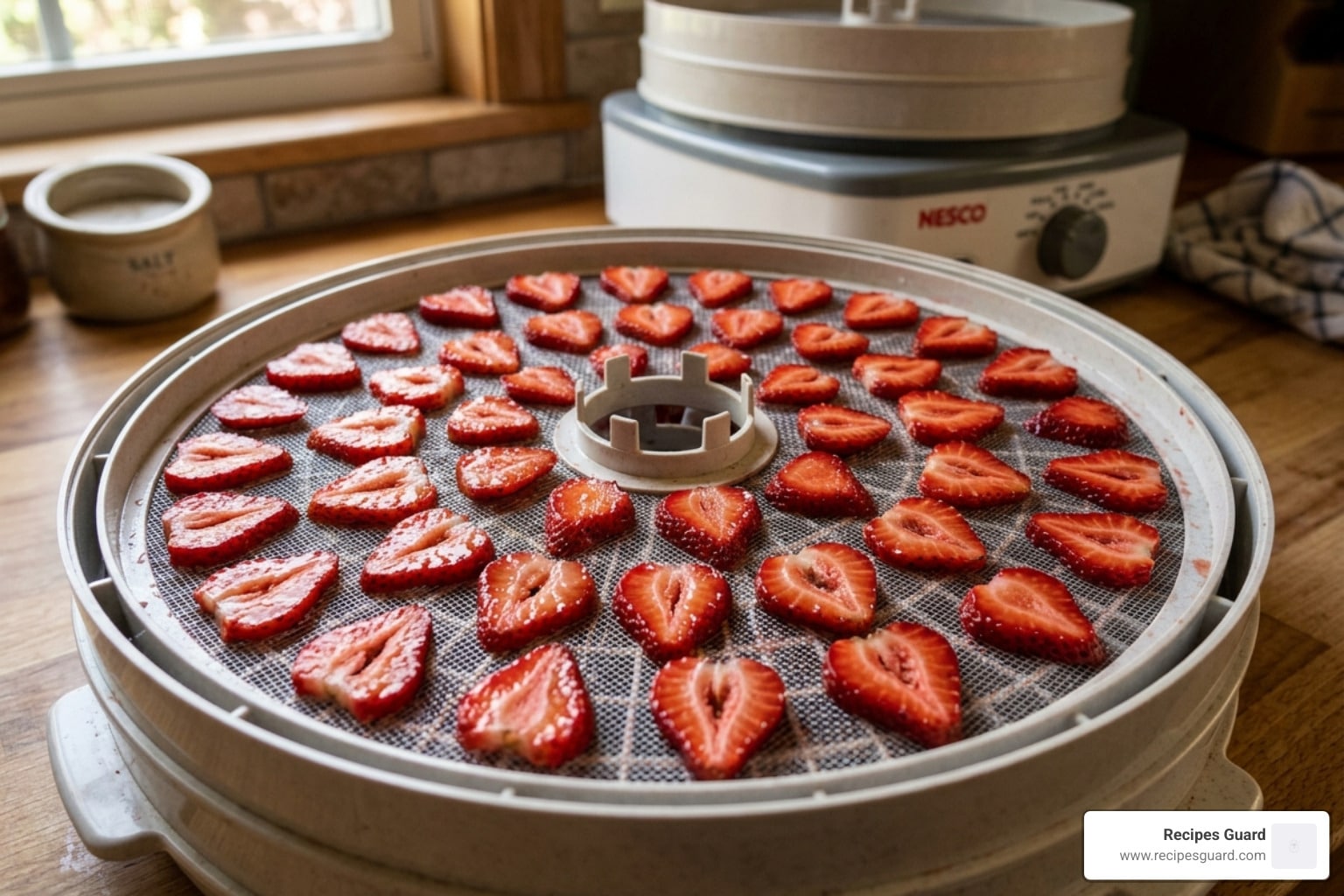
Arrange your slices in a single layer. Ensure there is at least 1/4-inch of space between each piece. Air circulation is what actually removes the moisture, so overcrowding the trays will result in “wet spots” and uneven drying. If you have small bits or ends, use a fine mesh tray insert so they don’t fall through the slats as they shrink.
Temperature and Time
The ideal temperature for fruit is 135°F (57°C). Some modern machines have a specific “fruit” setting that defaults to this.
- Time: Slices typically take 6 to 12 hours.
- Factors: Humidity in your house, the water content of the specific berry variety, and how crowded your trays are will all affect the duration.
Horizontal vs. Vertical Airflow
If your dehydrator has a fan at the back (horizontal airflow, like an Excalibur), you likely won’t need to rotate trays. If the fan is at the bottom or top (vertical airflow, like many Nesco models), we recommend rotating the trays every 3-4 hours to ensure the slices closest to the heat source don’t get “case hardened” (where the outside dries too fast, trapping moisture inside).
| Method | Temperature | Time | Best For |
|---|---|---|---|
| Dehydrator | 135°F (57°C) | 6-12 Hours | Long-term storage & powder |
| Oven | 170°F (Lowest) | 3-6 Hours | Immediate snacking |
| Air Fryer | 135°F | 1-2 Hours | Small batches |
Yield Statistics
It’s helpful to know what you’ll end up with. In our experience:
- 3 lbs of fresh strawberries yields approximately 3 pint jars of dried fruit.
- 575 grams (about 1.2 lbs) of sliced berries will shrink down to just 40 grams of dried chips.
How to Tell When Dehydrated Strawberries are Fully Dry
Testing for doneness is where most people go wrong. Never test fruit while it is still hot. Heat makes sugar pliable.
Remove a few slices and let them cool for 5–10 minutes. Once cool:
- Leathery/Pliable: They should feel like soft leather. You can bend them, and they shouldn’t stick to your fingers, but they shouldn’t snap like a cracker yet.
- Snappy/Crisp: If you want to make strawberry powder, they must be “snappy dry.” They should break cleanly when folded.
- Moisture Check: Squeeze a slice hard. If any beads of moisture appear, they need more time. As noted in the guide Dehydrating Strawberries; Better than candy!, these are one of the most foolproof fruits to dry, so when in doubt, give them another hour.
Dehydrating Frozen Strawberries and Whole Berries
Can you dehydrate frozen berries? Absolutely! This is a great way to clear out the freezer in April 2026 to make room for the new harvest.
- Thaw slightly: Let them sit until you can slice them (if they are whole).
- Juice: Save any liquid that leaches out—it’s pure strawberry gold for smoothies!
- Time: Frozen berries take longer (often 12–18 hours) because the freezing process breaks down cell walls, releasing more internal moisture.
If drying whole berries, be prepared for a long haul. Small whole berries can take 24 to 36 hours. We recommend at least cutting them in half and placing them skin-side down on the trays to prevent them from sticking and to allow moisture to escape from the cut surface.
Conditioning and Storing Your Dried Harvest
You’ve finished dehydrating strawberries in dehydrator trays, but you aren’t ready for the pantry yet. This is the most critical stage for food safety.
The Importance of Conditioning
Conditioning is the process of ensuring moisture levels are equalized across the whole batch. Even with uniform slicing, some pieces will be slightly drier than others.
- Place cooled berries in a clear glass jar, filling it about 2/3 full.
- Shake the jar once a day for 5 to 7 days.
- Watch for condensation: If you see any fogging or water droplets on the glass, the berries are not dry enough. Put them back in the dehydrator immediately for another 2 hours.
- If you see mold, throw the whole jar out. This is why we condition!
This process is a staple of How to Make Dehydrated Strawberries in a Dehydrator because it prevents the heartbreak of finding a moldy jar a month later.
Maximizing Shelf Life
Once conditioned, move your strawberries to their final storage containers.
- Airtight Containers: Mason jars with tight-fitting lids are the gold standard.
- Vacuum Sealing: For storage longer than 6 months, vacuum sealing is highly effective. It removes the oxygen that causes fats to go rancid and colors to fade.
- Oxygen Absorbers: Dropping a small 100cc oxygen absorber into your jar can extend the shelf life significantly.
- Desiccant Packs: If you live in a humid environment or plan on opening the jar frequently to snack, a silica gel desiccant pack will help absorb any moisture that enters the jar.
Storage Location: Keep your jars in a cool, dark, and dry place. Light is the enemy of nutrition and color. Properly stored, these will stay delicious for 6 to 12 months.
Creative Uses and Making Strawberry Powder
One of our favorite things to do with a surplus of dried berries is to turn them into “pink gold”—strawberry powder.
How to Make Strawberry Powder
To make powder, your strawberries must be snappy dry. If they are leathery, they will just turn into a sticky paste in your blender.
- Place snappy-dry slices into a high-speed blender or clean coffee grinder.
- Pulse technique: Blend in short bursts. If you run the motor too long, the heat can melt the natural sugars and cause clumping.
- Yield: 40 grams of dried strawberries (about 1.25 cups of slices) will yield roughly 6 tablespoons of powder.
- Storage: Store powder with a desiccant pack. It is extremely prone to clumping because it loves to absorb moisture from the air.
Culinary Applications
There are so many ways to use the fruits of your labor:
- Buttercream Frosting: Mix 2 tablespoons of powder into your favorite frosting. It provides a natural pink color and a punch of real fruit flavor without thinning out the icing like a puree would.
- Oatmeal Mix: Combine dried slices with oats, cinnamon, and nuts for “instant” gourmet breakfast packets.
- Trail Mix: Mix with dark chocolate chips and almonds.
- Strawberry Tortillas: Rehydrate 1/3 cup of dried berries in 1/4 cup of water, mash them, and spread on a tortilla with peanut butter.
- Cocktail Garnish: A single dehydrated strawberry slice floating in a glass of champagne looks stunning and slowly rehydrates, flavoring the drink.
- Fermentation: At Recipes Guard, we love adding a handful of dehydrated strawberries to the second ferment of kombucha. The concentrated sugars provide excellent carbonation and a deep berry hue.
For more ideas on how to incorporate preserved foods into your daily meals, check out our More info about preserving basics page.
Frequently Asked Questions about Strawberry Dehydration
What are the nutritional benefits of dehydrated strawberries compared to fresh?
Dehydrating is a “low heat” process, which means most of the nutrients stay intact.
- Fiber: Remains unchanged. It’s excellent for digestion.
- Antioxidants: Polyphenols and flavonoids become more concentrated by weight.
- Vitamin C: Some is lost to heat and light, but a significant amount remains.
- Sugar: The sugar isn’t increased, but because the water is gone, the sugar-to-volume ratio is much higher. One cup of fresh strawberries has the same amount of sugar as about 1/4 cup of dried ones.
What are common mistakes to avoid when dehydrating strawberries?
- Overcrowding: This leads to “fermenting” on the tray rather than drying.
- High Temperatures: Drying at 160°F or higher “cooks” the fruit, resulting in a gummy texture and loss of nutrients.
- Skipping Conditioning: This is the #1 cause of moldy jars.
- Using Overripe Fruit: If it’s already on the edge of spoiling, the dehydrator won’t save it. It will just taste “off.”
Can I use dehydrated strawberries in fermentation and baking?
Yes!
- Baking: If adding to muffins or scones, you may want to soak them in water or juice for 10 minutes first so they don’t suck all the moisture out of your batter.
- Fermentation: They are perfect for flavoring water kefir or kombucha. Because the water is removed, they won’t dilute your ferment.
- Rehydration Ratio: Generally, use 1 cup of fruit to 1/2 cup of water. They will be mushier than fresh berries once rehydrated, so they are best used in cooked applications or blended into smoothies.
Conclusion
Dehydrating strawberries in dehydrator units is more than just a way to save money—it’s a way to capture the essence of summer and keep it in your pantry all year long. It reduces food waste, provides your family with healthy, dye-free snacks, and opens up a world of culinary creativity with homemade powders and infusions.
At Recipes Guard, we believe that mastering these basic preservation skills is the foundation of a self-sufficient and flavorful kitchen. Whether you’re a hiker looking for the perfect trail snack or a baker wanting to level up your frostings, the humble dehydrated strawberry is your new best friend.
Ready to explore more? Dive into our More info about preserving basics for guides on other fruits, vegetables, and fermentation techniques. Happy drying!