
Emergency Visa Requests for Students Who Needed Them Yesterday
When Your Student Visa Is an Emergency, Not Just a Formality
emergency visa claim student situations are more common than you might think — and when they happen, every hour counts.
Here’s a quick answer to what most students need to know right now:
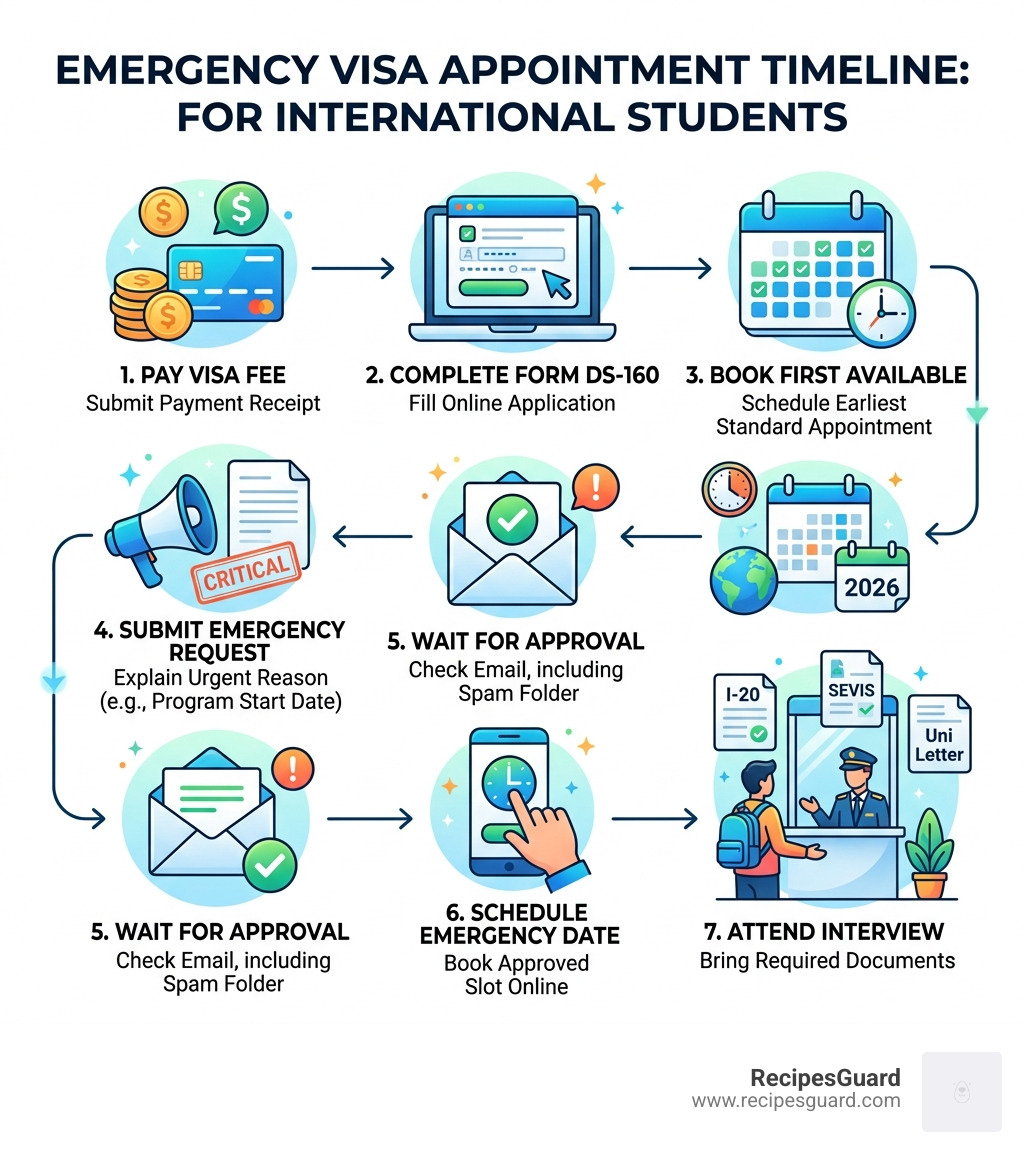
How to request an emergency student visa appointment:
- Pay your visa application fee
- Complete Form DS-160 (the Non-Immigrant Visa Electronic Application)
- Book the earliest available normal appointment
- Submit an Emergency Request Form explaining your urgent reason
- Wait for email approval from the US Embassy or Consulate (check spam folders)
- If approved, schedule your emergency appointment online
- Attend with all required documents (Form I-20, SEVIS fee receipt, university support letter)
Key eligibility rules: Your program start date must be within 60 days, and you must not have had a visa refusal in the last 6 months.
Imagine this: it’s April 2026, your university program starts in three weeks, and your visa interview isn’t scheduled until after your first day of class. You’re not alone. Thousands of international students hit this wall every year — delayed appointments, rescheduled consular dates, or sudden crises back home that throw everything into chaos.
The good news? There are real, official pathways built for exactly this situation. From emergency visa appointments to Special Student Relief (SSR) for F-1 students experiencing hardship, the US immigration system has specific tools designed to help — if you know where to look and move fast.
This guide walks you through all of them, step by step.
emergency visa claim student terms to remember:
- delayed baggage claim process
- delayed visa claim process
How to Request an Emergency Visa Claim Student Appointment

When we talk about an emergency visa claim student situation, we are usually referring to a “Consular Expedited Appointment.” This isn’t a different type of visa; it’s a way to jump the queue because your academic future is on the line. In Australia, U.S. Consulates in Sydney, Melbourne, and Perth handle these requests, but the criteria are strict.
To even be considered, your program start date must be approaching rapidly (typically within 60 days), and the earliest available regular appointment must be after that start date. If the embassy cancels or reschedules your appointment and offers no alternatives that fit your timeline, you are also a prime candidate for an emergency request.
However, there is a major “gotcha”: if you have been refused a visa in the last six months, you are generally ineligible for an expedited slot. The system assumes that if you were already denied, your “emergency” is a result of that denial rather than a scheduling conflict. For more details on navigating these hurdles, you can check out Requesting an Emergency Non-Immigrant Visa Appointment.
Essential Documents for Your Emergency Visa Claim Student Request
You cannot walk into an emergency interview with just a smile and a “trust me.” You need a bulletproof paper trail. We recommend organizing these documents in a dedicated folder before you even hit “submit” on your request.
- Original Form I-20 or DS-2019: This is your golden ticket. It must show a program start date that is within the next 60 days.
- SEVIS Fee Receipt: Proof that you’ve paid the Student and Exchange Visitor Information System fee.
- University Support Letter: A letter from your school stating the importance of your arrival by the start date and any consequences of a late start.
- Financial Proof: Evidence that you have the funds to cover your tuition and living expenses.
- Australian Visa Status: If you are an international student in Australia applying for a U.S. visa, ensure your Subclass 500 Student visa or other residency documents are current.
Step-by-Step Expedited Appointment Process
The process is a bit counter-intuitive because you have to book a “normal” appointment first. Here is how we suggest you handle it:
- Complete the DS-160: Fill out the online visa application accurately.
- Pay the Fee: You must pay the MRV (Machine Readable Visa) fee before the system lets you see the calendar.
- Book the “Placeholder”: Schedule the first available appointment, even if it’s six months away. You cannot request an expedite without an existing booking.
- Submit the Emergency Request Form: Look for the “Emergency Request” link in your online profile. You will need to write a brief, factual explanation of why you need an earlier date.
- Wait for the Email: The Consulate will review your request. This usually takes 1–3 business days. Keep a close eye on your junk folder!
- Reschedule: If approved, you will receive instructions to log back in and select a new, earlier date from a hidden calendar reserved for emergencies.
Warning: If you misrepresent your situation or miss your approved emergency appointment, you will not be allowed to book another one. Treat this like a “one-shot” opportunity.
Special Student Relief (SSR) for Emergent Circumstances
While emergency appointments help you get to your destination, Special Student Relief (SSR) is designed to help you stay there when the world turns upside down. SSR is a suspension of certain F-1 regulations by the Department of Homeland Security (DHS) in response to “emergent circumstances.”
What qualifies as an emergent circumstance? Think natural disasters, wars, military conflicts, or massive national financial crises in your home country. When DHS issues an SSR notice in the Federal Register, it provides a safety net for students from that specific region who are facing severe economic hardship. You can find the latest official updates on the F-1 Special Student Relief Fact Sheet | ICE.
Maintaining Status and Your Emergency Visa Claim Student Eligibility
The beauty of SSR is that it allows you to survive financially without losing your F-1 status. Normally, F-1 students are strictly limited in how much they can work and must take a full course load. SSR changes the rules by allowing:
- Reduced Course Load (RCL): You can take fewer classes than normally required while still being considered a “full-time” student for immigration purposes.
- Increased Work Hours: You can work more than the standard 20 hours per week on-campus.
- Off-Campus Employment: You can apply for an Employment Authorization Document (EAD) to work off-campus due to severe economic hardship.
To be eligible, you must have been lawfully present in the U.S. on F-1 status on the date specified in the SSR notice. If you entered the U.S. after the notice was published, you generally won’t qualify for that specific relief. For more on these benefits, visit Special Student Relief | Study in the States.
The Role of the Designated School Official (DSO)
Your DSO is your best friend in an emergency visa claim student scenario involving SSR. You cannot simply decide to work 40 hours or drop a class; your DSO must certify your eligibility in the SEVIS system first.
The DSO will:
- Verify that you are suffering from severe economic hardship directly related to the crisis.
- Update your SEVIS record with the SSR notation.
- Issue a new Form I-20 with specific remarks regarding your authorized employment and reduced course load.
- Certify that you are still maintaining your status despite the modified requirements.
Always talk to your DSO before you change your enrollment. If you drop a class before the DSO updates SEVIS, you could accidentally terminate your own visa status.
Navigating Immigration Relief and Document Replacement
Sometimes the emergency isn’t a calendar date, but a lost document or a sudden need to travel home. If you lose your passport, I-94, or EAD, you don’t have time for standard 6-month processing windows. USCIS offers expedited processing for document replacement in “unforeseen circumstances.”
If you are already in the U.S. and need to leave for an urgent reason — such as a family death or medical emergency — but your travel documents are pending, you may need to visit a USCIS field office for an emergency travel document. For more on this, see Emergency Travel | USCIS.
SSR vs. Severe Economic Hardship Employment
It is important to distinguish between “Standard” Economic Hardship and “Special Student Relief.”
| Feature | Standard Economic Hardship | Special Student Relief (SSR) |
|---|---|---|
| Trigger | Individual unforeseen financial loss | DHS Federal Register Notice (Crisis) |
| Course Load | Must maintain full course load | Can take a Reduced Course Load (RCL) |
| Work Hours | Max 20 hours/week (on-campus) | Can exceed 20 hours/week |
| Application | Form I-765 to USCIS | DSO recommendation + Form I-765 |
Standard hardship might be caused by a parent losing a job or a medical bill. SSR is for systemic crises. For the technical policy breakdown, refer to 20230222-SpecialStudentRelief.pdf.
Interaction with TPS and DED
If your home country is designated for Temporary Protected Status (TPS) or Deferred Enforced Departure (DED), you might wonder if you can have those and SSR at the same time. The answer is yes!
You can hold F-1 status and TPS concurrently. However, if you use a TPS-based EAD to work, you still have to follow F-1 rules (like a full course load) unless you also have SSR authorization. We always recommend getting the SSR notation on your I-20 if you are an F-1 student, as it provides the most flexibility for your academic path while allowing you to work.
Protocols for Immigration-Related Emergencies
When an emergency strikes, knowing who to call can prevent a stressful situation from becoming a legal disaster.
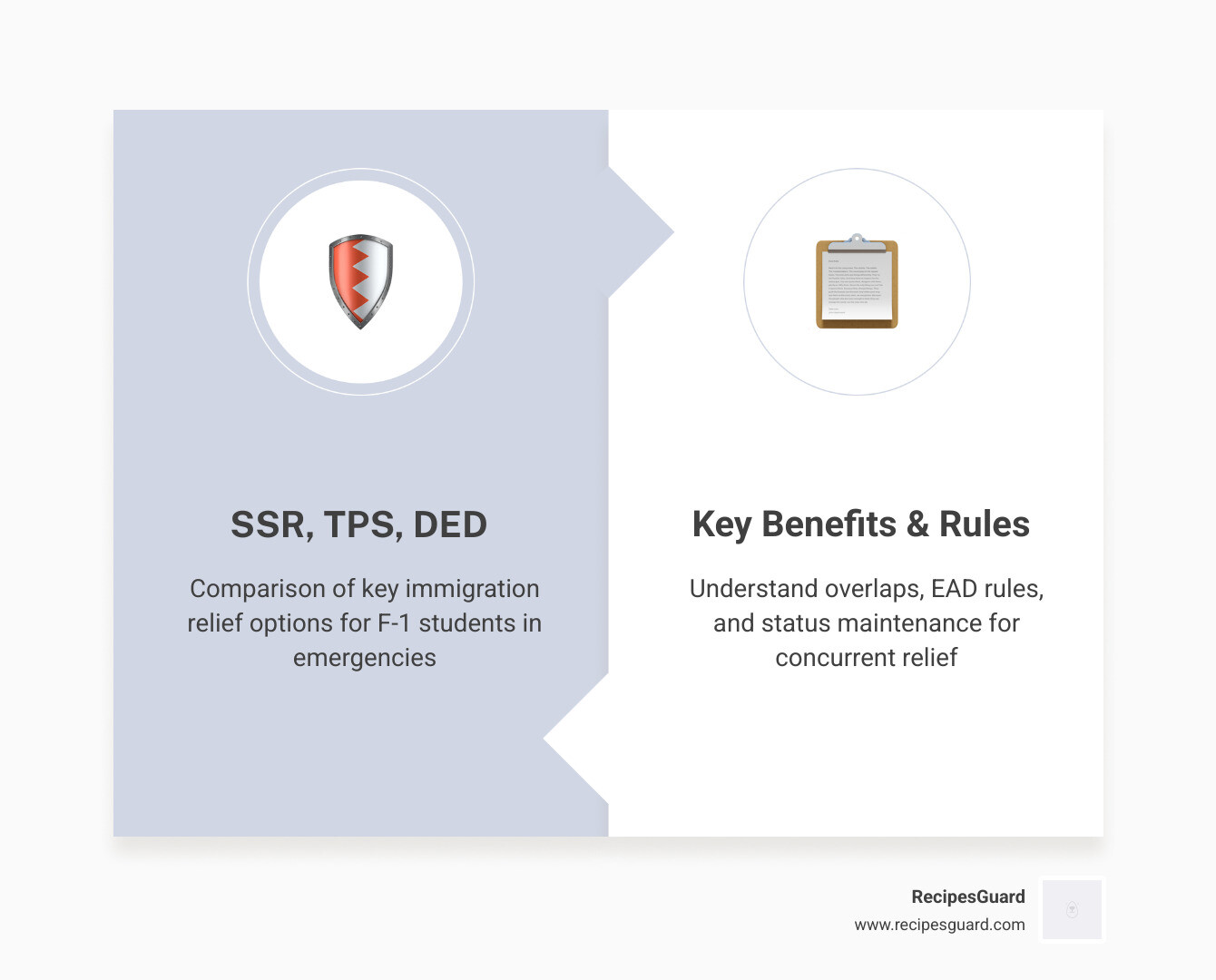
If you are detained at a port of entry or face a sudden threat of deportation, do not panic. Most universities have an emergency protocol. For instance, you should immediately contact your school’s International Student Office. Outside of business hours, campus police can usually reach a designated immigration official for you. You can see an example of these protocols at Emergency Protocol & Campus Resources | Case Western Reserve University.
Urgent Travel and Re-entry Procedures
If you have an “emergency travel” need and your travel authorization (Advance Parole) hasn’t arrived, USCIS can sometimes issue an emergency document if you need to travel in less than 15 days. You will need to provide evidence of the urgency, such as a death certificate or medical records with a certified English translation.
In some extreme cases, countries like Norway offer visas issued at the border for “very important and unexpected reasons,” but the U.S. and Australia generally do not. You must have your documents sorted before you land. For a look at how other countries handle this, see Emergency visa – visa issued at the border – UDI.
Handling Status Expiration Mid-Term
What happens if the SSR notice for your country expires on November 1st, but your semester doesn’t end until December 15th?
The good news is that you are usually protected until the end of the current term. You can continue your reduced course load and your increased work hours until the semester concludes. However, for the following term, you must return to a full course of study and standard work limits. If you are working off-campus, you may need to renew your EAD to cover that final “gap” period between the SSR expiration and the end of your classes.
Frequently Asked Questions about Student Visa Emergencies
Can F-2 dependents or M-1 students apply for SSR?
Unfortunately, no. SSR is a benefit strictly reserved for F-1 students. F-2 dependents (spouses and children) are not authorized to work in the U.S. under any circumstances, and M-1 vocational students are excluded from the SSR regulatory suspensions. If an M-1 student faces a crisis, they must look into other humanitarian options like TPS.
What happens if my emergency visa request is denied?
If the Consulate denies your request for an expedited appointment, their decision is final. You cannot appeal it. You will have to keep your original “placeholder” appointment. In this case, we recommend notifying your university immediately. They may be able to defer your enrollment to the next semester or allow you to start classes online while you wait for your visa.
How do I find active SSR notices for my country?
The best place to check is the “What’s New” page on the SEVP website (ICE.gov). You can also search the Federal Register for your country’s name and the term “Special Student Relief.” Your DSO will also likely receive an alert if a notice is published that affects a significant portion of the student body.
Conclusion
Navigating an emergency visa claim student situation is one of the most stressful parts of being an international student. Whether you’re fighting for an expedited interview date or trying to maintain your status during a crisis back home, these systems exist to help you succeed.
At RecipesGuard, we know that travel and visa emergencies don’t just affect your status — they affect your wallet and your peace of mind. That’s why we provide expert guides on travel insurance claims for students, helping you navigate the complexities of financial recovery when plans go awry. From step-by-step claim tutorials to advisory services, we are here to ensure your focus stays on your education, not on the fine print.
Stay safe, stay informed, and keep your documents ready. For more help with your journey, visit More info about student travel insurance claims.
My name is Bianca, and my journey into the world of fermentation and food safety began with a costly mistake. I once lost an entire season’s harvest of chili peppers because I relied on guesswork instead of science. That failure was my turning point.
