
Mastering the Emergency Medical Student Claim Process
When Every Minute Counts: Filing an Emergency Medical Student Claim
Filing an emergency medical student claim doesn’t have to be overwhelming — here’s what you need to know right away:
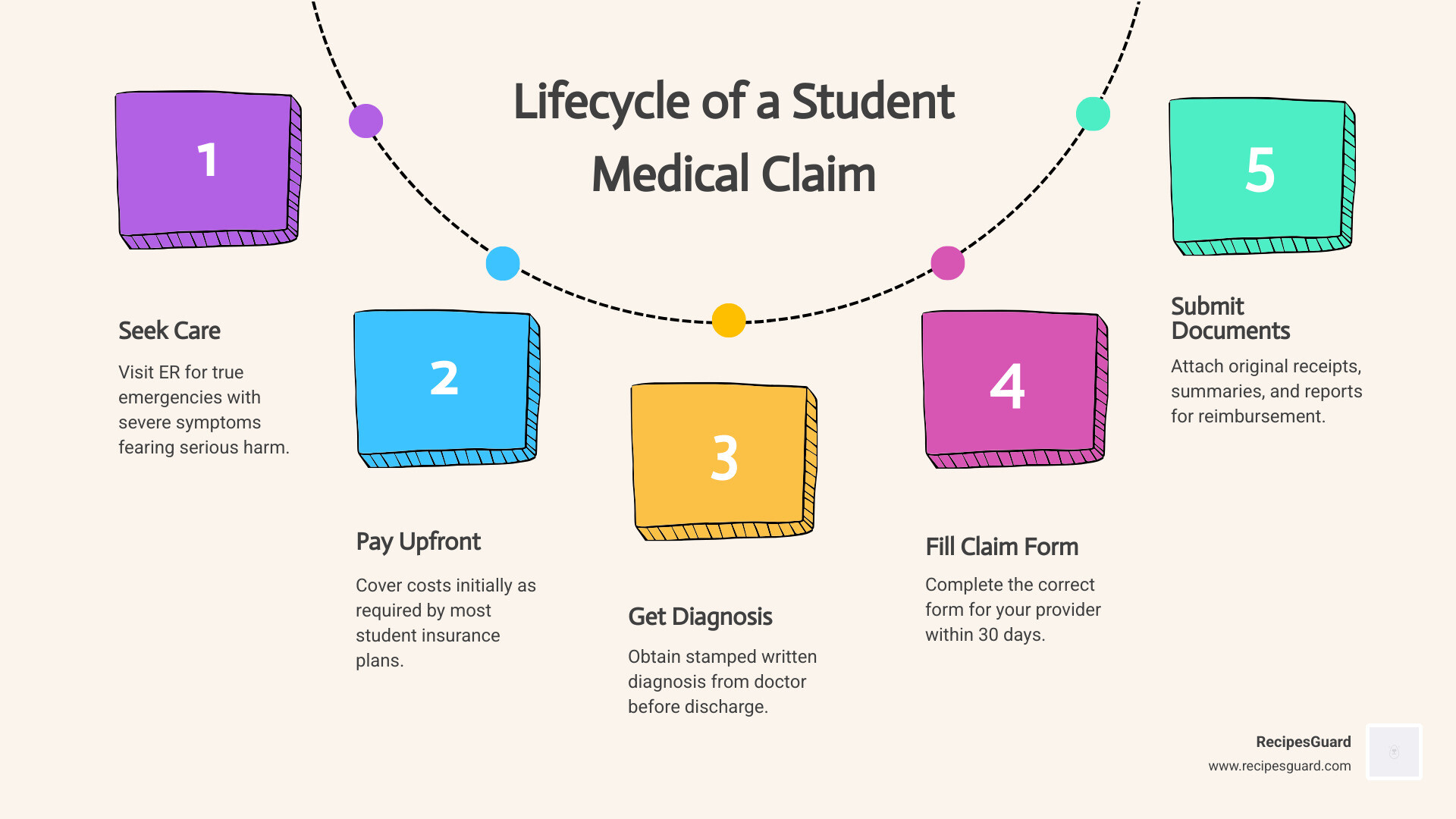
Quick Steps to File a Student Medical Claim:
- Seek care first — go to the emergency room only for true emergencies (symptoms severe enough that a reasonable person would fear serious harm without immediate treatment)
- Pay upfront if required — many student insurance plans require you to pay costs first, then claim reimbursement
- Get a stamped written diagnosis from your doctor or hospital before leaving
- Fill out the correct claim form for your insurance provider (e.g., Liberty Insurance, Kammarkollegiet, or your university’s plan)
- Submit within the deadline — most plans require submission within 30 days of discharge
- Attach all original receipts, discharge summaries, and physician reports
Being a student abroad is exciting — until a medical emergency hits. Suddenly you’re dealing with unfamiliar hospitals, policies written in legal jargon, and tight deadlines you didn’t know existed.
The stakes are real. Student health insurance plans typically cover 80% of reasonable charges after your deductible, but only if you follow the right steps. Miss a reporting deadline or submit the wrong form, and your claim could be denied entirely.
And if you’re a medical student providing care in an emergency department? The risks go even further. Research shows that 75% of emergency physicians are named in a malpractice lawsuit at some point in their careers — and trainees are not exempt.
This guide walks you through everything: from understanding what qualifies as a covered emergency, to filing your claim correctly, to protecting yourself with the right indemnity insurance.
Understanding the Emergency Medical Student Claim

When we talk about an emergency medical student claim, we first have to define what an “emergency” actually is in the eyes of an insurance company. Most providers use the prudent layperson standard. This means if a person with average medical knowledge believes that delaying care could result in serious jeopardy to their health, impairment of bodily functions, or organ dysfunction, it counts as an emergency.
In Australia, international students often find the healthcare system confusing. If you are an international student, you might wonder, I’m an international student, what do I do if I need medical assistance? The answer usually involves navigating your Overseas Student Health Cover (OSHC).
Qualifying Emergency Conditions
An emergency medical student claim typically stems from acute symptoms of sufficient severity. Examples include:
- Severe chest pain or difficulty breathing.
- Sudden loss of consciousness or severe head injury.
- Uncontrollable bleeding or compound fractures.
- Symptoms of a stroke, such as sudden weakness or slurred speech.
If your condition isn’t life-threatening, you should opt for urgent care or a local GP. Why? Because Emergency Room Costs in Australia can be significantly higher for international students, and your insurance might not cover the full cost if they deem the visit was for a non-emergency.
Financial Responsibilities and Copays
Don’t let the word “insurance” fool you into thinking everything is free. Most student plans involve:
- Deductibles: The amount you pay out-of-pocket before insurance kicks in.
- Copays: Fixed amounts (often $50 for urgent care and $150 for the ER) for specific services.
- Reasonable and Customary Charges: Insurance often pays 80% of what they consider a “fair” price. If the hospital charges more, you pay the 20% difference plus any “excess” fees.
One silver lining: if you are admitted as an inpatient directly from the emergency room, many policies will waive the ER copay. However, you must report the visit to your provider within one business day to ensure smooth processing.
Malpractice Risks and the Emergency Medical Student Claim

If you are a medical student or trainee, the term emergency medical student claim might refer to something much scarier: a malpractice lawsuit. It is a sobering reality that 75% of emergency physicians will face a lawsuit in their career.
For trainees, the risk is real but often misunderstood. Research into 60 cases involving trainees in the ED between 1982 and 2017 found that failure to diagnose was the most common error, making up 62% of claims. This was followed by treatment errors (22%) and procedural errors (15%).
The Role of Supervision in Trainee Liability
The biggest red flag in trainee-related claims is the lack of supervision. In 35% of reviewed malpractice cases involving ED trainees, it was alleged that no attending physician was involved in the patient’s care at any time. Even more shocking? The attending saw the patient in person in only 18% of the cases.
The Accreditation Council for Graduate Medical Education (ACGME) has strict standards for supervision, but in the environment of the ED, these can slip. When they do, the financial consequences are massive.
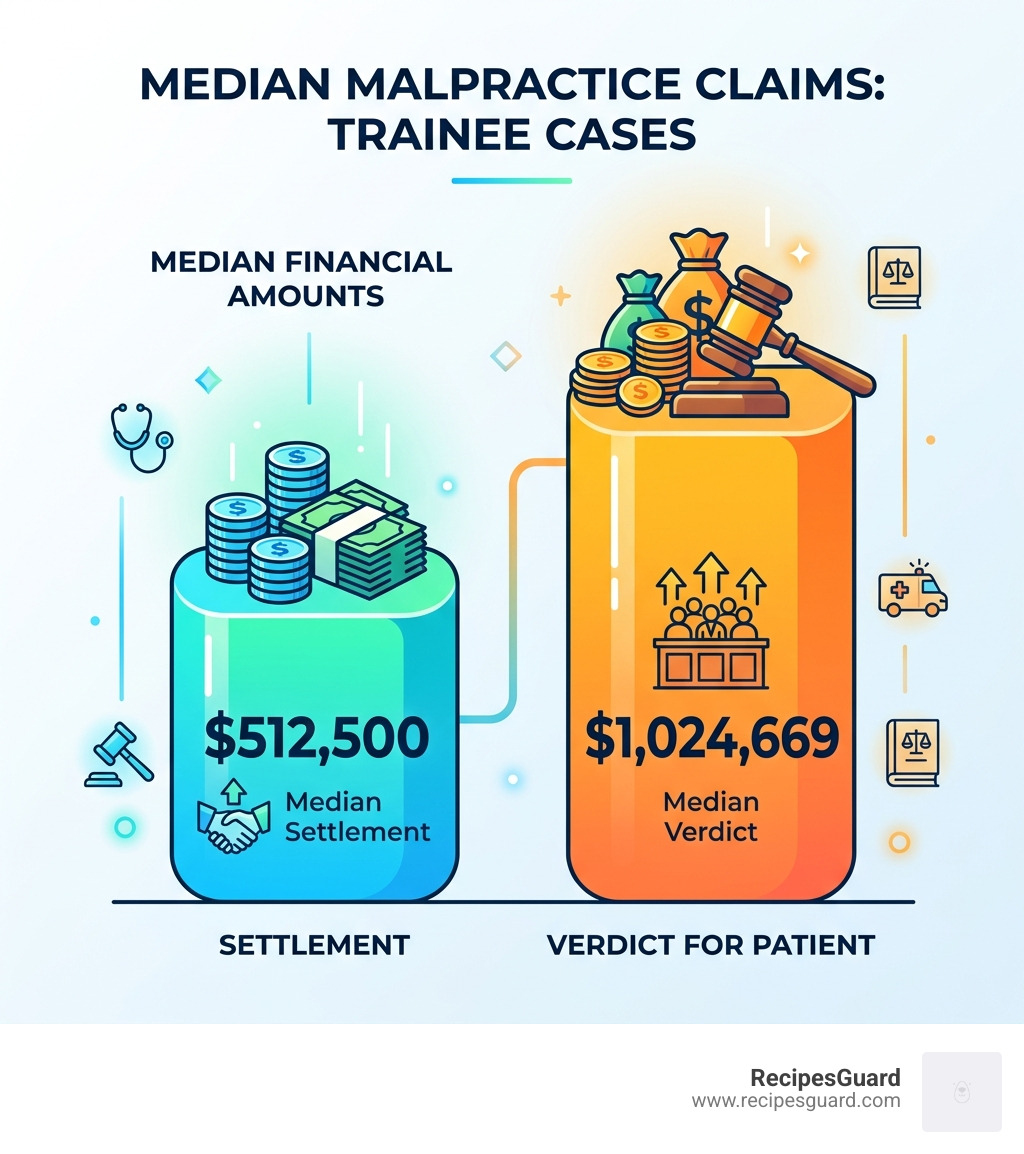
| Outcome Type | Median Amount | Mean Amount |
|---|---|---|
| Verdict for Patient | $1,024,669 | $3.8 Million |
| Settlement | $512,500 | $1.948 Million |
Note: Data based on 50 ED trainee malpractice cases with known outcomes (1982-2017).
Corporate Practice and Trainee Rights
Young physicians and students must also be aware of the Corporate Practice of Emergency Medicine (CPOM). Some contract management groups prioritize profits over physician autonomy. This can lead to “fee-splitting” practices where corporations withhold a portion of the physician’s professional fees.
As outlined in Rules of the Road for Young Emergency Physicians, you have the right to review billing and payment records. Be wary of restrictive covenants (non-compete clauses) that might prevent you from working in the same region if you leave a group. These clauses are often viewed as illegitimate in emergency medicine because they don’t protect trade secrets — they just control the labor market.
The Step-by-Step Filing Process
When it’s time to file your emergency medical student claim, speed and accuracy are your best friends. Most insurance companies, such as Liberty Insurance, require you to submit your claim within 30 days of being discharged.
Our Step-by-Step Guide to Filing:
- Gather the Paperwork: You will need the Claim Form – Student Medical Claim, original hospital bills, and a discharge summary.
- Get Physician Certification: Your treating doctor must fill out a section of the form detailing the diagnosis and whether the condition was pre-existing.
- Verify Your Status: Attach a copy of your student pass or enrollment verification.
- Choose Payment Mode: Most modern providers offer direct bank transfers or PayNow options.
Filing an Emergency Medical Student Claim Abroad
If you’re studying in Europe, specifically Sweden, the process might involve Kammarkollegiet (the Swedish Legal, Financial and Administrative Services Agency). At institutions like Lund University or BTH, students are often covered by Student IN or FAS+ insurance.
The process there is unique: you often have to pay the medical center upfront and then seek reimbursement. You must take your form to the university’s Student portal or reception to get it signed before sending it to the state agency.
Required Documentation and Verification
We cannot stress this enough: get a stamped diagnosis. Insurance companies are notoriously picky. A simple receipt isn’t enough; they need a formal medical report that matches the CPT or ICD codes used for billing.
To avoid the “black box” of billing, many clinics are moving toward digital solutions. Using a Student Insurance Claim Form | Emitrr can help streamline the process, ensuring all fields like “Date of Accident” and “Medical Provider Details” are completed accurately, which reduces the chance of a denial.
Mitigating Liability through Documentation and Indemnity
For the medical student on the other side of the stethoscope, documentation is your best defense. We like to say, “Think in Ink.” If it wasn’t documented, it didn’t happen.
Proper documentation for an emergency medical student claim should follow a strict structure. According to Medical Student Documentation EMRA, a high-quality note includes:
- HPI (History of Present Illness): A clear “one-liner” describing the patient and their chief complaint.
- ROS (Review of Systems): Ideally covering 10 systems to show a thorough evaluation.
- Physical Exam: Documenting at least 8 systems.
Documentation for an Emergency Medical Student Claim
The most critical part of your note is the Medical Decision Making (MDM) section. This is where you explain your “why.”
- List your Differential Diagnosis (DDx).
- Explain why you ruled out life-threatening conditions (e.g., “Chest pain unlikely to be ACS given normal EKG and low HEART score”).
- Document Return Precautions: “Patient advised to return immediately for worsening shortness of breath or fainting.”
This narrative of the ED course is what protects you if a patient has a “bounce-back” or an adverse outcome.
Professional Indemnity for Medical Students
In Australia, we highly recommend that students join the Students | Medical Indemnity Protection Society. MIPS provides membership that includes indemnity insurance for healthcare students.
Why MIPS matters for you:
- $20 Million Cover: Protection against civil liability claims.
- 24/7 Medico-Legal Advice: You can call an expert at 3 AM if an incident occurs.
- Support for Disputes: Coverage for university or training disputes, including workplace bullying.
- Student-Specific: It covers you for placements both in Australia and overseas (excluding the USA).
Frequently Asked Questions about Student Medical Claims
What constitutes an “emergency” for insurance purposes?
An emergency is any condition that a “prudent layperson” would consider life-threatening or capable of causing permanent harm without immediate treatment. This includes severe pain, difficulty breathing, or sudden neurological changes. Routine check-ups or mild flu symptoms typically do not qualify for an emergency medical student claim.
How does lack of supervision affect a malpractice claim?
Lack of supervision is a primary allegation in over half of resident-centered litigation. If a student or trainee performs a procedure (like placing a central line) without an attending present and an error occurs, the hospital and the attending can be held liable for “failure to supervise.” In the 60 cases reviewed, procedural errors without supervision almost always ended in a payout for the patient.
What is the typical payout for a trainee-involved medical error?
The financial stakes are high. For cases decided in favor of the patient, the median verdict is over $1 million. Even settlements average around $512,500. These amounts reflect the severity of outcomes often seen in these cases, which include permanent disability (52% of cases) and death (33%).
Conclusion
Navigating an emergency medical student claim is a test of both your patience and your attention to detail. Whether you are a student seeking reimbursement for a midnight ER visit or a medical trainee documenting a complex case, the rules are the same: document everything, act quickly, and know your rights.
At RecipesGuard, we specialize in making these complex insurance hurdles easy to clear. We believe that no student should be buried in debt or legal stress because of a paperwork error. Our step-by-step claim filing tutorials are designed to guide you through the process, ensuring you get the coverage and protection you deserve.
Ready to take control of your insurance? Master your claim with RecipesGuard and let us handle the fine print while you focus on your studies.

My name is Bianca, and my journey into the world of fermentation and food safety began with a costly mistake. I once lost an entire season’s harvest of chili peppers because I relied on guesswork instead of science. That failure was my turning point.
