
Mastering Your Medical Receipt Claims as an International Student
What International Students Need to Know About the Claim Process Student Visa Holders Face
The claim process student visa holders must navigate is more complex than most students expect — and getting it wrong can cost you hundreds, or even thousands, of dollars in unreimbursed medical expenses.
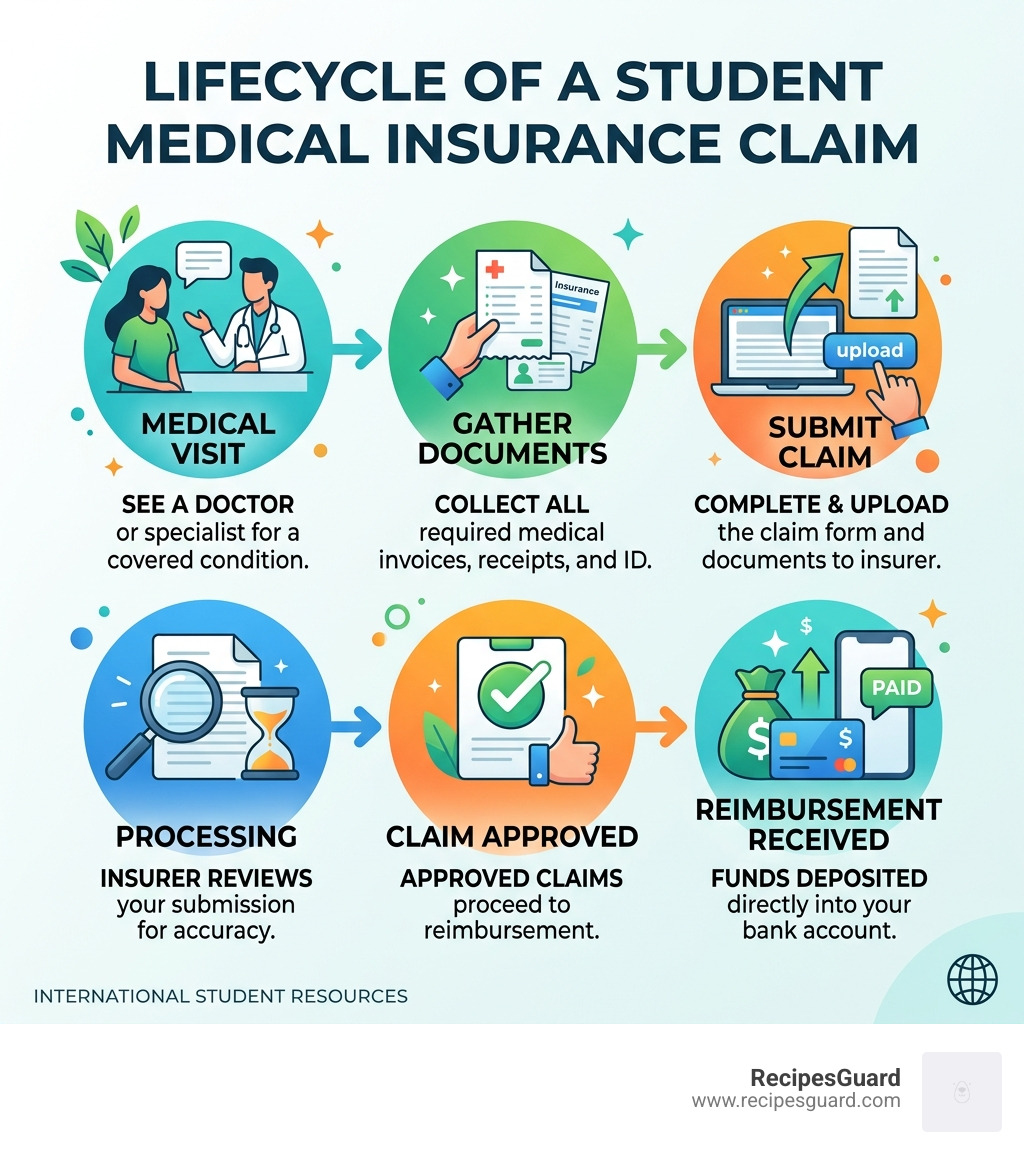
Here is a quick overview of how to file a medical claim as an international student:
- Gather your documents — student ID, itemized medical receipts, provider invoices, and your insurance policy number
- Check if pre-approval is required — some insurers require you to request approval before seeing a specialist or counsellor
- Complete the claim form — download it from your insurer’s portal and fill in all required fields accurately
- Submit your claim — email or upload your form and supporting documents to your insurance provider
- Provide your bank details — so reimbursement can be paid directly to your account
- Follow up — keep copies of everything and track your claim status
Studying abroad is exciting. But between settling into a new country, managing coursework, and keeping your visa status current, the last thing you want is a confusing insurance claim standing between you and your money.
The stakes are real. International students face strict visa conditions, mandatory insurance requirements, and tight deadlines — all at once. A missed step in the claims process can mean a denied reimbursement, just when you need financial relief most.
This guide walks you through exactly what to do, step by step.
Understanding Your Visa Type and Eligibility
Before you can master the claim process student visa holders rely on for medical costs, you must understand the foundation of your stay: your visa. In April 2026, the landscape for international education remains competitive, and your visa type dictates your insurance obligations.
While we often focus on the U.S. and Australia, each has distinct categories. In the U.S., the F-1 visa is for academic students, the M-1 is for vocational students, and the J-1 is for exchange visitors. In Australia, the Subclass 500 Student visa is the primary pathway. Each of these requires specific documentation, such as the Form I-20 (for the U.S.) or a Confirmation of Enrolment (CoE) for Australia.
Navigating the Australia Student Visa Process 2023 – Prodigy Finance (which still informs current 2026 standards) shows that Overseas Student Health Cover (OSHC) is a non-negotiable requirement. You cannot even obtain your visa without proof of this insurance.
Basic Requirements for April 2026 Applicants
To be eligible for a student visa today, you must meet several core criteria:
- Proof of Acceptance: You must be enrolled in a CRICOS-registered course (in Australia) or an SEVP-certified school (in the U.S.).
- Financial Support: You must prove you have enough money to cover tuition, travel, and living costs. As of 2024 and 2025, these financial thresholds have increased significantly to ensure students don’t face hardship.
- Ties to Home Country: You must demonstrate that you intend to return home after your studies. This is often where many applicants stumble.
- Health and Character: You’ll likely need a health examination and a criminal background check.
Navigating the DS-160 and Interview
For those heading to the U.S., the DS-160 online application is your first major hurdle. Accuracy is everything. A single typo can delay your claim process student visa journey before it even begins. Once submitted, you’ll schedule an interview at a U.S. embassy.
Don’t let the “interview” label scare you—it usually lasts only 2 to 3 minutes. However, in those 180 seconds, you must prove your English proficiency and your genuine intent to study. Consular officers are trained to look for “immigrant intent,” so be ready to explain why your specific degree will help your career back home.
Navigating the Claim Process Student Visa Holders Need for Medical Expenses
Once you are on the ground and studying, life happens. You might catch a nasty flu, need a specialist for a recurring back issue, or require a counselor to help with the stress of finals. This is where the claim process student visa medical reimbursement becomes your best friend.
At RecipesGuard, we see students struggle most when they treat their insurance like a “set it and forget it” task. In reality, Making an insurance claim requires active management.
Step-by-Step Claim Process Student Visa Medical Reimbursement
If you’ve visited a doctor and paid out of pocket, follow these steps to get your money back:
- Request an Itemized Invoice: A simple credit card receipt isn’t enough. You need a document that lists the date of service, the medical codes for the treatment, and the provider’s details.
- Confirm Your Bank Details: Ensure your local bank account is active. Most insurers will not mail international checks; they prefer direct deposits.
- Download the Correct Form: Visit your insurer’s “Claims” page. Ensure you are using the version for the current 2026 policy year.
- Complete the Narrative: Explain why you sought care. “I felt sick” is okay, but “Persistent fever and chest pain for three days” is better.
- Submit Electronically: Most modern providers in Australia and the U.S. prefer portal uploads. This creates a digital paper trail that is harder to “lose” than a physical envelope.
Documentation for the Claim Process Student Visa Requirements
The number one reason claims are delayed is missing paperwork. We recommend keeping a digital folder on your phone with scans of:
- Your Student ID card.
- Your current Visa Grant Notice.
- All medical reports or referral letters.
- Proof of payment (the receipt showing the balance is $0).
| Feature | Pre-approval Claim | Post-service Claim |
|---|---|---|
| When to file | Before the appointment | After you’ve paid |
| Best for | Specialists, surgery, MRI | GP visits, prescriptions |
| Direct Billing | Often available (you pay $0) | Rarely available (you pay first) |
| Processing Time | 3–5 business days | 10–15 business days |
Avoiding Denials and Managing Visa Status
A denied insurance claim is a headache, but a denied visa is a life-altering event. According to the U.S. Student Visa Visa Denial and Appeal Process – USCIS Guide, thousands of students are refused every year.
The most common culprit is Section 214(b). This is the legal way of saying the officer isn’t convinced you’ll go home. In 2026, social media vetting has also become standard. If your public profiles suggest you are looking for permanent work rather than a degree, your application is at risk.
Top Reasons for Visa Refusal in 2026
We’ve identified the top pitfalls for students this year:
- Insufficient Ties: Not having a clear plan or family/property connections in your home country.
- Financial Insufficiency: Using “suspicious” sources of funds or not having enough to cover the recent 2024/2025 cost-of-living increases.
- Fraudulent Documents: Never use “visa consultants” who offer to “fix” your bank statements. Consulates have sophisticated ways to verify these, and a fraud finding leads to a permanent bar.
- Scam OPT Sponsors: Be careful who you associate with. Previous associations with companies known for “selling” work authorization can lead to a lifetime ban under Section 212(a)(6)(C)(i).
Maintaining Valid F-1 Status After Arrival
Getting the visa is just the beginning. To keep it, you must follow the rules:
- Full-time Enrollment: You cannot drop below a full course load without prior authorization from your International Student Advisor.
- Address Reporting: If you move apartments, you must report your new address within 10 days.
- Travel Endorsements: Before you fly home for summer break, your I-20 or CoE must be signed for travel by your school official.
- The 60-Day Grace Period: After you graduate, you generally have 60 days to leave the country, start a new program, or apply for post-study work (like OPT in the U.S. or the Temporary Graduate visa in Australia).

Frequently Asked Questions about Student Visas and Claims
How do I get an IHS refund in the UK?
While our primary focus is Australia and the U.S., many of our readers are EU students who have studied in the UK. If you are an EU, Swiss, or Norwegian student with a valid EHIC card, you might be eligible for a refund of the Immigration Health Surcharge.
You can Get an immigration health surcharge refund if you’re a student from the EU, Switzerland, Norway, Iceland or Liechtenstein – GOV.UK if you meet the strict criteria. You must be in full-time education and not working. If you start a part-time job, you lose your eligibility for the refund because your EHIC may become invalid for UK healthcare.
Can I extend my visa if I fail a course?
Yes, but it isn’t automatic. If you fail a subject and need another semester to graduate, you must apply for a new visa before your current one expires. You should Check or change your student visa conditions :: Immigration New Zealand (or the equivalent Australian/U.S. portal) to see if you need a “Variation of Conditions.”
In Australia, you’ll need a new CoE from your provider. Be aware that “academic progress” is a visa condition; if you fail too many courses, your school is legally required to report you, which could lead to visa cancellation.
What happens if my claim is found to be fraudulent?
We cannot stress this enough: Never exaggerate or fake a medical claim. Insurance fraud is a serious crime. If an insurer discovers you’ve submitted a fake receipt, they will cancel your policy immediately. Because having health insurance is a mandatory condition of your student visa, the cancellation of your policy will likely lead to the termination of your enrollment and the subsequent cancellation of your visa. You could be deported and barred from returning.
Conclusion
Mastering the claim process student visa holders deal with doesn’t have to be a nightmare. By staying organized, keeping your documents in order, and understanding the rules of your stay, you can focus on what really matters: your education.
At RecipesGuard, we are dedicated to providing student-focused, step-by-step advisory services to help you navigate the complexities of international student life. Whether you are How to apply for your visa | Study Australia or filing your tenth medical claim, we are here to help.
For more detailed guides on International Student Visa and Travel Insurance Requirements, explore our latest tutorials and ensure your journey abroad is as smooth as possible. Safe travels and happy studying!

My name is Bianca, and my journey into the world of fermentation and food safety began with a costly mistake. I once lost an entire season’s harvest of chili peppers because I relied on guesswork instead of science. That failure was my turning point.
