
How to compare student contents insurance without losing your mind
Why comparing student contents insurance matters more than you think
Comparing student contents insurance is one of the smartest money moves you can make before starting university. Here’s a quick breakdown to help you decide fast:
How to compare student contents insurance — at a glance:
| What to compare | Why it matters |
|---|---|
| Sum insured | Covers total value of your belongings |
| Single-item limits | Protects expensive gadgets like laptops |
| Accidental damage cover | Often not included as standard |
| Personal possessions cover | Covers items taken outside your room |
| Excess amount | Affects how much you pay per claim |
| Exclusions | Theft without forced entry is commonly excluded |
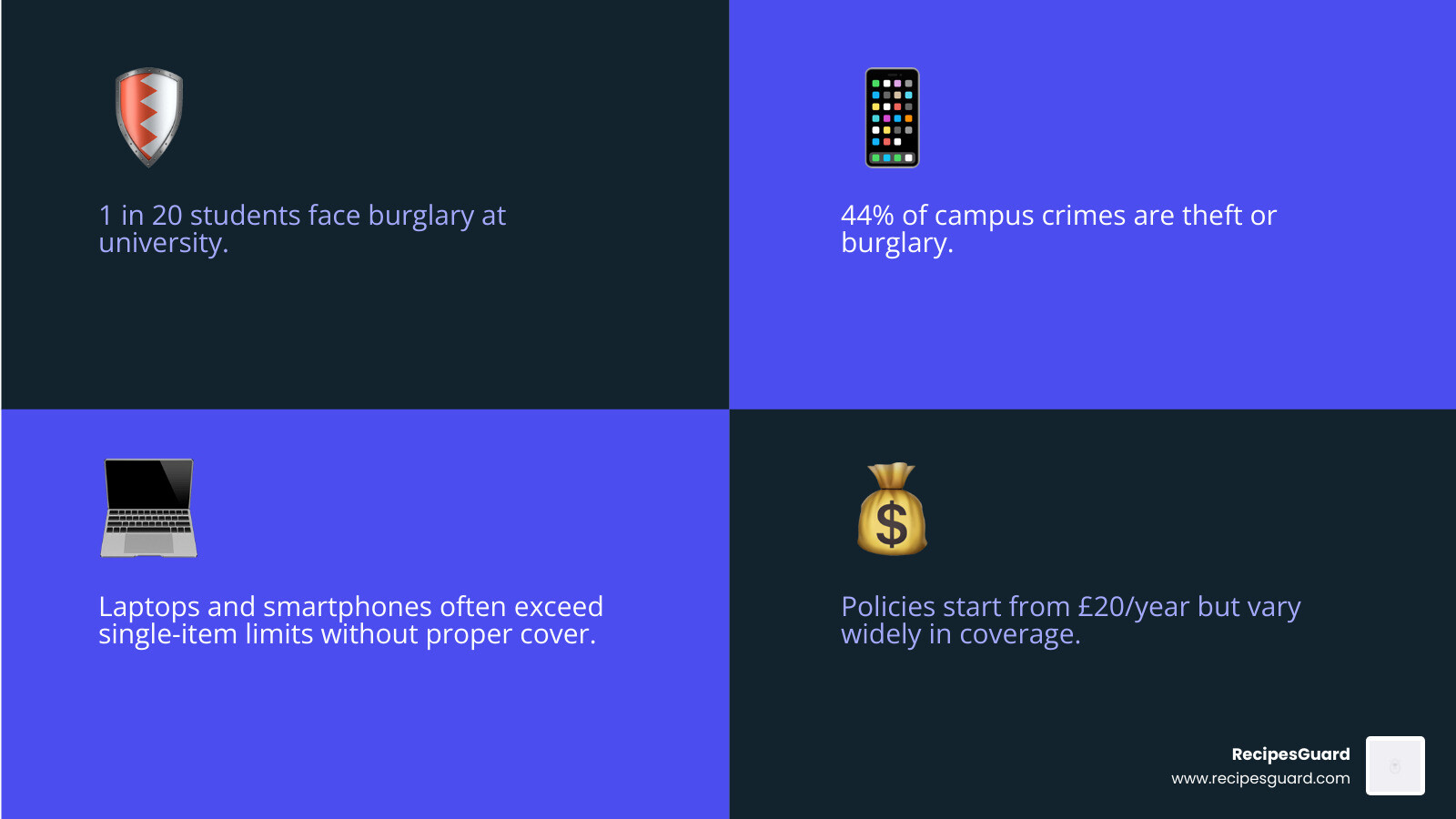
Around 1 in 20 students experience a break-in or burglary at university. And on college campuses broadly, theft and burglary make up 44% of all criminal activity.
That’s not a small risk.
Yet most students arrive at uni without any cover — partly because 82% say school never taught them about personal finance, including insurance.
The problem isn’t just theft. Laptops get dropped. Floods happen. Fires start. And replacing everything out of pocket on a student budget is close to impossible.
The good news? Student contents insurance can start from as little as £20 a year. The tricky part is knowing which policy actually covers what you need — and which ones leave dangerous gaps.
This guide walks you through exactly how to compare your options without getting lost in the fine print.
Compare student contents insurance terms simplified:
- Australian student insurance claims
- claim injury student travel
- illness claim student travel
Why you need to compare student contents insurance in 2026
As we move through April 2026, the landscape of student living has changed. With the average student now carrying thousands of dollars worth of tech—laptops, tablets, smartphones, and noise-canceling headphones—the stakes for your gear have never been higher. Statistics show that 5% of students reported experiencing a break-in or burglary while at university in recent surveys. When you consider that burglaries and theft make up 44% of all criminal activities on college campuses, the need for protection becomes clear.
Market trends for 2026 indicate that while basic policies remain affordable, the cost of replacing high-end electronics has risen. A standard student budget rarely has a $1,500 buffer sitting around for a new MacBook. This is where student contents insurance steps in. It isn’t just about theft protection; it’s a financial safety net against fire damage, floods, and even vandalism.
When you compare student contents insurance, you are looking for more than just the lowest price. You are looking for a policy that understands the “student life” perils—like a pipe bursting in the room above you or a kitchen fire in a shared flat. At RecipesGuard, we believe that being prepared shouldn’t be a headache. We provide guides on how to handle the aftermath of these incidents, ensuring that if the worst happens, you know exactly how to file your claim.
For more on protecting your lifestyle, check out our RecipesGuard Guide to Student Protection.
Key features to look for when you compare student contents insurance
Navigating insurance jargon can feel like reading a textbook in a language you haven’t learned yet. To compare student contents insurance effectively, you need a checklist of essential features. Don’t just tick the box for the cheapest premium; look for these pillars of coverage:
- Tenant’s Liability Cover: This is a big one. It covers you if you accidentally damage the landlord’s property (like burning the carpet or smashing a window). Without it, that damage comes straight out of your bond.
- New for Old Cover: This ensures that if your three-year-old laptop is stolen, the insurer pays for a brand-new equivalent, rather than just the “current value” of a used machine.
- Accidental Damage: Most basic policies exclude this. If you want protection against spilling coffee on your keyboard, you usually need to add this as an extra.
- Sum Insured: This is the total value of everything you own. If you underestimate this, you might only receive a portion of your claim.
- Single-Item Limit: This is the maximum an insurer will pay for any one item. If your laptop is worth $2,500 but your limit is $1,500, you’re in trouble.
When living in shared housing, coverage limits can be tricky. Some policies only cover items inside your locked bedroom. If your PlayStation is stolen from the communal lounge, a “room-only” policy won’t pay out.
How to compare student contents insurance for high-value gadgets
Your gadgets are likely your most expensive possessions. Between laptops for assignments and smartphones for… well, everything… you’re carrying a lot of value. When you compare student contents insurance, pay close attention to the gadget add-ons.
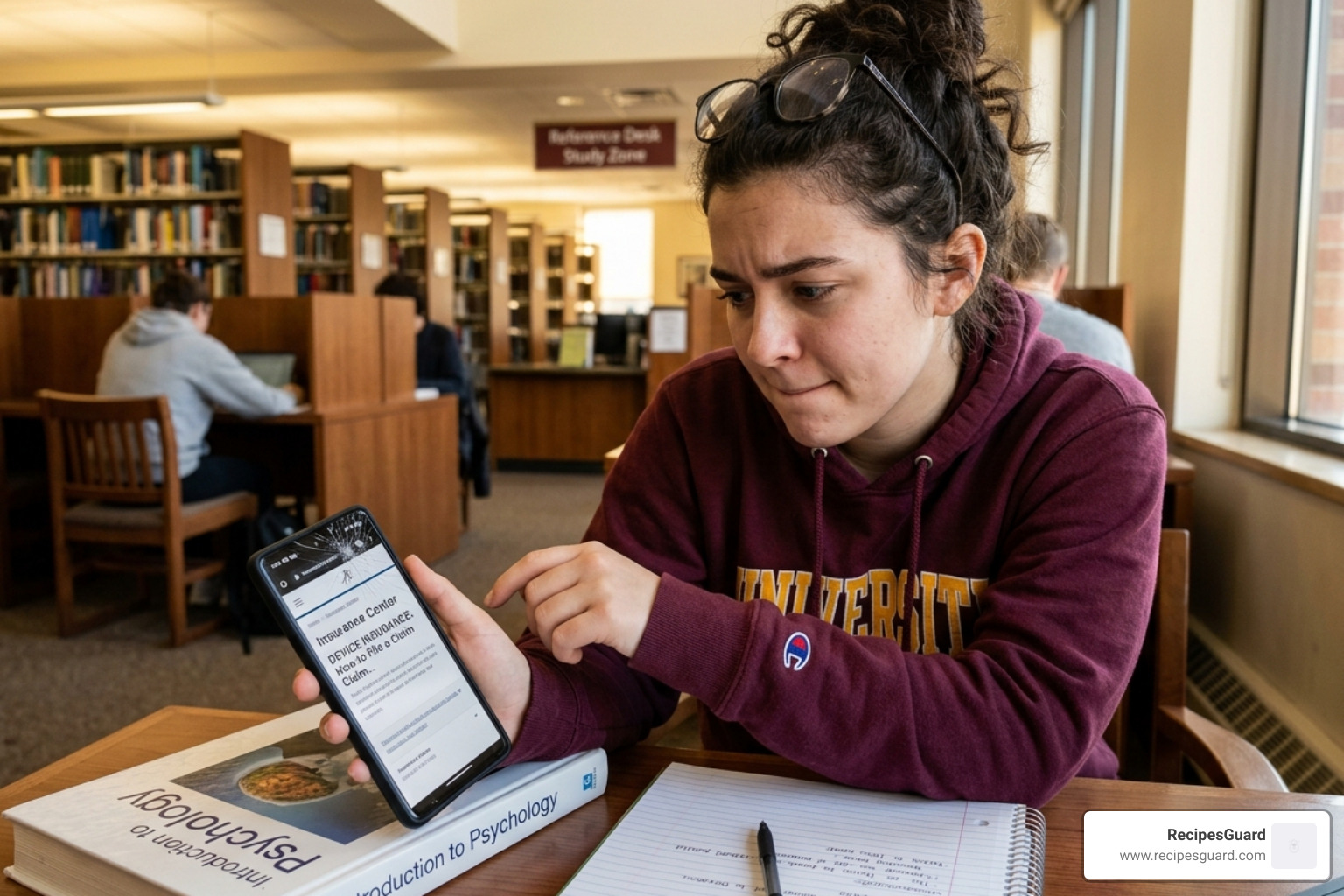
Many students assume their phone is covered everywhere. However, standard contents insurance often only covers items inside your accommodation. If your phone gets swiped at the library or a café, you need “Personal Possessions” or “Worldwide” cover. Also, check the single-item limit. If you have a high-spec gaming laptop or a professional camera, you may need to list these items individually on the policy to ensure they are fully covered.
Steps to compare student contents insurance quotes effectively
To get an accurate quote, you need to have your facts straight. Follow these steps to compare student contents insurance quotes like a pro:
- Calculate your Sum Insured: Walk around your room and list everything. Don’t forget textbooks (which can cost over $1,200 a year!), clothes, and bedding.
- Check for existing cover: Are you covered by your parents? Does your uni hall have a “block” policy? (More on this in the FAQ).
- Decide on your excess: This is what you pay toward a claim. A higher excess usually means a lower premium.
- Look at annual vs. monthly payments: Paying annually is almost always cheaper as it avoids interest charges.
- Read the exclusions: This is where most people get caught out. Common exclusions include theft without signs of forced entry (so lock your doors!) and items stolen from an unoccupied property (usually if you’re away for more than 30 days).
How to calculate your sum insured and excess
One of the biggest mistakes students make is “under-insuring.” If you tell the insurer your stuff is worth $2,000 but it’s actually worth $4,000, they might only pay out 50% of any claim you make. This is called the “condition of average.”
To avoid this, create an inventory. Use the retail price of items as if they were new.

When it comes to the “excess,” you need to find a balance. The excess is the amount you contribute when you make a claim.
| Excess Type | Premium Cost | Out-of-pocket at claim | Best for… |
|---|---|---|---|
| High Excess | Lower | Higher (e.g., $250) | Students with a “rainy day” fund |
| Low Excess | Higher | Lower (e.g., $25) | Students on a very tight monthly budget |
There are two types of excess: Compulsory (set by the insurer) and Voluntary (the extra amount you choose to pay to lower your premium). Make sure the total of both is an amount you can actually afford to pay if your laptop disappears.
Room-only vs. whole-house policies
Where you live dictates what kind of policy you need.
Room-Only Policies are standard for students in halls or shared houses with individual contracts. These policies usually require you to have a lock on your bedroom door. The “catch” is that items left in the kitchen or living room are often not covered. If you leave your laptop on the dining table and a housemate’s guest swipes it, the insurer may deny the claim due to a lack of “forced entry.”
Whole-House Policies are more common for groups of friends renting a private house together on a joint tenancy. While these can be cheaper per person, they come with risks. If one housemate makes a claim, it can affect the no-claims discount for everyone on the policy.
For most students, an individual policy is the safest bet. It gives you control over your own optional extras, and your premium isn’t tied to your housemate’s clumsiness. At RecipesGuard, we see many claims where students were confused about shared liability—always read the fine print regarding communal areas!
Frequently Asked Questions about student insurance
Are students covered by their parents’ home insurance?
Maybe, but don’t bet on it without checking. Around 26% of parents’ home insurance policies do not cover student belongings as standard. Even if they do, there are often strict conditions: the student’s permanent address must still be the parents’ house, and the coverage is usually limited to “contents temporarily removed.”
Be aware that making a claim on a parent’s policy could wipe out their no-claims bonus and increase their premiums for years. Often, a separate $20-$50 student policy is a much better deal than risking your parents’ insurance standing.
Does university accommodation include contents insurance?
Many university-managed halls of residence provide “block insurance.” This is a basic level of cover included in your rent. However, it is often very limited. It might have a total cap of $3,000 and a single-item limit of only $250. If your $1,500 phone is stolen, you’d only get $250 back. Always check if you need “top-up” cover to protect your high-value gadgets.
What doesn’t student contents insurance cover?
Insurance isn’t a “blank cheque” for every mishap. Common exclusions include:
- Theft without forced entry: If you leave your window open or your door unlocked, you likely won’t be covered.
- Cosmetic damage: A scratch on your phone screen that doesn’t stop it from working isn’t usually a valid claim.
- Unoccupied property: If you leave for the summer holidays (usually more than 30 consecutive days), your cover might lapse unless you notify the insurer.
- Wear and tear: Insurance covers sudden accidents, not things just getting old and breaking.
Conclusion
The secret to comparing student contents insurance without losing your mind is to focus on value, not just the sticker price. Ensure your gadgets are covered outside your room, check that your single-item limits match your tech, and always—always—lock your door.
At RecipesGuard, we know that the real stress starts after something goes wrong. That’s why we specialize in student-focused advisory services, providing step-by-step tutorials on how to file your insurance claims successfully. Whether you’re dealing with a stolen bike or a water-damaged laptop, we’re here to help you navigate the paperwork.
Don’t wait until you’re staring at an empty desk to think about insurance. Get protected today so you can focus on what really matters—your studies (and maybe the occasional party).
More info about insurance claims

My name is Bianca, and my journey into the world of fermentation and food safety began with a costly mistake. I once lost an entire season’s harvest of chili peppers because I relied on guesswork instead of science. That failure was my turning point.
