
Student Travel Insurance for Europe: Your Safety Net Across the Pond
What Is Student Travel Insurance and Which Plans Are Best for Europe?
Student travel insurance is a specialized type of travel coverage designed for students studying, exploring, or living abroad — and it works very differently from the standard policy you might buy for a quick vacation.
Here’s a quick comparison of typical student travel insurance coverage levels for Europe:
| Coverage Level | Medical Limit | Deductible | CFAR | Best For |
|---|---|---|---|---|
| Basic | $50,000 | $100 | No | Short summer courses |
| Standard | $250,000 | $50 | Optional | Semester exchange |
| Comprehensive | $500,000+ | $0 | Available | Full academic year |
| Elite | $1,000,000 | $0 | Available | High-risk activities |
The short answer: For most students heading to Europe, look for a plan with at least $250,000 in emergency medical coverage, emergency evacuation, trip cancellation, and 24/7 assistance. If you’re on a J-1 or F-1 visa, make sure your plan explicitly meets those visa requirements.
So you’ve booked your flights, registered for classes in Barcelona or Berlin, and started a packing list. But what happens if your bag never arrives at baggage claim? Or you end up in a foreign hospital with no idea who to call or how to pay?
These aren’t rare worst-case scenarios. They’re exactly the situations thousands of students face every year abroad.
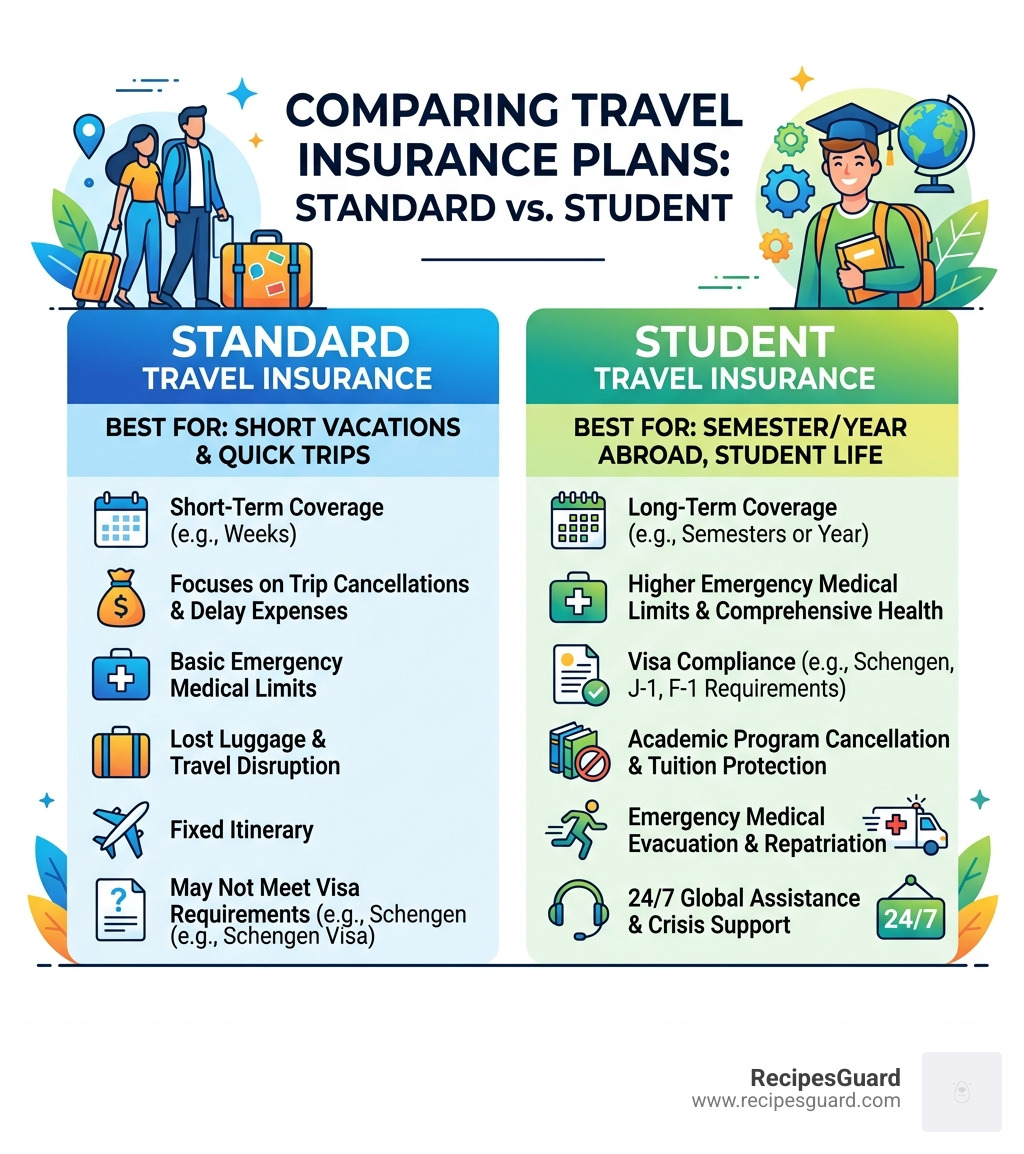
Standard travel insurance is built for short trips. It doesn’t account for semester-long stays, academic program cancellations, visa compliance needs, or the reality that your US health insurance almost certainly won’t be accepted at a hospital in Paris or Prague.
That’s where student-specific plans come in — and choosing the right one before you board that flight could save you tens of thousands of dollars.
Why You Need Specialized Coverage for Your European Adventure
When we talk about heading to Europe for a semester or a gap year, the excitement often overshadows the “what-ifs.” However, the reality of international travel involves navigating complex healthcare systems and strict visa regulations. For example, if you are applying for a Schengen visa to study in countries like France, Italy, or Germany, you are legally required to show proof of travel insurance that includes a minimum medical coverage (often €30,000) and repatriation of remains. You can review the broader rules for the Schengen Area to understand why insurance documentation is so commonly requested for student travel.
Standard policies often fall short because they don’t focus on the long-term nature of academic life. Student travel insurance is built to handle the “campus lifestyle” abroad. This includes coverage for:
- Emergency Medical Expenses: If you trip over a cobblestone in Rome and break your ankle, your domestic health insurance likely won’t cover the bill. Specialized plans can offer up to $1,000,000 in medical coverage, ensuring you aren’t paying out of pocket for surgeries or hospital stays.
- Emergency Evacuation: This is the big one. If you’re in a remote area or a local facility can’t treat your condition, evacuation costs to a better hospital or back home can exceed $100,000. Most student plans include high limits for this.
- Repatriation: In the tragic event of a death, this coverage handles the logistics and costs of returning remains to your home country.
- Trip Cancellation and Interruption: If a family emergency forces you to fly back to Australia mid-semester, or if your school cancels the program entirely, these benefits help reimburse your non-refundable tuition and travel costs.
At RecipesGuard, we specialize in helping you navigate these complex situations. Our Comprehensive Student Travel Insurance Guide at RecipesGuard provides the insights you need to understand how these benefits work in the real world.

One of the most valuable features is 24/7 assistance services. Imagine it’s 3:00 AM in Budapest, you’ve lost your passport, and you don’t speak the language. A specialized student plan gives you a “lifeline” – a multilingual team that can help with legal referrals, translation services, and even replacing lost travel documents.
Comparing Key Features of Student Travel Insurance Plans
Choosing a plan isn’t just about the lowest price; it’s about the “fit.” Students have different needs than a retiree on a cruise. For instance, a student might need coverage for mental health counseling or injuries sustained during a university soccer match.
Feature Comparison Breakdown
| Feature | Standard Travel Plan | Student-Specific Plan |
|---|---|---|
| Duration | Usually 30 days max | Up to 364 days or more |
| Mental Health | Rarely covered | Often includes outpatient/inpatient care |
| Organized Sports | Excluded | Often covered (club, intramural, intercollegiate) |
| Deductibles | Often $100 – $500 | Frequently $0 for students |
| Visa Compliance | Hits and misses | Built to meet J-1 and F-1 requirements |
Mental Health Support: Many modern student plans recognize that being away from home is stressful. They often include benefits for mental health disorders, which is a massive gap in standard travel insurance.
Adventure Sports & Leisure: If you plan on skiing in the Alps or scuba diving in Greece, you need to check your policy. While many plans cover “leisure sports,” high-risk activities like skydiving often require an add-on.
Pre-existing Conditions: This is a common hurdle. Most plans have a “look-back period” (often 180 days). However, some plans offer a waiver if you buy the insurance within a certain window of your first trip payment. If you have a chronic condition, you must Compare Student Insurance Plans and Benefits to ensure you won’t be left without coverage for a flare-up abroad.
Personal Liability: We don’t like to think about it, but if you accidentally cause damage to your dorm room or someone else’s property, personal liability coverage can protect you from a massive lawsuit.
Understanding Costs and Exclusions in Student Travel Insurance
How much should you actually pay? On average, student travel insurance costs between 5% and 7% of your total trip cost. If your semester abroad costs $10,000, expect to pay around $500 to $700 for comprehensive protection.

Factors Affecting Your Premium
- Age: Younger travelers usually pay less because they are statistically healthier.
- Trip Length: A 10-day spring break trip is much cheaper than a 10-month exchange.
- Coverage Limits: A $1,000,000 medical limit will cost more than a $50,000 limit.
- Destination: Countries with higher healthcare costs (like those in Northern Europe) can sometimes drive up premiums.
Common Exclusions: The “Fine Print”
Even the best safety net has holes. It is vital to Understanding Student Coverage Exclusions so you aren’t surprised by a denied claim. Common exclusions include:
- Alcohol and Drugs: If you get injured while under the influence, your claim will almost certainly be denied.
- High-Risk Activities: Unless you bought a specific “Adventure” rider, activities like bungee jumping or professional athletics are usually out.
- Routine Care: Travel insurance is for emergencies. It generally doesn’t cover routine check-ups, vaccinations, or standard dental cleanings.
- Uninhabitable Accommodation: If your Airbnb is just “gross,” insurance won’t help. It typically only kicks in if the accommodation is made uninhabitable by a fire, flood, or natural disaster.
How to Choose the Right Plan for Long-Term Stays
For students staying in Europe for several months, the requirements change. You aren’t just a tourist; you’re a temporary resident.
Visa Compliance: If you are a student heading to the USA from Australia on a J-1 or F-1 visa, or vice versa, your school will likely have a list of “must-haves.” This usually includes specific medical maximums and $0 deductibles. Specialized student plans are popular because they are pre-verified to meet these J-1 requirements.
Multi-trip vs. Single Trip:
- Single Trip: Best if you are going to one place and staying there for the duration.
- Multi-trip (Annual): If you plan to fly home for the holidays and then head back to Europe, or if you plan on visiting five different countries during your gap year, an annual plan might be more cost-effective.
When selecting a plan for long-term stays, consider the “Home Country Coverage” benefit. Some plans allow you to return home for a short visit (usually up to 15 days) without voiding your insurance. This is perfect for those who want to spend Christmas with family before returning to their studies. You can find more about Long-Term Student Travel Solutions and Compliance on our advisory pages.
Frequently Asked Questions about Student Travel
Does student travel insurance cover mental health and sports?
Yes, many specialized plans do! Unlike standard vacation insurance, student travel insurance often includes benefits for mental health disorders, including inpatient and outpatient care. For sports, most plans cover “leisure” activities (like a pickup game of soccer). However, if you are playing for a university team (intercollegiate) or in organized club sports, you often need a higher-tier plan offered by specialized student insurance providers.
What are the benefits of Cancel For Any Reason (CFAR) for student travel insurance?
CFAR is the ultimate flexibility tool. While standard trip cancellation only covers “covered reasons” (like getting sick or a death in the family), CFAR allows you to cancel because you changed your mind, your academic schedule shifted, or you’re just feeling homesick.
- Reimbursement: Usually covers up to 75% of non-refundable costs.
- Timing: You must typically purchase CFAR within 14–21 days of your initial trip deposit.
- Cost: It usually adds about 40-50% to your premium, but for students with uncertain schedules, it’s a financial lifesaver.
How do I meet J-1 visa or school insurance requirements?
To meet these requirements, you need a plan that provides a “Visa Letter” or “Proof of Coverage” immediately upon purchase. Most student-specific providers will email you this document instantly. Key requirements usually include:
- Medical benefits of at least $100,000 per accident or illness.
- Repatriation of remains coverage of $25,000.
- Medical evacuation coverage of $50,000.
- A deductible that does not exceed $500 per accident or illness.
You can Get a Fast Student Insurance Quote at RecipesGuard to find plans that are guaranteed to meet these strict compliance checks.
Conclusion
At RecipesGuard, we believe that the best part of studying abroad shouldn’t be worrying about what happens if things go wrong. We operate as an insurance advisory specifically for students, providing the “missing manual” for travel protection.
While we don’t sell the insurance directly, we provide something even more valuable: step-by-step claim filing tutorials. Most students get their claims denied not because they weren’t covered, but because they didn’t follow the correct procedure or provide the right documentation. Our guides walk you through exactly what to do from the moment you enter the hospital to the moment the check arrives in your mail.
Don’t leave your European adventure to chance. Secure your peace of mind, meet your visa requirements, and make sure you have a safety net that actually catches you.
Access student claim guides at RecipesGuard

My name is Bianca, and my journey into the world of fermentation and food safety began with a costly mistake. I once lost an entire season’s harvest of chili peppers because I relied on guesswork instead of science. That failure was my turning point.
