
When Your Study Abroad Plans Fall Apart: What You Need to Know
Filing a student trip cancellation insurance claim is how you get reimbursed for prepaid, non-refundable trip costs when something unexpected forces you to cancel your travels.
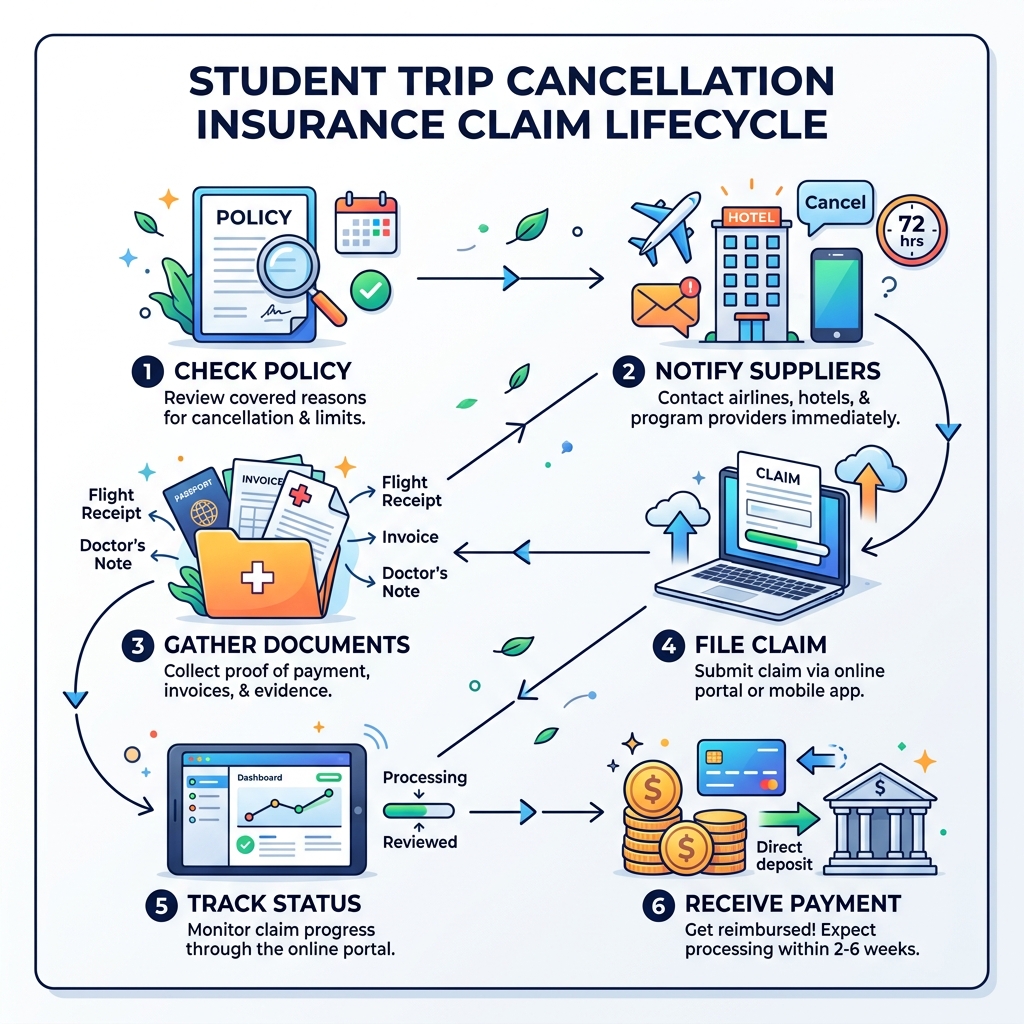
Here’s the quick version of how to file a student trip cancellation claim:
- Check your policy – confirm your reason for cancelling is covered before you do anything else
- Notify your travel suppliers – contact airlines, hotels, and program providers as soon as possible (within 72 hours)
- Gather your documents – proof of payment, trip invoices, and evidence of your covered reason (e.g., medical certificate)
- File your claim – submit via your insurer’s online portal or app with all supporting documents
- Track your claim – use your insurer’s online portal or student zone to monitor status
- Receive payment – expect 2 to 6 weeks for processing; direct deposit is typically faster
You saved up for months. You paid for flights, accommodation, and program fees. Then something went wrong — an illness, a family emergency, or a sudden change in circumstances — and now you’re staring at a pile of non-refundable bookings.
This is exactly the situation student trip cancellation insurance is designed for.
But here’s the thing: having the insurance is only half the battle. Many students lose money not because they weren’t covered, but because they didn’t know how to file correctly. A missing document, a late notification, or a misunderstood policy term can result in a denied claim.
The good news? The process is straightforward once you know the steps.
This guide walks you through everything — from understanding what’s covered to submitting your claim and getting your money back as fast as possible.
Understanding Your student trip cancellation insurance claim

When we talk about a student trip cancellation insurance claim, we are referring to the formal request you make to your insurance provider to pay you back for money you’ve already spent on a trip that can no longer happen. For students, this isn’t just about a lost holiday; it often involves significant academic investments.
Unlike standard travel insurance, student-specific policies are built to protect the unique “what-ifs” of educational travel. This includes coverage for tuition reimbursement, non-refundable airfare, and specific academic fees that a regular tourist wouldn’t have to worry about. If you are heading overseas from Australia for a semester in Europe or a short course in Asia, your financial stakes are high.
To navigate this successfully, you first need to understand the difference between “Cancellation” and “Interruption.” We’ve seen many students get these confused, which can lead to filing the wrong type of paperwork.
| Feature | Trip Cancellation | Trip Interruption |
|---|---|---|
| When it applies | Before your scheduled departure date. | After your trip has already begun. |
| What it covers | 100% of prepaid, non-refundable costs. | Up to 150% of unused costs + return airfare. |
| Common Trigger | Sudden illness before the flight. | Getting injured while abroad and needing to go home. |
| Goal | To get your deposit and ticket money back. | To cover the cost of getting home and lost days. |
For more details on choosing the right plan, check out our guide on student-friendly travel insurance with cancellation coverage.
Covered Reasons for a student trip cancellation insurance claim
You can’t just file a student trip cancellation insurance claim because you have “pre-travel jitters” or decided you’d rather stay home and play video games. The reason for the cancellation must be “covered” under your specific policy.
Commonly covered reasons include:
- Sickness, Injury, or Death: This applies to you, a traveling companion, or a close family member. The illness must be “disabling” enough that a reasonable person would cancel their trip.
- Quarantine: If you are legally required to isolate due to a contagious disease (like COVID-19), this is typically a named risk.
- Inclement Weather: If a cyclone or severe storm grounds all flights for 24 hours or more, you’re usually covered.
- Terrorism or Civil Unrest: If a terrorist act occurs in your destination city shortly before your arrival. It is often helpful to provide evidence from official sources like Smartraveller to support claims related to safety risks.
- Financial Insolvency: If your airline or tour operator goes bankrupt and ceases operations.
Tuition and Academic Fees in a student trip cancellation insurance claim
One of the most critical components for students is the protection of academic fees. If your university program is cancelled or if you have to withdraw for a medical reason, you could be out thousands of dollars in tuition.
Many specialized student policies allow you to include tuition as an insurable expense. This means if you have to cancel your semester abroad because of a serious injury, you can claim back those non-refundable program fees. We highly recommend reviewing our tutorial on how to get your credits and cash back to ensure you don’t leave money on the table.
Essential Documents for a Successful Filing
Think of your student trip cancellation insurance claim like a university assignment: if you don’t provide the evidence, you won’t get the grade (or in this case, the money). Insurers need “proof of loss.” They aren’t trying to be difficult; they just need to verify that the event happened and that you actually lost money.
The first things you should grab are your proof of payment documents. This includes:
- Paid trip invoices: Showing the total cost and what was prepaid.
- Credit card or bank statements: Proving the money actually left your account.
- Trip confirmation: Your original itinerary with reservation numbers.
For a comprehensive checklist, see our article on what documents students need for travel insurance claims.
Medical and Academic Evidence
If you are cancelling for a medical reason, a simple note saying “Student was sick” won’t cut it. You will likely need a formal Medical Certificate completed by a licensed physician. This form must state that the doctor advised you to cancel the trip before the cancellation occurred.
Additionally, insurers may require an Authorization for Release of Information. This allows them to verify your medical history to ensure the claim isn’t related to an undisclosed pre-existing condition. If the cancellation is academic—such as a program being scrapped by the provider—you will need an official letter from a school official or the registrar.
Travel and Refund Verification
Before the insurance company pays you, they want to know if you’ve already received money from elsewhere. If the airline gave you a partial refund, the insurance will only cover the remaining “out-of-pocket” loss.
You will need to provide:
- Unused tickets: Proof that you didn’t actually use the transport.
- Supplier refund policies: A copy of the terms showing that your booking was indeed non-refundable.
- Common carrier reports: If the flight was cancelled by the airline, you need their official statement.
If you’re specifically dealing with flight issues, our guide on how to get money back after flight cancellation is a lifesaver.
Step-by-Step Guide to Filing Your Claim
Filing a student trip cancellation insurance claim is a race against the clock. Most policies have a 72-hour notification rule. This means once you decide to cancel, you have three days to notify your travel suppliers (airlines, hotels, etc.) to minimize the cancellation penalties. If you wait a week to tell the airline you aren’t coming, and the cancellation fee goes up, the insurance company might not pay the extra amount.
Follow our step-by-step guide to filing a claim for the most efficient results.
Immediate Actions After Cancellation
The moment you know the trip is off, do these three things:
- Call your insurance provider’s emergency assistance line. They can guide you on the specific forms you need.
- Contact your travel providers. Cancel your flights and accommodation in writing so you have a timestamped record.
- See a doctor (if medical). If you haven’t already, you must have a medical exam within 72 hours of cancelling to prove the illness was legitimate.
We’ve detailed these high-priority tasks in our post on how to effectively file a claim.
Submitting and Tracking Your Request
Most modern insurers, especially those serving the Australian market, allow you to submit everything through an online portal or a “Student Zone.”
Once submitted, you will receive an Explanation of Benefits (EOB). This document explains what was covered, what wasn’t, and why.
Claim Processing Statistics:
- Initial Review: Usually takes about 10 business days.
- Total Processing Time: Typically ranges from 2 to 6 weeks.
- Payment Method: Direct deposit is almost always faster than receiving a cheque in the mail.
Avoiding Common Pitfalls and Claim Denials
Nothing is more frustrating than waiting six weeks only to have your student trip cancellation insurance claim rejected. Most denials happen because of small technicalities that could have been avoided.
One of the biggest hurdles is the “Pre-existing Condition” clause. Most policies won’t cover a cancellation caused by a health issue you already had before buying the insurance. However, many plans offer a Pre-existing Condition Waiver if you purchase the insurance within a specific timeframe (often within 14-21 days of making your first trip deposit).
To avoid these traps, read our advice on how to not get stuck with a non-refundable nightmare.
Cancel For Any Reason (CFAR) Upgrades
If you want the ultimate peace of mind, look for a Cancel For Any Reason (CFAR) upgrade. Standard insurance only covers “named perils” (the reasons listed in the policy). CFAR, as the name suggests, allows you to cancel because you’re tired, scared of travel, or simply changed your mind.
Important CFAR Facts:
- Reimbursement: Usually covers 75% of your non-refundable costs, not 100%.
- Timing: You must typically purchase this upgrade within 21 days of your initial trip payment.
- Execution: You must cancel the trip at least 48 hours before your scheduled departure.
Why Student Claims Get Rejected
Beyond pre-existing conditions, here are the top reasons we see claims get tossed:
- Lack of Documentation: Missing the original receipts or the doctor’s signature.
- Non-Covered Reasons: Trying to claim for an exam conflict or a breakup (unless you have CFAR).
- Late Notification: Waiting too long to cancel with the airline, leading to higher fees.
- Disabling Illness Definition: The illness wasn’t severe enough to actually prevent travel (e.g., a mild cold).
Frequently Asked Questions about Student Trip Cancellation
How long does it take to receive payment for a claim?
In our experience with Australian student policies, the standard processing time is 2 to 6 weeks. Most insurers aim for a 10-day initial review period. If your claim is straightforward and all documents are uploaded correctly to the online portal, you could see a direct deposit in under a month.
Are pre-existing medical conditions covered?
Generally, no, unless you have a waiver. Insurers look back at your medical history (usually the last 180 days). If you’ve been treated for the condition in that window, it’s excluded. To get around this, you must buy your insurance early—usually right after you pay your first trip deposit—to qualify for a stability waiver.
Can I cancel my trip if I change my mind about studying abroad?
Only if you have Cancel For Any Reason (CFAR) coverage. Standard trip cancellation insurance does not cover “change of mind.” If you have CFAR, you can typically get about 75% of your money back, provided you cancel at least 48 hours before you were meant to leave.
Conclusion
Navigating a student trip cancellation insurance claim doesn’t have to be a nightmare. While the paperwork can feel overwhelming, especially when you’re already dealing with the stress of a cancelled trip, following a structured process is the key to success.
At RecipesGuard, we specialize in providing students with the step-by-step tutorials they need to handle the insurance advisory world with confidence. Whether you’re heading to the UK, the US, or staying within the Asia-Pacific region, our focus is on ensuring you don’t lose your hard-earned savings to unexpected travel hiccups.
Ready to start your paperwork? Get started with your student travel claim today and let us help you get your money back where it belongs—in your pocket.
