
Your Flight Got Canceled — Here’s How to Get Your Money Back
The flight cancellation claim process is simpler than most people think, especially after new U.S. rules took effect in October 2024. Here’s a quick overview of the steps:
- Check if you qualify — Your flight was canceled, or delayed 3+ hours (domestic) or 6+ hours (international)
- Decide: rebook or refund — You can accept a new flight, or decline and request a full cash refund
- Reject vouchers in writing — If you want cash, don’t accept travel credits without confirming your right to a refund
- Contact the right party — Reach out to your airline directly, or your travel agent if you booked through one
- Wait for processing — Refunds take up to 7 days for credit cards, or 20 days for other payment methods
Flight cancellations are stressful at the best of times. For international students studying abroad, they can feel completely overwhelming — especially when you’re dealing with a medical emergency, don’t speak the local language fluently, and have no idea what you’re actually entitled to.
The good news? The rules are now more clearly on your side.
As of October 28, 2024, the U.S. Department of Transportation (DOT) requires airlines to issue automatic cash refunds when flights are canceled or significantly delayed — no more fighting for what you’re owed. Before this rule, getting a refund could be a frustrating, drawn-out process where airlines might push vouchers or credits instead of real money.
And it’s not just the U.S. The EU, UK, and Canada all have their own passenger protections that can put money back in your pocket — sometimes hundreds of dollars — depending on your route and airline.
This guide walks you through exactly what to do, step by step.
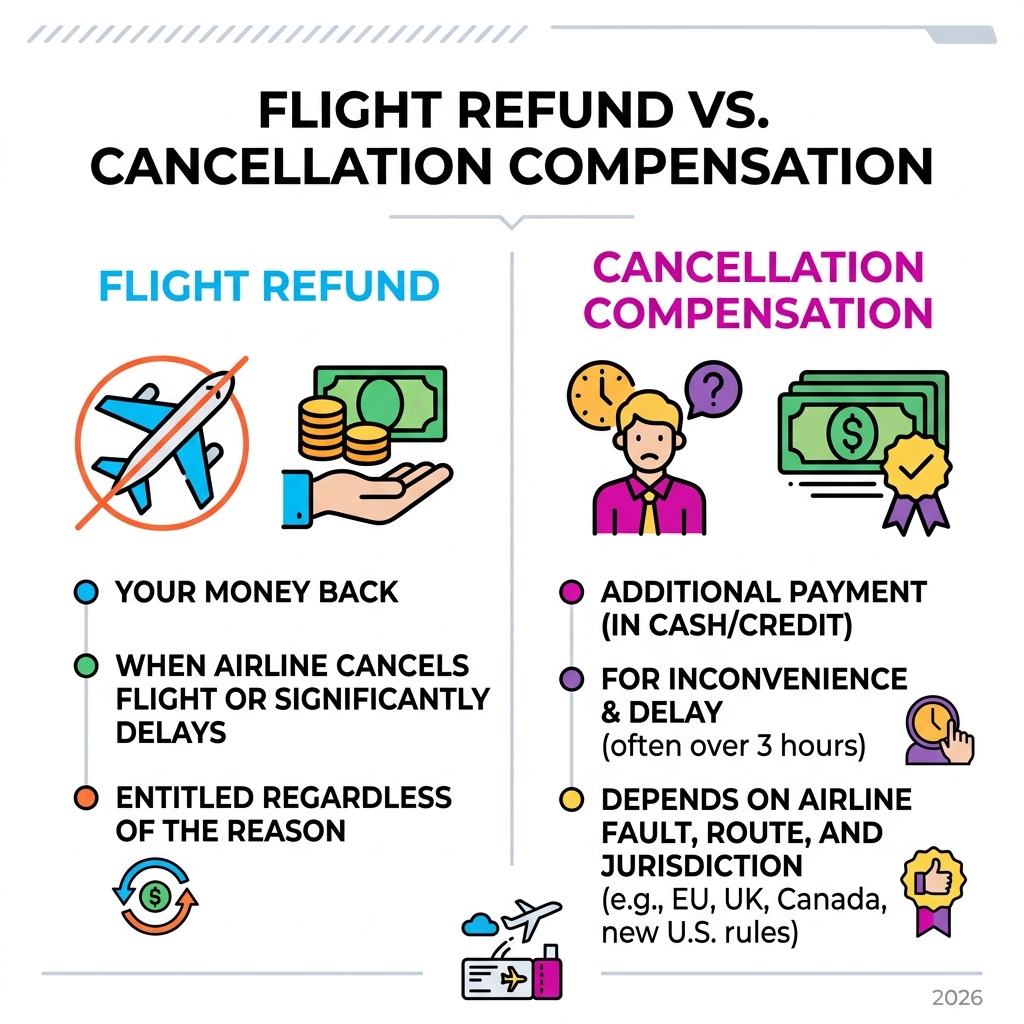
Understanding Your Rights Under New DOT Rules
Navigating the flight cancellation claim process used to feel like a full-time job. You’d spend hours on hold, only to be offered a “travel credit” that expired in six months. We have some great news: those days are largely over. New U.S. Department of Transportation (DOT) rules have fundamentally shifted the power back to the passenger.
The core of these new rules is the “automatic refund.” If your flight is canceled or significantly changed, and you choose not to travel on the alternative offered, the airline must give you your money back. You don’t even have to ask for it in many cases—it is supposed to be triggered automatically if you don’t accept the rebooking.
What Counts as a “Significant Change”?
Not every delay entitles you to a full cash refund, but the DOT has finally put hard numbers on what “significant” means. You are entitled to a refund if:
- Domestic Flights: Your departure or arrival time changes by more than 3 hours.
- International Flights: Your departure or arrival time changes by more than 6 hours.
- Airport Changes: The airline moves your flight to a different airport (e.g., switching from JFK to Newark).
- Increased Connections: They add a connection to your itinerary that wasn’t there before.
- Downgrades: You are moved to a lower class of service (e.g., from Business to Economy).
- Accessibility Issues: For our student travelers with disabilities, if the aircraft is changed to one that is less accessible, you are entitled to a refund.
Processing Timelines: When Will You See the Cash?
The DOT isn’t just mandating that you get paid; they are mandating when. Airlines are now required to process refunds within:
- 7 business days if you paid by credit card.
- 20 calendar days if you paid by cash, check, or other methods.
This is a massive win for students on a budget who can’t afford to have hundreds of dollars tied up in “airline limbo” for months. To see how your specific airline stacks up, you can check the Airline Cancellation and Delay Dashboard, which tracks the commitments made by the 10 largest U.S. carriers.
The 24-hour refund rule for new bookings
Before we dive deeper into the flight cancellation claim process, let’s talk about the “Oops” rule. If you book a flight and realize ten minutes later that you picked the wrong date (we’ve all been there), you are generally protected.
For tickets booked at least seven days before departure, U.S. law requires airlines to either:
- Allow you to hold the reservation at the quoted fare for 24 hours without payment, or
- Allow you to cancel the booking within 24 hours for a full refund to your original payment method.
Pro Tip: This rule applies to the “merchant of record.” If you booked directly with the airline, they handle it. If you used a ticket agent or an online travel agency (OTA), you must contact them to initiate the refund.
The Step-by-Step Flight Cancellation Claim Process
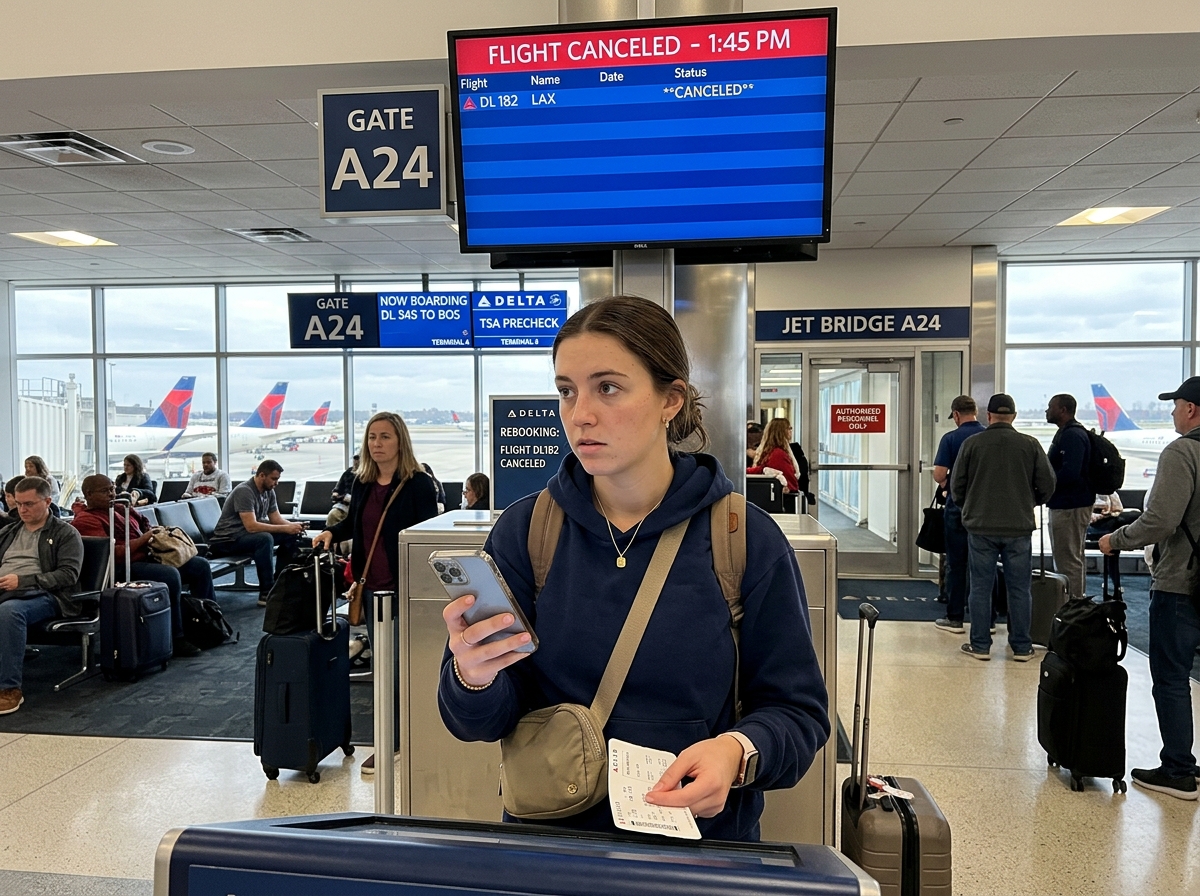
When the screen at the gate turns red and says “CANCELED,” don’t panic. Following a logical flight cancellation claim process will ensure you get home (or get your money back) with the least amount of friction.
1. Check Your App Immediately
The second a flight is disrupted, the airline’s automated systems start working. Open the airline’s mobile app. Most major carriers like Delta, United, and American will automatically suggest a new itinerary. You can often “Accept” or “Find Alternative Flights” directly in the app.
2. Decide: Travel or Refund?
This is the most important decision in the flight cancellation claim process.
- If you want to get to your destination: Use the app to rebook. If the options are bad, head to the customer service desk (or call the airline’s international service line, which often has shorter wait times).
- If you want your money back: If the delay is “significant” (3+ hours domestic/6+ hours international) and you decide not to take the new flight, you are entitled to a refund.
3. Reject Vouchers in Writing
Airlines love giving out vouchers because it keeps your money in their ecosystem. However, under the new rules, they cannot force you to take a voucher if you are entitled to a cash refund. If an agent offers a credit, say: “I appreciate the offer, but I am exercising my right to a full cash refund to my original form of payment as per DOT regulations.”
4. Refund Timelines Table
| Payment Method | Refund Processing Time |
|---|---|
| Credit Card | 7 Business Days |
| Cash, Check, or Other | 20 Calendar Days |
Initiating the flight cancellation claim process with your airline
If the refund doesn’t happen automatically within the 7-to-20-day window, you’ll need to step in.
- Direct Bookings: Visit the airline’s “Refunds” page. You will usually need your 6-digit confirmation code (PNR) and ticket number (a 13-digit code starting with the airline’s specific prefix).
- Third-Party Agents: If you booked through a site like Expedia or a student travel agency, they are the “merchant of record.” You must request the ticket price refund through them. However, the airline is still responsible for refunding any ancillary fees (like bags or seats) you paid directly to the carrier.
Documenting evidence for a successful flight cancellation claim process
We cannot stress this enough: Document everything. Airlines are much more likely to approve a claim when you have receipts.
- Take a photo of the departure board showing your flight as “Canceled” or “Delayed.”
- Save your boarding passes (digital or paper).
- Screenshot the “Reason for Delay” if it’s listed in the app (e.g., “Mechanical” or “Crew Availability”).
- Keep all receipts for food, water, or hotels if the airline doesn’t provide them.
For our student community, knowing what documents students need for travel insurance claims is vital. Often, the same documents you use for the airline will be required by your insurance provider.
Controllable vs. Uncontrollable Disruptions: What Are You Owed?
One of the biggest points of confusion in the flight cancellation claim process is why some people get free hotels and others get told to sleep on the floor. It all comes down to whether the delay was “controllable.”
Controllable Disruptions (Airline’s Fault)
These are issues the airline could have prevented. Examples include:
- Maintenance: A broken engine or a faulty Wi-Fi system.
- Crew Issues: The pilot timed out or the flight attendants didn’t show up.
- Cabin Cleaning: The plane wasn’t ready in time.
- Baggage Loading: Delays in getting suitcases on the plane.
If the disruption is controllable, most major U.S. airlines (except Frontier) have committed to providing:
- Meal Vouchers: Usually if the delay is 3+ hours.
- Hotel Accommodations: If you are stranded overnight away from home.
- Ground Transportation: A shuttle or Uber to the hotel.
Uncontrollable Disruptions (Not the Airline’s Fault)
If Mother Nature decides to throw a blizzard at Chicago, the airline isn’t legally required to buy you a steak dinner.
- Weather: The most common “uncontrollable” excuse.
- Air Traffic Control (ATC): If the FAA tells the airline they can’t land because of congestion.
- Security Issues: Airport-wide shutdowns.
Expert Tip: Even if the delay is uncontrollable, you are still entitled to a refund of your ticket price if you choose not to travel. The “controllable” distinction only applies to the extra perks like hotels and meals.
Claiming refunds for ancillary services
Did you pay $50 for a checked bag that didn’t arrive with you? Or $20 for Wi-Fi that didn’t work? You are entitled to get that money back.
- Baggage Fee Refunds: Under the new rules, if your bag isn’t delivered within 12 hours (domestic) or 15–30 hours (international), the airline must refund your baggage fee. You must file a “Mishandled Baggage Report” at the airport to start this clock.
- Unused Services: If you paid for a seat with extra legroom but were moved to a standard seat, or if the Wi-Fi you paid for was broken, you are entitled to a refund for those specific fees.
If an airline refuses to honor these commitments, we recommend you file a complaint with the DOT to make your voice heard.
International Protections: EU EC 261 and UK Rules
If your flight touches European or British soil, the flight cancellation claim process gets even better. Under a regulation called EC 261 (and its UK equivalent), you might be entitled to “Fixed Compensation”—which is cash on top of your refund.
Does it apply to you?
- Flights departing from an EU/UK airport: Applies to any airline.
- Flights arriving in the EU/UK from outside: Applies only if you are flying on an EU/UK-based airline (e.g., British Airways, Lufthansa, Air France).
How much can you get?
The amount is based on the distance of the flight and how long you were delayed:
- Short flights (<1,500km): Up to €250 (~$270).
- Medium flights (1,500km – 3,500km): Up to €400 (~$430).
- Long flights (>3,500km): Up to €600 (~$650).
To qualify, the airline must have given you less than 14 days’ notice of the cancellation, and the reason must not be “extraordinary circumstances” (like weather). You can read the text of EC 261 here to see the fine print.
How Travel Insurance Fills the Gaps for Students
While the DOT rules are great for ticket refunds, they don’t cover everything. What about the $500 non-refundable hotel you booked in Paris? Or the concert tickets you missed? This is where travel insurance becomes a student’s best friend.
At RecipesGuard, we specialize in helping students navigate these tricky waters. We’ve seen countless cases where a student was stranded, and while the airline refunded the flight, they wouldn’t cover the “consequential losses.”
Why Students Need Extra Protection
- Trip Interruption: If a family emergency forces you to cancel your trip, the airline won’t help you, but insurance will.
- Medical Emergencies: If you get sick and can’t fly, insurance covers the cancellation costs.
- The “Gap” Coverage: Insurance often pays out for delays as short as 6 hours, providing a “daily allowance” for food and essentials that might exceed what the airline offers.
We highly recommend looking into student-friendly-travel-insurance-with-cancellation-coverage before your next semester break. If you do find yourself needing to use it, our guide on how-to-effectively-file-a-travel-insurance-claim-as-a-student will walk you through the paperwork so you can get back to studying (or, more likely, catching up on sleep).
Frequently Asked Questions about Flight Cancellations
What qualifies as a ‘significant change’ for a refund?
As of late 2024, the DOT defines this as a delay of 3+ hours for domestic flights and 6+ hours for international flights. It also includes changes to the departure or arrival airport, the addition of connections, or a downgrade in the class of service.
Can I get a refund if I booked through a travel agent?
Yes, but the flight cancellation claim process is slightly different. The travel agent (the merchant of record) is responsible for refunding the ticket price. However, the airline is still responsible for refunding any fees for extras (like bags or seats) that you paid directly to them.
Are airlines required to provide a hotel for weather delays?
No. Under U.S. law, airlines are not required to provide hotel accommodations for “uncontrollable” events like weather. However, many will provide “distressed passenger” rates (discounted hotel vouchers) if you ask nicely. This is also where your credit card travel insurance or a separate policy from RecipesGuard would kick in to cover your costs.
Conclusion
The flight cancellation claim process doesn’t have to be a nightmare. By understanding the new 2024 DOT rules, keeping meticulous records, and knowing when to stand your ground, you can ensure that a canceled flight doesn’t ruin your finances.
Remember:
- Know your hours: 3 for domestic, 6 for international.
- Cash is King: Don’t let them push a voucher on you if you want a refund.
- Document everything: Photos, screenshots, and receipts are your best friends.
For students, travel is an incredible opportunity, but it comes with risks. We’re here to help you manage those risks so you can focus on the adventure. If you’re feeling stuck, check out our step-by-step-guide-to-filing-a-travel-insurance-claim-as-a-student for more detailed advice.
Safe travels, and may your flights always be on time! Visit RecipesGuard for more student travel tips.
