
What You Need to Know About the Student Abroad Claim Process
The student abroad claim process is how you get reimbursed for unexpected costs — medical bills, lost baggage, trip cancellations, and more — that happen while studying overseas.
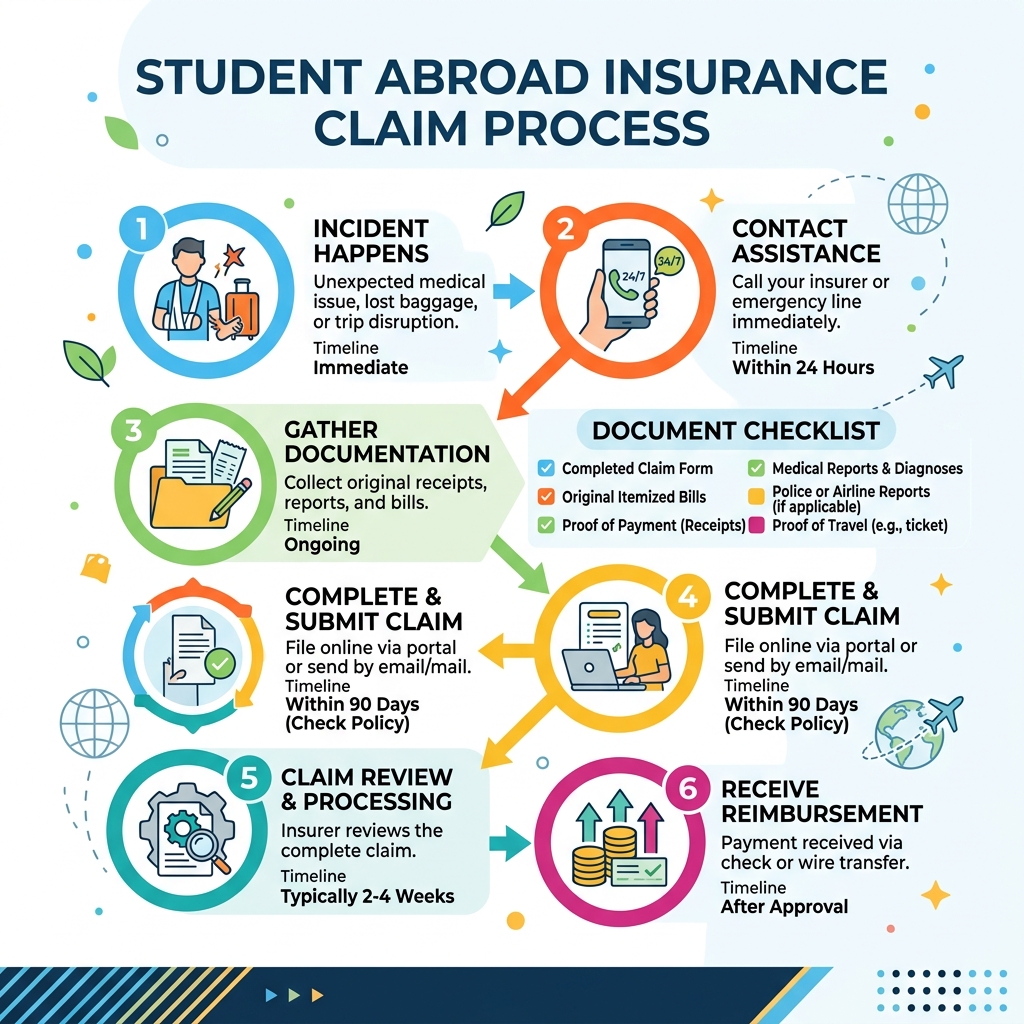
Here’s a quick overview of how it works:
- Incident happens — medical emergency, lost luggage, trip disruption
- Contact your insurer or emergency assistance line immediately (many operate 24/7)
- Pay upfront in most cases, then claim reimbursement later
- Gather documents — receipts, medical reports, police reports, bills
- Submit your claim via online portal, email, fax, or mail within the deadline (usually 90 days)
- Wait for processing — typically 2 to 4 weeks for a complete claim
- Receive reimbursement by check or wire transfer
This matters more than most students expect. Over 80% of students who study abroad face at least one unexpected medical or travel issue during their time overseas. Yet many arrive without knowing how their insurance actually works — or what to do when something goes wrong.
The result? Delayed reimbursements, denied claims, and out-of-pocket costs that could have been avoided.
This guide walks you through every step — from emergency actions to documentation, submission, and appeals — so you can recover your money without the guesswork.
Immediate Actions During a Medical or Travel Emergency
When you’re in the middle of a crisis in a foreign country, the last thing you want to do is read a 50-page policy document. However, the actions you take in the first hour can determine whether your student abroad claim process goes smoothly or turns into a bureaucratic nightmare.
First, always carry your insurance ID card and an emergency contact card. Most student policies include 24/7 assistance services through providers like AXA Assistance or International SOS. These aren’t just “help lines”—they are your lifeline for coordinating care and ensuring the bills get paid.

In a medical emergency, you generally have two paths:
- Upfront Payment: For minor issues (like a quick visit to a local GP for a sinus infection), you will likely pay the bill yourself and seek reimbursement later. We recommend keeping at least US$500 (or the local equivalent) in emergency funds for these situations.
- Direct Billing / Guarantee of Payment: For major incidents like hospital admissions or surgeries, you must contact your assistance provider immediately. They can often issue a “Guarantee of Payment” to the hospital, meaning the insurer pays the facility directly so you don’t have to cough up thousands of dollars on the spot.
To ensure you don’t miss a beat, check out our guide on how to effectively file a travel insurance claim as a student.
Enrolling in Safety Programs for U.S. Students
If you are a U.S. citizen studying in Australia or elsewhere, one of the smartest “pre-claim” moves you can make is to Enroll in STEP (opens in a new tab). The Smart Traveler Enrollment Program (STEP) is a free service that connects you with the nearest U.S. embassy or consulate.
While STEP isn’t insurance, it plays a vital role in the emergency process. If a natural disaster or civil unrest occurs, the embassy uses STEP data to contact you or your emergency contacts. This official connection can be crucial when documenting “Trip Interruption” claims caused by government-ordered evacuations.
Essential Documentation for Reimbursement Success
The number one reason claims are delayed? Missing paperwork. Think of the insurance company as a very skeptical friend who needs proof for every cent you spent. You need to be a “document hoarder” during your time abroad.
| Claim Type | Essential Documents Needed |
|---|---|
| Medical | Itemized bills, physician’s diagnosis, pharmacy receipts with drug names, proof of payment. |
| Baggage Loss | Police report (if stolen), airline “Property Irregularity Report,” original receipts for items. |
| Trip Cancellation | Flight itinerary, boarding passes, unused tickets, medical certificate explaining the “why.” |
When dealing with medical issues, a simple credit card receipt isn’t enough. You need an itemized bill that shows exactly what service was provided and a physician’s diagnosis. If you bought medicine, ensure the pharmacy receipt lists your name, the date, the specific drug, and the amount dispensed.
For a deeper dive into the specifics, read our article on what documents students need for travel insurance claims.
Handling Non-Medical Claims and Losses
Not every claim involves a doctor. If your baggage is delayed for more than 6 to 12 hours, most policies allow you to buy “essential” items (like toiletries and a change of clothes). To get your money back, you must get a written confirmation of the delay from the airline.
If you are involved in an incident involving personal liability (for example, if you accidentally damage your student housing), never admit liability or promise to pay the other party. Contact your insurer first. They will handle the legal side. If something is stolen, you usually have a strict 24-hour window to file a police report. Without that report, your claim is almost certainly dead on arrival.
Navigating the Claims Process with Major Administrators
Once you have your documents, it’s time to actually file. Most modern providers have moved away from “snail mail” and now offer streamlined participant portals. Whether you are using CISI, ACI, or WorldStrides, the step-by-step guide to filing a travel insurance claim as a student follows a similar logic.
You will typically Login to Submit Your Claim through a dedicated student portal. Here, you’ll answer guided questions about the incident and upload your PDFs or photos of receipts.
If your provider is ACI (Administrative Concepts, Inc.), they often handle claims for various study abroad programs like WorldStrides. You can submit via their website, but they also accept claims via email or fax. Just remember: if you’re mailing physical documents, always keep copies. Documents have a mysterious way of disappearing in international transit.
Digital Submission Methods and Mobile Apps
We live in a digital age, and insurance is finally catching up. Some providers, like AXA, offer apps like “Emma by AXA” that allow for paperless filing.
The benefits of using an app or portal include:
- Real-time tracking: No more wondering if your claim was received.
- Faster processing: Some digital claims are reviewed within 7 working days.
- Instant communication: If a document is missing, you get a notification immediately rather than waiting for a letter in the mail.
Claiming Education Tax Credits for International Study
While most of this guide focuses on insurance, the student abroad claim process also extends to your wallet back home. If you are a U.S. taxpayer (or a dependent of one) studying at an eligible university in Australia, you might be able to claim the American Opportunity Tax Credit (AOTC) or the Lifetime Learning Credit (LLC).
To do this, you’ll need to use Form 8863. These credits can be worth thousands of dollars, effectively giving you “cash back” on your tuition and required fees.
Pro Tip: Keep all tuition receipts and enrollment verifications. Since foreign schools don’t always issue the standard Form 1098-T, you’ll need these documents to prove your expenses to the IRS. Also, remember to record the currency exchange rate on the day you made each payment!
Verifying School Eligibility and Federal Codes
Not every school qualifies for these tax credits. To be eligible, the foreign university must participate in the U.S. federal student aid program. You can check this by looking for a Federal School Code.
Foreign institutions have a six-character code that usually starts with the letter “G.” You can search for your school on StudentAid.gov. If your school is on the list, you’re in luck—your international education just got a whole lot cheaper.
Avoiding Denials in the student abroad claim process
Getting a “Claim Denied” stamp is a heart-sinking moment, but most denials are preventable. Our guide on how to file a travel insurance claim as a student highlights the most common traps.
The biggest “gotchas” include:
- The 90-Day Deadline: Most insurers require you to file within 90 days of the incident. If you wait until the semester is over to deal with a claim from orientation week, you’re likely too late.
- Pre-existing Conditions: If you have a chronic illness, make sure your policy covers it. Many basic plans exclude anything you were treated for in the 6 months before travel.
- Incomplete Forms: Missing a signature or leaving the “Description of Incident” blank will result in an immediate delay.
- Unauthorized Treatment: For non-emergencies, some policies require “pre-approval” before you see a specialist.
If you are denied, don’t panic. You usually have a 90-day window to file an appeal. Provide the missing information or a letter from your doctor clarifying the situation, and many insurers will reconsider.
How long does the student abroad claim process take?
Patience is a virtue, but when you’re waiting for a $1,000 reimbursement, it’s hard to stay calm. Here is what to expect:
- Initial Review: Usually 15 business days from the date they receive your documents.
- Total Processing: Most complete claims are settled within 2 to 4 weeks.
- Payment Delivery: If they mail a check to a U.S. address, it takes 7–10 days. If you’re still in Australia, a wire transfer is faster, though you may need to provide your international banking details (SWIFT/BIC).
Note: Reimbursement checks are often only valid for 120 days. Don’t let that check sit in your mailbox back home—have someone deposit it for you!
Common pitfalls in the student abroad claim process
Beyond the big denials, watch out for these smaller issues that can slow things down:
- Missing Receipts: “I lost the paper” is not a valid excuse for an insurance company.
- Late Notification: Failing to call the emergency line during a hospital stay.
- Exclusion Clauses: Engaging in “high-risk” activities like skydiving or bungee jumping that aren’t covered by standard student plans.
- Alcohol/Drug Involvement: Most claims are automatically denied if the injury occurred while you were under the influence.
Frequently Asked Questions about Overseas Claims
What should I do if I lose my passport abroad?
First, file a police report immediately. Then, contact the nearest embassy or consulate to start the replacement process. Your insurance often covers the cost of the replacement passport and travel expenses to get to the embassy, but you’ll need the police report and receipts for all fees paid.
Can I file a claim after I return to my home country?
Yes, as long as you are within the filing deadline (usually 90 days from the incident). However, it is much harder to get a missing medical report or a police statement once you’ve left the country. We always recommend starting the student abroad claim process while you are still on-site.
How do I handle medical bills if the provider doesn’t accept my insurance?
This is common. In many countries, you are expected to pay the bill at the time of service. You then take that itemized bill and submit it to your insurer for reimbursement. This is why having access to a credit card with a decent limit is essential for any student traveler.
Conclusion
Navigating the student abroad claim process doesn’t have to be a nightmare. At RecipesGuard, we’ve seen that the difference between a paid claim and a denied one usually comes down to two things: speed and documentation.
Keep your receipts, call your insurer the moment something feels wrong, and don’t miss your deadlines. Studying abroad is a once-in-a-lifetime experience—don’t let a medical bill or a lost suitcase ruin the memories.
For more detailed tutorials and checklists, visit our student claim guides. Safe travels!
