
Where Is My Bag? What to Do Right Now
If you’re dealing with a lost bag claim australia situation, here’s the short answer:
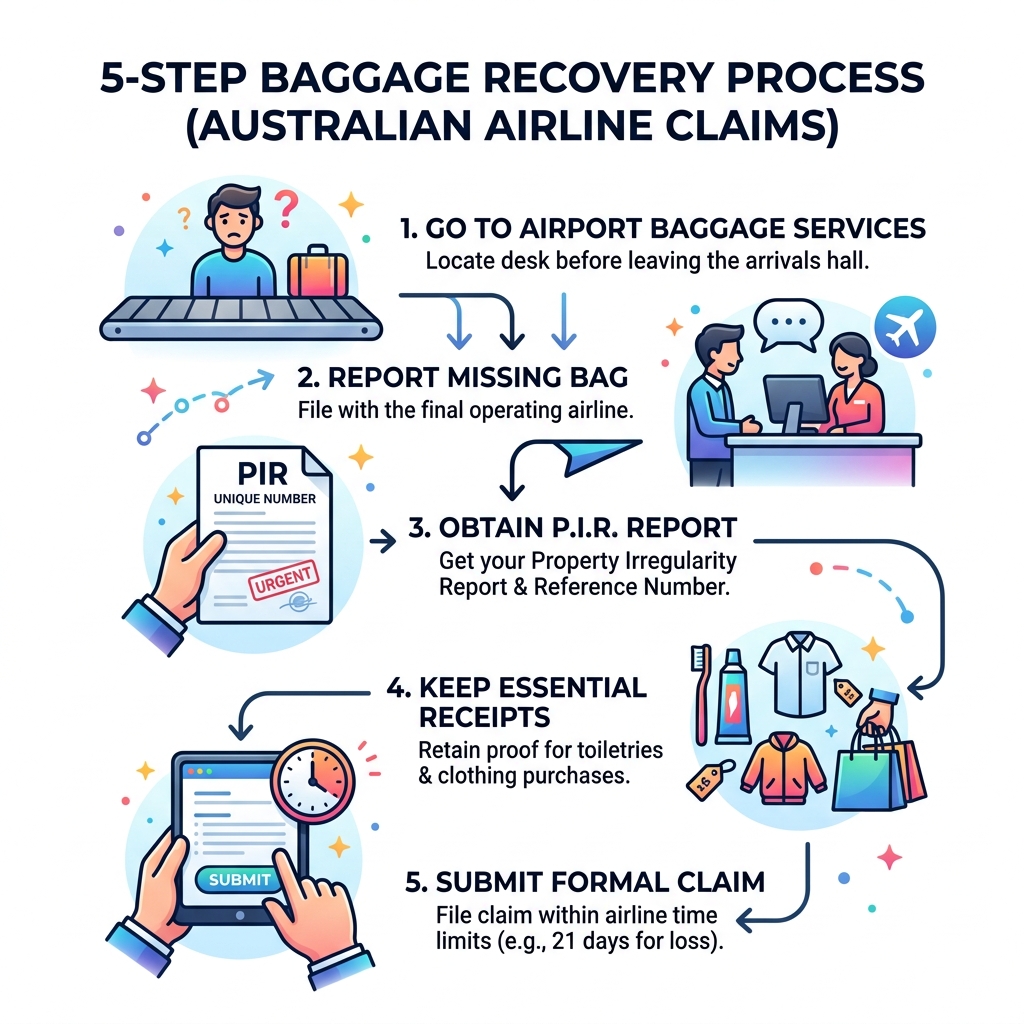
How to file a lost bag claim in Australia (quick steps):
- Go to the baggage services desk before leaving the airport — do not exit the arrivals hall first
- Report your missing bag to the final operating airline (not necessarily the one you booked with)
- Get a Property Irregularity Report (PIR) — this is your reference number for everything that follows
- Keep all receipts for essential items you buy while waiting (toiletries, clothing)
- Submit a formal claim form within the strict time limits — as short as 3 days for damage, 21 days for loss
There are few travel moments more stressful than watching the baggage carousel go around and around — and realising your bag just isn’t on it. As one travel writer puts it, “It’ll never happen to me.” Yet there you stand.
For international students in Australia, the stress is even sharper. You may be far from home, short on spare clothes, and completely unfamiliar with how Australian airline claims work. The good news? You have clear legal rights, and most delayed bags come back within 24 to 48 hours.
This guide walks you through exactly what to do — step by step — whether your bag is delayed, damaged, or officially lost.
Immediate Steps for a Lost Bag Claim in Australia
When the carousel stops and your suitcase is nowhere to be found, your first instinct might be to head to your hotel and call the airline later. Do not do this. The most critical part of a lost bag claim australia happens before you walk through the arrivals gate.
Reporting Before You Leave the Airport
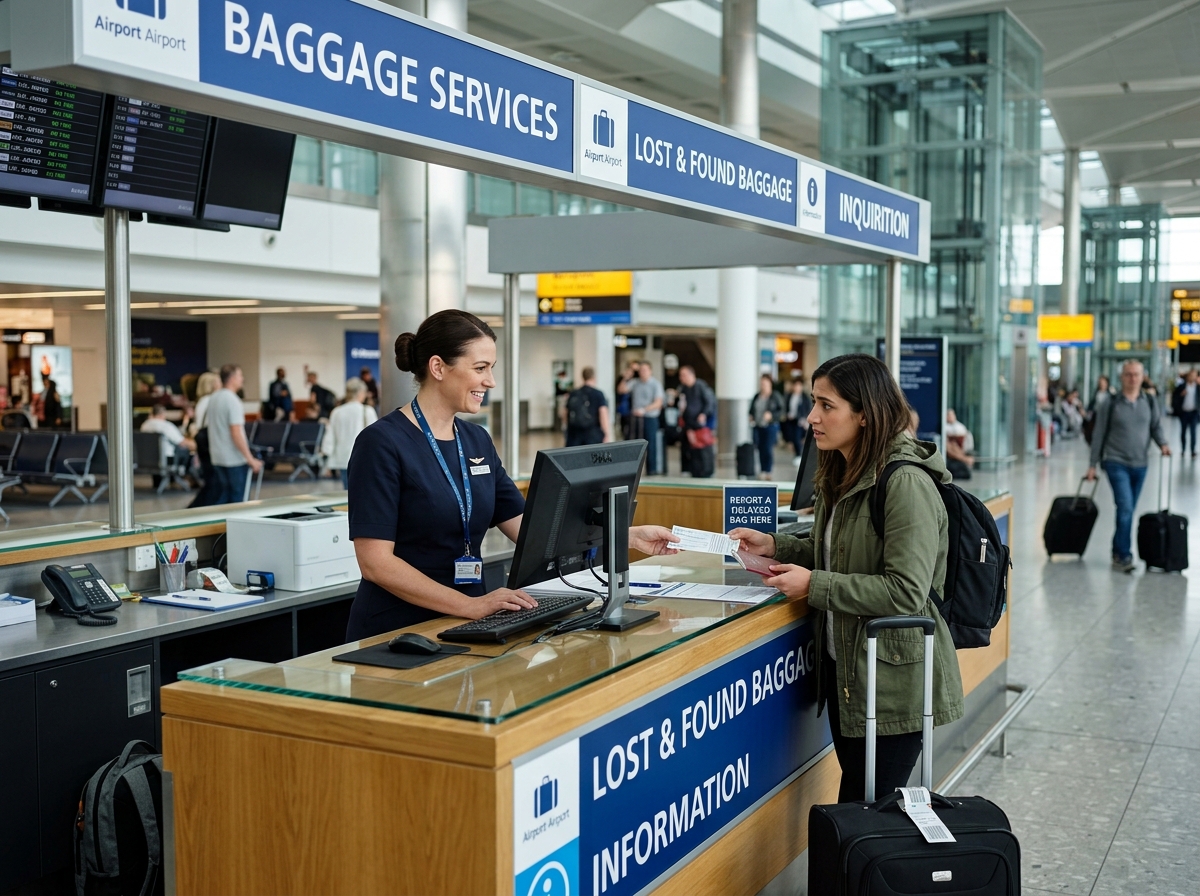
You must locate the Baggage Services desk. This is usually tucked away near the carousels in the arrivals hall. If you can’t find a desk for your specific airline, look for ground handling agencies like Swissport, Dnata, or Menzies. These companies often manage baggage for multiple international airlines at major hubs like Melbourne or Sydney.
When you speak to the agent, you will need:
- Your baggage tags (usually stuck to the back of your boarding pass).
- Your booking reference (PNR).
- A physical description of your bag (color, brand, size, any unique ribbons or stickers).
The agent will create a Property Irregularity Report (PIR). This is a 10-character alphanumeric code (e.g., MELQF12345) that is absolutely essential for tracking your bag and filing future reimbursement claims. You can often submit a delayed baggage report online if the queue is too long, but getting that PIR reference before leaving the airport is the gold standard for protection.
If you flew on a codeshare flight (e.g., booked with Qantas but the last leg was on Emirates), you must report the issue to the final carrier that operated the flight you just stepped off. According to Mishandled Checked Baggage | Air New Zealand – Australia, the last airline to touch your bag is legally responsible for the claim process.
The Difference Between Lost Property and Mishandled Baggage
It is important to distinguish between “mishandled baggage” and “lost property.”
- Mishandled Baggage: This refers to checked luggage that the airline took responsibility for at the check-in counter but failed to deliver to the carousel.
- Lost Property: These are items you accidentally left behind in the cabin items, seat pockets, or airline lounges.
Airlines generally hold found lost property for about 30 days (sometimes up to 60 if you make contact). To collect these items, you will usually need to provide photo ID. However, airlines are typically not liable for items left on the plane, whereas they are liable for checked bags under Australian law.
Understanding Time Limits and Liability for Baggage Claims
In aviation, “later” often means “too late.” There are very strict windows for reporting issues. If you miss these deadlines, your lost bag claim australia may be summarily rejected.
Strict Deadlines for a Lost Bag Claim in Australia
The rules change depending on whether your flight was domestic or international. Domestic travel within Australia is governed by the Civil Aviation (Carriers’ Liability) Act, while international travel falls under the Montreal Convention or the older Warsaw Convention.
| Issue Type | Domestic (Australia) | International |
|---|---|---|
| Damaged Checked Bag | 3 Days | 7 Days |
| Damaged Carry-on | 3 – 7 Days | 7 Days |
| Delayed/Lost Bag | 21 Days | 21 Days |
For domestic flights, you have a tiny window of just 3 days to report damage. If your bag is delayed, it is legally considered “delayed” for the first 21 days. On the 22nd day, it is officially classified as “lost.” You can find more details on these time limits Mishandled Checked Baggage | Air New Zealand – Australia.
The liability limits are also fixed. For domestic travel in Australia, the maximum compensation is capped at $3,000 for checked baggage and $300 for unchecked baggage. For international flights, the limit is set in “Special Drawing Rights” (SDR), which usually equates to roughly AUD $2,300–$2,500 depending on exchange rates.
Liability Exclusions and Damage Policies
Airlines are not “all-risk” insurers. They will frequently deny claims for what they call “normal wear and tear.” This includes:
- Minor scratches, dents, or scuffs.
- Broken zippers or handles resulting from overpacking.
- Damage to wheels or feet.
- Damage to fragile items that weren’t packed appropriately.
If your bag has a major hole or a missing wheel that wasn’t there before, you should submit a damaged baggage report immediately. Do not remove the baggage tags until you have taken photos of the damage, as these tags prove the bag was in the airline’s possession.
How to File a Lost Bag Claim in Australia with Major Airlines
Most major airlines in Australia use a centralized system called WorldTracer to locate bags. This is a global database that matches “found” bags with “lost” reports.
Filing a Lost Bag Claim in Australia with Qantas and Virgin
Qantas and Virgin Australia have streamlined their processes through online portals.
- Virgin Australia: They recommend reporting the loss at the airport to get your PIR. You can then Check status Damaged and lost baggage via their WorldTracer link. If your bag isn’t found within 7 days, you must submit a formal Baggage Claim Form.
- Qantas: Similar to Virgin, Qantas uses a 10-character code for tracking. They also offer a self-service portal where you can update your delivery address or contact details. You can view their full policy on Damaged and lost baggage to see how they handle different scenarios.
Jetstar and Air New Zealand follow similar protocols, though Jetstar’s baggage services are available 24/7 to assist with immediate reports.
Essential Documents for Your Lost Bag Claim in Australia
To ensure your claim isn’t stuck in “pending” forever, we recommend gathering these documents immediately:
- The PIR reference number.
- Your boarding pass and baggage receipts (the sticky tags).
- Proof of value for expensive items (receipts or bank statements).
- Repair quotes if you are claiming for a damaged suitcase.
- A completed damaged baggage claim form if you’ve already left the airport.
Tracking Your Luggage and Claiming Reimbursements
The waiting game is the hardest part. Fortunately, technology has made tracking a lost bag claim australia much easier than it used to be.
Tracking Your Luggage
Airlines now provide SMS notifications or email updates as your bag moves through the system. If you want to take matters into your own hands, many travelers now use Apple AirTags.
- Qantas Integration: Qantas has actually started allowing passengers to share their Find My app location link directly with baggage agents via their tracking portal. This adds a layer of “real-time” data to the airline’s internal scanning.
- Online Portals: You can log into tools for managing your delayed baggage report to see if your bag has been loaded onto a new flight.
Reimbursement for Essential Items
If you are away from home and your bag is delayed, you are generally entitled to “reasonable” emergency expenses. This usually covers toiletries and basic clothing (like underwear and a change of clothes).
Typical Limits:
- Virgin Australia: Estimates around $50 per person, per day.
- Qantas: Does not specify a hard daily dollar limit but emphasizes “essential” and “reasonable” items. You can submit your Reimbursements claim for lost or delayed baggage expenses | Qantas AU online.
Crucial Tip: You must keep all receipts. The airline will not reimburse you based on a “guess” of what you spent. Also, if the airline provides you with an “amenity kit” at the airport, this may be deducted from your total claim.
What Happens After 21 Days?
If your bag has not been located after 21 days, it is officially lost. At this point, you shift from “reimbursement for essentials” to a “settlement process.” You will need to submit a claim listing every item in the bag and its approximate value.
Be aware that airlines rarely pay the “replacement value” (the cost of a brand-new item). Instead, they pay the depreciated value based on how old the item was. This is where having travel insurance becomes vital.
When to Involve Travel Insurance for Your Baggage
While airlines have a legal liability, their payouts are often limited by the caps mentioned earlier ($3,000 for domestic). If you are an international student carrying an expensive laptop, textbooks, or designer clothing, the airline’s payout might not cover half of your loss.
Coordinating Between Airlines and Insurers
Most comprehensive cover policies will kick in after a 12-hour delay. Here is how we recommend handling the dual-claim process:
- Claim with the airline first. They are legally the primary responsible party.
- Get a written report. If the airline pays you $500 but your loss was $2,000, you will need a letter from the airline confirming the amount they paid.
- Claim the “Shortfall” from your insurer. Your insurance can cover the gap between what the airline paid and the actual value of your items. For students, learning how to effectively file a travel insurance claim as a student can save you thousands.
Beyond standard policies, you should always check if your credit card provided free travel insurance. Many “Gold” or “Platinum” cards in Australia offer baggage protection if you used the card to pay for your flights.
For a more detailed breakdown, our step-by-step-guide-to-filing-a-travel-insurance-claim-as-a-student provides a checklist of exactly what insurers look for. Mastering the student travel claim process is all about documentation and persistence.
Frequently Asked Questions about Lost Bags
How long does it take to get a delayed bag back?
Statistically, about 90% of delayed bags are returned within 24-48 hours. Once the bag is located, the airline will typically arrange a courier service to deliver it directly to your home or hotel address at no cost to you.
What is the maximum compensation for lost luggage in Australia?
For domestic flights, the maximum is $3,000 for checked bags under the Civil Aviation Act. For international flights, the Montreal Convention sets a limit of approximately 1,288 SDR (roughly AUD $2,500). These limits are per passenger, not per bag.
Can I track my bag if I didn’t use an AirTag?
Yes. Every bag has a unique bag tag number (the barcode). Airlines use the WorldTracer system to scan these at every transit point. You can check the status on the airline’s app or website using your PIR reference.
Conclusion
Navigating a lost bag claim australia is undeniably frustrating, but it doesn’t have to be a disaster. By acting quickly at the airport, keeping your receipts, and understanding the 21-day rule, you put yourself in the best position to either get your bag back or get fairly compensated.
At RecipesGuard, we specialize in helping students navigate the complexities of travel. Whether you’re moving to Australia for university or just heading home for the holidays, we provide the step-by-step tutorials you need to handle insurance and airline hurdles.
Before your next trip, take a look at our travel-insurance-tips-for-students-traveling-to-australia to ensure you’re fully protected. For more expert advice, visit our main site for More info about travel insurance claims. Safe travels—and may your bags always be the first ones off the carousel!
