
Why the Australia Student Insurance Policy (OSHC) Is Non-Negotiable for International Students
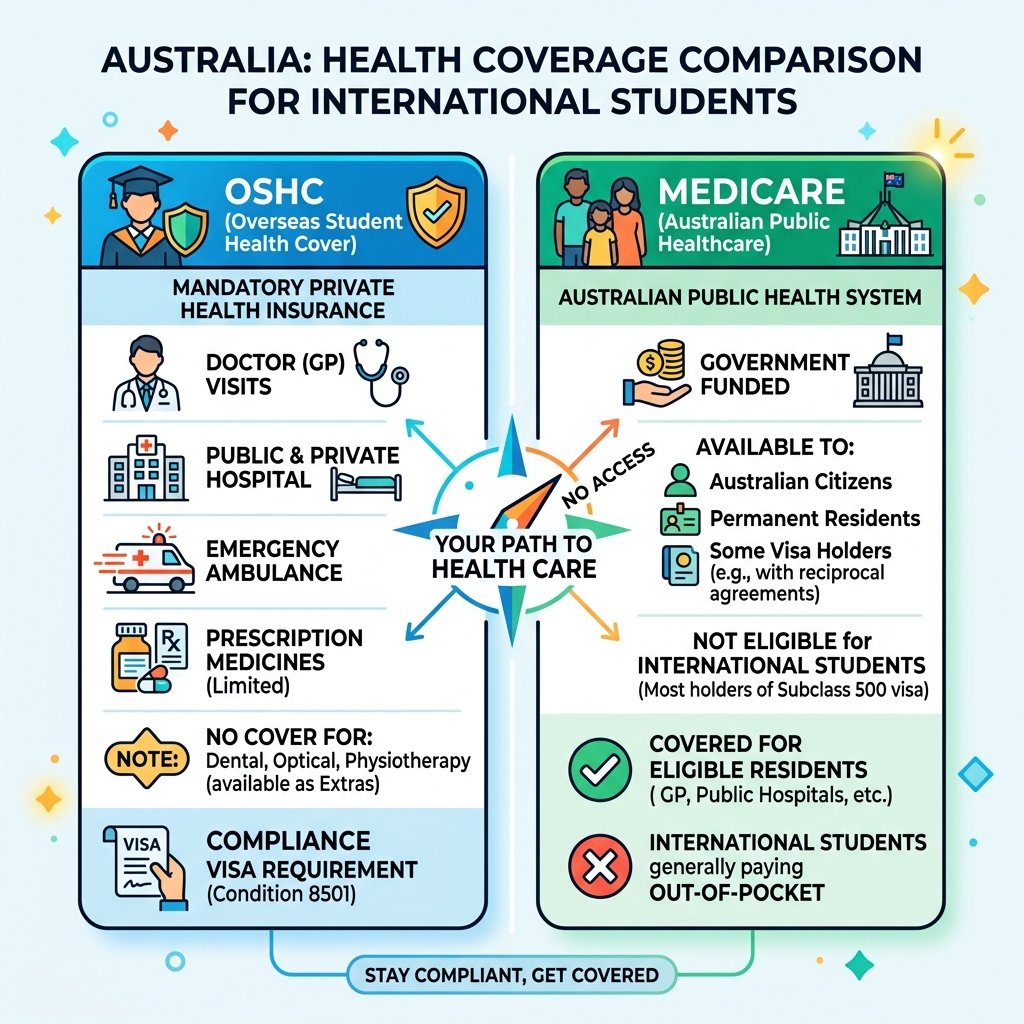
Australia student insurance policy — specifically Overseas Student Health Cover (OSHC) — is a mandatory requirement for all international students on a student visa (subclass 500). Without it, you cannot legally study in Australia.
Here’s a quick summary of what you need to know:
| Topic | Key Fact |
|---|---|
| What is it? | OSHC is health insurance designed for international students in Australia |
| Is it mandatory? | Yes — it is a condition of your student visa (condition 8501) |
| Who needs it? | All student visa (subclass 500) holders |
| What does it cover? | GP visits, hospital treatment, emergency ambulance, some prescription medicines |
| What doesn’t it cover? | Dental, optical, physiotherapy (available separately as “extras”) |
| Who provides it? | Five government-approved insurers |
| When does it start? | On your arrival date or visa grant date (whichever is later) |
| Can you use Medicare? | No — international students are not eligible for Medicare |
Unlike Australian citizens and permanent residents, international students have no access to Medicare — Australia’s public health system. That means without OSHC, a single trip to a GP or a hospital stay could cost you hundreds or thousands of dollars out of pocket.
OSHC exists to close that gap. It gives you access to affordable medical care so you can focus on your studies — not your medical bills.
Understanding the Australia Student Insurance Policy (OSHC)
When we talk about an australia student insurance policy, we are almost always referring to Overseas Student Health Cover (OSHC). This isn’t just a “good idea”—it is a legal requirement under Visa Condition 8501. If you are on a Student Visa Subclass 500, maintaining this insurance is a prerequisite for staying in the country. If your policy lapses, the Department of Home Affairs may be notified, which could lead to the cancellation of your visa.
Australia’s healthcare system is world-class, but it is also expensive for those not covered by the public safety net. Because international students are generally ineligible for Medicare (the taxpayer-funded system for citizens), the government mandates private cover through five approved providers. These insurers must follow a “community rating” system. This is a fancy way of saying they cannot charge you more based on your age, gender, or health status. Everyone gets a fair price based on the type of policy they choose.
Choosing the Right Australia Student Insurance Policy Type
Not every student comes to Australia alone. Your australia student insurance policy must reflect who is actually with you on your visa. Selecting the wrong type can lead to claim denials or issues with your visa compliance.
- Single Cover: This is for the student only. It’s the most common and affordable option.
- Dual Family Cover: This covers the primary student plus one dependent. This could be a spouse/partner or one child under 18.
- Multi-Family Cover: This is for the primary student plus more than one dependent (e.g., a partner and one or more children).
A crucial tip we always share: secondary visa holders (like your spouse) must be covered under the primary holder’s policy. They usually cannot go out and buy their own separate single OSHC policy if they are listed as a dependent on your student visa. Also, keep in mind that “Couples” or “Dual Family” policies are often more expensive than two single policies combined because they include significant benefits for pregnancy and childbirth services.
What is Covered: Medical Services and Hospital Treatment
Your australia student insurance policy is designed to mimic the benefits Australians get through Medicare. To understand what you’re getting, you need to know about the Medicare Benefits Schedule (MBS). The MBS is a list of all the services the government subsidizes and the “scheduled fee” for each.
- GP Visits: Most OSHC policies cover 100% of the MBS fee for General Practitioner (GP) visits. If a doctor “bulk bills,” you pay nothing. If they charge more than the MBS fee, you pay the “gap.”
- Specialist Visits: If you need to see a dermatologist or a cardiologist, OSHC typically covers 85% of the MBS fee.
- Hospital Treatment: This includes both public and private hospital stays. If you are admitted as a private patient in a “network” hospital (a hospital that has an agreement with your insurer), your accommodation and medical costs are generally covered.
- Emergency Ambulance: Unlike many other countries, ambulance rides in Australia aren’t always free. OSHC provides 100% coverage for emergency transport to a hospital when it is medically necessary.

Prescription Medicine and Pharmacy Benefits
While OSHC is great for doctor visits, it works a little differently for medicine. Australia has a Pharmaceutical Benefits Scheme (PBS) that keeps medicine prices low for locals. As a student, you’ll usually pay a “co-payment” (the amount a local would pay).
Most OSHC providers offer a pharmacy benefit to help with the rest of the cost. A standard setup looks like this:
- Per Item Limit: You might get up to $50 back per prescription item.
- Annual Individual Limit: Usually capped at around $500 per year.
- Annual Family Limit: Usually capped at $1,000 per year.
You usually have to pay for the medicine upfront at the chemist and then claim the money back from your insurer.
Managing Your Policy: Claims and Waiting Periods
Once you have your australia student insurance policy, the next step is knowing how to use it without getting a headache. We recommend checking out our guide on How to Master OSHC Insurance Australia Without Losing Your Mind for deep-dive tips on navigating the system.
Most modern OSHC providers offer an app (like the MyHealth app or similar) where you can manage your policy digitally.
The Claim Filing Process:
- Direct Billing: Look for doctors in your insurer’s “provider network.” These doctors bill the insurer directly, so you don’t have to pay anything upfront (or you only pay the small “gap”).
- Online Portals: If you go to a non-network doctor, you pay the full bill, keep the receipt, and upload a photo of it to your insurer’s app or website.
- RecipesGuard Tip: We specialize in step-by-step claim filing tutorials. If your claim is ever denied, we can help you understand the “why” and how to appeal it.
Understanding Waiting Periods for Your Australia Student Insurance Policy
A “waiting period” is the time you must hold your policy before you can claim for certain conditions. You can’t buy insurance today and expect them to pay for a surgery you already knew you needed yesterday.
- Pre-existing Conditions: There is a standard 12-month waiting period for any ailment or illness where signs or symptoms existed in the 6 months before you arrived in Australia.
- Pregnancy and Childbirth: This almost always has a 12-month waiting period. If you are planning to start a family, you need to have your OSHC in place well in advance.
- Psychiatric Care: Usually has a shorter waiting period, often around 2 months.
If you are switching from one OSHC provider to another, your new insurer will usually recognize the time you already “served” with your old provider, so you won’t have to start the waiting periods all over again.
Policy Duration, Switching, and Visa Changes
One of the biggest mistakes students make is not matching their policy dates to their visa dates. For more on preparing for your trip, see our Travel Insurance Tips for Students Traveling to Australia.
- Start Date: Your policy should start the day you arrive in Australia or the day your visa is granted, whichever is later.
- End Date: Your policy must cover the entire duration of your visa. If your course ends in November, but your visa is valid until March, you need OSHC until March.
- Switching Providers: You are allowed to switch OSHC providers at any time. If you find a better deal elsewhere, you can buy the new policy and then ask your old provider for a pro-rata refund for the unused portion of your premium.
- Visa Rejections: If your visa is rejected before you arrive, you are entitled to a full refund of your OSHC premium. You will just need to provide the “letter of refusal” from the Department of Home Affairs.
- Transitioning to a Graduate Visa: Once you finish your studies and move to a 485 Temporary Graduate Visa, you are no longer eligible for OSHC. You will need to switch to Overseas Visitor Health Cover (OVHC).
For those still in the planning stages, check out our resource on Travel Insurance for Students Traveling to Australia to see how travel insurance and health insurance work together.
Beyond the Basics: Extras and Additional Support
A standard australia student insurance policy is focused on “medical necessity”—doctors and hospitals. It generally does not cover what the industry calls “Extras.”
- Dental: Routine checkups, fillings, and wisdom teeth removal are not covered by standard OSHC.
- Optical: Glasses and contact lenses are out-of-pocket expenses.
- Physio/Chiro: These are generally not covered unless they are part of an in-hospital treatment.
To get coverage for these, you can purchase an “Extras” policy separately. Many providers offer student-specific extras packages that are quite affordable.
Additional Support Services: Many OSHC providers now offer more than just insurance. Look for policies that include:
- Telehealth: 24/7 access to a doctor via video call (great for late-night flu symptoms).
- Mental Health Support: Specialized lines for students struggling with homesickness or exam stress.
- Reciprocal Health Care Agreements (RHCA): If you are from a country like the UK, Sweden, or Belgium, you might have limited access to Medicare. However, the Australian government still requires you to maintain OSHC for your student visa in most cases.
Frequently Asked Questions about OSHC
Can I switch my OSHC provider if I find a better deal?
Yes! You are not locked into the provider your university recommends. By comparing providers, students save an average of $300 on their policy. Just ensure there is no gap in coverage when you switch, as a gap can violate your visa conditions.
What happens to my insurance if my student visa is cancelled?
If your visa is cancelled or you decide to leave Australia early, you can apply for a refund for the remaining “unused” portion of your policy. You will need to provide proof of your visa cancellation or your departure date (like a plane ticket).
Does OSHC cover me for travel outside of Australia?
Generally, no. OSHC only covers you while you are within Australian borders. If you are going for a holiday to New Zealand or back home for the summer, you should look into separate travel insurance.
Conclusion
Navigating the australia student insurance policy can feel overwhelming, but it’s the most important safety net you’ll have while studying abroad. At RecipesGuard, we are dedicated to making sure you don’t just “have” insurance, but that you know how to use it. Our step-by-step claim filing tutorials are designed to help you get your money back faster and with less stress.
Remember:
- Keep your coverage continuous.
- Match your policy dates to your visa.
- Use network doctors to minimize out-of-pocket costs.
Stay safe, stay covered, and enjoy everything the Australian education system has to offer! Learn more about international student visa and travel insurance requirements to ensure you’re fully prepared for your journey.
