
When Disaster Strikes Abroad: What Every Student Needs to Know About Emergency Evacuation Claims
An emergency evacuation claim student situation can happen fast — a hurricane, a political crisis, or a sudden medical emergency can upend your studies and leave you scrambling for help. Knowing how to file a claim before you need it can mean the difference between recovering your costs quickly or losing thousands of dollars.
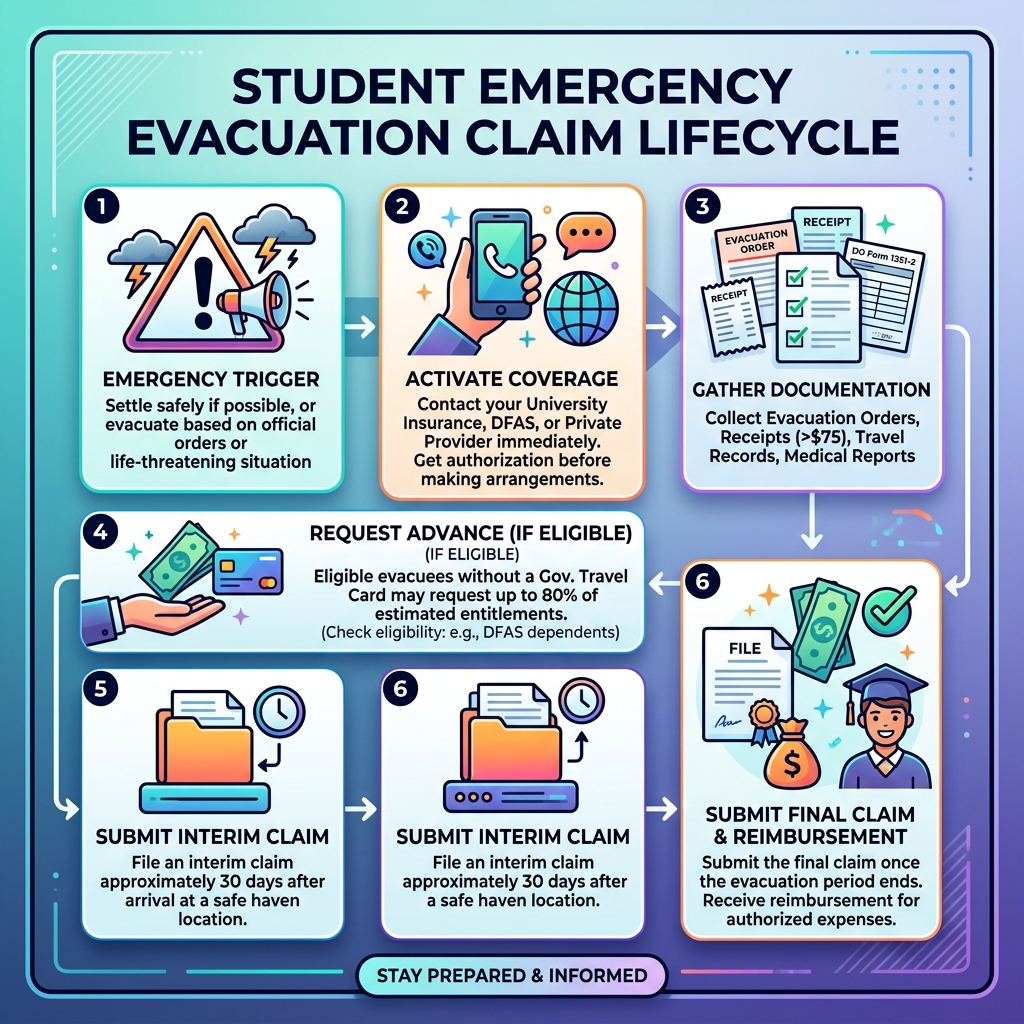
Here’s a quick overview of how to file an emergency evacuation claim as a student:
- Identify your coverage type — DFAS (for military dependents/civilian employees), university-backed insurance (e.g., institutional travel assistance providers), or a standalone commercial plan (e.g., Emergency Evacuation Insurance)
- Contact your provider immediately — Don’t arrange services on your own; unauthorized arrangements may not be reimbursed
- Gather your documents — Evacuation orders, receipts over $75, DD Form 1351-2 (for DFAS claims), and medical reports where applicable
- Request a travel advance if needed — DFAS authorizes up to 80% of estimated entitlements for eligible evacuees without a Government Travel Card
- Submit your claim — File an interim claim approximately 30 days after arriving at your safe haven location, then a final claim once the evacuation period ends
Whether you’re a student on an F or J visa studying in the US, or a university student heading abroad on an exchange program, the financial side of an evacuation can be overwhelming. Real cases show just how complex this gets — for example, when Coastal Carolina University evacuated 51 students during Hurricane Dorian, the institution had to go through two rounds of FEMA appeals to recover even a portion of its $26,878.37 claim.
The rules around eligibility, documentation, and deadlines are strict. Missing one step can get your claim denied entirely.
This guide walks you through everything you need to know — clearly and simply.
Understanding Eligibility for an Emergency Evacuation Claim Student

When the sirens go off or the “leave now” email hits your inbox, the first question is usually: “Am I covered for this?” Eligibility for an emergency evacuation claim student depends heavily on your status and the type of orders you are under. At RecipesGuard, we see many students get confused between being a “traveler” and an “authorized evacuee.”
Who is an Eligible Evacuee?
Generally, you fall into the eligible category if you are:
- Military Dependents: Spouses or children of active-duty members who are ordered to evacuate from a permanent duty station.
- Civilian Employees and Dependents: Those working for the Department of Defense (DoD) or other government agencies.
- F/J Visa Holders: International students studying in the U.S. who have purchased standalone emergency evacuation insurance.
- Study Abroad Students: Students enrolled in university programs that provide blanket travel assistance through specialized student insurance carriers.
It is important to note the distinction for service members. Service members themselves are typically not considered “evacuees” in the traditional sense. Instead, they are usually placed on Temporary Duty (TDY) or Permanent Change of Station (PCS) status. If they are forced to leave their local residence due to an emergency but remain in the local area, they might qualify for Local Emergency Displacement (LED) instead.
If you are an international student, your eligibility often hinges on having a “Safe Haven” destination. This is the location you are authorized to travel to until it is safe to return to your school. For more detailed insights, check out the international student guide to emergency claims and evacuations.
Government vs. Private Insurance: Navigating Claim Types
Navigating claims feels a bit like choosing between two different languages. On one side, you have government-funded reimbursements (DFAS and FEMA), and on the other, you have commercial insurance policies.
DFAS and FEMA Claims
The Defense Finance and Accounting Service (DFAS) handles claims for military-affiliated students and families. These claims are based on Joint Travel Regulations (JTR). FEMA Public Assistance, meanwhile, usually goes to the university to cover the costs of moving large groups of students, though it rarely pays individual students directly.
Commercial and Student Insurance
Most students will deal with private insurance. This includes:
- Medical Evacuation: Coverage for when you are too sick or injured to stay where you are and need to be flown to a better hospital or home.
- Political/Security Evacuation: Coverage for when civil unrest or war makes your study location unsafe.
- Natural Disaster Evacuation: Coverage for hurricanes, earthquakes, or floods.
| Feature | DFAS / Government Claims | Private / Commercial Insurance |
|---|---|---|
| Primary Forms | DD Form 1351-2 | Provider-specific Claim Form |
| Advance Funds | Up to 80% available | Rarely offered (usually pay & claim) |
| Receipts | Required for expenses over $75 | Required for all major expenses |
| Authority | Evacuation Orders required | Medical or Security Provider approval |
For a deeper dive into the medical side of these events, see our guide on understanding medical emergency coverage in student travel insurance.
Step-by-Step Guide to Filing Your Claim
Once you’ve reached your safe haven, the clock starts ticking. For an emergency evacuation claim student to be successful, you need to be methodical.
- Determine your Per Diem: Your reimbursement for food and lodging is based on the rates at your safe haven. You can find these using the official per diem rate lookup tool.
- File an Interim Claim: If the evacuation lasts a long time, don’t wait until the end. You can typically submit an interim claim every 30 days to keep your bank account from hitting zero.
- Submit the Final Claim: Once you return to your school or the evacuation order is rescinded, submit your final voucher.
For more tips on making sure your submission is bulletproof, read how to effectively file a travel insurance claim as a student.
Required Documentation for an Emergency Evacuation Claim Student
Documentation is the “make or break” part of this process. If you don’t have the paper trail, the insurance company or government won’t have the money.
- DD Form 1351-2: This is the “Travel Voucher.” You must download DD Form 1351-2 and fill it out accurately.
- Evacuation Orders: A copy of the official memo or DD Form 1610 authorizing your departure.
- Receipts: Keep everything! Specifically, any lodging expense and any other single expense over $75 must have a receipt.
- Evacuation Information Verification Sheet: This provides your bank details and the names/ages of any dependents traveling with you.
- Medical Reports: If the evacuation was for health reasons, a signed report from the attending physician is mandatory.
Requesting a Travel Advance for an Emergency Evacuation Claim Student
Let’s be real: most students don’t have a spare $5,000 sitting around for an emergency flight and two weeks in a hotel. If you don’t have a Government Travel Card, you can request an advance.
DFAS allows authorized evacuees to receive up to 80% of their estimated entitlements for the first 30 days. To do this, you’ll need to submit a “Request for Advance” form along with your evacuation orders to Travel Voucher Direct. You can find more specific instructions and contact info at askDFAS Evacuations.
Avoiding Common Pitfalls and Claim Denials
Nothing is more frustrating than doing the work and getting a “denied” letter. We’ve analyzed real-world cases to see where students and schools go wrong.
The “Prior Approval” Trap
One of the biggest reasons for denial is Non-Congregate Sheltering (NCS). This is a fancy term for staying in a hotel instead of a mass shelter (like a gym). In the Baylor University case during COVID-19, the school claimed over $281,000 for hotel-based quarantine. FEMA denied it because there was no official public health order and no prior approval from the FEMA Regional Administrator.
The lesson? Always get approval before booking that hotel if you expect the government or insurance to pay for it.
Operating Expenses vs. Emergency Measures
In another case, Coastal Carolina University tried to claim over $566,000 for student-athlete travel during Hurricane Florence. Because the athletes continued to compete in games rather than simply evacuating to safety, FEMA ruled these were “ineligible operating expenses.”
For more help avoiding these mistakes, check out FEMA appeal insights on ineligible costs and our own student insurance tips for handling medical emergencies abroad.
Institutional Support and Global Assistance
You aren’t alone in this. Most universities have a Crisis Management Team and an Emergency Response Plan.
- Personal Evacuation Plans (PEP): Many schools now require students to fill these out before the semester starts. This documents where you will go and how you will get there.
- HEERF Grants: During the pandemic, the Higher Education Emergency Relief Fund provided millions in emergency grants directly to students for unexpected expenses.
- Emergency Assistance to Institutions: Universities can apply for discretionary grants at grants.gov to help rebuild after a disaster, which indirectly helps students by keeping the campus running.
If you are looking for your own safety net, you can find affordable emergency medical coverage for students that includes standalone evacuation benefits starting as low as $43 for three months.
Frequently Asked Questions about Student Evacuations
What is the timeline for submitting an evacuation claim?
You should aim to submit your initial or interim claim approximately 30 days after arriving at your safe haven. If the evacuation is short, you can just file one final claim when you return. Most private insurers have a 90-day window for filing, but government claims can be more flexible—though waiting longer just delays your money!
Do service members qualify as evacuees?
Technically, no. Service members are usually considered to be on TDY (Temporary Duty) or PCS (Permanent Change of Station) status during an evacuation. However, their dependents (including students) are classified as evacuees and are eligible for evacuation allowances.
What role do public health officials play in quarantine claims?
For a quarantine or isolation claim to be valid (especially for FEMA reimbursement), there must be an official order signed by a public health official. Support letters or general “recommendations” from a school clinic usually aren’t enough to trigger a successful claim.
Conclusion
Filing an emergency evacuation claim student doesn’t have to be a disaster of its own. By keeping your receipts, staying in touch with your insurance provider, and following the official orders to the letter, you can ensure that your “Great Escape” doesn’t leave you in financial ruin.
At RecipesGuard, we’re dedicated to helping you navigate these tricky waters. Before you head out on your next adventure, make sure you have your documentation ready and your emergency contacts saved.
Your Final Checklist:
- [ ] Copy of official evacuation orders.
- [ ] All lodging and travel receipts (over $75).
- [ ] Completed DD Form 1351-2.
- [ ] Bank account routing and account numbers.
- [ ] Contact info for your insurance provider’s 24/7 assistance line.
Safe travels, and remember: safety first, paperwork second, and reimbursement eventually!
