
Why Going Abroad Without Health Insurance Is a Risky Gamble
Travel abroad health insurance is a must-have for any student heading overseas for a semester — and the stakes are higher than most people realize.
Here’s a quick breakdown of what you need to know before you go:
| Question | Quick Answer |
|---|---|
| Does U.S. health insurance cover you abroad? | Usually not, or only partially |
| Does Medicare or Medicaid cover overseas care? | No — neither covers care outside the U.S. |
| How much can a medical evacuation cost? | Up to $200,000 or more |
| How much does travel medical insurance cost? | Around $5/day, or ~$103 for a 20-day trip |
| When should you buy it? | Before you leave — most plans can’t be purchased after departure |
| Is it required anywhere? | Yes — Schengen visa countries require proof of coverage |
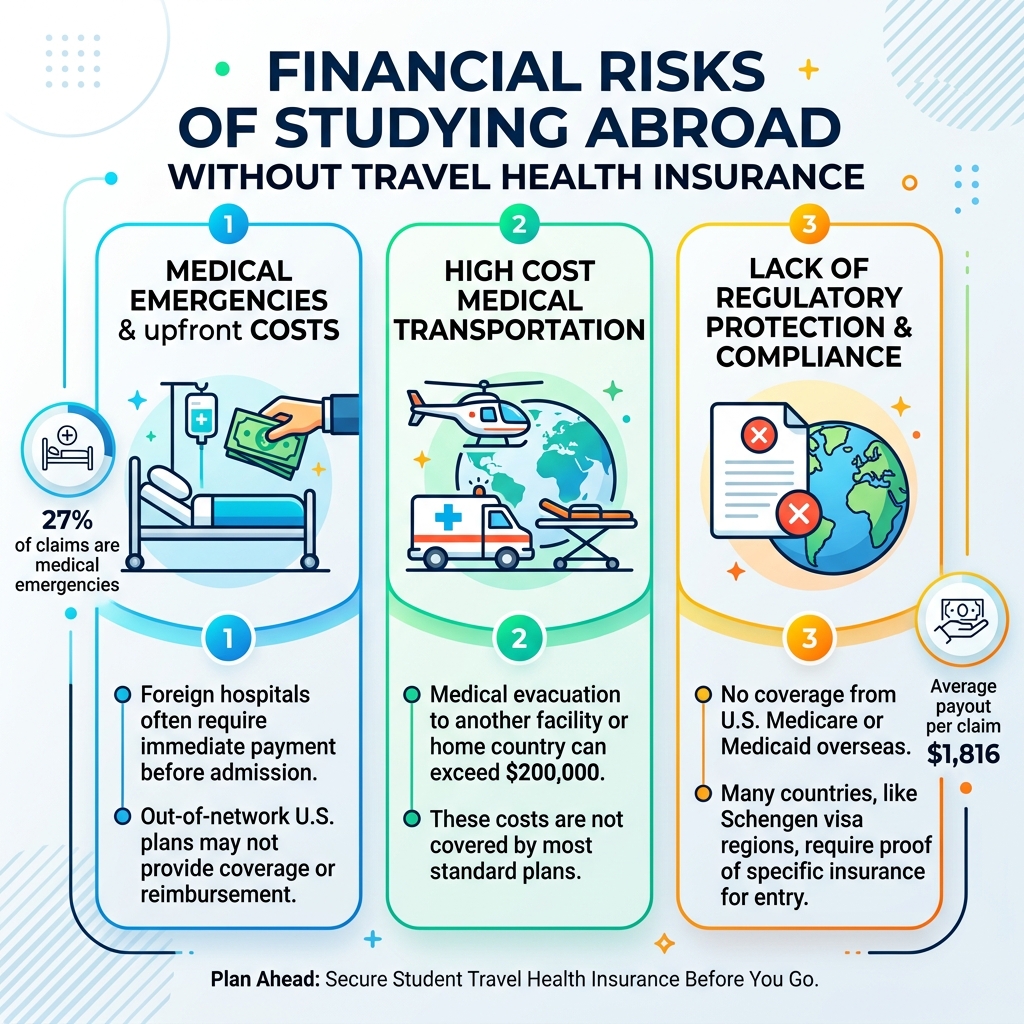
Picture this: you’re three weeks into your semester in Bangkok when you come down with pneumonia. You’re rushed to a hospital where staff ask for a payment guarantee before they’ll admit you. Without travel insurance, you’re looking at thousands of dollars out of pocket — possibly charged to a credit card with no way to pay it back quickly.
This isn’t a rare edge case. More than 27% of all travel insurance claims are medical emergencies. And the average payout is $1,816 per claim — money that most students simply don’t have sitting around.
The problem is that most U.S. domestic health plans offer little to no coverage overseas. Medicare and Medicaid don’t cover a single dollar of care received outside the United States. Even private insurance plans often leave you stranded in an out-of-network situation abroad, forcing you to pay upfront and hope for reimbursement later.
For students on a semester abroad, this coverage gap is a serious financial risk — one that the right insurance plan can close for as little as a few dollars a day.
This guide compares the best travel abroad health insurance plans for students, so you can find the right coverage before your flight takes off.
Why Students Need Travel Health Insurance for International Studies
When we pack our bags for a semester in Europe or an internship in Tokyo, we usually focus on the credits we’ll earn or the food we’ll eat. We rarely think about what happens if we trip over a cobblestone street or catch a severe tropical flu. However, the financial reality of international healthcare is a wake-up call.
According to U.S. State Department guidance on overseas medical costs, the U.S. government does not pay medical costs for U.S. citizens traveling abroad. If you find yourself in a foreign hospital, you are on your own regarding the bill. Furthermore, Medicare and Medicaid provide zero coverage outside the United States. Even if you have a robust private U.S. health plan, it often treats international providers as “out-of-network,” meaning you might have to pay 100% of the costs upfront and fight for a partial reimbursement months later.
The CDC insurance recommendations for travelers are very clear: every traveler should secure international coverage. For students, this is even more critical. You are often living in shared housing, navigating new environments, and potentially engaging in high-energy activities. Without travel abroad health insurance, a single emergency room visit could cost more than your entire semester’s tuition.
Understanding travel abroad health insurance Limits
Not all policies are created equal. When we look at student-specific plans, we need to understand the “caps” and “floors” of coverage. Most experts recommend a minimum of $50,000 in emergency medical coverage, though many student plans offer limits up to $1 million or even $8 million for premium tiers.
It is also important to distinguish between “Travel Medical” and “Comprehensive Trip Insurance.”
| Feature | Travel Medical Insurance | Comprehensive Trip Insurance |
|---|---|---|
| Primary Focus | Health and Medical Emergencies | Financial protection for the whole trip |
| Medical Limits | High ($50k – $8M) | Moderate ($10k – $250k) |
| Trip Cancellation | Usually not included | Included (non-refundable costs) |
| Cost | Lower (approx. $1-$5/day) | Higher (4-10% of trip cost) |
| Best For | Students, Expats, Long-term stay | Vacationers with expensive bookings |
For a student spending several months abroad, a standalone travel abroad health insurance policy is often the most cost-effective choice. You can often choose your deductible—ranging from $0 (which we love for simplicity) to $2,500—to help manage your monthly premium.
Essential Benefits for Your Semester Abroad
What exactly are you paying for? It’s not just a piece of paper; it’s a suite of services designed to save your life and your bank account. The most terrifying statistic in travel is the cost of medical evacuation. If you are in a remote area or a country where the local hospitals cannot treat your specific condition, you may need to be flown to a better facility or back to the U.S. on a private medical jet. These evacuations can cost upwards of $200,000.
More info about medical emergency coverage for students shows that coverage usually includes:
- Emergency Medical Evacuation: Up to $1,000,000 or more.
- COVID-19 Expenses: Most modern plans treat COVID-19 like any other illness, covering testing and hospitalization.
- Emergency Dental: Because a toothache in Rome shouldn’t ruin your trip.
- Repatriation of Remains: A somber but necessary inclusion for any international policy.
We also have to consider pre-existing conditions. If you have asthma, diabetes, or a chronic illness, you need to be extra careful. The CDC high-risk travel advice for chronic illnesses suggests looking for plans that offer a “Pre-existing Condition Waiver.” Usually, you must buy the insurance within a short window (14–21 days) of making your first trip payment to qualify for this.
Key Benefits of travel abroad health insurance
Beyond the big hospital bills, a good policy acts as a personal assistant. More info about comprehensive medical coverage highlights benefits like:
- 24/7 Assistance: A hotline that can help you find a local English-speaking doctor or translate medical records.
- Mental Health Support: Many student-focused plans now include teletherapy or crisis counseling, recognizing that “culture shock” can have real health impacts.
- Physical Therapy: If you sprain an ankle on a weekend trip, your policy might cover the follow-up rehab sessions.
- Accidental Death & Dismemberment (AD&D): Provides a lump sum to your family in the event of a worst-case scenario.
Choosing the Right travel abroad health insurance Policy
If you are heading to Europe, you might not even have a choice in the matter. Countries in the Schengen Area often require proof of travel abroad health insurance with at least €30,000 in coverage before they will issue a student visa.
When we evaluate a policy, we use a specific checklist:
- Destination Validity: Does it cover every country you plan to visit (including those weekend trips to neighboring nations)?
- Trip Length: Does it cover the full duration of your semester plus any travel before or after?
- Adventure Sports: Do you plan on skiing in the Alps or scuba diving in the Great Barrier Reef? Standard policies often exclude these unless you add a “rider.”
- 24-Hour Helpline: Can you reach someone at 3 AM local time?
Understanding the health vs travel insurance differences is also vital. While your U.S. health insurance wants to manage your long-term wellness, travel medical insurance is designed to stabilize you and, if necessary, get you home.
Filing a travel abroad health insurance Claim
This is where many students get stuck. At RecipesGuard, we specialize in helping you navigate this paperwork. More info about student insurance importance emphasizes that you must be proactive.
- Keep every receipt: From the taxi to the hospital to the prescription from the pharmacy.
- Get a medical report: Ask the doctor for a written summary of the diagnosis in English if possible.
- Contact the insurer immediately: Most companies require you to “open a case” within 24–48 hours of the incident.
How to Manage Medical Emergencies and Claims Abroad
Handling a crisis in a foreign language is stressful. One of the best features of high-end travel abroad health insurance is “Direct Billing.” This means the insurance company pays the hospital directly, so you don’t have to put $10,000 on your credit card.
If direct billing isn’t available, the insurer can often provide a “Letter of Guarantee.” This is a document that tells the hospital, “Treat this student; we promise to pay the bill.” This is often required for hospital admission in many parts of the world.
More info about handling emergencies abroad suggests using the digital tools provided by your insurer. Many modern providers have apps that allow you to:
- Search for local, vetted doctors.
- Access telehealth appointments for minor issues like rashes or sinus infections.
- Store a digital version of your ID card in your Apple or Google Wallet.
For those on a budget, more info about affordable emergency coverage shows that you don’t have to sacrifice quality for price. By choosing a higher deductible or focusing strictly on medical (rather than trip cancellation) benefits, you can find solid protection for the price of a daily cup of coffee.
Frequently Asked Questions about Travel Abroad Health Insurance
How much does travel medical insurance cost on average?
On average, standalone travel medical insurance costs about $5 per day. Based on industry pricing data, the average user spends about $103 per policy for a 20-day trip. For a full semester (approx. 120 days), you might see costs ranging from $300 to $600 depending on your age and the level of coverage you choose.
Factors affecting your premium include:
- Age: Costs rise significantly once you hit 30, but students (usually 18–24) get the best rates.
- Destination: Coverage for the U.S. (if you are an international student coming in) or high-cost areas like Singapore may be higher.
- Coverage Limits: A $1,000,000 limit will cost more than a $50,000 limit.
- Deductible: Choosing a $250 deductible will lower your upfront premium compared to a $0 deductible.
When is the best time to buy travel insurance for a student trip?
The best time to buy is immediately after you book your flight or pay your first tuition installment. Most policies require you to be in your home country when you purchase the plan. While some companies allow you to extend a policy while you are already abroad, you generally cannot buy a new policy once you have left the U.S.
If you find yourself abroad and realize you forgot insurance, your options are extremely limited and often much more expensive. Always ensure you have your policy number and the 24-hour help line saved in your phone before you head to the airport. Check out more info about handling medical emergencies for a pre-departure checklist.
Are pre-existing conditions covered for students studying abroad?
This is a tricky area. Most travel medical plans exclude pre-existing conditions by default. A “pre-existing condition” is usually defined by a “look-back period” (often 60 to 180 days) where you received treatment, took medication, or had symptoms of the condition.
However, some plans offer coverage for the “Acute Onset of a Pre-existing Condition.” This means if you have a stable condition that suddenly and unexpectedly flares up into a life-threatening emergency, the insurance will cover the stabilization. For full coverage, you should look for a policy with a pre-existing condition waiver. According to scientific research on travelers with additional considerations, travelers with chronic illnesses should prioritize plans that specifically mention “medical underwriting” or waivers to ensure they aren’t left with a denied claim.
Conclusion
Studying abroad should be one of the most exciting chapters of your life. Whether you’re studying art history in Florence or marine biology in Australia, the last thing you want to worry about is a medical bill that could derail your future.
At RecipesGuard, we are dedicated to making the “boring stuff” easy. We provide student-focused, step-by-step claim filing tutorials to ensure that if you do get sick, the paperwork is the least of your worries. More info about RecipesGuard services can help you prepare for your journey with confidence.
Don’t leave your financial health to chance. Secure your travel abroad health insurance today, and go see the world with the peace of mind you deserve.
