
What Is Lost Luggage Insurance and Why Does It Matter?
Lost luggage insurance is a type of travel protection that reimburses you when your bags are lost, stolen, or damaged during a trip — beyond what the airline is required to pay you.
Here’s a quick breakdown of what you need to know:
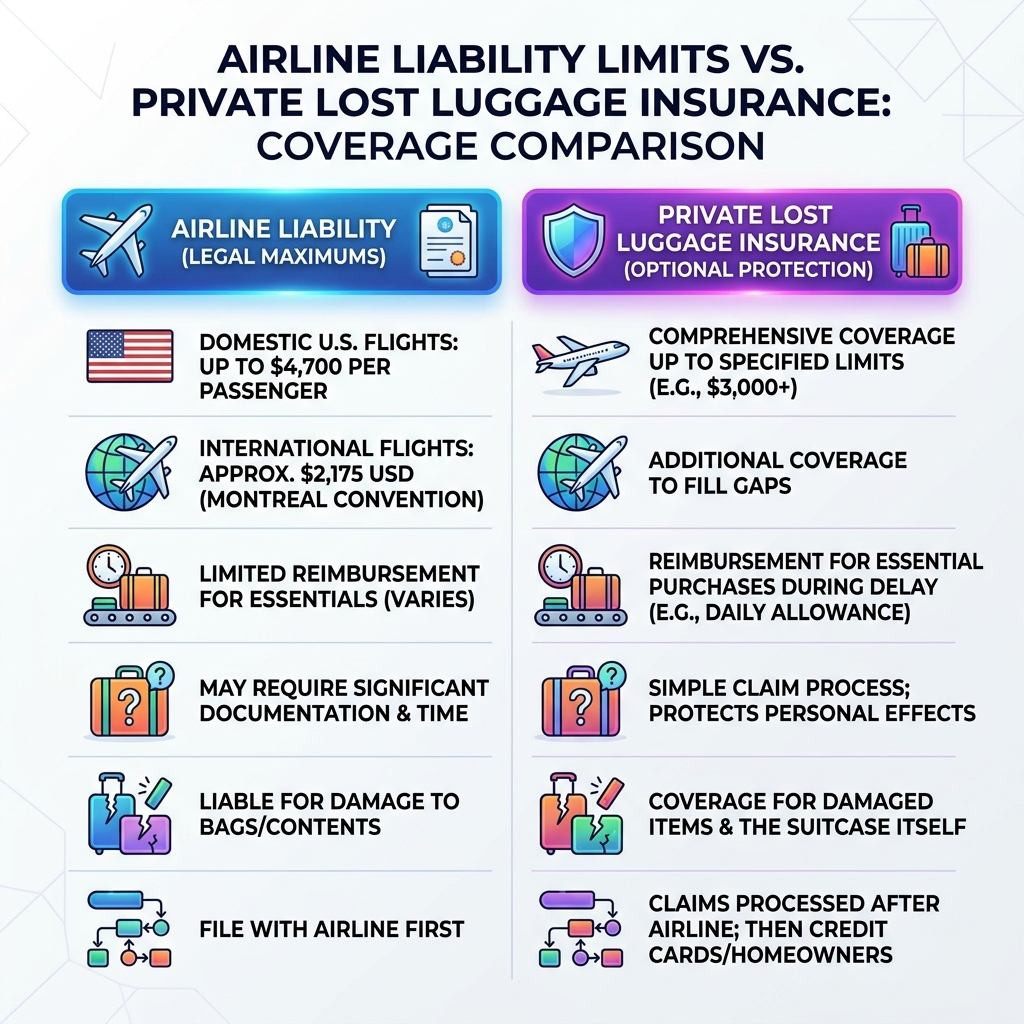
- Airline liability is limited. For domestic U.S. flights, airlines must pay up to $4,700. For most international flights, the cap is around $2,175 USD under the Montreal Convention.
- Travel insurance fills the gap. A comprehensive travel insurance plan can cover costs the airline won’t — including essential purchases while you wait for a delayed bag.
- Credit cards can help too. Some premium travel cards offer automatic lost luggage reimbursement when you book your flight with them.
- Claims go in order. You file with the airline first, then travel insurance, then your credit card or homeowners insurance.
Most people don’t think about any of this until their bag doesn’t show up on the carousel. That’s exactly the wrong time to find out what you’re not covered for.
Whether you’re a student studying abroad or a frequent flyer, understanding how lost luggage insurance works — and where your airline coverage ends — can save you real money and a lot of stress.
Understanding Lost Luggage Insurance
When we talk about lost luggage insurance, we are looking at a safety net designed to protect your “personal effects”—that’s insurance-speak for your clothes, toiletries, and the physical suitcase itself. While the airline has a legal responsibility to get your gear from Point A to Point B, their liability is often lower than the actual value of what’s inside your bag.

What is Lost Luggage Insurance?
At its core, lost luggage insurance is a benefit found in most comprehensive travel insurance policies. It provides reimbursement for the “Actual Cash Value” (ACV) of your belongings.
What does ACV mean? In the insurance world, it’s the cost to replace your items minus depreciation. If your three-year-old sneakers go missing, the insurance company won’t pay for a brand-new pair at retail price; they’ll pay what those used sneakers were worth right before they vanished.
Most policies have two types of limits:
- Per-item limit: The maximum they will pay for a single item (often $250 to $500).
- Total policy limit: The maximum they will pay for the entire claim (ranging from $500 to $3,000 depending on your plan).
It is important to remember that this is usually “secondary coverage.” This means you must first seek compensation from the airline. If the airline’s payout doesn’t cover the full value of your loss, your lost luggage insurance kicks in to cover the difference.
Baggage Delay vs. Lost Luggage Insurance
Many travelers get these two confused, but they serve very different purposes.
Baggage Delay Insurance is for when your bag is merely “taking a later flight.” If your suitcase doesn’t arrive on the carousel within a certain timeframe—usually a 12-hour threshold—this coverage reimburses you for “reasonable and necessary” incidental expenses. We’re talking about a toothbrush, some deodorant, and a change of clothes so you don’t have to attend your study abroad orientation in your pajamas.
Lost Luggage Insurance only applies once the airline officially declares the bag “lost.” This usually happens between 5 and 14 days after your flight. Once that declaration is made, you can claim for the total value of the bag and everything inside it.
Airline Liability and Passenger Rights
Even if you don’t have a private insurance policy, you have rights. Airlines are legally required to compensate you if they lose or damage your bags, but the amount depends on where you are flying.
| Regulation Type | Coverage Limit | Key Detail |
|---|---|---|
| Domestic (U.S.) | Up to $4,700 | Set by the DOT; applies to flights within the US. |
| International | 1,519 SDR (~$2,175 USD) | Montreal Convention; applies to most global routes. |
| Assistive Devices | Original Purchase Price | Domestic flights have no cap on wheelchairs/braces. |
Domestic Flight Regulations
For those of us traveling within the United States, the Department of Transportation (DOT) has strict rules. Airlines must compensate passengers for lost, damaged, or delayed baggage up to a limit of $4,700 per person.
Airlines are also required to refund any baggage fees you paid if they lose your bag. Furthermore, if your bag is “significantly delayed”—defined as 12 hours for domestic flights—you may be eligible for a refund of that fee even if the bag eventually shows up.
International Flight Regulations
When we fly between countries (like Australia to the UK), the Montreal Convention usually governs the airline’s liability. Instead of a flat dollar amount, they use “Special Drawing Rights” (SDR), which is an international reserve asset. Currently, the limit is 1,519 SDR, which fluctuates but sits around $2,175 USD (roughly $3,300 AUD).
These limits are reviewed every five years by the International Civil Aviation Organization (ICAO) to keep up with inflation. If you are flying on an older route where the Montreal Convention doesn’t apply, the Warsaw Convention might take over, which generally offers much lower compensation.
If your travel plans have been completely derailed by more than just a missing bag, you might want to check out more info about flight cancellation rights to see what else you’re entitled to.
How to File a Claim for Lost Luggage
Filing a claim can feel like a part-time job, especially when you’re a student trying to focus on a new semester. At RecipesGuard, we specialize in making this process manageable.
Immediate Steps at the Airport
The moment you realize your bag isn’t coming, do not leave the airport.
- Find the Baggage Office: Every airline has a desk near the carousels.
- File a Property Irregularity Report (PIR): This is the most important document you will ever hold. It’s your official proof that the bag is missing. Without a PIR, filing a lost luggage insurance claim later is nearly impossible.
- Keep Your Tags: That little sticker they put on the back of your boarding pass? That’s your bag’s “ID card.” Keep it safe.
- Ask for Essentials: Some airlines provide “overnight kits” with basic toiletries. It doesn’t hurt to ask!
Check out our step-by-step guide to filing a travel insurance claim as a student for a more detailed walkthrough of the paperwork.
Required Documentation for Lost Luggage Insurance
To get your money back, you need to prove what you lost. We recommend keeping a digital folder with:
- A copy of your PIR.
- Your boarding pass and baggage claim stubs.
- An itemized list of everything in the bag.
- Receipts: This is the hard part. Most insurers want receipts for any item over $150. If you don’t have them, they may cap your reimbursement at a much lower amount.
- Photos: If you took a photo of the contents of your bag before you zipped it up (highly recommended!), include that as visual proof.
If you suspect your bag wasn’t just lost by the airline but actually stolen from the carousel or your hotel, you’ll need to follow a slightly different path. Learn how to handle a theft claim to ensure you meet the police report requirements.
Coverage Exclusions and High-Value Items
It is a common misconception that lost luggage insurance covers everything you pack. In reality, there are several “no-go” zones.
Common Policy Exclusions
Standard policies almost always exclude:
- Cash and Currency: Never pack money in your checked bag. It’s gone forever if the bag vanishes.
- Animals: Sorry, your pet’s travel costs aren’t covered under baggage loss.
- Perishables: That fancy cheese you bought in France? Not covered.
- Business Documents: Professional gear or manuscripts often have very low limits or are excluded entirely.
- Reckless Handling: If you left your bag unattended in the middle of a busy train station, the insurer might deny the claim based on “failure to exercise due care.”
Protecting High-Value Belongings
If you’re traveling with a $2,000 MacBook or a $3,000 engagement ring, a standard policy with a $500 per-item limit won’t cut it.
- Carry-on Strategy: The best insurance is keeping it with you. Always put electronics, jewelry, and essential medications in your carry-on.
- Riders and Upgrades: Many insurers allow you to “schedule” high-value items for an extra fee. This raises the limit for that specific item.
- Specialized Coverage: If you’re a student traveling with expensive sports equipment (like a professional surfboard or ski gear), look for “Sports Equipment” add-ons.
Alternative Sources of Baggage Protection
Sometimes, the best lost luggage insurance is the one you already have without knowing it.
Credit Card Travel Benefits
Many premium credit cards (like the American Express Platinum or Chase Sapphire Reserve) offer built-in baggage insurance.
- The Catch: You must have paid for the flight (or at least the taxes on a points booking) with that specific card.
- The Benefit: These cards often provide daily stipends for baggage delays (e.g., $100 a day for 5 days) and high limits for lost bags (up to $3,000).
Homeowners and Renters Insurance
Your home insurance policy often includes “off-premises” coverage. This means your personal property is covered even when it’s halfway across the world.
- Drawbacks: Filing a claim here might cause your monthly premiums to go up. Plus, your deductible (the amount you pay out of pocket) might be $500 or $1,000, which could be more than the value of the lost clothes.
- Use Case: This is best for extremely high-value losses that exceed both airline and travel insurance limits.
For students living in dorms or shared housing, more info about study abroad claims can help you understand how your parents’ policy or your own renters insurance might apply.
Frequently Asked Questions about Baggage Coverage
How long before a bag is officially considered lost?
Airlines are optimistic. They will usually call a bag “delayed” for the first few days while they use their tracking systems to find it. Most airlines officially declare a bag “lost” between 5 and 14 days after the flight. At that point, the claim transitions from “delay” to “loss.”
Does travel insurance cover stolen luggage from a hotel?
Yes, but with a caveat. Most policies cover theft under the “Baggage and Personal Effects” benefit. However, you must prove you took “reasonable care.” If you left your bag in a locked hotel room or with a valet and it was stolen, you’re likely covered. You will almost certainly need to provide a police report filed within 24 hours of the discovery.
Can I claim for items without original receipts?
You can try, but it’s harder. Many insurers have a “no-receipt cap”—often around $150 per item. If you’re claiming a $600 camera without a receipt, they might only give you $150. We suggest using credit card statements or old emails as “proof of purchase” if you’ve lost the physical receipt.
Conclusion
Losing a bag is a rite of passage for many travelers, but it doesn’t have to be a financial disaster. By understanding the layers of protection available—from airline liability to lost luggage insurance and credit card benefits—you can travel with peace of mind.
At RecipesGuard, we know that for students, every dollar counts. Whether you’re navigating a gap year or heading to a semester in Europe, our mission is to provide you with the step-by-step tutorials you need to get your cash back when things go wrong. Don’t let a missing suitcase ruin your adventure.
