
What to Do When Your Luggage Goes Missing (And How to Get Compensated)
The lost baggage claim process can feel overwhelming — especially if you’re a student traveling abroad and your bag doesn’t show up at the carousel.
Here’s the quick answer if you need it now:
How to navigate the lost baggage claim process:
- Report it immediately at the airline’s Baggage Service Office before leaving the airport
- Get a file reference number — you’ll need this for all follow-up claims
- Track your bag using the airline’s app, website, or your AirTag
- Keep receipts for any essential items you buy while waiting
- Submit a formal claim if your bag isn’t found within 5 days
- Escalate to a lost bag claim if it isn’t located within 21 days
Most delayed bags turn up within 24 to 48 hours. But when they don’t, the clock starts ticking on important deadlines — and missing them can cost you your right to compensation.
Under U.S. Department of Transportation rules, airlines can be liable for up to $4,700 per passenger on domestic flights. For most international flights, the Montreal Convention caps liability at around $2,175 USD (1,519 Special Drawing Rights).
Knowing when to act — and what to document — makes a real difference in how much you recover.

Glossary for lost baggage claim process:
- flight cancellation claim process
- emergency claim student policy
- international student emergency claim
Immediate Steps at the Airport
The moment you realize the baggage carousel has stopped and your suitcase is nowhere to be found, take a deep breath. While it is tempting to head straight to your hostel or dorm, you must act before leaving the arrivals hall.
First, double-check the surrounding carousels. Sometimes bags are pulled off by staff or end up on a different belt due to a last-minute gate change. If it’s definitely gone, your next stop is the airline’s Baggage Service Office (BSO), usually located near the carousels.
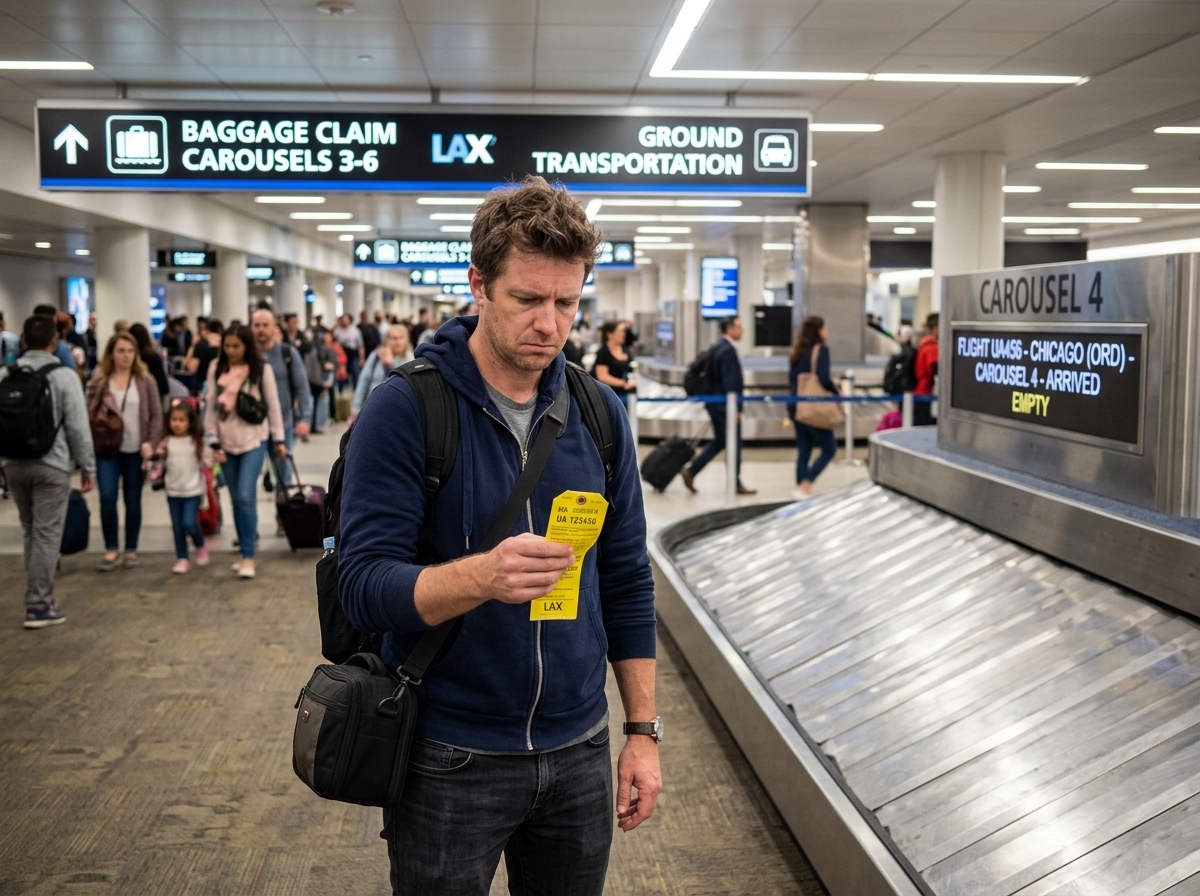
At the BSO, you will need to file a Property Irregularity Report (PIR). This is the most critical document in the lost baggage claim process. Do not leave without a File Reference Number. This is a unique 8- to 13-character alphanumeric code (e.g., SYDAC12345) that is different from your six-character flight confirmation code. You will need this for every single interaction with the airline moving forward.
According to scientific research on recovering misplaced belongings, immediate reporting significantly increases the chances of a successful reunion with your items.
Immediate Action Checklist:
- Locate your bag tag: The small sticker usually placed on the back of your boarding pass.
- Provide a detailed description: Mention the brand, color, size, and any identifying features like a bright ribbon or stickers.
- Give a local address: If you are a student, provide your university housing or temporary accommodation address.
- Ask for a copy: Ensure you have a physical or digital copy of the PIR before walking away.
Filing a digital lost baggage claim process report
Many modern airlines now allow you to skip the long queue at the BSO by using QR codes placed around the baggage hall or through their official mobile apps. For example, American Airlines and Delta often provide QR codes that let you file a report directly from your smartphone.
When filing digitally, you’ll still need your bag tag number and a physical description. If you are a student navigating this for the first time, you might find our guide on student travel claims helpful for managing the paperwork involved in travel disruptions.
Tracking your bags in real-time
If you were proactive and placed a tracker like an Apple AirTag or a Samsung SmartTag in your suitcase, now is the time to use it. Many airlines, including American Airlines, now allow you to share a “Find My” location link directly within your delayed bag report. This helps the airline’s central tracing team pinpoint exactly which airport your bag is currently sitting in.
Even without a personal tracker, most major airlines have robust tracking portals on their websites. By entering your last name and File Reference Number, you can see if your bag has been scanned onto a subsequent flight. Using trackers to monitor bag location has become one of the most effective ways for passengers to advocate for themselves when an airline claims a bag is “untraceable.”
Understanding the lost baggage claim process
To navigate this successfully, we need to understand the legal definitions. A bag isn’t just “missing”—it transitions through three official stages:
- Delayed: The bag is not at the carousel but the airline expects to find it (usually within the first 5 days).
- Missing/Escalated: After 5 days, the search is usually moved from the local airport team to a central baggage recovery department.
- Officially Lost: If the bag is not located within 21 days, it is legally declared lost, triggering the full compensation process.
Liability Limits: Domestic vs. International
| Flight Type | Governing Regulation | Maximum Liability Limit |
|---|---|---|
| Domestic (U.S.) | DOT Regulations | $4,700 USD per passenger |
| International | Montreal Convention | 1,519 SDR (approx. $2,175 USD) |
| International (Old) | Warsaw Convention | $9.07 per lb / $20 per kg |
Note: Liability limits are subject to periodic inflationary adjustments by the International Civil Aviation Organization (ICAO).
When an airline officially declares a bag lost
While the 21-day mark is the legal standard for “lost” status under the Montreal Convention, many airlines have their own internal windows. For instance, Delta Air Lines typically begins settlement discussions if a bag hasn’t been found within 21 days. However, the search usually intensifies after the 5-day mark, when you are often required to fill out a more detailed “Inventory Form” listing every item in the bag and its estimated value.
If you’re traveling during a break or a gap year, losing your gear can be devastating. We’ve detailed how to handle a gap year theft claim which shares many similarities with the baggage recovery journey.
Refund eligibility for baggage fees
If your bag is significantly delayed or lost, you shouldn’t have to pay for the “service” of the airline losing it. In the U.S., a bag is considered “significantly delayed” if it arrives more than 12 hours after your flight. For international travel, this threshold is usually 15 hours for shorter flights and up to 30 hours for long-haul journeys. If these limits are exceeded, you are generally entitled to a refund of your checked baggage fees.
Reporting Timelines and Required Documentation
The lost baggage claim process is governed by strict deadlines. If you miss these windows, the airline can legally deny your claim.
- Damaged Baggage: You must report this within 24 hours for domestic flights and 7 days for international flights.
- Delayed/Lost Baggage: While you should report it immediately, the formal claim for expenses usually must be submitted within 21 days of the bag being returned to you (or 21 days from the date it should have arrived).
- Missing Contents: If the bag arrives but items are missing, report it within 24 hours (domestic) or 7 days (international).
When you file your formal claim, you will need a “paper trail.” We recommend keeping a digital folder with:
- Your boarding pass and ticket.
- The baggage claim tag (the sticker).
- The Property Irregularity Report (PIR) and File Reference Number.
- Photos of the bag’s exterior and interior (taken before you flew).
- Receipts for any “essential” items you had to buy.
For students, organizing these documents is half the battle. You can find a checklist of what documents students need for travel insurance claims to ensure you don’t miss a single piece of evidence.
Liability limits for domestic and international flights
As mentioned, the U.S. Department of Transportation (DOT) has set a maximum liability of $4,700 for domestic travel. It is important to know that airlines cannot set a lower “ceiling” than this for domestic flights.
For international trips, the Montreal Convention is the gold standard. It uses “Special Drawing Rights” (SDR) as a currency, which currently equates to roughly $2,175 USD. If your itinerary involves a country that hasn’t signed the Montreal Convention, the older Warsaw Convention might apply, which pays out based on the weight of the bag rather than the value of the contents—a much less favorable deal for the traveler.
Items excluded from airline liability
Airlines are notorious for excluding high-value items from their liability policies. Usually, they will not pay for:
- Fragile items (glass, ceramics).
- Electronics (laptops, cameras, tablets).
- Jewelry and precious metals.
- Cash or negotiable papers.
- Perishable goods (food).
- Normal “wear and tear” (minor scratches, scuffs, or broken zippers caused by overpacking).
If you are carrying these items, they should always be in your carry-on. If you must check them, this is where a private travel insurance policy becomes essential. Check out our step-by-step guide to filing a travel insurance claim to see how a secondary policy can cover what the airline won’t.
Maximizing Your Compensation and Reimbursements
While your bag is missing, you are entitled to reimbursement for “reasonable and necessary” expenses. This typically covers toiletries, basic clothing, and items required for the purpose of your trip (like a suit for a scheduled interview).
Many airlines suggest a guideline of $50 USD per day for the first five days, but the DOT explicitly states that airlines cannot set an arbitrary daily limit. If you need to spend $150 on a specific piece of equipment to continue your study program, and you can justify it, the airline is often required to pay—provided you have the receipts.
To make sure your claim is approved:
- Keep every receipt. Physical and digital.
- Buy only what is “essential.” A designer handbag is not an essential; a toothbrush and clean underwear are.
- Submit within 30 days. Most airlines require reimbursement requests within 21 to 30 days of the bag’s recovery.
For more tips on the paperwork side, read our guide on how to effectively file a travel insurance claim.
How to expedite the lost baggage claim process for students
As students, we often travel with our entire lives in a suitcase—textbooks, laptops (hopefully in carry-on!), and expensive winter gear. To speed up the lost baggage claim process, you should provide an itemized inventory list as soon as the airline asks for it (usually after day 5).
Having pre-travel photos of your open suitcase makes this much easier. It proves you actually owned the items you are claiming for. If you are an international student, your baggage claim might be tied to your visa status or university requirements; see our visa claims 101 for international students for more on how these processes overlap.
Rights for assistive devices and mobility aids
There is a major exception to liability limits: assistive devices. For domestic U.S. flights, airlines have unlimited liability for wheelchairs, CPAP machines, and other mobility aids. They must pay the full original purchase price if the item is lost or destroyed. Additionally, airlines are often required to provide a temporary replacement while yours is being repaired or located.
Handling TSA Inspections and Unclaimed Items
Sometimes, the airline isn’t the one who damaged your bag—it was the security screeners. If you open your suitcase and find a “Notice of Inspection” card from the TSA, any damage or missing items must be handled through them, not the airline.
The TSA holds items left at checkpoints for a minimum of 30 days. After this period, unclaimed items are either sold, destroyed, or transferred to state agencies. Crucially, any electronics like laptops or tablets will have their memory destroyed to protect your personal data before disposal. You can find TSA Lost and Found contact information to file a claim directly with the government.
What to do if TSA damaged your bag
If your lock was cut or your suitcase was ripped during a security check, you must file a claim with the TSA (or CATSA in Canada) directly. You will need to provide:
- Evidence of the damage.
- The Notice of Inspection card.
- Receipts for the repair or the original bag’s value.
For broader advice on recovering costs from travel mishaps, our article on how to get your money back after flight issues covers several common scenarios.
Preventing future baggage loss
While no system is perfect, we can take steps to minimize the risk:
- Label everything: Put your name, phone number, and email inside and outside the bag.
- Remove old tags: Those little barcode stickers from previous flights can confuse the scanners.
- Check-in early: Late check-ins are the #1 cause of bags missing their flights.
- Fly nonstop: Most bags are lost during the “transfer” between connecting flights.
- Use trackers: An AirTag is the best $30 investment a traveler can make.
Frequently Asked Questions about Baggage Claims
When is a bag officially considered lost?
Airlines typically declare a bag lost if it is not located within 5 to 21 days, depending on the carrier’s specific policy and the itinerary. Under the Montreal Convention, you can legally treat a bag as lost if it hasn’t arrived within 21 days.
What are “reasonable” expenses for delayed bags?
Reasonable expenses include essential clothing and toiletries needed for your trip; many airlines suggest a guideline of $50 per day for the first five days. However, this is not a legal cap, and you can claim more if the expenses are justifiable and backed by receipts.
Can I claim items lost at a TSA checkpoint?
Yes, but you must contact the TSA Lost and Found at that specific airport directly. The airline is not responsible for items left at security. Items are held for a minimum of 30 days before disposal or data destruction.
Conclusion
Navigating the lost baggage claim process requires patience, persistence, and a lot of paperwork. By reporting the loss immediately, securing a File Reference Number, and keeping meticulous receipts, you can ensure that you are fairly compensated for the inconvenience.
At RecipesGuard, we know that as a student, every dollar counts. Whether you’re dealing with a missing suitcase or a flight delay, our student-focused advisory is here to help you through the insurance claim maze with step-by-step tutorials. Don’t let a missing bag ruin your semester abroad—stay informed and advocate for your rights.
