
What to Do When a Student Travel Injury Happens (And How to Claim)
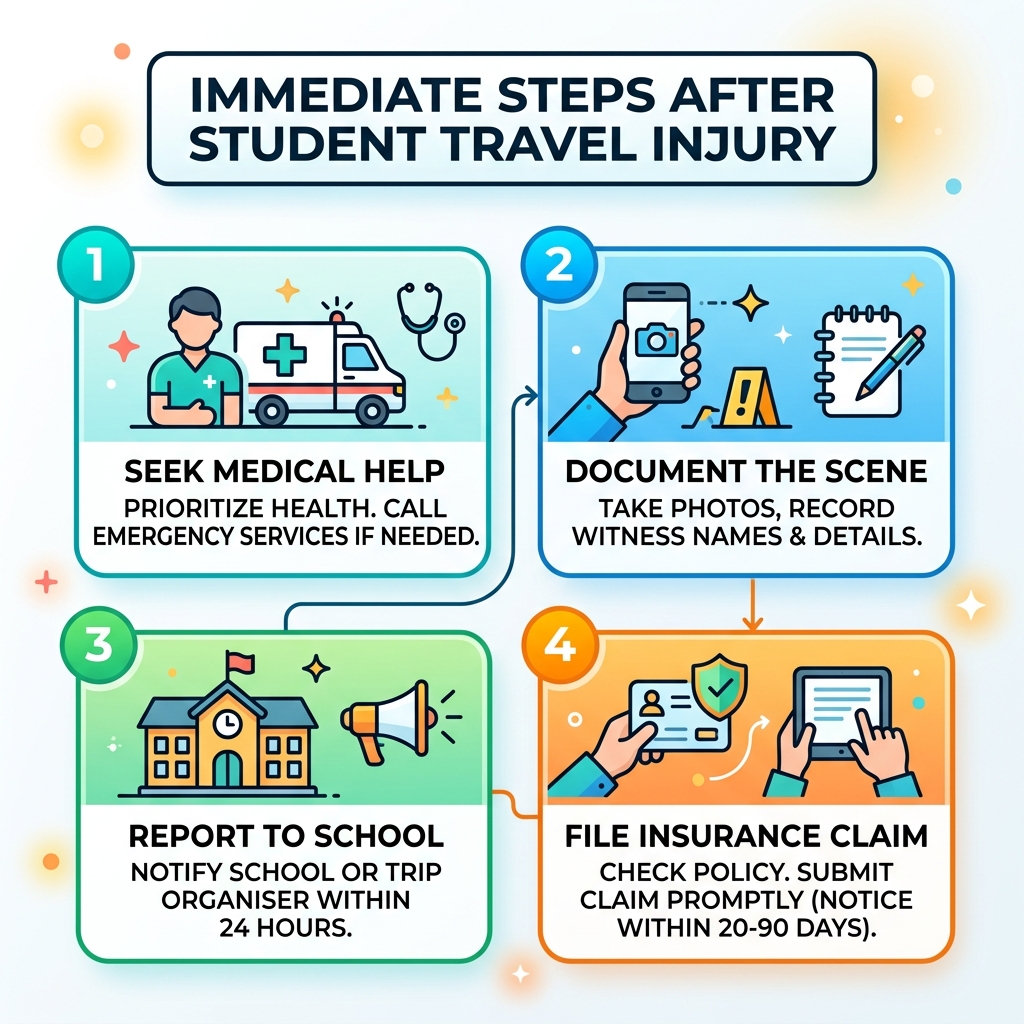
If you need to claim injury student travel benefits quickly, here are the key steps to take right away:
- Seek medical attention immediately – call emergency services if needed
- Document everything – photos, witness names, incident details
- Report the injury – notify the school, trip organiser, or university within 24 hours
- Locate your insurance policy – check if your university provides automatic coverage or if you have personal travel insurance
- File your claim promptly – most policies require written notice within 20-90 days of the injury
School trips and study abroad programs open up incredible experiences for students. But accidents do happen – sometimes serious ones. In 2023, 16 children were hospitalised after falling from an 18-foot structure during a field trip in Manitoba. A high school student in Pennsylvania suffered injuries from a 30-foot fall during a forest excursion. These aren’t rare edge cases – they’re reminders that even well-organised trips carry real risk.
For students and parents, the aftermath of an injury can feel overwhelming. Who pays the medical bills? Does the school’s waiver mean you can’t sue? What does your insurance actually cover? These are stressful questions to face at the worst possible time.
This guide breaks it all down in plain language – covering liability, insurance claims, and your legal options – whether the injury happened on a local field trip or overseas.
Understanding Liability and the School’s Duty of Care
When we talk about a claim injury student travel situation, the first question is usually: “Whose fault was this?” In the legal world, this falls under the concept of “duty of care.” Essentially, schools and universities have a legal obligation to ensure the safety and well-being of students while they are under their supervision.
This duty doesn’t mean the school is responsible for every scraped knee or stubbed toe. However, it does mean they must take reasonable steps to prevent foreseeable harm. If a school fails to provide adequate supervision or ignores a known danger, they might be found negligent.
A landmark example of how this responsibility is shifting is the case of Nova Southeastern University v. Gross. While universities generally aren’t responsible for dangers they didn’t create, this case suggested that if a university has a level of control over the environment—like a mandatory internship or a structured study abroad program—they can be held negligent if they fail to warn students of known risks.
In Australia, the rules are similar. Public schools may sometimes be protected by “governmental immunity” in certain jurisdictions, but this isn’t a blanket shield. If the injury resulted from a clear failure in supervision or a breach of safety protocols, a claim is often still possible.
Third parties also play a huge role. If a student is injured in a bus crash, the bus company might be liable. If a balcony collapses at a hotel during a study abroad trip, the venue owner is likely the one in the hot seat. Chaperones, too, have a role, though courts often apply a slightly more relaxed standard to volunteer parents compared to professional educators.
Identifying Negligent Parties
Figuring out who to name in a claim injury student travel lawsuit can feel like a game of “Who’s Who.” Here are the usual suspects:
- The School or University: For poor planning, lack of supervision, or failing to vet third-party providers.
- The Venue: Under “premises liability,” businesses like museums, zoos, or hotels must keep their grounds safe. If a student trips on a loose carpet or is bitten by an animal at a petting zoo, the venue is likely responsible.
- Transportation Companies: Bus companies must maintain their vehicles and hire qualified drivers. A school bus fire or a collision due to driver fatigue is a clear case of third-party liability.
- Third-Party Program Providers: Many universities outsource study abroad logistics. Even if the school isn’t directly at fault, these providers have a duty to meet safety standards.
Do Liability Waivers Fully Protect Schools?
We’ve all seen them: those long “permission slips” or waivers that look like they were written by a robot with a law degree. Many parents sign these thinking they’ve signed away their right to ever hold the school accountable.
Here is the good news: Liability waivers are not “get out of jail free” cards.
In many cases, these forms are considered “general consent” or “informed consent.” A General Consent Waiver basically says you know your child is going on a trip. An “Informed Consent” waiver goes deeper, explaining specific risks. However, neither of these typically protects a school from “gross negligence.”
If a school sends students hiking in a lightning storm or hires a bus driver with a history of DUIs, a signed piece of paper won’t stop a judge from allowing a lawsuit. There is also the legal concept of Assumption of Risk, where a student knowingly engages in a dangerous activity (like bungee jumping). But even then, the organiser must provide proper safety gear and instruction.
| Type of Waiver | What it Usually Covers | Can You Still Sue? |
|---|---|---|
| General Consent | Permission to attend the trip. | Yes, for almost any negligence. |
| Informed Consent | Acknowledgement of specific, inherent risks. | Yes, if the school was negligent beyond those risks. |
| Liability Waiver | Attempt to waive all legal rights. | Often unenforceable for gross negligence or minors. |
Common Injuries and Immediate Post-Accident Steps
Student travel injuries range from the “oops” to the “oh no.” Common incidents include:
- Transportation Accidents: Bus collisions or injuries during transit.
- Slips, Trips, and Falls: Especially common in historic sites or rugged outdoor environments.
- Recreational Injuries: Accidents during skiing, swimming, or sports.
- Foodborne Illness: Particularly a risk during international travel.
- Crime-Related Injuries: Assaults or thefts, which can happen if students are placed in unsafe housing.
If an injury occurs, the clock starts ticking. The steps you take in the first hour can make or break your claim injury student travel outcome.
First, obviously, get medical help. Don’t worry about the paperwork yet—just get to a doctor. Once the situation is stable, start documenting. Take photos of the scene. If a student fell because of a broken railing, take a picture of that railing before someone “fixes” it. Collect names and phone numbers of any witnesses, including other students and chaperones.
Notify the school or university immediately. Most institutions have a formal incident report process. Ask for a copy of this report for your records.
Immediate Response Protocol
We recommend following a strict protocol to ensure you have the evidence needed for a successful insurance or legal claim:
- Emergency Communication: Use the school’s emergency contact line. Ensure the parents are notified with accurate information.
- Incident Reports: Ensure the school files a “Student and Visitor Accident/Incident Report.”
- Medical Diagnosis: Get a full, written diagnosis from the treating physician. Don’t just settle for “he’s fine now.”
- Evidence Collection: Keep all receipts—from the ambulance ride to the bandages you bought at the pharmacy.
How to Claim Injury Student Travel Insurance Benefits
This is where we at RecipesGuard come in. Filing a claim injury student travel insurance report doesn’t have to be a nightmare if you know the rules of the game.
Many universities provide automatic coverage for sponsored trips. For example, some institutions offer up to $10,000 in medical expense benefits for domestic trips with a $0 deductible. Others might provide $5,000 in indemnity for accidents. These are “minimal medical policies,” meant to cover immediate costs, but they often act as “excess” coverage—meaning they kick in after your personal health insurance has paid its share.
To get started, you’ll need to know how to effectively file a travel insurance claim as a student. You’ll need your policy number, the date of the incident, and a clear description of what happened.
Filing a Claim Injury Student Travel Report
Timing is everything. Some policies, like those used by large universities, require “written notice of claim” within 20 days of the accident. If you wait two months, the insurance company might reject the claim entirely.
Here is a quick checklist for your filing:
- Claim Forms: Use the specific form provided by the insurer (such as an HSR or QBE form).
- Signatures: Many university policies require an “unrelated” party—like a camp director or chaperone—to sign the report to verify the accident.
- Itemized Bills: Don’t just send a credit card statement. You need itemized bills that show exactly what services were provided.
- Medical Diagnosis: A complete medical report is essential.
For more details, check out our step-by-step guide to filing a travel insurance claim as a student or our list of what documents students need for travel insurance claims.
Domestic vs. International Claim Injury Student Travel Differences
Filing a claim for a trip to the local zoo is very different from filing one for a semester in Rome.
For domestic trips in Australia, Medicare and your private health insurance will do most of the heavy lifting. The school’s insurance usually covers the “gap” or specific accident-related costs.
For international travel, things get spicy. You often need a Travel Health Passport or an insurance card that international doctors will recognise. International policies usually include:
- Medical Evacuation: If a student needs to be flown home on a medical jet (which can cost $50,000+).
- Repatriation of Remains: A grim but necessary inclusion.
- Trip Cancellation/Interruption: If a medical emergency cuts the trip short, you can claim back the non-refundable costs (often up to $1,500 – $5,000).
Factors Influencing Compensation and Legal Recourse
If the injury was serious, an insurance payout of $5,000 might not even cover the first day in the ICU. This is when you look at a personal injury claim.
The amount of compensation depends on several factors:
- Nature and Extent of Injuries: A broken arm is one thing; a permanent spinal injury is another.
- Medical Expenses (Past and Future): If the student needs physical therapy for the next five years, that should be included.
- Emotional Distress and Trauma: Don’t underestimate the psychological impact of a major accident, especially for younger children.
- Statute of Limitations: In most places, you have a limited window (often 2-3 years) to file a lawsuit.
Negotiating with insurance companies is like wrestling an octopus—they have a lot of arms and they’re very slippery. They will often try to offer a “quick settlement” that is much lower than what you actually deserve.
When to Seek Legal Counsel
We always suggest consulting an expert if:
- The injury resulted in permanent disability or long-term care.
- The school is denying all responsibility despite clear evidence of negligence.
- The insurance company is “lowballing” your settlement.
- Multiple parties are involved (e.g., a bus company, a venue, and the school).
Firms like Lionheart Lawyers or Carter Capner specialise in these types of travel and student injury cases. They can help you navigate the “duty of care” complexities and ensure you aren’t bullied into a bad deal. You can also find help through Stacks Goudkamp if you are a foreign visitor injured while studying in Australia.
Frequently Asked Questions about Student Travel Injuries
Who is liable if a student is injured on a third-party venue’s property?
Usually, the venue is primary. Under premises liability, businesses must maintain safe environments. However, the school could also be liable if they knew the venue was dangerous and took the students there anyway, or if the injury happened because the teachers weren’t watching the kids.
Are liability waivers signed by parents always legally binding?
Nope! While they are used to discourage lawsuits, they often fail in court if there is evidence of negligence. You cannot generally waive a child’s right to sue for injuries caused by an adult’s failure to keep them safe.
What is the maximum medical benefit for university-sponsored travel insurance?
It varies wildly. Some university policies provide a modest $5,000 to $10,000 for accidents. However, comprehensive international plans can have lifetime maximums of $1,000,000 to $5,000,000. Always check your specific “Summary of Benefits.”
Conclusion
Handling a claim injury student travel situation is never fun, but it doesn’t have to break the bank. By acting quickly, documenting the scene, and understanding the difference between a school’s “duty of care” and a “liability waiver,” you can protect your family’s finances and your student’s future.
At RecipesGuard, we believe that every student deserves to explore the world safely. If things go wrong, we are here to provide the step-by-step tutorials you need to get your claim filed and your life back on track.
For more info about student travel claim services, browse our latest guides and tutorials today. Stay safe out there!
