
Gap Year Insurance Policies That Won’t Break the Bank
Why Working Holiday Insurance Can Make or Break Your Gap Year
Working holiday insurance is a specialized travel coverage designed for people who plan to work while traveling abroad — and it’s one of the most important things you’ll buy before your trip.
Here’s a quick breakdown of what you need to know:
| Topic | Quick Answer |
|---|---|
| What is it? | Insurance covering medical, travel, and work-related risks during an extended working trip abroad |
| Is it mandatory? | Yes in Canada, Argentina, and South Korea; strongly recommended in Australia and New Zealand |
| How long does it last? | Typically 1–24 months depending on your destination |
| What does it cover? | Emergency medical, repatriation, work accidents, baggage, trip cancellation |
| How much does it cost? | From around €31–€40 per month depending on provider and destination |
| Who needs it? | Anyone on a Working Holiday Visa (WHV), typically aged 18–35 |
Gap years are exciting. But they come with real financial risks that standard travel insurance simply doesn’t cover.
A hospital night in Australia can cost between AU$1,000 and AU$2,500. A medical evacuation can run anywhere from $15,000 to $100,000 USD. Without the right policy, a single accident could wipe out your entire travel fund.
And here’s the part most people miss: if your insurance doesn’t cover your full stay, some immigration officers may actually shorten your visa at the border.
In this roundup, we compare the top gap year coverage options so you can find solid protection without overpaying.
Understanding Working Holiday Insurance and Why You Need It
When we talk about working holiday insurance, we aren’t just talking about a “nice-to-have” add-on. For many travelers, it is a legal prerequisite for entry. If you are heading to Australia on a 417 or 462 visa, or trekking across the Tasman to New Zealand, you are entering a world where your home country’s social security often holds no power.

Visa Compliance and Mandatory Requirements
In our experience advising students and young travelers, the biggest “gotcha” happens at the border. For example, Canada’s International Experience Canada (IEC) program is very strict: your insurance must cover the entire duration of your intended stay. If you show up with a six-month policy but a two-year visa, the border officer has the authority to shorten your visa to match your insurance.
Furthermore, medical costs abroad are astronomical. In Australia, an emergency ambulance in a regional area can cost up to AU$2,059. Without a policy that includes repatriation (the cost of flying you home in a medical emergency), you or your family could be left with a bill exceeding $100,000 USD.
Is insurance required for your specific destination?
While the rules vary, here is the general landscape for popular destinations:
- Canada (IEC): Absolutely mandatory. Must cover medical care, hospitalization, and repatriation.
- Australia: Not strictly mandatory for the visa grant for all nationalities, but strongly recommended as most visitors are ineligible for Medicare.
- New Zealand: Generally required for most WHV nationalities.
- South Korea & Argentina: Mandatory proof of insurance is required to secure the visa.
For those balancing studies and travel, checking out budget travel insurance for Erasmus students can provide additional context on how student-specific plans differ from full working holiday versions.
Comparing Coverage: Standard Travel vs. Working Holiday Insurance
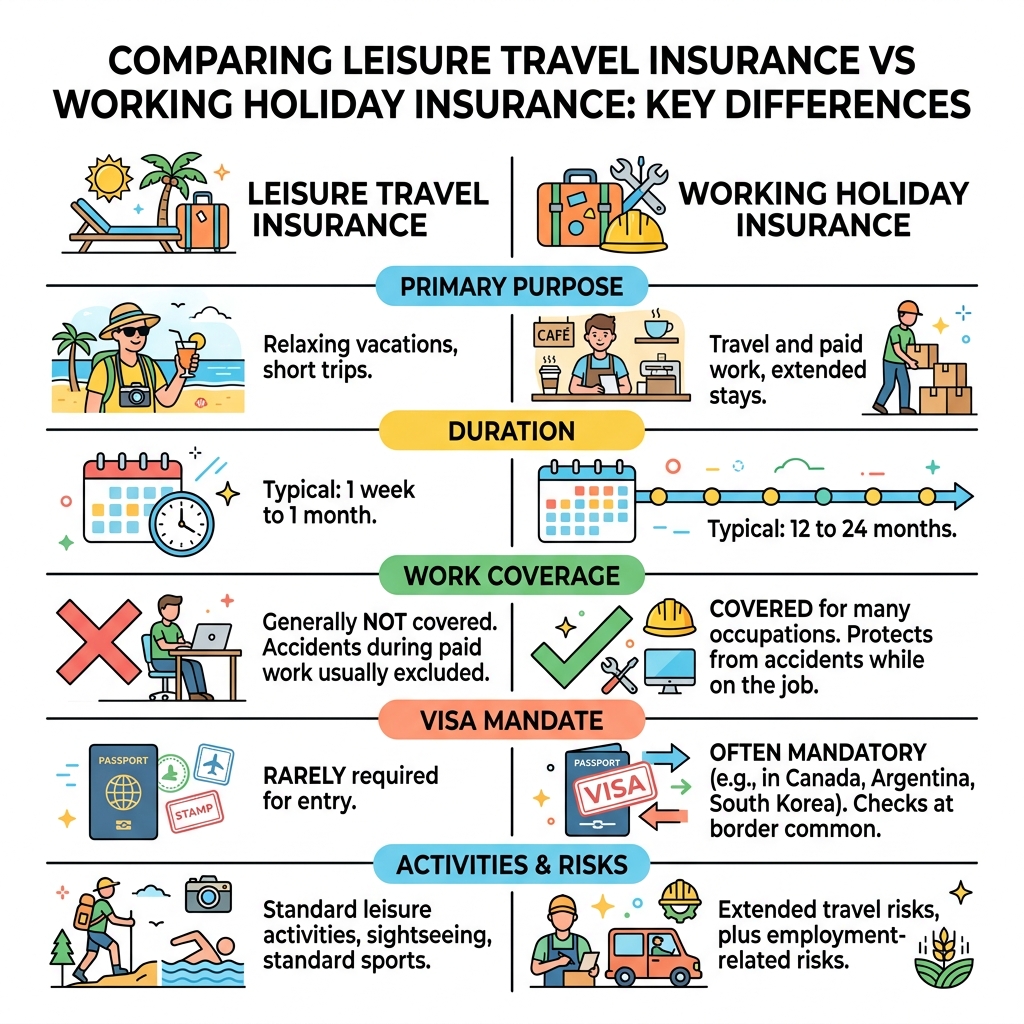
You might wonder, “Can’t I just use the travel insurance that comes with my credit card?” Generally, the answer is a resounding no. Standard travel insurance is designed for short-term leisure. It usually caps trips at 30 to 90 days and explicitly excludes any form of “manual labor” or “paid activity.”
| Feature | Standard Travel Insurance | Working Holiday Insurance |
|---|---|---|
| Max Duration | Often 30–90 days | Up to 12 or 24 months |
| Work Coverage | Usually excluded | Covers hospitality, farm work, etc. |
| Personal Liability | General | Often excludes work-related liability |
| Home Visits | Usually ends policy | Often allows 1–2 temporary returns |
| Medical Limit | Lower ($50k–$100k) | High (Up to €1,000,000 or Unlimited) |
If you’re a student looking for a middle ground, you might find some best budget travel insurance for students abroad options that offer extended stays, but always check the “work” clause.
Typical work activities covered by working holiday insurance
Most working holiday insurance policies are designed for the “typical” backpacker jobs. We see coverage most commonly for:
- Hospitality: Bar work, waiting tables, and hotel housekeeping.
- Au Pair/Nanny: Living with families and providing childcare.
- Office Admin: Clerical work and data entry.
- Fruit Picking & Farming: Seasonal agricultural work (though some high-risk machinery work might require an “Adventure” or “Manual Labor” pack).
- WWOOFing & Volunteering: Unpaid work in exchange for food and board (often arranged through organizations like WWOOF) is typically covered.
Essential Benefits for Your Global Adventure
When we evaluate a policy, we look beyond the price tag. You need a safety net that catches you when things go truly wrong in a foreign country.
Medical limits and emergency repatriation
A solid policy should offer at least €500,000 to €1,000,000 in medical coverage. Some premium Australian-focused plans even offer unlimited overseas medical expenses.
- 24/7 Assistance: Essential for finding a doctor who speaks your language or coordinating with a hospital.
- Psychological Support: Long-term travel can be taxing; some modern plans now include telehealth counseling.
- COVID-19 Coverage: Most reputable insurers now include COVID-19 related hospitalizations and quarantine hotel costs (e.g., €80 per night) as standard.
For young adults specifically, we often recommend looking at top budget travel insurance plans for young adults to see which providers offer the best emergency assistance networks. If you’re an EU citizen, there are also affordable budget travel insurance plans for EU students that bridge the gap between home social security and international needs.
Protecting your gear and travel plans
Your laptop and smartphone are your lifelines when working remotely or staying in touch with home.
- Baggage & Gadget Cover: Look for limits around $2,000–$2,500 total, with “per item” caps (usually $250–$500).
- Trip Cancellation: If your visa is refused or a family member falls ill before you leave, this can reimburse your non-refundable flights.
- Travel Delays: If you’re stuck in an airport for over 6 hours, some policies provide a small cash benefit (e.g., $200) to cover meals and essentials.
Students traveling on specific funding should also review budget travel insurance for students on scholarships as these plans sometimes have unique “interruption” benefits.
Managing Costs and Policy Extensions While Abroad
How much should you actually pay? On average, we see working holiday insurance starting at roughly €31.84 to €40.00 per month.
Several factors will influence your premium:
- Age: Prices often jump once you hit 30 or 35.
- Destination: The USA and Canada are the most expensive due to their healthcare costs.
- Deductibles (Excess): Choosing a higher excess (the amount you pay out of pocket for a claim) can lower your monthly premium. Many WHV plans offer €0 deductible options for faster, easier claims.
For those coming from specific regions, such as India, specialized advice like best budget travel insurance for Indian students abroad can help navigate currency and regional pricing differences.
Can you extend your working holiday insurance?
Plans change! You might fall in love with a city and decide to stay for a second year.
- Extensions: Many providers allow you to extend your policy while abroad, provided your current policy hasn’t expired and you haven’t made a major claim.
- Home Visits: Some “Gap Year” policies allow you to return home for up to 14–21 days (e.g., for Christmas or a wedding) without voiding the insurance.
- Refunds: If you decide to go home early, some insurers will refund the unused months of your premium (minus an admin fee), provided you have at least 2 months remaining and haven’t made a claim.
If you are a UK-based traveler, exploring the cheapest travel insurance for UK students abroad might reveal plans that specialize in these long-term “backpacker” extensions.
Frequently Asked Questions about Working Holiday Insurance
Are pre-existing medical conditions covered?
Generally, no—not automatically. Most budget-friendly working holiday insurance policies exclude pre-existing conditions to keep premiums low. However, you can often declare your conditions during the application. An assessment fee (around NZ$45/AU$50) may apply, and the insurer might agree to cover “acute episodes” of your condition for an extra premium.
What are the common exclusions to watch for?
We always tell our readers: read the “What is Not Covered” section first! Common exclusions include:
- Manual Labor at Heights: Working on ladders or scaffolding above 6 meters.
- Heavy Lifting: Jobs requiring lifting over 25kg.
- Intoxication: If you are injured while under the influence of alcohol or illicit drugs, your claim will almost certainly be denied.
- Unsupervised Belongings: Leaving your phone on a hostel table while you go to the bathroom is considered “leaving items unattended” and isn’t covered.
- High-Risk Sports: Activities like skydiving or off-piste skiing often require an “Adventure Pack” add-on.
How do I make a claim while overseas?
This is where we at RecipesGuard specialize. Most modern insurers offer e-claiming through an app.
- Notify: For hospitalizations over 24 hours, you must call the 24/7 assistance line immediately.
- Document: Keep every receipt, medical report, and police report (for theft).
- Submit: Upload photos of your documents via the insurer’s portal.
- Wait: Simple medical claims (under €500) are often processed in 5–10 business days.
Conclusion
A working holiday is a once-in-a-lifetime opportunity to immerse yourself in a new culture while earning your keep. But whether you’re picking grapes in the Barossa Valley or pouring pints in a London pub, the risks are real.
At RecipesGuard, we believe that being a “budget traveler” shouldn’t mean being an “unprotected traveler.” By choosing a dedicated working holiday insurance policy, you ensure that a medical emergency or a stolen bag doesn’t end your journey prematurely. We focus on providing student-focused, step-by-step claim filing tutorials because we know that the paperwork is the last thing you want to deal with when you’re halfway across the world.
Do your research, check the PDS (Product Disclosure Statement), and start your journey with the right protection. Safe travels!
