
When a Medical Emergency Abroad Becomes a Financial Crisis
Filing a medical emergency abroad claim is something most student travelers never think about — until they’re sitting in a foreign hospital, unsure who to call or what their insurance actually covers.
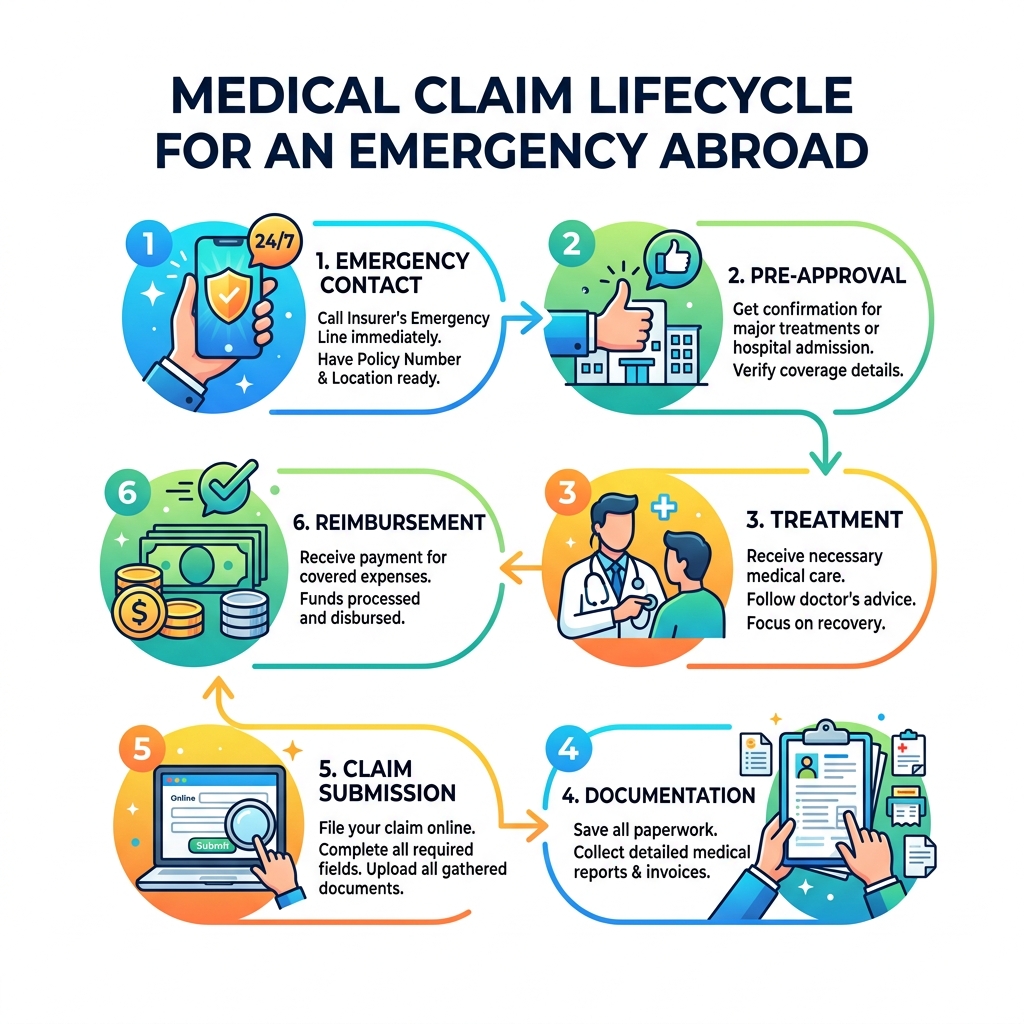
Here’s the short version of how to file a medical emergency abroad claim:
- Call local emergency services (112 in most of Europe, 911 in North America) if the situation is life-threatening.
- Contact your travel insurer’s 24/7 emergency line as soon as possible — have your policy number, location, and symptoms ready.
- Get pre-approval before major treatment, surgery, or hospital admission if your condition allows.
- Save every document — itemized bills, discharge papers, doctor’s notes, pharmacy receipts.
- File your claim online through your insurer’s portal, as soon as possible after treatment.
That’s the core process. But the details matter a lot — and missing even one step can get your claim denied.
Here’s the hard truth: most domestic health insurance plans, including Medicare, do not cover you once you leave the U.S. And medical care abroad is not cheap. A medical evacuation by air ambulance can cost anywhere from $20,000 to over $200,000, depending on where you are in the world. In extreme cases, medical repatriation costs have reached $1 million.
For international students especially, the stakes are high. You’re in an unfamiliar country, possibly without family nearby, navigating a healthcare system you’ve never dealt with before — all while feeling unwell. Knowing exactly what to do before that moment happens can be the difference between a manageable situation and a financial disaster.
This guide walks you through every step: from what to do in the first five minutes of a medical emergency, to filing a complete claim that actually gets paid.
Understanding Emergency Medical Travel Insurance Coverage

When we talk about travel insurance, many students think of lost luggage or cancelled flights. However, the heavy lifter of any policy is the emergency medical component. This coverage acts as a safety net for unexpected accidents and illnesses that occur while you are outside your home country.
It is vital to understand that travel medical insurance is typically secondary coverage. This means if you have a primary health insurer that offers some limited international benefits, you must usually file with them first. Your travel insurance then steps in to cover the remaining “out-of-pocket” costs, such as deductibles or amounts exceeding your primary plan’s limits.
Key components of this coverage include:
- Emergency Medical Expenses: Coverage for hospital stays, surgery, physician visits, and prescribed medicines.
- Emergency Dental: Usually limited to sudden pain or injury to sound, natural teeth.
- Medical Evacuation: Transporting you to the nearest adequate medical facility if local care isn’t sufficient.
- Repatriation: The cost of flying you back home once you are stable enough to travel.
Why Domestic Plans Fall Short Abroad
We often hear students ask, “Why do I need this if I already have health insurance?” The answer lies in the fine print. Medicare coverage limitations are quite strict; Medicare generally does not provide any coverage for medical costs incurred outside the 50 states and U.S. territories. Even private domestic plans often treat international providers as “out-of-network,” leaving you with massive bills.
Furthermore, U.S. Embassy assistance limits are often misunderstood. While a consulate can help you find a doctor or notify your family, they cannot pay your medical bills. You are 100% responsible for the costs. For more specific advice on how these gaps affect those studying overseas, check out our student-insurance-tips-for-medical-emergencies-abroad.
| Feature | Primary Domestic Insurance | Secondary Travel Insurance |
|---|---|---|
| Coverage Area | Usually Home Country Only | International / Global |
| Emergency Evacuation | Rarely Covered | Standard Benefit |
| Direct Hospital Payment | Standard (In-Network) | Often Arranged for Emergencies |
| 24/7 Travel Assistance | No | Yes |
Medical Evacuation and Repatriation Costs
One of the most terrifying aspects of a medical emergency abroad claim is the potential for “six-figure” transport costs. If you are hiking in a remote area and suffer a serious injury, a “bed-to-bed” transfer via air ambulance back to your home country can easily cost between $25,000 and $250,000.
The CDC travel health advice emphasizes that the decision for evacuation is typically made by the insurance company’s medical team in consultation with local doctors. They determine if the local facility can provide the necessary level of care. To dive deeper into the logistics of being moved across borders during a crisis, see the-international-student-guide-to-emergency-claims-and-evacuations.
Immediate Steps: What to Do During a Medical Emergency Abroad
In a crisis, adrenaline takes over, but logic needs to follow. If you find yourself facing a health scare, your first priority is safety. If the situation is life-threatening, call local emergency services immediately. Once you are in a safe environment or at a medical facility, the “insurance clock” starts ticking.
Many policies require precertification. This is a fancy way of saying you must get the insurance company’s “okay” before undergoing major procedures like surgery or being admitted for an overnight stay. Failing to do this can lead to a significant reduction in your reimbursement or even a total denial of the claim. For a detailed walkthrough of the hospital experience, read how-to-handle-the-hospital-stay-claim-process.
Contacting Your Insurer for Pre-Approval
Your insurance card isn’t just a piece of plastic; it’s your ticket to 24/7 assistance. When you call, have the following ready:
- Your policy or certificate number.
- Your exact location (hospital name and city).
- The name and contact info of the treating physician.
- A brief description of the symptoms or accident.
By involving the insurer early, they can often “guarantee payment” to the hospital. This means they handle the bill directly so you don’t have to swipe your own credit card for thousands of dollars. We recommend finding-your-student-policy-emergency-details-fast and saving them in your phone’s contacts before you even board your flight.
Finding Quality Medical Providers
Navigating a foreign medical system is tricky. Should you go to a public or private hospital? In many countries, public hospitals provide excellent care but may have long wait times or language barriers. Private clinics often cater to expats and travelers, offering English-speaking staff, but they usually require payment upfront.
The International Association for Medical Assistance to Travelers is a fantastic resource for finding reputable, English-speaking doctors. Your insurer’s assistance team can also provide a list of “in-network” providers where the claims process will be much smoother.
How to Successfully File a Medical Emergency Abroad Claim
Once the medical crisis has passed, the “paperwork crisis” begins. A medical emergency abroad claim is only as strong as the evidence supporting it. In a study of international travelers, insurance companies fully paid only about two-thirds of claims — often because of poor documentation or pre-existing condition issues.
We cannot stress this enough: keep everything. Even the smallest receipt for a bandage or a taxi ride to the hospital can sometimes be reimbursed. For a student-focused tutorial on the submission process, see how-to-effectively-file-a-travel-insurance-claim-as-a-student.
Essential Documentation for Your Medical Emergency Abroad Claim
To ensure your claim is processed without a hitch, you will typically need:
- Itemized Bills: A summary bill isn’t enough; the insurer needs to see exactly what you were charged for (e.g., X-rays, specific medications).
- Medical Reports/Discharge Papers: These must show the diagnosis and the treatment provided.
- Proof of Travel: Copy of your flight itinerary or passport stamps to prove the incident happened during your covered trip dates.
- Physician Notes: A letter from the doctor explaining why the treatment was an “emergency” and could not wait until you returned home.
For a comprehensive checklist of what to bring back in your suitcase, check out what-documents-students-need-for-travel-insurance-claims.
Avoiding Common Pitfalls in the Medical Emergency Abroad Claim Process
Why do claims get denied? Aside from missing paperwork, the most common reasons are:
- The “Wait and See” Approach: Waiting weeks to file. Most insurers require you to notify them within 20 to 30 days of the incident.
- Alcohol or Drug Involvement: If an accident happens while you are intoxicated, most policies will immediately void the coverage.
- Non-Emergency Care: Travel insurance is not for routine check-ups or getting a new pair of glasses. It must be a “sudden and unexpected” event.
Mastering these nuances is key to getting your cash back. Learn more at how-to-master-the-student-travel-claim-process.
Navigating Exclusions and Pre-Existing Conditions
Every insurance policy has “The List” — the things they simply won’t cover. Common exclusions include:
- High-risk adventure sports (unless you bought a specific rider).
- Elective surgery or “medical tourism.”
- Mental health care (coverage varies wildly here).
- Injuries sustained while breaking the law.
Pandemics are another hot topic. While many modern plans now cover COVID-19 as they would any other illness, always check the CDC information on pandemic influenza and your specific policy wording to see if quarantine costs are included. For students, understanding these boundaries is essential; read understanding-medical-emergency-coverage-in-student-travel-insurance for a deeper look.
Understanding the Pre-Existing Condition Waiver
This is the most common reason for claim denials. A “pre-existing condition” is generally any health issue you had in the 60 to 180 days (the “look-back period”) before buying the policy.
However, many insurers offer a Pre-Existing Condition Exclusion Waiver. To get this, you usually must:
- Purchase the insurance within a short window (often 14-21 days) of making your first trip deposit.
- Insure the full cost of your trip.
- Be medically fit to travel at the time of purchase.
If you have a chronic condition, don’t skip this step! It’s the only way to ensure an “exacerbation” of your condition is covered while abroad. We have more tips on affordable-emergency-medical-coverage-for-students that explain how to find these waivers.
Frequently Asked Questions about Medical Emergency Abroad Claims
Does travel insurance cover COVID-19 or pandemics?
Most plans today treat COVID-19 like any other unexpected illness. This means if you contract the virus while traveling and require hospitalization, it should be covered under your emergency medical benefits. However, “fear of travel” or general lockdowns are rarely covered unless you have a “Cancel for Any Reason” (CFAR) add-on.
What happens if I get sick abroad without insurance?
Without insurance, you are 100% responsible for all costs. Some private hospitals may refuse treatment until you provide a cash deposit or proof of funds. You may also be stuck with a lower standard of care in facilities that lack modern equipment. In short, it can turn a health scare into a lifelong debt.
How does travel insurance handle emergency dental care?
Emergency dental is usually meant for “pain relief.” If you trip and break a tooth, or develop a sudden, agonizing abscess, you’re likely covered. If you just want a cleaning or a filling for a cavity you’ve had for months, that will be denied. Most plans have a small sub-limit for dental, often around $500 to $750.
Conclusion
At RecipesGuard, we believe that being a student traveler should be about exploring new cultures, not worrying about hospital bills. Our mission is to provide you with the most clear, step-by-step claim filing tutorials in the industry. We know that the process of a medical emergency abroad claim can feel overwhelming, but with the right preparation and documentation, you can navigate it successfully.
The best time to understand your policy is before you need it. Carry your insurance card, know your emergency contact numbers, and always keep your receipts. For more insights on why this protection is a non-negotiable for your next semester abroad, read medical-emergencies-abroad-the-importance-of-travel-insurance-for-students.
Safe travels, and stay healthy out there!
