
Why Most Students Struggle With Travel Claim Success (And How to Fix It)
Student travel claim success comes down to a few key habits: acting fast, keeping the right documents, and knowing your policy before you need it.
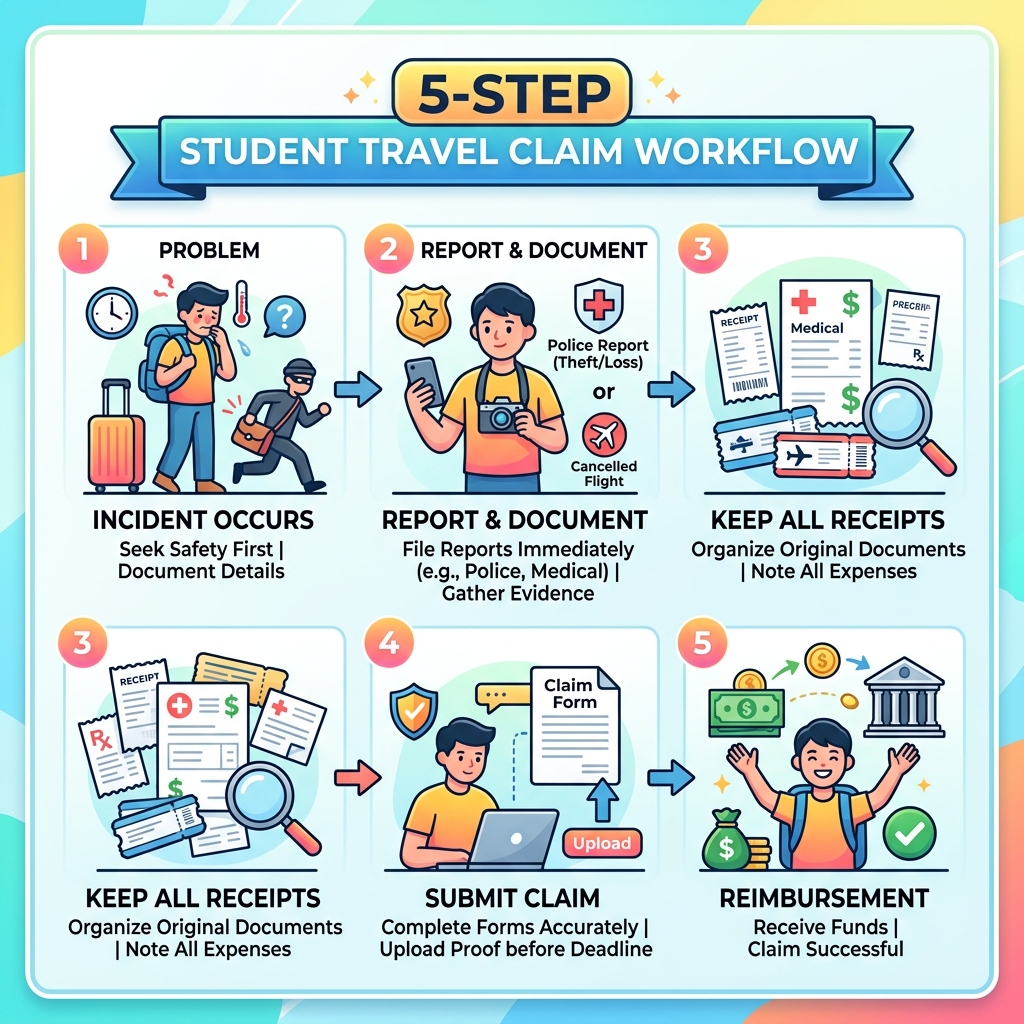
Here’s a quick overview of what it takes to get your claim approved:
- Contact your insurer immediately after any incident — don’t wait until you’re back home
- File a police report within 24 hours for theft, passport loss, or robbery
- Keep every receipt — medical bills, transport costs, prescriptions, and accommodation
- Know your policy limits — check exclusions, deductibles, and deadlines before you travel
- Submit your claim on time — most insurers require submission within 60–90 days of the incident
Studying abroad is exciting. But unexpected events — a sudden illness, a stolen bag, a cancelled flight — can turn that excitement into stress fast.
What makes it worse? Most students have never filed an insurance claim before. The forms are confusing. The deadlines are tight. And the stakes are high, especially when medical costs abroad can run into thousands.
The good news: a successful claim is absolutely achievable. Preparation and documentation make all the difference. Students who act quickly, keep records, and understand their coverage consistently get reimbursed — even for complex situations like medical evacuations or lost passports.
This guide walks you through exactly what to do.
Why Preparation is the Foundation of Student Travel Claim Success
We often see students treat travel insurance like a “set and forget” task. They buy the policy to satisfy a visa requirement and then tuck the PDF away in a buried email folder. However, student travel claim success is built long before you ever step into a doctor’s office or a police station.
The foundation of a successful claim is understanding your policy’s 24/7 assistance capabilities. Most modern student policies provide an international representative or a dedicated emergency assistance team. These are not just customer service agents; they are your lifeline. If you are hospitalized, calling them immediately allows them to coordinate with the hospital, verify your policy limits, and in many cases, arrange for a “Guarantee of Payment.” This means the insurer pays the hospital directly, saving you from having to find thousands of dollars in cash upfront.
Before you depart, we recommend creating a “Claims Ready” kit. This should include:
- The 24/7 emergency contact number (stored in your phone and written on a card in your wallet).
- Your policy number and the name of the underwriter.
- A clear understanding of your deductibles—the amount you have to pay out of pocket before the insurance kicks in.
- A list of policy exclusions, such as high-risk sports or pre-existing conditions that aren’t covered.
For a deeper dive into navigating these requirements, check out more info about overseas student claim guides. Being proactive ensures that when a crisis hits, you aren’t scrambling to find a login password while dealing with a medical emergency.
Leveraging Technology for Student Travel Claim Success
In today’s digital age, your smartphone is your most powerful tool for ensuring a smooth claim process. Many insurance providers now offer dedicated travel apps that allow you to access digital ID cards instantly. Having your ID card on your phone means you can present it to a pharmacist or clinic immediately, which is often the first step in a successful “cashless” transaction.
Technology also bridges the gap in medical care. Many student plans now include telehealth services or virtual consultations. If you have a minor ailment—like a skin rash or a mild cold—a virtual doctor can provide a consultation and a prescription without you ever leaving your dorm. This speeds up the “claim” because the insurer handles the billing for the virtual visit internally.
Furthermore, digital record-keeping is vital. If you are claiming government-related subsidies, such as the Claim for Reimbursement of Travelling Expenses for Study Periods Abroad 2025-2026, having scanned copies of your travel itinerary and tickets can prevent the delays often associated with physical mail. We always suggest taking a photo of every paper receipt the moment you receive it. Paper fades and gets lost; a cloud-stored photo is forever.
Essential Documentation: The Paper Trail to Approval
If there is one “secret sauce” to student travel claim success, it is documentation. Insurers are not trying to be difficult; they simply need verifiable proof that the event occurred and that the costs were legitimate.

When you file a claim, you are essentially telling a story to an adjuster who wasn’t there. To make that story believable, you need evidence.
- Medical Claims: You need more than just a credit card statement. You need itemized bills that show exactly what treatment was provided, pharmacy receipts for prescriptions, and a medical report from the attending physician.
- Theft and Loss: This is where many students fail. If your laptop is stolen, you must obtain a police report within 24 hours. If you wait three days because you were “too busy,” the insurer may deny the claim on the basis that you didn’t take immediate action.
- Travel Interruptions: If a flight is cancelled, get a written statement from the airline explaining why.
For a comprehensive checklist of what to keep in your folder, refer to our guide on what documents students need for travel insurance claims. Disclosing your medical history is also part of the documentation process. If you have a pre-existing condition, ensure you disclosed it when buying the policy. Hiding a condition is a fast track to claim denial.
Navigating the Claim Process: From Emergency to Reimbursement
Understanding the “how” of the process is just as important as the “what.” Most students will encounter two types of claim settlements: Cashless (Direct Billing) and Reimbursement.
| Feature | Cashless Facility | Reimbursement |
|---|---|---|
| Upfront Cost | Insurer pays the provider directly. | You pay out of pocket first. |
| Documentation | Required at the time of service. | Required after the service. |
| Speed | Instant financial relief. | Can take 15–60 days to get paid. |
| Best For | Major hospital stays, surgeries. | Small clinic visits, prescriptions. |
The process usually begins with immediate notification. Even if you don’t think you’ll need financial help right away, alerting the insurer creates a “case number.” This case number is the golden ticket for all future correspondence.
Once you’ve received care or dealt with the incident, you typically have a 90-day deadline to submit all paperwork. If your receipts are in a foreign language, some insurers provide translation services, but it’s always helpful to have a basic English summary of the charges. For a step-by-step breakdown of the medical side, see our article on mastering the student medical claim process.
Real-World Examples of Student Travel Claim Success
Real stories often highlight the difference between a rejected claim and a successful one. We’ve seen many instances where students turned a disaster into a manageable situation through quick thinking.
The Medical Evacuation Success: A student studying in a remote part of Southeast Asia developed a severe infection that required specialized care not available locally. Because the student had a comprehensive plan and called the emergency assistance line within the first hour of reaching a local clinic, the insurer coordinated a medical evacuation to a high-quality facility in a nearby capital city. The “secret” here was the immediate contact; the insurer’s medical team spoke directly to the local doctor to confirm the necessity of the move, ensuring the $20,000 cost was covered.
The “Reasonable Cost” Reimbursement: In Australia, students claiming allowances like ABSTUDY need to be aware of “reasonable cost” rules. One student traveling from a regional area to Sydney for university paid for an expensive last-minute flight. When they went to claiming after your trip, they were only reimbursed for the equivalent cost of a bus ticket because the flight wasn’t deemed the “most reasonable” travel method. Student travel claim success in this context means checking the rules before booking.
The Gap Year Theft: Another student had their backpack stolen in a crowded train station. Instead of panicking, they went straight to the transit police, got a report, and took photos of the empty locker where the bag had been. By providing the police report along with original purchase receipts for their laptop and camera, the claim was settled within 30 days. You can find more tips on this in our guide on how to handle a gap year theft claim.
Frequently Asked Questions
What are the most common reasons for student travel claim denials?
The most common reason is a lack of documentation, specifically police reports for theft or itemized medical bills. Another major pitfall is “high-risk activities.” If you are injured while bungee jumping or participating in intercollegiate sports, your claim might be denied unless you bought a specific “sports rider” or add-on.
Policy exclusions are also a factor. Most standard policies won’t cover incidents involving alcohol or illegal drugs. If a student is injured while intoxicated, the insurer has grounds for denial. Lastly, missing the filing deadline is a heartbreaking way to lose a claim. For more on avoiding these traps, read the student guide to getting money back after a cancelled trip.
How long does it typically take to settle a student travel claim?
Processing timelines vary, but you can usually expect a decision within 15 to 30 days of submitting complete documentation. The keyword is “complete.” If the insurer has to email you back to ask for a missing receipt, the clock restarts.
For Australian students using government schemes, the deadline to submit is often 12 months after the travel starts, but we recommend doing it within 60 days of your return. Once approved, funds are usually sent via electronic fund transfer, which is the fastest way to get your money back.
Frequently Asked Questions about Student Travel Claim Success
How can I maximize my reimbursement? To get the most back, always use the cheapest available public transport and utilize student concessions like railcards. Some government grants will actually reimburse the cost of the concession card if it saves the program money overall!
Is COVID-19 still covered? Most modern student travel policies now include COVID-19 coverage as standard. This often includes medical treatment if you test positive and “quarantine benefits” which can pay for lodging and meals (up to a certain limit, like $2,000) if a government mandates you stay in a hotel due to a contagious disease.
What if my university provides the insurance? University-sponsored plans, like those offered through Gallagher or CISI, are often very robust. They frequently include “crisis management” and mental health support, which are critical for students struggling with culture shock or anxiety abroad. Always check if your university has a “Safety and Security” office that can help facilitate the claim.
Conclusion
Achieving student travel claim success isn’t about luck; it’s about following a proven process. By staying organized, acting quickly, and using the digital tools at your disposal, you can ensure that a travel mishap is just a minor detour rather than a financial disaster.
At RecipesGuard, we are dedicated to providing the advisory expertise you need to navigate these complex waters. Our step-by-step tutorials are designed specifically for the unique needs of international students. Don’t leave your finances to chance—be prepared, stay informed, and travel with confidence.
