
Why Knowing How to Compare Private Health Insurance Gov Tools Can Save You Money and Stress
Compare private health insurance gov tools are the fastest way to find unbiased, complete policy information — straight from official government sources.
If you’re an international student dealing with a medical emergency abroad, the last thing you need is confusion about which policy covers you. Here’s a quick answer:
The main government tools to compare private health insurance are:
| Country | Official Government Tool | What You Need to Start |
|---|---|---|
| Australia | PrivateHealth.gov.au | Cover type, who’s covered, your state |
| United States | HealthCare.gov | ZIP code, household size, income |
| Ireland | HIA Comparison Tool | Coverage preferences |
These tools list every registered policy in their country. No commissions. No hidden filters.
Private health insurance costs are rising fast. In Australia alone, 2026 is seeing the biggest premium increases in nine years. The average combined hospital and extras policy already costs around $3,020 per year for a single person — before government rebates.
Choosing the wrong policy (or no policy) can leave you with huge out-of-pocket bills when something goes wrong.
The good news? Government comparison tools are free, independent, and surprisingly easy to use — once you know where to look and what to enter.
Finding the Official Tools to Compare Private Health Insurance Gov
When we set out to find the best deal on coverage, the internet often throws a barrage of “top 10” lists and flashy ads at us. However, if you want the ground truth, you have to go to the source. Official government portals are designed to provide transparency, not to make a sale.
In Australia, the gold standard is PrivateHealth.gov.au. This isn’t just another website; it is the official, independent government portal for every single health insurance policy available in the country. By law, every registered insurer must provide their policy details to the Private Health Insurance Ombudsman, meaning this database is 100% comprehensive.
If you are looking for broader guidance on the “why” and “how” of the system, the Australian Government Department of Health provides extensive resources on choosing private health insurance. These resources help us understand that while Medicare provides a safety net, private cover offers us a choice of doctor, shorter waiting lists for elective surgery, and access to private hospital facilities.

Identifying Your Local Marketplace
Navigating the right marketplace depends entirely on where you live. For our readers in Australia, the PrivateHealth.gov.au site is your primary destination. It is managed by the government to ensure that consumers have a clear, side-by-side view of what they are actually buying.
For those currently in the United States, the primary tool is HealthCare.gov. This marketplace is the hub for the Affordable Care Act (ACA) plans, where you can preview plans and prices based on your income before committing to a full application. Similarly, in Ireland, the Health Insurance Authority (HIA) offers a non-commercial health insurance comparison tool that updates prices and benefits on the 15th of every month.
It is important to remember that these sites are geographically specific. If you are an international student, you must ensure you are looking at the marketplace for the country where you are currently residing and seeking treatment.
Step-by-Step Guide to Using Government Comparison Tools
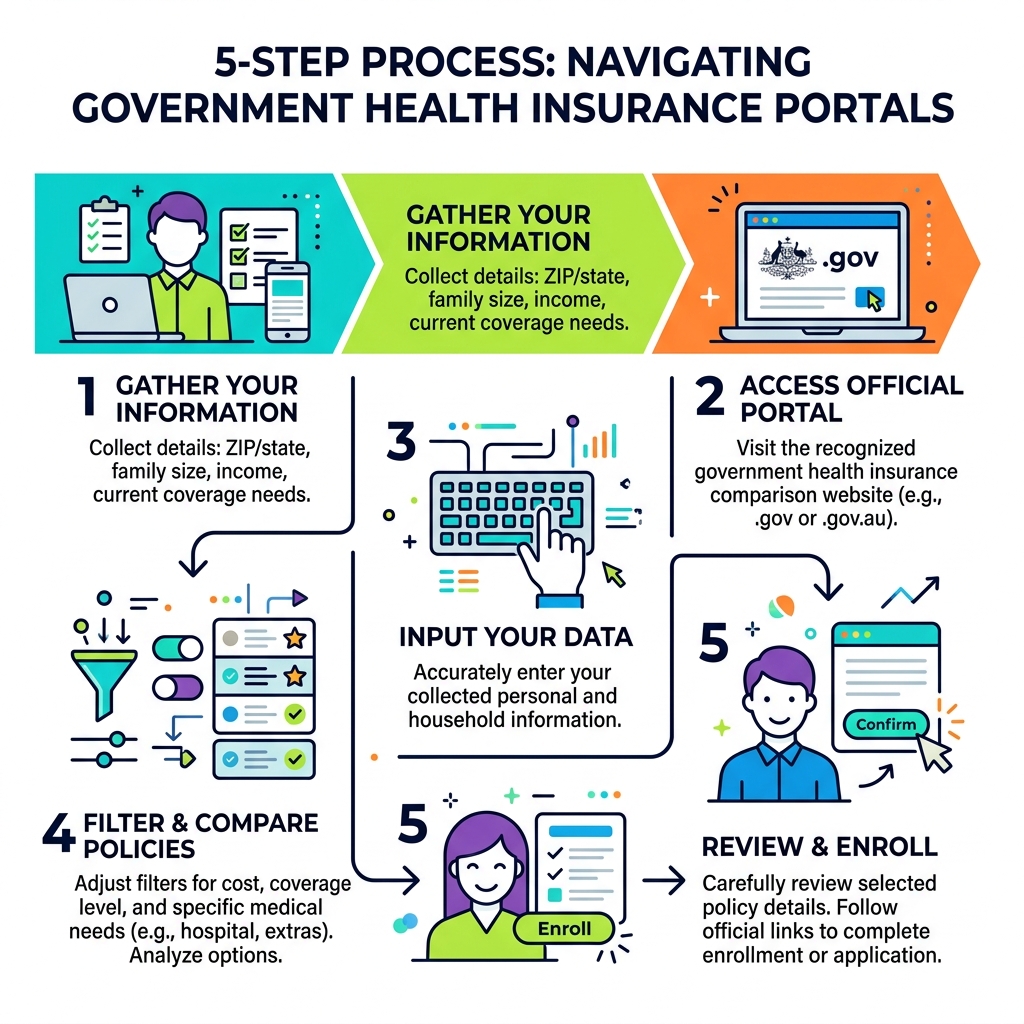
Using a government tool is a bit like using a sophisticated filter on a shopping site, but with much higher stakes. To compare private health insurance gov policies effectively, you need to follow a structured process.
- Select Your Basics: You’ll start by entering who needs cover (single, couple, or family) and your location. In Australia, premiums can vary significantly between states like NSW and WA.
- Define the Cover Type: Do you want Hospital only, Extras only (like dental and physio), or a Combined policy?
- Review the PHIS: Every policy on the government site has a “Private Health Information Statement” (PHIS). This is a standardized summary that makes it easy to compare “Apples to Apples.”
- Save Your Search: Most government tools provide a “Personal Key.” We recommend saving this so you can return to your search later without re-entering all your data.
What You Need to Compare Private Health Insurance Gov
Before you click “start,” gather your details. The more accurate your information, the more accurate the premium estimate will be. You will typically need:
- Your Postcode: Prices are region-specific.
- Family Status: Are you a single parent? A couple? A student?
- Household Income: This is vital for calculating your government rebate eligibility.
To help you decide on the type of cover, consider this breakdown:
| Cover Type | What it Covers | Best For… |
|---|---|---|
| Hospital | Accommodation, theatre fees, and doctors’ fees in a hospital. | Avoiding long public waiting lists and the Medicare Levy Surcharge. |
| Extras | Dental, optical, physiotherapy, and chiropractic. | People who use “ancillary” services regularly. |
| Combined | Both hospital and extras under one policy. | Comprehensive peace of mind and maximum convenience. |
Filtering for Your Budget and Healthcare Needs
One of the best features of government tools is the ability to filter by your actual needs. For example, if you are planning to start a family, you can filter for policies that include pregnancy and birth-related services.
Budgeting isn’t just about the monthly premium; it’s about the “out-of-pocket” costs. You can adjust the excess (the amount you pay when you go to the hospital) to lower your monthly bill. A higher excess usually means a lower premium. In the US context, you might see “Metal Levels” (Bronze, Silver, Gold, Platinum), which indicate how you and the insurer split costs. While we focus on Australia, it’s worth noting that international tools often use these categories to simplify the “cost vs. coverage” trade-off.
Furthermore, these tools help highlight protections against surprise medical billing, ensuring you aren’t hit with unexpected costs from out-of-network providers during emergencies.
Understanding Costs, Rebates, and Penalties
Price is often the deciding factor, but the “sticker price” isn’t always what you pay. In Australia, the government actually helps many of us pay for our private health insurance through a rebate. Conversely, if you earn over a certain amount and don’t have hospital cover, you might be hit with the Medicare Levy Surcharge (MLS).
How the Private Health Insurance Rebate and LHC Affect Premiums
The Private Health Insurance Rebate is a means-tested contribution from the Australian Government. Depending on your income and age, the government may pay a percentage of your premium. The older you are, the higher the rebate typically becomes.
Then there is the Lifetime Health Cover (LHC) loading. This is a bit of a “carrot and stick” approach. If you don’t take out hospital cover by July 1st following your 31st birthday, you will pay a 2% loading on top of your premium for every year you are over 30 when you eventually join. This loading stays on your policy for 10 years!
For students, understanding these long-term financial implications is key. We often discuss understanding student travel insurance coverage because it shares a similar logic: paying a little now to avoid a massive bill later.
Why You Should Compare Private Health Insurance Gov Instead of Commercial Sites
You might wonder why we shouldn’t just use a popular commercial comparison site. The answer is simple: Commissions.
Commercial sites often only show policies from insurers that pay them a fee or commission. This means they might hide the “best” or “cheapest” policy simply because that insurer doesn’t play the commission game.
When you compare private health insurance gov tools:
- Every Policy is Listed: You see the restricted funds (like those for teachers or police) and the big players alike.
- Unbiased Data: The government doesn’t care which insurer you choose; their only goal is that you are informed.
- Legal Mandates: Insurers are legally required to keep this data up to date.
This is a philosophy we share at RecipesGuard; whether we are explaining student travel insurance vs health insurance key differences, we believe in providing the full picture so you can make the best choice for your specific situation.
Avoiding Common Pitfalls When Choosing a Policy
Even with the best tools, it’s easy to trip up on the fine print. Here are the most common traps we see:
- Waiting Periods: You can’t buy insurance today and have a heart bypass tomorrow. Most hospital policies have a 2-month general waiting period and a 12-month period for pre-existing conditions.
- The “Gap”: Just because you have insurance doesn’t mean the doctor’s bill is fully covered. The “gap” is the difference between what the doctor charges and what the insurer and Medicare pay. Look for “Gap Cover” schemes in the policy details.
- Exclusions and Restrictions: Some “Basic” or “Bronze” policies exclude things like joint replacements or dialysis. If you need these, a cheap policy is a waste of money.
- Restricted Insurers: Some of the best deals are found in restricted funds (e.g., for healthcare workers or military). Check if you or a family member qualify.
If you are a student, you might also be looking at how to manage multiple types of cover. We have a great guide on how to combine student health insurance with travel insurance to ensure you aren’t paying for the same thing twice while remaining fully protected.
Frequently Asked Questions about Government Health Insurance
How often should I review and compare my health insurance policies?
We recommend a “Health Insurance Check-up” at least once a year. The best time is in March, right before the annual premium increases take effect on April 1st.
In 2026, premium rises are expected to be the highest in nearly a decade. One “pro tip” is to prepay your premium for 12 months in late March. This allows you to lock in the current year’s lower rate for another full year, effectively dodging the price hike. You should also review your policy whenever a major life event occurs, such as getting married, having a child, or if your income changes significantly (affecting your rebate).
What is the difference between Australian and US government marketplaces?
While both aim for transparency, they function differently. Australia’s PrivateHealth.gov.au acts as a comprehensive directory for a system that sits alongside a universal healthcare system (Medicare). You don’t “buy” the insurance on the government site; it directs you to the insurer.
The US marketplace (HealthCare.gov) is a more integrated “shop and enroll” platform. Because the US doesn’t have a universal system like Medicare for all citizens, the marketplace is the primary way for many to access subsidies and legally mandated coverage levels.
Are all registered insurers listed on government comparison sites?
Yes! In Australia, it is a legal requirement for every registered private health insurer to list every single one of their products on the PrivateHealth.gov.au website. This includes “restricted” funds that are only open to specific industries or groups. This is why the government site is the only place where you truly get the “full picture” of the market.
Conclusion
Choosing health insurance doesn’t have to feel like a gamble. By using official tools to compare private health insurance gov options, you are taking control of your financial and physical well-being. These tools provide the transparency needed to avoid “junk” policies and find coverage that actually works when you need it most.
At RecipesGuard, we know that insurance is complex, especially for students navigating a new country. Whether you are filing a claim or just trying to understand your excess, we are here to provide step-by-step guidance. Your health is your most valuable asset—don’t leave it to chance. Visit RecipesGuard for more insurance guides and take the stress out of staying protected.
