
What Is Travel Insurance Claim Evidence (And Why It Makes or Breaks Your Claim)
Travel insurance claim evidence is the collection of documents, reports, and receipts that prove your loss actually happened — and that your insurer needs before they’ll pay you back.
Here’s a quick overview of the most common documents required:
| Claim Type | Key Evidence Required |
|---|---|
| Trip Cancellation | Booking invoice, proof of payment, cancellation notice, unused tickets |
| Medical Emergency | Hospital bills, doctor’s notes, medical certificate, pharmacy receipts |
| Baggage Loss/Theft | Police report, proof of ownership, receipts, Property Irregularity Report |
| Baggage Delay | Airline irregularity report, receipts for essential items purchased |
| Trip Delay | Carrier delay confirmation, meal/hotel receipts, travel itinerary |
Every single claim you file requires documentation. That’s not a maybe — it’s a rule across every major insurer. Without the right evidence, even a completely legitimate claim can be denied.
This matters especially if you’re a student studying abroad. You’re already dealing with a stressful situation — a medical emergency, a stolen bag, a cancelled flight — and now you have to navigate a claims process you’ve never done before. Getting your evidence right the first time is the fastest path to getting your money back.
The good news? It’s not complicated once you know what to gather.
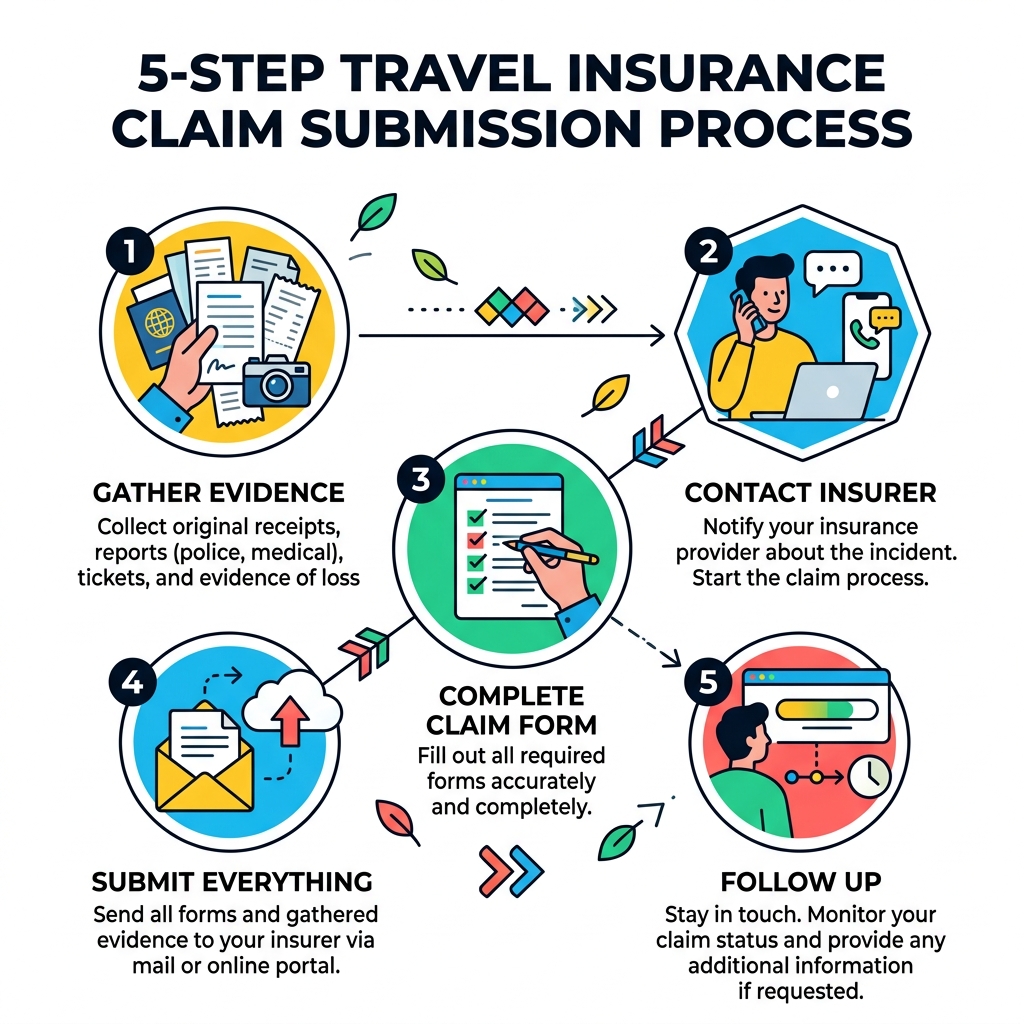
The Importance of Travel Insurance Claim Evidence

When we talk about filing a claim, the “burden of proof” lies with us, the travelers. Insurance companies aren’t just being difficult when they ask for a mountain of paperwork; they are regulated financial institutions that must verify every cent they pay out according to financial services regulations. Think of travel insurance claim evidence as the keys to a locked vault. Without the right keys, the vault stays shut.
We’ve seen thousands of claims processed, and the number one reason for delays isn’t the insurer being slow—it’s missing documentation. In fact, while many insurers aim to review a well-organized claim within 3 business days, a messy or incomplete file can push that timeline to 10 days or longer. If you want to get paid quickly, you need to make it easy for the claims processor to say “yes.”
One of the most critical “insider tips” we can share is to understand the timely filing limit. For most Australian policies and international plans, you must file your claim within a specific window—often 90 days from the date of the incident. Some providers even suggest submitting your paperwork within 4 weeks of returning home while the details are still fresh.
Missing these deadlines is a surefire way to get a denial, regardless of how much evidence you have. You should also keep your policy schedule and any coverage alerts handy. These documents outline exactly what you are covered for, helping you avoid the mistake of claiming for something that was never in your plan to begin with. If you’ve recently been in a mishap, learning how to handle an insurance claim after an accident is a great first step in understanding the broader process.
Required Documentation for Common Claim Types
Every claim is different, but they all share a common DNA: the need for a clear, chronological story. When we describe an incident to an insurer, we need to answer the “Big Five”: Who, What, When, Where, and How.
- Who was involved? (You, a doctor, a police officer?)
- What happened? (A theft, a fall, a flight cancellation?)
- When did it occur? (Date and exact time.)
- Where did it happen? (City, airport, hospital name.)
- How did it happen? (The sequence of events.)
Beyond the story, your travel itinerary and proof of payment (like credit card statements or bank receipts) are the foundation of almost every claim. They prove you were actually on the trip and that you were the one who paid for the services.
Evidence for Trip Cancellation and Interruption
If your trip ends before it begins or gets cut short, the insurer needs to know why and how much money you’ve actually lost. Start by gathering your booking invoices and unused tickets. If a flight was scrubbed, you’ll need carrier cancellation proof—usually an email or a formal letter from the airline stating the flight was cancelled and why.
Crucially, you must show refund documentation. If the airline gave you a partial refund or a travel voucher, the insurance company will deduct that from your payout. They only cover “non-refundable” expenses. If the cancellation was due to a tragedy, such as a death in the family, a death certificate will be required. For those struggling to navigate the aftermath of a cancelled trip, checking out our guide on how to get your money back after a flight cancellation can provide a more detailed roadmap.
Travel Insurance Claim Evidence for Medical Emergencies
Medical claims are often the highest value, which means they are scrutinized the most. If you end up in a clinic or hospital overseas, do not leave without a medical certificate or clinical notes. These documents should clearly state your diagnosis and the treatment provided.
We always remind students that HIPAA compliance (or similar privacy laws in Australia) means your medical records are confidential. You will likely need to sign an “Authorization for Release of Information” so your insurer can verify the bills with the hospital.
Keep every single hospital bill, physician note, and pharmacy receipt. Even a small receipt for bandages or over-the-counter meds prescribed by a doctor can be reimbursed. For international students, the stakes are even higher, so we recommend reading the-international-student-guide-to-emergency-claims-and-evacuations to ensure you have the specific evidence needed for high-cost evacuations.
Proof for Baggage Loss, Damage, or Delay
If your suitcase goes on its own vacation, you need a Property Irregularity Report (PIR). This is the document the airline desk gives you when you report the bag missing. Do not leave the airport without it.
For stolen items, a police report filed within 24 hours is usually mandatory. Insurers also require proof of ownership. This is where many students trip up. If you don’t have the original receipts for your laptop or camera, you can sometimes use photos of you with the item or credit card statements as alternative proof.
If your bag is merely delayed, keep receipts for “essential items.” This means basic toiletries and a change of clothes—not a designer tuxedo! For more tips on keeping your cool during a theft, see our guide on how to handle a gap year theft claim without losing your mind.
How to Submit Your Evidence Like a Pro
The days of mailing thick envelopes of paper are mostly over. Most modern insurers prefer electronic submission through an online portal or mobile app. This is faster, safer, and allows you to track your status in real-time.
However, there are some technical “pro tips” to keep in mind:
- File Size Matters: Most portals have a limit, often around 7MB per file. If your scan is too big, it will fail to upload.
- PDF is King: Use a “scan to PDF” app on your phone rather than just taking a blurry photo. It makes the text much more legible for the claims processor.
- Organize by Date: Rename your files (e.g., “2023-10-12HospitalReceipt.pdf”) so the adjuster can see the timeline clearly.
- The Claim Reference Number: Once you start a claim, you’ll get a unique number. Write this on every piece of paper you have.
For students who might be filing for the first time, our step-by-step-guide-to-filing-a-travel-insurance-claim-as-a-student breaks down the digital upload process in even simpler terms.
Digital vs. Physical Travel Insurance Claim Evidence
While we love digital, some insurers might still request original receipts for very high-value claims (like a $5,000 medical bill). If you have to mail anything, always make a digital copy first.
Using online portals significantly boosts processing speed. When you upload directly, your documents are automatically linked to your file. If you fax or mail them, a human has to manually sort and attach them, which adds days to the 10-day review window. Once approved, choosing direct deposit over a physical check can get your money into your account up to a week faster.
For a deeper dive into the specific needs of scholars, check out what-documents-students-need-for-travel-insurance-claims.
Avoiding Common Pitfalls and Denials
It’s a heartbreaking sight: a “Denied” notification. But why does it happen? Usually, it’s not because the insurer is “evil”—it’s because of a technicality in the travel insurance claim evidence.
- Late Filing: If you wait 91 days to file a claim with a 90-day limit, it’s almost impossible to get it approved.
- Policy Exclusions: If you were injured while participating in an “extreme sport” that wasn’t covered, no amount of hospital receipts will help.
- Pre-existing Conditions: If you didn’t have a waiver for a pre-existing condition, your medical claim might be rejected.
- Insufficient Proof: Claiming a $1,000 phone was stolen without a police report or a receipt of purchase.
If you are a student, you face unique risks, which is why we’ve written about how to effectively file a travel insurance claim as a student.
Can you appeal? Yes! If your claim is denied, don’t panic. You can often reopen a claim by submitting new evidence. Perhaps you found the receipt you thought was lost, or you managed to get a more detailed letter from your doctor. Insurers are often willing to take a second look if you can provide a clear explanation and the missing documentation.
Frequently Asked Questions about Travel Insurance Claim Evidence
How soon must I file my claim after an incident?
Most plans have a timely filing limit of 90 days from the date of the incident. However, best practice is to notify your insurer as soon as the incident happens via their emergency 24/7 line, and then submit the formal paperwork within 4 weeks of your return home. Always check your specific policy terms as these can vary.
What if I don’t have a receipt for a small expense?
We’ve all been there—a taxi in a remote area or a small pharmacy that only takes cash. If you lose a receipt, don’t give up. Provide a credit card statement or bank record showing the transaction. If that’s not possible, write a detailed explanation note including the date, amount, and what was purchased. While not guaranteed, adjusters are human and may accept alternative proof for small, reasonable amounts.
Can I appeal a claim if it was initially denied?
Absolutely. The appeal process usually involves writing a formal letter or filling out a reconsideration request. You should work closely with a claims advisor to understand exactly why the claim was rejected. If it was due to a “lack of evidence,” simply providing the missing document is often enough to get the decision reversed.
Conclusion
Gathering travel insurance claim evidence doesn’t have to be a nightmare. By staying organized, acting quickly, and keeping every scrap of paper, you can navigate the process like a pro. At RecipesGuard, we specialize in helping students and travelers navigate these tricky waters with student-focused advisory and step-by-step tutorials.
Our goal is your claim success. If you’re heading off on an adventure, make sure you’re prepared for the “what ifs.” For more guides and resources, visit us at https://www.recipesguard.com/. Safe travels!
