
What International Students in Australia Need to Know About Health Insurance
Student health insurance australia — specifically called Overseas Student Health Cover (OSHC) — is a mandatory requirement for anyone studying in Australia on a student visa.
Here’s a quick summary of what you need to know:
- Who needs it: All international students on a Subclass 500 (Student) or Subclass 590 (Guardian) visa
- How long you need it: For the entire duration of your visa, not just while you’re studying
- What it covers: Hospital treatment, GP visits, emergency ambulance, and limited prescription medicines
- What it doesn’t cover: Dental, optical, physiotherapy, or cosmetic procedures
- Who provides it: A small group of government-approved insurers authorized by the Australian Government
- How to get it: Purchase online before or upon arrival — most providers issue your visa certificate within minutes
- How much you could save: By comparing providers, students save up to $300 on average
But knowing you have OSHC and knowing how to use it — especially when something goes wrong — are two very different things.
Many international students arrive in Australia with a valid policy but have no idea how to file a claim, what costs they can recover, or what happens if they need to switch providers or graduate. The claims process can feel confusing, especially when you’re already dealing with a medical issue in an unfamiliar country.
This guide breaks it all down simply: what your policy covers, how to file a claim, and how to get your money back as smoothly as possible.
Understanding Student Health Insurance Australia Requirements
In Australia, maintaining health insurance isn’t just a good idea; it’s a legal obligation. Under Visa Condition 8501, international students must hold adequate health insurance for the entire duration of their stay. If your policy lapses, you risk your visa being cancelled by the Department of Home Affairs.
This requirement primarily applies to those on a Visa subclass 500 (Student) or a Visa subclass 590 (Student Guardian). The policy must be active from the day you arrive in Australia and must remain valid until the day you leave or your visa expires. It is a common mistake to only buy cover for the academic semester, but the government requires you to be covered for the “total duration” of the visa, including the months after your exams end.
The Overseas Student Health Cover basics are governed by a “Deed of Agreement” between the Australian Government and specific insurers. This ensures that every approved policy meets a minimum standard of care.
Choosing the Right Policy Type
When you set up your student health insurance australia, you’ll need to choose a category based on who is travelling with you:
- Single membership: Covers only the primary student visa holder.
- Dual family: Covers the primary student plus one adult dependent (like a partner or spouse) OR the primary student plus one or more children under 18.
- Multi-family: Covers the primary student, a partner, and any dependent children.
It is important to note that secondary visa holders (dependents) must usually be insured under the primary holder’s policy; they cannot typically hold their own separate OSHC. If you are feeling overwhelmed by the paperwork, learning how to master OSHC insurance can save you a lot of stress.
Activation Steps: Once you purchase your policy, you will receive a certificate (often within minutes). However, the policy isn’t fully “active” until you arrive. Most providers require you to log in to their app or website upon arrival in Australia to confirm your address and “activate” your membership so they can mail out your physical card.
What Does Your Policy Actually Cover?
Your OSHC is designed to mirror the benefits Australians receive through Medicare. While it isn’t “free” healthcare, it significantly reduces the cost of essential services.
- Hospital Treatment: This is the big one. If you are admitted to a public hospital or a private hospital that has an agreement with your insurer, most (or all) of the costs for the room and treatment are covered.
- GP Visits: When you see a local doctor (General Practitioner) for a cold, flu, or minor injury, your insurance will pay a portion of the fee.
- Emergency Ambulance: Unlike some countries, ambulance rides in Australia can cost thousands of dollars. Most student health insurance australia policies provide 100% cover for emergency transport to a hospital.
- Pharmaceutical Limits: OSHC provides limited benefits for prescription medicines. Typically, you can claim $50 per item, up to a maximum of $300 per year for a single membership ($600 for families). This means if a medicine costs $70, you pay $20 and the insurer pays $50.
- Mental Health Support: Many modern OSHC plans now include 24/7 mental health support lines and coverage for psychiatric services, often with no waiting periods for in-hospital treatment.
Exclusions in Student Health Insurance Australia
It is just as important to know what is not covered. Standard OSHC is “hospital and medical” cover, which means it excludes “Extras.”
- Dental and Optical: If you need a filling or new glasses, OSHC won’t pay for it. You would need to purchase a separate “Extras” policy.
- Physiotherapy: Treatment for sports injuries or back pain is usually an out-of-pocket expense.
- Pre-existing Conditions: There is usually a 12-month waiting period for ailments you had before arriving in Australia (excluding psychiatric conditions).
- Cosmetic Surgery: Any procedure performed for elective aesthetic reasons is excluded.
Because OSHC doesn’t cover your belongings or travel delays, many students also look into travel insurance for students to protect their laptops and flights during the journey to Australia.
How to Manage and File Your OSHC Claims
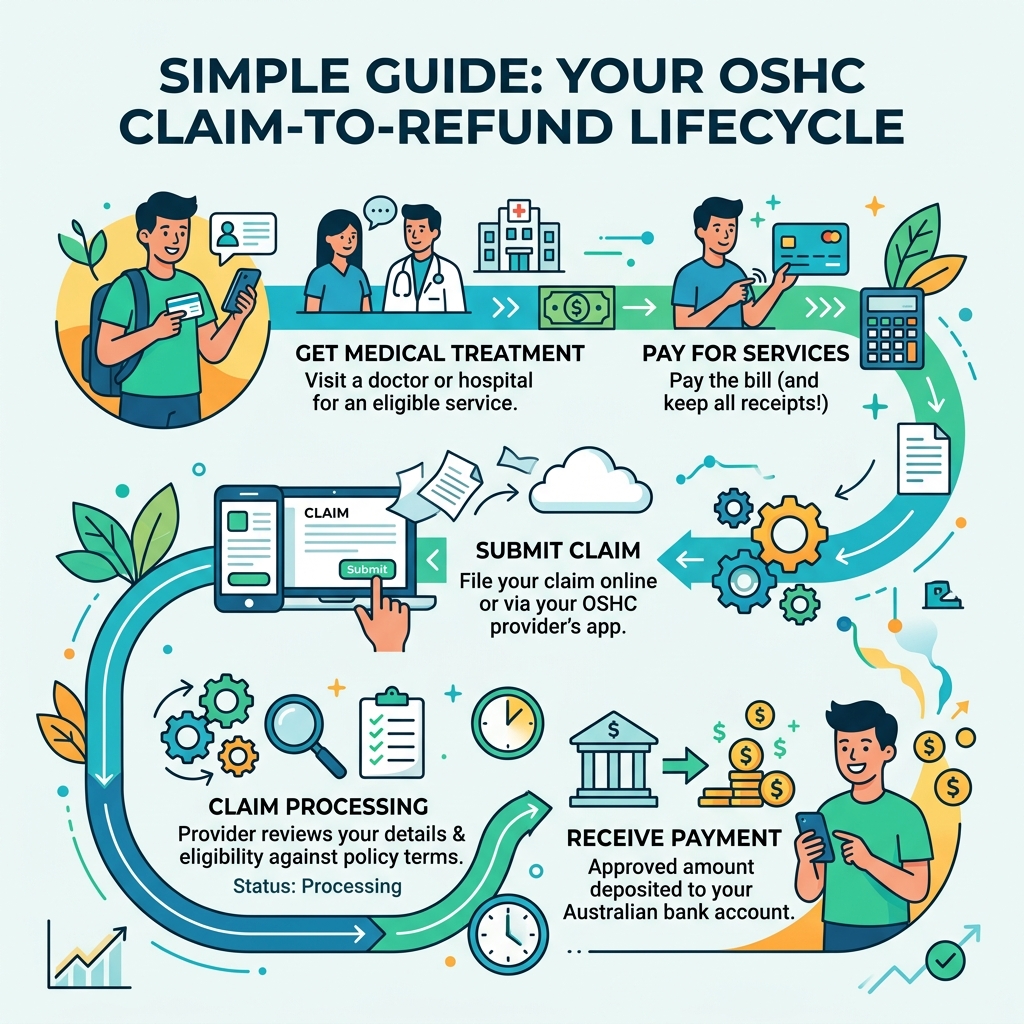
Filing a claim is the process of asking your insurance company to pay you back for a medical bill you’ve already settled.

There are two main ways to handle payments:
- Direct Billing: This is the easiest method. Many insurers have a network of “Direct Billing” doctors. When you visit these clinics, you show your OSHC card, and the doctor bills the insurance company directly. You might pay nothing, or just a small “gap fee.”
- Pay and Claim: If the doctor doesn’t offer direct billing, you pay the full amount upfront, keep the receipt, and then submit a claim to get your money back.
To make overseas student claims made easy, most providers offer a mobile app. You simply take a photo of your receipt and upload it. Most refunds are processed and deposited into your Australian bank account within a few business days.
If you’re feeling unwell but don’t want to leave your room, many providers now offer Telehealth services. This allows you to speak to a doctor over a video call, often with no out-of-pocket costs. For more detailed steps, check out your overseas student claim guide.
Maximizing Your Student Health Insurance Australia Benefits
To get the most value out of your policy, you should look beyond just the medical coverage.
| Benefit Type | Single Membership Limit | Family Membership Limit |
|---|---|---|
| Prescription Items | $50 per item | $50 per item |
| Annual Pharmacy Cap | $300 per year | $600 per year |
| Ambulance | Unlimited (Emergency) | Unlimited (Emergency) |
Student Rewards Programs: Some of the larger providers offer rewards programs. These can offer up to $650 in value during the first few months through discounts on brands like Apple, Uber, and various grocery stores.
Additionally, look for providers that offer multilingual assistance. Being able to explain your symptoms or discuss a claim in your native language can be a huge relief during a medical emergency.
Switching Providers and Post-Graduation Transitions
You are not stuck with the insurer your university recommended! You have the right to switch your student health insurance australia provider at any time.
The Switching Process:
- Purchase a new policy with your chosen provider.
- Ensure the new policy starts on the same day the old one ends (no gaps!).
- Contact your old provider and request a pro-rata refund for the remaining time on your policy.
- Provide proof of your new policy to the old insurer.
Graduation and Visa 485: Once you graduate and move to a 485 Temporary Graduate Visa, you are no longer eligible for OSHC. You must switch to Overseas Visitor Health Cover (OVHC). This is a different type of insurance that meets the requirements for working visas.
Reciprocal Health Care Agreements (RHCA): Students from the UK, Sweden, Netherlands, Belgium, Slovenia, Italy, and New Zealand may have access to Medicare through reciprocal agreements. However, even if you are from these countries, you usually still need OSHC to satisfy your visa conditions. The only common exemptions are for Swedish students (covered by Kammarkollegiet) and Norwegian students (covered by the Norwegian National Insurance Scheme).
Frequently Asked Questions about OSHC
Can I get a refund if my visa is refused?
Yes. If your visa application is denied by the Australian Government, you are entitled to a full refund of your OSHC premium. You will need to provide your insurer with the official visa refusal letter. Most providers will process this quickly, though some may charge a small administrative cancellation fee. You can also get a pro-rata refund if you leave Australia early or finish your studies ahead of schedule.
How much can I save by comparing providers?
On average, students can save up to $300 by comparing all government-approved providers rather than just accepting the one suggested by their university. Prices vary significantly between different insurers. By using comparison tools, you can find the lowest premium that still provides 100% visa-compliant coverage and an instant certificate for your visa application.
Do I need insurance if my country has a reciprocal agreement?
In almost all cases, yes. While a Reciprocal Health Care Agreement (RHCA) allows you to access some Medicare benefits (like subsidized medicine or public hospital care), it does not replace the requirement for OSHC. The Department of Home Affairs still requires OSHC for the Subclass 500 visa. The only exceptions are very specific arrangements for students from Sweden, Norway, and Belgium. For everyone else, OSHC is the primary way to avoid massive medical bills and keep your visa valid.
Conclusion
Navigating student health insurance australia doesn’t have to be a headache. While it is a mandatory expense, it serves as a vital safety net that ensures you can focus on your studies rather than worrying about medical bills.
At RecipesGuard, we specialize in helping students navigate the complexities of the insurance industry. By following the step-by-step claim filing tutorials and keeping your coverage continuous, you can ensure you stay visa-compliant and get every dollar back that you’re entitled to. Remember to keep your receipts, use your provider’s app, and always compare policies to find the best deal.
Ready to find the best cover for your journey? GET A QUOTE NOW and secure your peace of mind today.
