
What Every Student Should Know Before Filing an Insurance Claim
Knowing how to file insurance claim paperwork correctly can mean the difference between getting reimbursed quickly and losing money you’re owed.
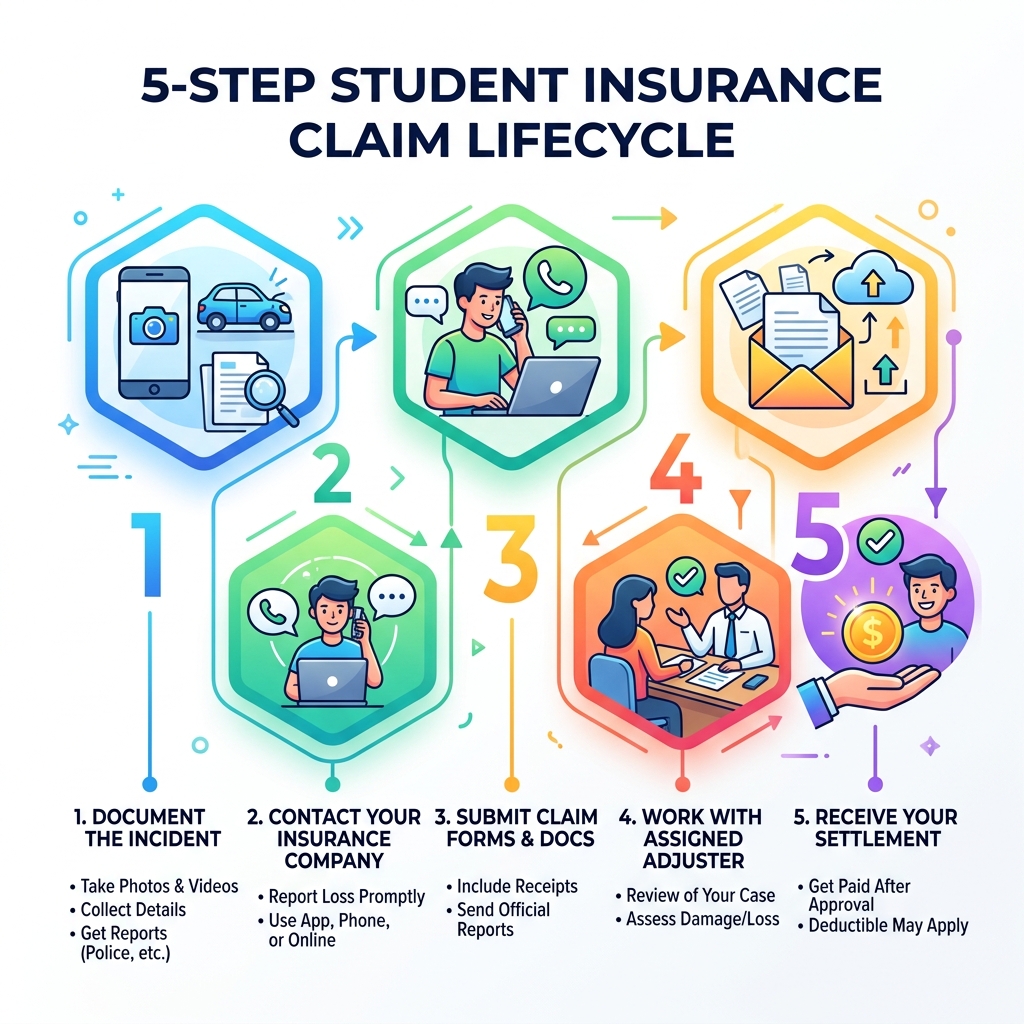
Here’s a quick overview of the core steps:
- Document the incident – Take photos, collect details, and get a police report if needed
- Contact your insurance company – Report the loss as soon as possible, by phone, app, or online
- Submit your claim forms and supporting documents – Include receipts, photos, and any official reports
- Work with the assigned adjuster – They’ll review your case and assess the damage or loss
- Receive your settlement – Get paid (minus any deductible) once the claim is approved
Most insurers have about 30 days to investigate and resolve a claim after you file. An adjuster will typically reach out within 1 to 3 days of submission.
As a student studying abroad, you probably didn’t spend much time reading your insurance policy before something went wrong. You’re not alone. One industry observer put it plainly: “The insurance policy is probably the most purchased yet least read contract in existence.”
That’s exactly why the process feels so confusing when you actually need it.
Whether you’re dealing with a medical emergency overseas, a stolen laptop, a car accident, or a cancelled trip – the claims process follows a similar structure across most insurance types. Once you understand that structure, it becomes much less intimidating.
This guide breaks it all down in plain language, step by step.
Immediate steps after an accident or incident

When something goes wrong—whether it’s a fender bender on the way to campus or a medical emergency during a weekend trip—the first few minutes are the most critical. At RecipesGuard, we always tell students: keep a cool head. Your future self (the one trying to get paid) will thank you for being thorough right now.
Safety First
Before you even think about how to file insurance claim paperwork, ensure everyone is safe. If you are in Australia and there are injuries or a significant hazard, call 000 immediately. If it’s a car accident, move your vehicle to a safe location if possible to avoid further collisions.
Call the Authorities
For many claims, especially theft, vandalism, or major car accidents, a police report is non-negotiable. In Australia, if there is property damage and the other party refuses to exchange details, or if there are injuries, the police must be notified. This official record serves as an unbiased account of the event, which is gold for your insurance adjuster. If you’re dealing with a health issue, check out our guide on how-to-handle-a-travel-injury-without-breaking-the-bank.
Document the Scene
Think of yourself as a forensic investigator. You need evidence.
- Photos and Videos: Take wide shots of the scene and close-ups of the damage. If it’s a car accident, photograph both vehicles and any skid marks or broken glass.
- Witness Information: If anyone saw what happened, get their name and phone number. Their statement could be the tie-breaker if the other party tells a different story later.
- Exchange Details: Get the other person’s name, address, phone number, and insurance information. Don’t forget to note the make, model, and registration number of their vehicle.
No-Fault Reporting
In some Australian states, personal injury from motor accidents is covered under “no-fault” schemes (like the CTP schemes in NSW or Victoria). This means you might be eligible for medical benefits regardless of who caused the crash. However, you still need to report the incident promptly to trigger these benefits. For more on managing the immediate aftermath, read our tutorial on how-to-handle-an-insurance-claim-after-an-accident.
How to file insurance claim: The documentation phase
Once the dust has settled, the real work begins. We call this the “Paperwork Marathon,” but with the right preparation, it’s more like a brisk walk. The goal of the documentation phase is to leave the insurance company with zero excuses to deny your claim.
The Proof of Loss
The “Proof of Loss” is a formal document (or digital form) where you declare the value of what you lost. For students, this often involves itemizing property like laptops, phones, or textbooks. If your luggage went missing on a flight to Sydney, you’ll need to know exactly what was inside. Check out our resources on lost-luggage-insurance-101 for tips on listing belongings.
Medical Receipts and Reports
If you’re filing a medical claim, you need every scrap of paper the hospital gave you. This includes:
- Medical reports detailing the diagnosis.
- Itemized invoices (not just the credit card receipt).
- Prescriptions for any medication.
For those studying far from home, we’ve simplified this in our guide: how-to-file-a-study-abroad-medical-claim-without-the-headache.
Digital Uploads and Apps
Most modern Australian insurers allow you to file via a mobile app. This is a lifesaver for students. You can often snap photos of your receipts and upload them instantly. This creates a digital paper trail that is much harder to lose than a physical envelope. To make sure you have everything ready, see what-documents-students-need-for-travel-insurance-claims.
The Golden Rule: Save Everything
Even the smallest receipt matters. If you had to buy a toothbrush because your bag was delayed, save that receipt. If you had to take an Uber to the clinic, save the digital trip record. These “out-of-pocket” expenses are often reimbursable. Learn more about the submission process at how-to-submit-claim-paperwork-and-actually-get-paid.
Understanding the adjuster and the settlement process
After you hit ‘submit,’ your claim is assigned to an insurance adjuster. Think of the adjuster as the “judge and jury” of your claim. Their job is to verify the facts, determine if the loss is covered by your policy, and calculate how much the company should pay.
First-Party vs. Third-Party Claims
Understanding the difference between these two is vital for knowing who to talk to.
| Claim Type | Who You File With | Example |
|---|---|---|
| First-Party | Your own insurance company | Your car is damaged by hail, or you get sick abroad. |
| Third-Party | The other person’s insurance | Someone else hits your car, and you file against their policy. |
In Australia, if you have comprehensive car insurance, it’s usually easier to file a first-party claim and let your insurer deal with the other person’s company (a process called subrogation).
The Damage Assessment
The adjuster will review your photos and may want to inspect the damage in person. For car claims, they might ask you to take the vehicle to a “Select Service” shop or a partner repairer for an estimate. For medical claims, they will review the necessity of the treatments. If you’re hospitalized, the process is a bit different; see how-to-handle-the-hospital-stay-claim-process for details.
Settlement Offers and Actual Cash Value (ACV)
When the adjuster makes an offer, they often use “Actual Cash Value.” This means they take the replacement cost of the item and subtract depreciation. So, that three-year-old laptop you bought for $1,500 might only be “worth” $600 in the eyes of the insurer.
If you disagree with the offer, don’t sign the release immediately. You have the right to negotiate or provide further evidence of the item’s value. Our step-by-step-guide-to-filing-a-travel-insurance-claim-as-a-student covers how to handle these negotiations.
Comparative Negligence
In Australia, fault isn’t always 100% one way. If you were partially responsible for an accident, your settlement might be reduced by your percentage of fault. For instance, if you’re found 20% at fault, you might only receive 80% of the total damages.
Navigating repairs, deductibles, and no-fault laws
Once the claim is approved, it’s time to get things back to normal. This usually involves repairs or medical reimbursements.
Choosing Your Repair Shop
In Australia, many policies give you the “choice of repairer,” but some might require you to use their preferred network to guarantee the work. If you choose your own shop and they charge more than the insurer’s “agreed price,” you might have to pay the difference.
OEM vs. Aftermarket Parts
When your car is being fixed, the insurer might specify “non-OEM” (aftermarket) parts to save costs. If you insist on Original Equipment Manufacturer (OEM) parts for an older car, you might face a “betterment charge”—where you pay the difference because the new part is considered an upgrade over your old, worn-out part.
The Deductible (The Excess)
The deductible (known as “excess” in Australia) is the amount you agree to pay out-of-pocket before the insurance kicks in.
- Standard Excess: Applies to most claims.
- Age Excess: If you’re a student under 25, you’ll likely face an additional “young driver” excess.
- When to pay: Usually, you pay this to the repair shop when you pick up your car, or it’s deducted from your final settlement check.
If you’re just looking to get reimbursed for a doctor’s visit, the process is usually simpler. Check out how-to-get-paid-back-for-your-doctor-visits or claiming-medical-expenses-as-a-student-made-easy.
Rental Car and Baggage Delays
Does your policy cover a rental car? Usually, this is an optional add-on unless your car was stolen. Similarly, for travel, “baggage delay” coverage provides a small allowance to buy essentials while you wait for your bags. For more on this, see the-baggage-delay-claim-process-explained-for-weary-travelers.
What to do if your claim is denied or delayed
It’s the email no one wants to see: “Claim Denied.” But at RecipesGuard, we want you to know that a denial isn’t always the final word.
Common Reasons for Denial
- Exclusions: The event wasn’t covered (e.g., “acts of God” or pre-existing medical conditions).
- Missed Deadlines: You waited too long to report the incident.
- Lack of Documentation: You didn’t provide enough proof.
- Policy Lapse: You forgot to pay your premium.
The Appeal Process
If you’re denied, the insurer must provide the reason in writing.
- Review the denial: Compare their reason against your policy wording.
- Gather new evidence: If they said there wasn’t enough proof, find more.
- Internal Dispute Resolution (IDR): Every Australian insurer has an internal complaints department.
- External Review: If IDR fails, you can take your case to the Australian Financial Complaints Authority (AFCA). This is a free service for consumers.
For students dealing with travel-specific denials, our guide on how-to-master-the-student-travel-claim-process is an essential resource.
Statutes of Limitations
Don’t sit on your rights. There are legal deadlines for filing lawsuits or finalising claims. In many Australian jurisdictions, you generally have several years for property damage, but medical or injury claims often have much tighter windows. If you’re struggling with a cancellation claim, read how-to-get-your-money-back-after-a-flight-cancellation.
Rate Increases
Will your premium go up? If you were at fault, likely yes. However, if you weren’t at fault and the insurer recovers the costs from the other party, your “No Claims Bonus” usually stays intact.
Frequently Asked Questions about how to file insurance claim
How long does it typically take to process and settle a claim?
In Australia, under the General Insurance Code of Practice, insurers should notify you of their decision within 10 business days of receiving all necessary information. However, complex claims involving investigations can take 30 days or longer. If there’s a delay, the insurer is required to keep you updated every 20 business days. For medical-specific timelines, see mastering-the-student-medical-claim-process-in-5-easy-steps.
Can I choose my own repair shop for my vehicle?
Yes, most of the time. However, you should check if your policy has a “choice of repairer” clause. If you use a shop outside the insurer’s network, they might not guarantee the repairs, and you might have to manage the communication between the shop and the adjuster yourself. We discuss this further in how-to-effectively-file-a-travel-insurance-claim-as-a-student.
Will my rates go up after I file an insurance claim?
It depends on the “fault.” If the accident was not your fault and you can identify the person who was, your rates generally won’t increase. If you are at fault, or if the claim is for something like a “hit and run” where the other party can’t be found, you might see an increase at renewal. Some insurers offer “rating protection” as an add-on to prevent this. For a stress-free experience, check out your-overseas-student-claim-guide-for-stress-free-travel.
Conclusion
Filing an insurance claim doesn’t have to be a nightmare. By staying organized, documenting everything, and understanding your rights as a policyholder, you can navigate the process with confidence.
At RecipesGuard, we are dedicated to student advocacy. We know that being a student is hard enough without having to fight an insurance company alone. Whether you’re in Sydney, Melbourne, or studying abroad, our step-by-step tutorials are here to ensure you get the resolution you deserve.
