
What Travel Insurance Luggage Damage Coverage Actually Does for You
Travel insurance luggage damage coverage reimburses you when your bags or their contents are broken, destroyed, or harmed while you’re traveling. Here’s a quick summary of what you need to know:
- What’s covered: Physical damage to your bags (cracked shells, broken handles, snapped wheels) and harm to contents caused by airlines or other carriers
- Who pays first: The airline is always first in line — travel insurance is secondary coverage that fills the gap
- Airline limits: Up to $4,700 for domestic U.S. flights; around $2,175 for most international flights under the Montreal Convention
- Travel insurance limits: Typically $750–$2,500 depending on your plan, with lower sub-limits for valuables
- Key step: File a Property Irregularity Report (PIR) at the airport before you leave — without it, most claims will be denied
Picture this: you land after a long international flight, exhausted and ready to start your trip. You pull your suitcase off the carousel and find the shell cracked clean through and a wheel snapped off. Now what?
For most travelers — especially students abroad for the first time — this moment is stressful and confusing. Who do you call? Does your insurance even cover this? Where do you even start?
That’s exactly what this guide is here to answer.
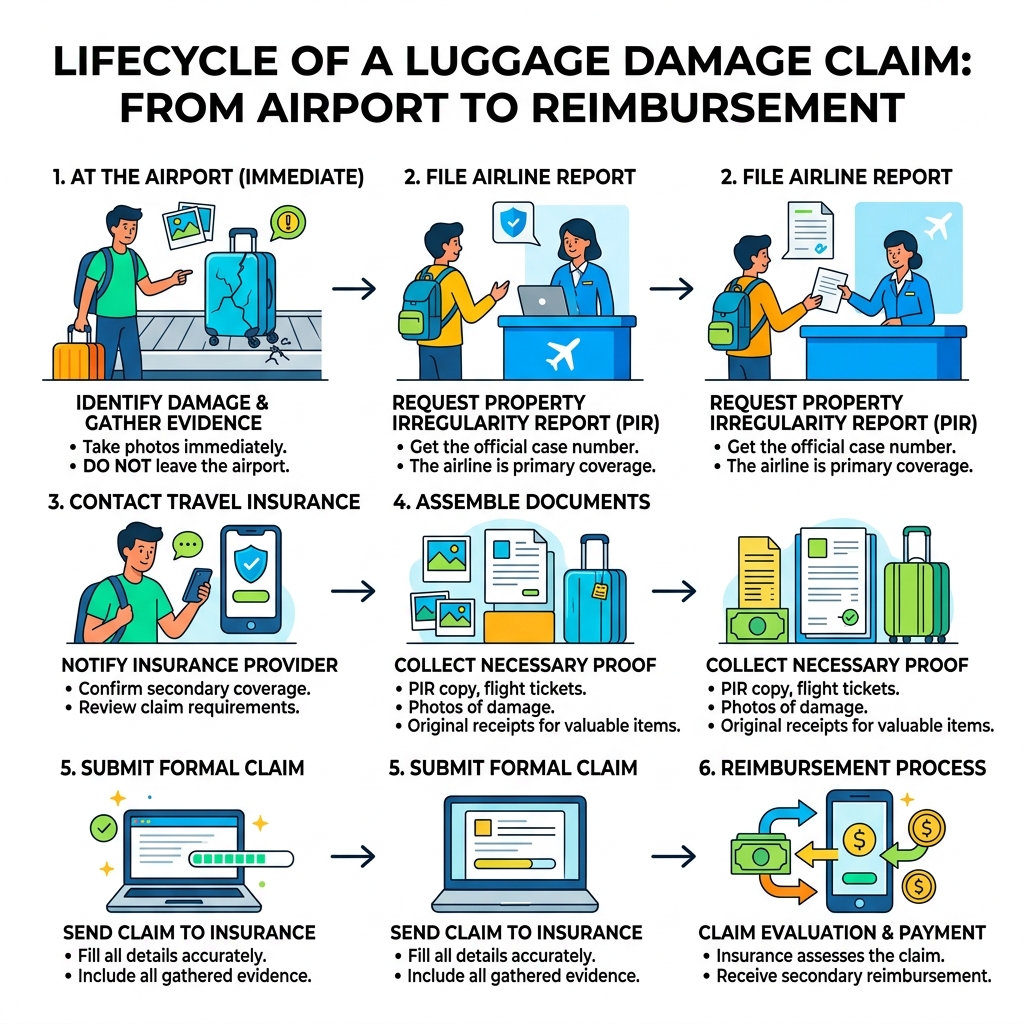
Handy travel insurance luggage damage terms:
Understanding Travel Insurance Luggage Damage Coverage
When we talk about travel insurance luggage damage, we are looking at a safety net designed to protect your belongings from the moment you leave your front door until you return. In the insurance industry, this is often bundled under “Baggage and Personal Effects Insurance.”
However, it is vital to understand the hierarchy of who pays. Most travel insurance policies act as secondary coverage. This means if an airline smashes your bag, they are legally the primary party responsible for the bill. Your insurance kicks in to cover the “excess”—the amount the airline refuses to pay or the value that exceeds their legal liability limits.
For students traveling to or from Australia, this coverage is a lifesaver. Whether you are carrying expensive textbooks, a laptop for uni, or just your entire wardrobe for a semester abroad, Baggage and Personal Effects Insurance ensures that a rough baggage handler doesn’t result in a massive out-of-pocket expense.
Common Types of Travel Insurance Luggage Damage
Not all damage is created equal. While a small scuff or a dirty mark is considered “wear and tear” (and generally not covered), structural failures that compromise the use of the bag are the bread and butter of insurance claims.
Commonly covered structural failures include:
- Smashed Shells: Hardside suitcases that have been cracked or punctured during transit.
- Broken Handles: Telescoping handles that no longer extend or have been ripped off entirely.
- Snapped Wheels: When a suitcase loses its “legs,” making it impossible to transport.
- Water Damage: If your bag was left on a rainy tarmac and the contents are ruined.
- Zippers and Latches: Heavy-duty zippers that have been burst open due to external pressure or mishandling.
What Items are Generally Excluded?
While we wish insurance covered everything, there are specific “no-go” zones. Understanding these prevents “claim heartbreak” later on.
- Pre-existing Damage: If your bag already had a cracked wheel before you checked it in, don’t expect a payout.
- Fragile Items: Many insurers exclude glassware, porcelain, or delicate carvings unless they were packed professionally.
- Professional Equipment: Items used for business or professional sports often require a specific “rider” or upgrade.
- Jewelry and High-Value Limits: Most standard plans have a “per-article limit.” For example, even if your plan covers $2,500 in total, it might only cover $250 for a single piece of jewelry.
- Unattended Items: If you leave your bag in a hotel lobby or a public area and it gets damaged or stolen, coverage is usually void. You must take “reasonable care.”
Navigating Limits and Airline Liability
When your bag is damaged, you aren’t just dealing with insurance companies; you’re dealing with international law. For Australian travelers, two main frameworks dictate how much cash you can get back.
The Montreal Convention is the big one for international flights. It sets a maximum liability for airlines at approximately $2,175 USD (1,519 Special Drawing Rights) per passenger. If you’re flying domestically within certain regions like the U.S., that limit jumps to $4,700. You can read more about the treaty framework here: Montreal Convention.
For a deeper dive into how these limits work, check out our guide on lost luggage insurance 101.
| Feature | Airline Liability (Montreal Convention) | Travel Insurance Benefits |
|---|---|---|
| Primary/Secondary | Primary | Secondary |
| Max Limit | ~$2,175 USD | $750 – $5,000 (Plan dependent) |
| Valuation Method | Depreciated Value | Actual Cash Value or Repair Cost |
| Claim Window | Immediate (usually 7 days for damage) | Varies (often 30 days) |
| Coverage Scope | Only while in airline’s care | Entire trip (Taxi, Hotel, Airline) |
How to Obtain Travel Insurance Luggage Damage Protection
You don’t always have to buy a standalone policy to be protected. Here are the three most common ways we see students and travelers getting covered:
- Comprehensive Travel Insurance: Many reputable providers offer plans where baggage coverage is built-in.
- Credit Card Benefits: Premium credit cards often provide “free” luggage insurance if you used the card to book the entire trip.
- Student-Specific Riders: At RecipesGuard, we often recommend students look for policies that allow upgrades for electronics, as standard limits often fall short of the cost of a modern MacBook or iPad. Check with specialized insurance providers for examples of these upgrades.
Interaction Between Airlines and Insurance Providers
Think of the process as a relay race. The airline runs the first leg. You must file a claim with them first. Once they provide a settlement (or a formal denial), you take that paperwork to your travel insurance provider.
This is known as sequential filing. The insurance company will ask for the airline’s settlement letter to ensure they aren’t “double-paying” you. Most insurers pay out the depreciated value of the item. This means if your three-year-old suitcase is smashed, they won’t pay for a brand-new one; they’ll pay what a three-year-old suitcase is worth today.
For those navigating the specific rules in the Land Down Under, read the ultimate guide to missing bag compensation in Australia to see how local regulations might affect your claim.
Step-by-Step Guide to Filing a Claim for Damaged Luggage
The secret to a successful travel insurance luggage damage claim is speed. If you walk out of those airport sliding doors without a report, your chances of a payout drop by about 90%.
- Inspect at the Carousel: Don’t wait until you get to your hotel. Check for cracks, missing wheels, or broken zippers immediately.
- Find the Baggage Service Office: Every airport has one near the carousels. Tell them, “My bag is damaged, and I need to file a PIR.”
- Get the PIR (Property Irregularity Report): This is a formal document with a unique reference number. Do not lose this. It is the single most important piece of evidence.
- Take Photos: Take clear, well-lit photos of the damage from multiple angles. Take a photo of the luggage tag still attached to the bag.
- Keep the Damaged Bag: Do not throw it away! The insurance company may want to inspect it or ask you to take it to a repair shop for a quote.
If your bag didn’t arrive at all, the process is slightly different. You can learn more about that in the baggage delay claim process explained for weary travelers.
Essential Documentation for Your Claim
When you finally sit down to file your claim with your chosen provider, you’ll need your “Evidence Folder” ready.
- The PIR Form: The golden ticket of luggage claims.
- Flight Documents: Your boarding pass and the little sticky luggage tag stub they gave you at check-in.
- Photos of Damage: Before and after (if you have “before” photos of your bag).
- Repair Estimate: A written quote from a luggage repair shop stating whether the bag can be fixed and at what cost.
- Original Receipts: For the bag itself and any damaged contents.
For more specific Australian advice, see where is my bag: a guide to lost bag claims in Australia.
Do I Need Receipts for Damaged Items?
This is the number one question we get at RecipesGuard. The short answer? Yes, if you want the full value.
Most insurers have a “no-receipt threshold.” Typically, if an item is worth more than $150, they will only reimburse you up to $150 if you don’t have a receipt. If you have the receipt showing you paid $800 for that designer suitcase last year, they can calculate the depreciation and give you a much higher payout.
Pro-tip for students: Dig through your emails! Most of us buy things online these days. A PDF of an Amazon or eBay order counts as a valid receipt.
Frequently Asked Questions about Luggage Damage
What should I do immediately if my luggage is damaged?
Stop! Do not leave the baggage claim area. Go straight to the airline’s service desk and file a Property Irregularity Report (PIR). Take photos of the damage right there on the airport floor. This proves the damage happened while the bag was in the airline’s possession, not in the back of your Uber.
Are there limits to the reimbursement for damaged contents?
Yes. Almost every policy has a “per-article limit” (often $250–$500) and an “aggregate limit” for valuables like electronics or jewelry. If you are carrying a $3,000 camera, a standard $1,000 baggage policy won’t cover it fully. You should look into “High-Value Item” add-ons from specialized insurance providers.
Does insurance cover damage to wheels and handles?
Generally, yes—provided the damage is structural. If a wheel is wobbly but still works, it might be denied as “wear and tear.” If the wheel is gone or the axle is snapped, that is considered travel insurance luggage damage and is eligible for a claim. Interestingly, the U.S. Department of Transportation (DOT) explicitly states that airlines cannot exclude liability for wheels, handles, or straps, even if their “fine print” says otherwise.
Conclusion
Dealing with a smashed suitcase is never the way you want to start or end a trip, but it doesn’t have to be a financial disaster. By understanding that your travel insurance luggage damage coverage is there to back up the airline’s liability, you can navigate the claims process with confidence.
At RecipesGuard, we specialize in helping students navigate these exact hurdles. Whether you’re studying in Melbourne, Sydney, or heading overseas, our step-by-step tutorials are designed to turn “baggage blues” into “reimbursement checks.”
Remember: File that PIR, keep your receipts, and don’t take “no” for an answer from the airline.
Ready to protect your gear for your next semester abroad? Get a Quote and Start Your Claim
