
What to Do When a Medical Emergency Hits Overseas
Abroad emergency claim steps can feel overwhelming when you’re sick, scared, and thousands of miles from home.
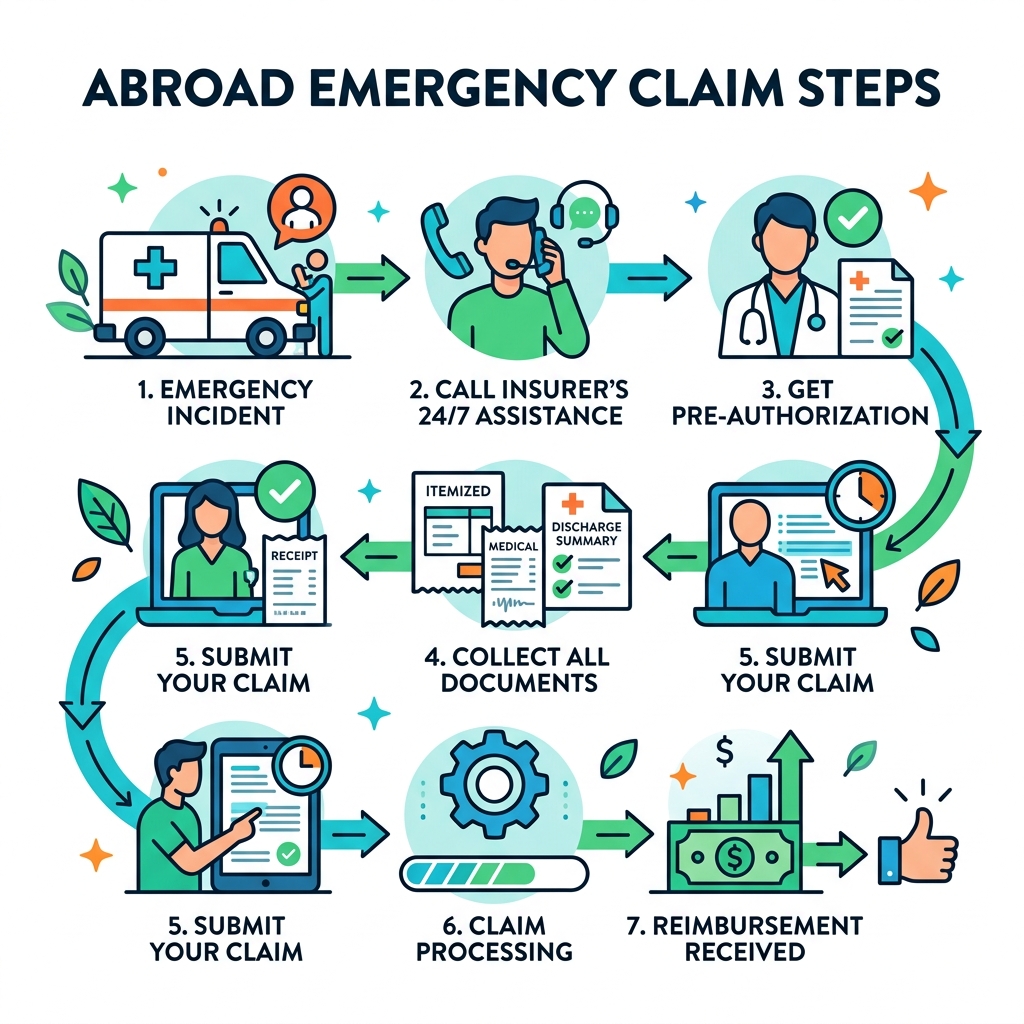
Here is a quick overview of what to do:
- Call local emergency services if your situation is life-threatening
- Contact your insurer’s 24/7 assistance line using the number on your insurance card
- Get pre-authorization before hospital admission if time allows
- Collect all documents – itemized bills, receipts, medical reports, and discharge summaries
- Submit your claim within your policy’s deadline (often 90 days to one year from the service date)
- Appeal if denied by providing documentation that addresses the specific rejection reason
According to Consumer Reports, roughly 15% of travelers run into a medical problem on their trip. For international students, that risk is even more real – you’re navigating unfamiliar healthcare systems, often without family nearby, and usually without prior experience filing insurance claims.
The good news? The process is manageable when you know what to do before panic sets in.
This guide walks you through every stage – from the moment an emergency happens to the day your reimbursement lands in your account.
Immediate Abroad Emergency Claim Steps: The First 24 Hours
When an emergency strikes, the first 24 hours are critical. Your priority is safety, but the actions you take in these early moments will dictate how smoothly your insurance claim progresses later. If you are a student studying in Australia or an Australian traveler heading overseas, knowing the local emergency numbers is your very first step. In Australia, that’s 000; elsewhere, it might be 911 or 112.
Once you are out of immediate danger, your next move is to find your insurance ID card. This card is your golden ticket. It contains your policy number and, most importantly, the 24/7 assistance line. We recommend saving this number in your phone contacts before you even leave home. These assistance teams are staffed by professionals who can guide you to the nearest reputable hospital and even provide translation support.
For more detailed advice on handling these high-pressure moments, check out our guide on more info about student medical emergencies. If you are a U.S. citizen, you can also seek emergency help for Americans abroad through government channels, though they generally won’t pay your medical bills.

Contacting Your Insurer and Pre-authorization
One of the most vital abroad emergency claim steps is obtaining “pre-authorization” or “pre-certification.” Unless it is a life-or-death situation where every second counts, you should contact your insurer before being admitted to a hospital or undergoing surgery.
Why is this so important? Pre-authorization allows the insurer to issue a “Guarantee of Payment” (GOP) to the hospital. This is a formal document where the insurance company promises to pay the facility directly. For students on a budget, this is a lifesaver because it means you won’t have to front thousands of dollars from your own pocket. To learn more about this specific stage, read our breakdown of how to handle the hospital stay claim process.
Using in-network providers is the easiest way to facilitate direct billing. These providers already have agreements with your insurer, making the administrative side of your emergency much less of a headache.
Navigating Local Healthcare Systems
Healthcare standards vary wildly across the globe. In many countries, you will have a choice between public and private hospitals. While public systems are often more affordable, private facilities frequently offer higher standards of care, shorter wait times, and more English-speaking staff.
When choosing a facility, look for JCI (Joint Commission International) accreditation. This is a “gold standard” indicating the hospital meets rigorous international safety and quality benchmarks. If you find yourself in a country where you don’t speak the language, don’t panic. Use translation apps or ask your insurer’s assistance line for help. For Australians traveling, the medical assistance overseas resource provides excellent insights into what to expect in different regions.
Essential Documentation for Your International Claim
If there is one thing we emphasize at RecipesGuard, it’s that documentation is the backbone of a successful claim. Insurers don’t just take your word for it; they need a paper trail. You should start a “claim folder”—either physical or digital—the moment you enter a clinic.
What exactly do you need?
- Itemized Bills: A summary isn’t enough. The insurer needs to see the cost of every bandage, pill, and consultation.
- Medical Reports: These should include your diagnosis and the doctor’s notes on your symptoms.
- Proof of Travel: Keep your boarding passes or flight itineraries to prove the incident happened during your covered period.
- Pharmacy Receipts: Even small costs for prescriptions (Rx) can add up and are often reimbursable.
To help you stay organized, we’ve put together a list of what documents students need for travel insurance claims.
Direct Billing vs. Reimbursement: A Comparison
| Feature | In-Network (Direct Billing) | Out-of-Network (Reimbursement) |
|---|---|---|
| Upfront Payment | Usually only deductible/copay | Full cost of treatment |
| Paperwork | Hospital handles most of it | You must collect and submit everything |
| Pre-authorization | Highly recommended | Often mandatory for big claims |
| Speed | Fastest (no money leaves your pocket) | Can take 5–30 days for refund |
Critical Abroad Emergency Claim Steps for Paperwork
Accuracy matters. When filling out claim forms, don’t leave any sections blank. If a question doesn’t apply to you, write “N/A.” A single missing signature can delay your payment by weeks.
One pro tip we always give students: keep a symptom timeline. Note down when you first felt sick, when you called the doctor, and what medications you were given. This is incredibly helpful if the insurer asks for clarification later. Also, keep your medicine in their original labeled containers; this helps doctors abroad identify exactly what you’ve been taking. For a deeper dive, see our guide on how to submit claim paperwork and actually get paid.
Managing Out-of-Pocket Costs
Even with great insurance, you might face some out-of-pocket costs.
- Deductibles: This is the fixed amount you pay before insurance kicks in. These can range from $100 to as high as $25,000 depending on your plan.
- Copays: A small, flat fee (like $20) you pay for a doctor’s visit.
- Currency Conversion: If you pay upfront in a foreign currency, your insurer will usually convert the amount based on the exchange rate on the date of service.
We know that managing finances as a student is tough, so we’ve made claiming medical expenses as a student made easy to help you navigate these costs without blowing your budget.
Understanding Timelines, Denials, and Appeals
How long does it take to get your money back? While every insurer is different, many top-tier providers aim to process claims within five business days of receiving all necessary documents. However, if you mail in paper forms rather than using a digital portal, expect it to take much longer.
Most insurers have a strict deadline for submission. This is usually 90 days from the date of service, though some generous policies give you up to a year. Missing this window is one of the most common reasons for claim denial. To stay on track, follow our step-by-step guide to filing a travel insurance claim as a student.
Why Claims Get Rejected and How to Appeal
It’s the email no one wants to see: “Claim Denied.” Before you panic, understand why it happened. Common reasons include:
- Pre-existing Conditions: If you had the illness before the policy started and didn’t declare it.
- Policy Exclusions: Some plans don’t cover “high-risk” activities like skydiving or riding motorcycles without a helmet.
- Incomplete Documentation: You forgot to include the itemized bill.
If your claim is rejected, you have the right to appeal. This involves writing a formal letter and providing new evidence to refute the denial reason. For example, if they claim it wasn’t an emergency, you might provide a doctor’s note stating that immediate care was necessary. Learn more about how to handle an insurance claim after an accident to be prepared for these hurdles.
Following Abroad Emergency Claim Steps for Denied Cases
When dealing with a denial, stay calm and methodical. Call the insurer and ask for a detailed explanation. Sometimes it’s just a simple misunderstanding or a clerical error. If the appeal process feels like too much of a “headache,” we have resources to help you file a study abroad medical claim without the headache.
Proactive Preparation and Consular Support
The best abroad emergency claim steps are the ones you take before you even pack your suitcase. Preparation can turn a potential disaster into a minor inconvenience.
First, enroll in the Smart Traveler Enrollment Program (STEP) if you are a U.S. citizen, or the equivalent for your home country. This makes it easier for the embassy to contact you in an emergency. Second, fill out the emergency contact page in your passport. It sounds old-school, but in a medical crisis where you might be unconscious, it’s the first place authorities look.
Knowing your blood type and carrying a laminated list of your medications (using generic names, as brand names change by country) can save lives. For more prep tips, see our guide on mastering the student medical claim process. You can also find official help abroad from the U.S. State Department.
The Role of Embassies and Consulates
What can an embassy actually do for you? While they cannot pay your medical bills or provide medical treatment, they are invaluable resources for:
- Providing lists of English-speaking local doctors.
- Helping notify your family back home.
- Assisting with emergency financial transfers or small loans if you are completely destitute.
- Replacing lost or stolen passports.
For European travelers, the consular assistance for emergencies abroad page offers a great perspective on the limits and capabilities of government help.
Final Abroad Emergency Claim Steps Before You Fly
Before you head to the airport, do one final check:
- Insurance Check: Is your policy active for your entire trip?
- Medication List: Do you have enough for 30+ days? Are they in original containers?
- Emergency Funds: Do you have a credit card with enough limit to cover a hospital deposit if direct billing isn’t available?
Our your overseas student claim guide is a great resource to keep bookmarked for these final checks.
Frequently Asked Questions about Emergency Claims
How long do I typically have to submit a claim after treatment?
Most international health insurers require claims to be submitted within 90 days. However, some providers may allow up to one year. We always recommend submitting as soon as you are discharged so the details are fresh in your mind.
What is the difference between in-network and out-of-network providers?
In-network providers have a pre-existing relationship with your insurer, allowing for direct billing (they bill the insurance, not you). Out-of-network providers usually require you to pay upfront and then file a claim for reimbursement later.
Can a U.S. embassy pay for my medical treatment abroad?
No. U.S. embassies and consulates do not have funds to pay for private medical bills. They can help you contact family to wire money or, in extreme cases, provide a repayable loan for repatriation, but the medical costs remain your responsibility.
Conclusion
Navigating abroad emergency claim steps doesn’t have to be a nightmare. By staying organized, contacting your insurer early, and keeping every single receipt, you can ensure that your focus stays on your recovery rather than your bank account.
At RecipesGuard, we are dedicated to helping students navigate the complexities of international insurance. From step-by-step tutorials to expert advisory, our goal is to give you the peace of mind you need to explore the world.
Ready to secure your next adventure? Start your stress-free travel journey with us today.
