
What to do when your bag doesn’t show up (and how to get your money back)
The baggage delay claim process can feel overwhelming when you’re already exhausted from a long flight — but knowing the right steps can help you recover your costs quickly.
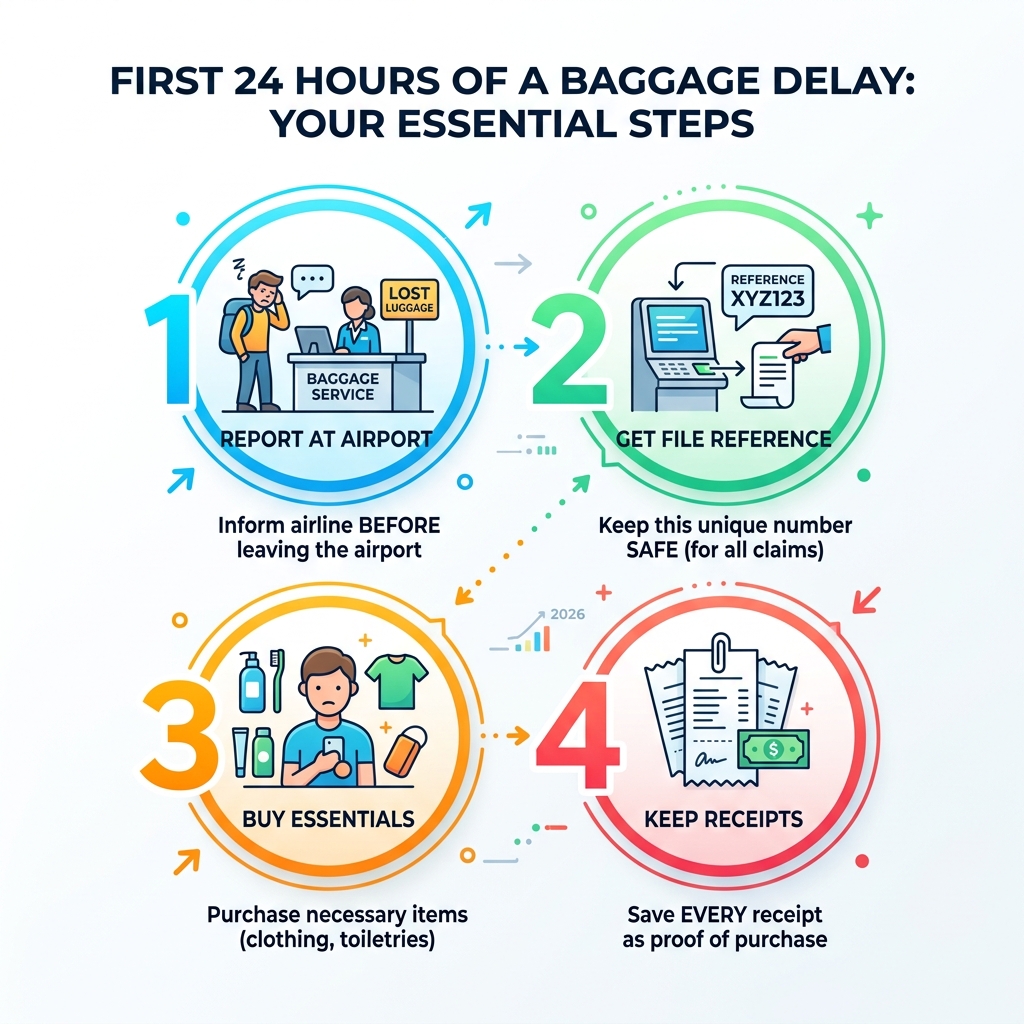
Here’s a quick overview of what to do:
- Report the missing bag immediately at the airline’s Baggage Service Office before leaving the airport
- Get a file reference number — you’ll need this for every step that follows
- Buy essential items (toiletries, clothing) and keep every receipt
- Submit a reimbursement claim within 30 days with your receipts and reference number
- Escalate to a lost bag claim if your bag hasn’t turned up within 5–21 days, depending on the airline
Most airlines are required to compensate you for reasonable expenses during a delay. The maximum liability is $4,700 per passenger on domestic U.S. flights and roughly $2,175 (1,519 SDR) on international flights under the Montreal Convention.
The bad news? The process involves strict deadlines, specific forms, and documentation requirements that most travelers don’t know about until it’s too late.
This guide walks you through every step — from the moment you realize your bag is missing to the final settlement.
Immediate steps to take at the airport
The moment the baggage carousel stops spinning and your suitcase is nowhere to be found, your “vacation mode” likely shifts into “panic mode.” We’ve all been there. However, the first rule of the baggage delay claim process is a simple one: Do not leave the airport without a paper trail.
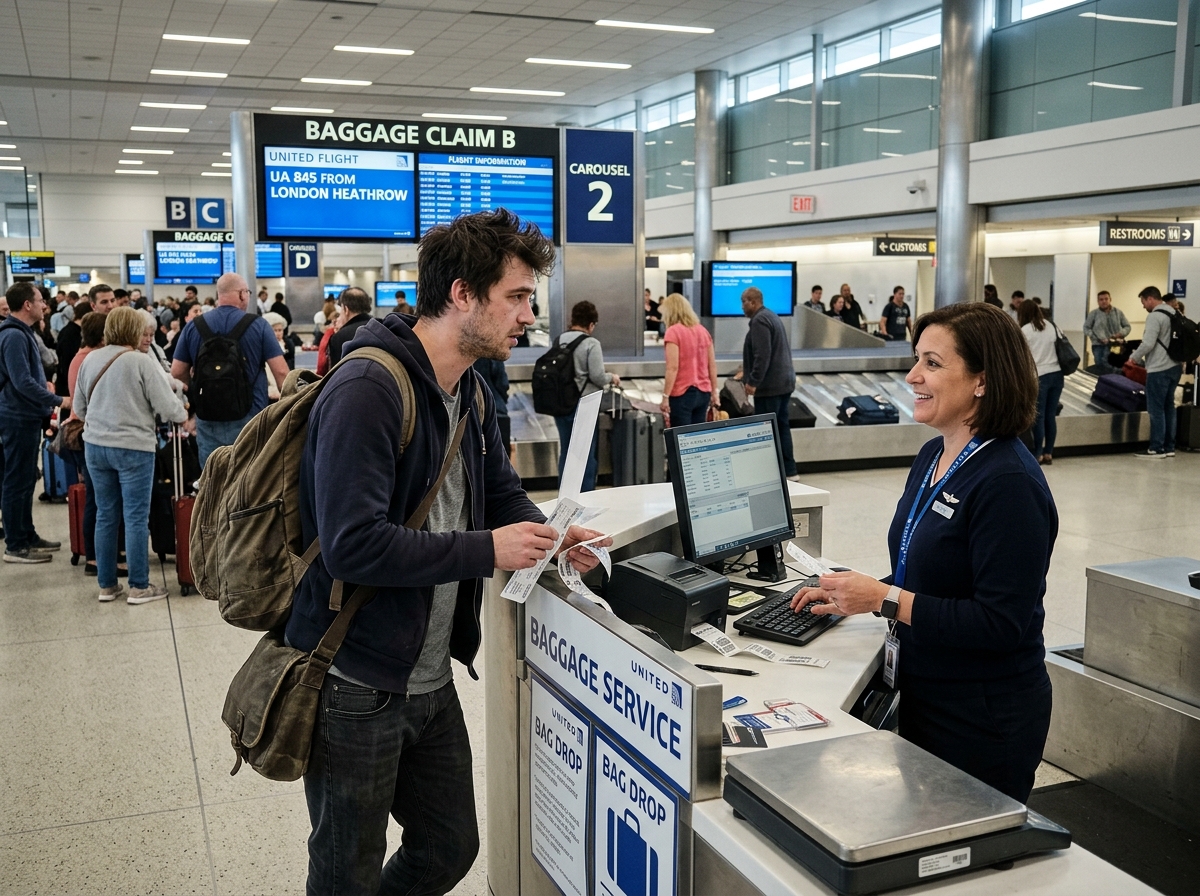
Locate the Baggage Service Office (BSO)
Before you head for the exit or hail a ride to your hotel, find the airline’s Baggage Service Office. This is usually located near the carousels in the arrivals hall. If you flew on a multi-airline itinerary (a codeshare flight), you must report the issue to the last operating carrier—the airline that operated the final leg of your trip.
File a Property Irregularity Report (PIR)
Once you find an agent, you’ll need to file a formal report. This is often called a Property Irregularity Report (PIR). You will be asked for:
- Your physical description of the bag: Be specific. Instead of “black suitcase,” mention the brand, any unique ribbons, or scuff marks.
- Your contact information: Ensure they have your local address (where you are staying now) and your permanent home address.
- Your bag tag number: This is the small sticker usually attached to the back of your boarding pass.
Secure your File Reference Number
This is the most critical piece of data you will receive. It is typically a 10 to 13-character alphanumeric code (e.g., SYDVA12345). This is NOT the same as your confirmation code or your bag tag number. You will need this ID to track your bag online and, more importantly, to file for reimbursement later. If you’re a student traveling abroad, learning how to master the student travel claim process starts with keeping these reference numbers safe in a digital folder or a notes app.
Arrange for Delivery
Most airlines are required to deliver your bag to your local address once it is found, free of charge. Insist on this. Do not agree to return to the airport to pick it up yourself unless it is absolutely necessary for your schedule.
Mastering the baggage delay claim process
Navigating the legalities of the baggage delay claim process requires understanding your rights, which vary depending on where you are flying. While we focus on the experience of travelers in Australia and those flying internationally, the rules are governed by specific conventions and government regulations.
Liability Limits: What are you owed?
Airlines aren’t allowed to just pick a random number when compensating you. There are legal ceilings on how much they must pay for lost or delayed luggage.
| Flight Type | Governing Rule | Liability Limit (Per Passenger) |
|---|---|---|
| Domestic (U.S.) | DOT Regulations | Up to $4,700 USD |
| International | Montreal Convention | 1,519 SDR (Approx. $2,175 USD / $3,300 AUD) |
| International (Old) | Warsaw Convention | Approx. $20 per kg ($9.07 per lb) |
The Montreal Convention is the gold standard for international travel. It applies to most flights between member countries (including Australia). The limit is measured in “Special Drawing Rights” (SDR), a currency unit defined by the International Monetary Fund. As of late 2024, this limit has been adjusted for inflation to 1,519 SDR. For more details on these legal protections, you can visit the Official DOT baggage rights and rules.
Crucial Deadlines
The baggage delay claim process is a race against the clock. If you miss a deadline, the airline can legally deny your claim.
- Domestic (U.S.) reporting: Usually within 4 to 24 hours of arrival.
- International (Montreal Convention) reporting: You must report the delay immediately at the airport, but you have up to 21 days from the date the bag was delivered to submit a formal written claim for expenses.
- Damaged baggage: If the bag arrives but is broken, you often only have 7 days to file a claim.
Essential documentation for your baggage delay claim process
Think of your claim like a court case; you need evidence. We recommend creating a digital folder for every trip that includes:
- Your Bag Tag and Boarding Pass: Never throw these away until your bag is safely in your hands.
- Itemized Receipts: If you had to buy a toothbrush, a suit for a meeting, or clean underwear, keep the original, dated receipts. Credit card statements are often not enough; airlines want to see exactly what you bought.
- The 13-character File ID: Your golden ticket for tracking.
- Photo Evidence: If you were smart enough to take a photo of your bag (and its contents) before checking it, include those.
For students, staying organized is the difference between getting a refund and being out of pocket. We’ve put together a guide on how to effectively file a travel insurance claim as a student that covers these documentation habits in depth.
Using AirTags to assist the baggage delay claim process
In the modern era, “blindly trusting the airline” is a thing of the past. We highly recommend using a Bluetooth tracker like an Apple AirTag or a Samsung SmartTag.
When you have an AirTag in your suitcase, you can see in real-time if your bag made it onto the plane or if it’s currently sitting in a terminal in Singapore while you’re in Sydney.
- Sharing Location Data: Some airlines now allow you to share the “Find My” location link directly with their baggage agents. This can significantly speed up the recovery process.
- Peace of Mind: Even if the airline tells you “it’s on the next flight,” your phone might tell you it’s actually across the street. This data is invaluable when you are escalating your claim or speaking with customer service.
Claiming reimbursement for reasonable expenses
A common myth in the baggage delay claim process is that the airline will give you a “daily allowance” or a “voucher.” In reality, they are required to reimburse you for reasonable, verifiable, and actual incidental expenses.
What counts as “Reasonable”?
Airlines cannot set arbitrary daily limits (like saying they only pay $50 a day). However, “reasonable” is subjective.
- Essentials: Toiletries, medicine, and basic clothing (underwear, socks, a change of clothes) are almost always covered.
- Context Matters: If you are a student attending a formal gala or a business traveler with a scheduled presentation, a replacement suit or dress is considered reasonable. If you are on a beach holiday, a tuxedo is not.
- Daily Guidelines: While not a hard cap, some airlines like Delta use a guideline of approximately $50 USD per day for the first five days. Use this as a mental baseline, but don’t be afraid to spend what is truly necessary to continue your trip.
Baggage Fee Refunds
If your bag is “significantly delayed,” you are often entitled to a refund of the fee you paid to check the bag in the first place.
- Domestic (U.S.): Usually triggered if the bag is not delivered within 12 hours.
- International: Varies by flight length, but typically between 15 and 30 hours.
Remember to keep your original receipts for these purchases. If the airline’s claim portal is acting up, having a clear record will help when you follow our step-by-step guide to filing a travel insurance claim as a student.
When a delayed bag becomes a lost bag
Most bags are found within 24 to 48 hours. However, if the clock keeps ticking, your claim shifts from “delayed” to “lost.”
The 21-Day Threshold
Under the Montreal Convention, a bag is officially considered “lost” if it has not arrived within 21 days. Some airlines, like Delta, may declare it lost as early as 14 days. Once this happens, the baggage delay claim process changes into a property loss claim.
Filing a Property Loss Claim
At this stage, you aren’t just claiming for a toothbrush; you are claiming for the value of the suitcase and everything inside it.
- Inventory List: You will need to provide a detailed list of every item in the bag, along with its age and estimated value.
- Depreciation: Be prepared for the airline to “depreciate” your items. They rarely pay the full original purchase price for a two-year-old pair of jeans.
- Exclusions: Many airlines exclude high-value items like jewelry, cash, and electronics from their liability. This is why we always tell students: Never check your laptop or expensive camera.
Missing or Pilfered Items
If your bag arrives but items are missing from inside (pilferage), you must report this immediately. For domestic flights, you usually have 24 hours, and for international flights, you have 7 days.
Secondary Insurance and Credit Cards
If the airline’s settlement doesn’t cover the full value of your loss, check your credit card. Many premium cards offer baggage delay and loss insurance as a secondary benefit. This coverage often kicks in after a 6-hour delay and can provide an additional $100 per day or a total loss payout that fills the gap left by the airline.
Frequently Asked Questions about baggage delays
How long before a bag is officially considered lost?
Most airlines will officially declare a bag lost between 5 and 21 days after your flight. Under international law (Montreal Convention), the 21-day mark is the legal point where a bag is automatically considered lost, even if the airline hasn’t admitted it yet.
Am I eligible for a refund of my checked bag fees?
Yes. If your bag is significantly delayed (usually 12 hours for domestic or 15-30 hours for international), you are entitled to a refund of the fees you paid to check the bag. You usually have to file a separate request for this through the airline’s refund department.
What should I do if my bag arrives damaged or items are missing?
Report it before you leave the airport if possible. If you’ve already left, you must file a written report within 24 hours (domestic) or 7 days (international). Take photos of the damage and the TSA “Notification of Inspection” tag if one was left inside your bag, as you may need to contact the TSA directly for inspection-related damage.
Conclusion
The baggage delay claim process is undoubtedly a test of patience, but it is a test you can win. By staying at the airport to get your file reference number, keeping every single receipt, and knowing the liability limits of the Montreal Convention, you can ensure that a luggage mishap doesn’t ruin your finances.
For students traveling abroad, these hurdles are just part of the journey. We at RecipesGuard are here to simplify the “boring stuff” so you can get back to your studies and adventures. If the airline is being uncooperative, don’t hesitate to escalate the issue by filing a complaint with the Department of Transportation (DOT) or your local aviation authority.
Ready to secure your next trip? Check out our step-by-step guide to filing a travel insurance claim as a student for more expert tips on navigating travel mishaps with ease.
Safe travels, and may your bags always meet you at the carousel!
