
Why Deadlines Can Make or Break Your Claim
A claim timeline extension guide is exactly what you need if you’re facing a deadline you can’t meet on an insurance or travel claim. Here’s a quick overview of how extensions work:
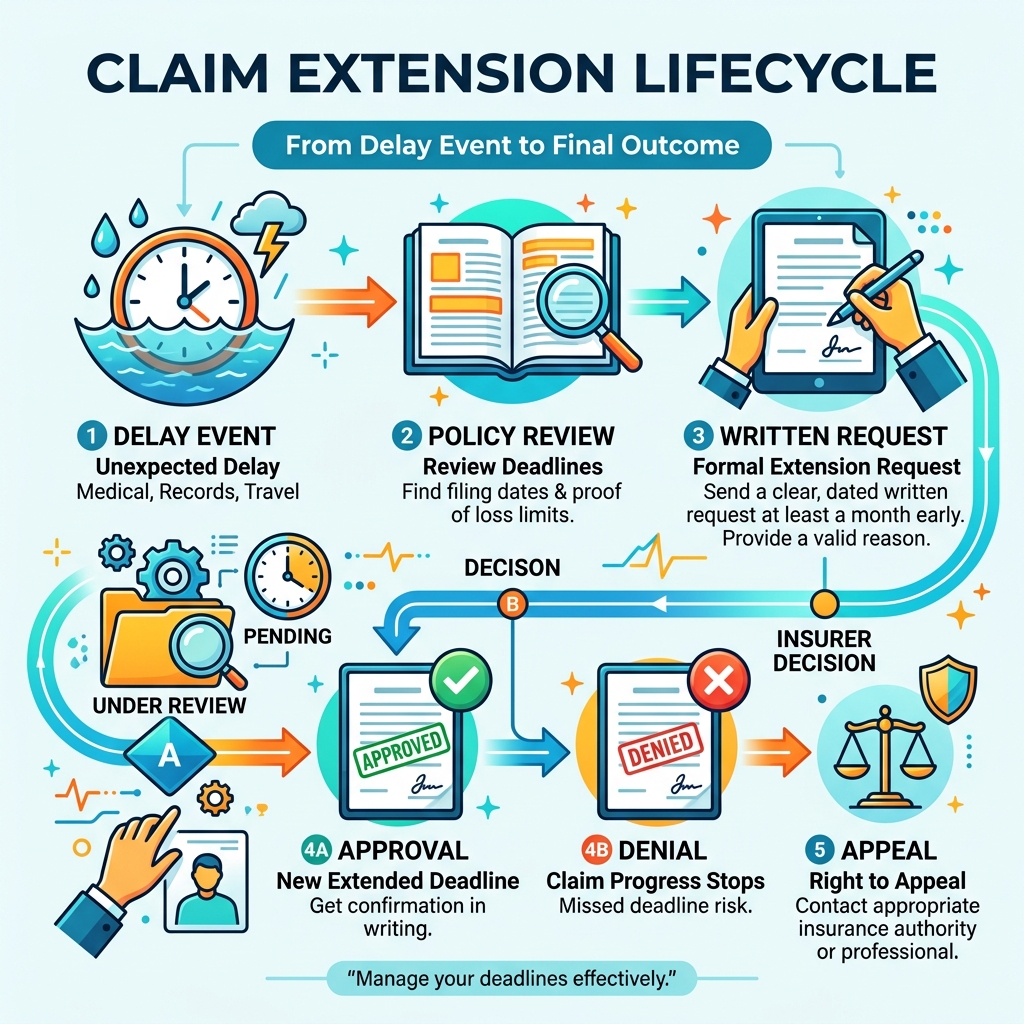
How to request a claim timeline extension:
- Review your policy – Find the exact deadlines for filing, proof of loss, and appeals
- Act early – Submit your extension request at least a month before the deadline
- Write it down – Always request extensions in writing, never rely on verbal agreements
- Give a valid reason – Medical emergencies, destroyed records, and travel disruptions all count
- Get confirmation – Ask the insurer to respond in writing within a set time frame
- Appeal if denied – Contact your state insurance department or a claims professional
Time limits in insurance policies are strict. Miss them, and you could lose your benefits entirely – no exceptions.
This matters a lot if you’re an international student dealing with a medical emergency or a trip cancellation abroad. You’re already stressed. The last thing you need is to lose your claim because of a deadline you didn’t know existed.
Insurance policies are packed with deadlines. Most have a 12-month window to file a lawsuit, many require proof of loss within 150 to 180 days, and some cut off living or travel expense benefits after just one year. These clocks start ticking whether you know about them or not.
The good news? Extensions are possible. Insurers can and do grant them – but you have to ask, and you have to ask the right way.
Understanding the Claim Timeline Extension Guide Basics

When we talk about a “claim timeline extension,” we are usually referring to a formal request to push back a deadline. In the construction world, this is often called an Extension of Time (EOT). In the insurance world, it’s simply a request for more time to submit paperwork or evidence.
At its core, an extension is a risk management tool. Whether you are a contractor building a skyscraper or a student trying to recover funds from a cancelled flight to Sydney, the timeline is your boundary. If you cross that boundary without a formal extension, you are effectively “out of bounds,” and the other party (the insurer or the project owner) often has no legal obligation to help you anymore.
Why a Claim Timeline Extension Guide is Essential for Success
Why do we need a guide for this? Because delays are the rule, not the exception. Industry statistics show that around 70% of medium-sized projects and a staggering 90% of large-scale projects encounter delays that result in EOT claims. If you’re a student, you might think your travel claim is simpler, but the principle is the same: things go wrong.
An extension serves several critical functions:
- Mitigation of Penalties: In construction, an EOT protects you from “liquidated damages”—those nasty daily fines for finishing late.
- Claim Preservation: It keeps your legal rights alive. If you miss a “time bar” (a hard deadline), your claim might be dead on arrival.
- Avoiding “Time at Large”: This is a legal concept where, if the timeline is managed poorly, the original completion date becomes invalid, leading to massive disputes.
How Contract Terms and State Regulations Govern Extensions
In Australia, the rules for extensions are usually baked into the contract. For example, standard Australian construction contracts like AS 4000 or AS 2124 have very specific “time bars”—often requiring you to give notice of a delay within 28 days.
While we focus on Australian standards, it is helpful to look at international benchmarks to see how strictly these things are handled. For instance, the National Association of Insurance Commissioners (NAIC) Unfair Claims Settlement Practices Act model law sets a global standard for how insurers should behave. Even in highly regulated areas like California, where the California Code of Regulations, Title 10, Section 2695.7 enforces some of the world’s strictest timelines, the message is clear: the law sets the floor, but your contract sets the ceiling.
Valid Reasons for Requesting an Extension of Time (EOT)
You can’t just ask for more time because you felt like taking a nap. You need a “valid reason.” In claims, these are usually events that were unforeseeable and outside of your control.
Common valid reasons include:
- Inclement Weather: Not just a light drizzle, but “exceptional” weather that stops work or travel.
- Owner Actions: If the person you’re working for (the project owner or the insurer) causes the delay, you are entitled to an extension. As says attorney Alexander Tuhtan Any delay directly caused by the project owner is covered by EOT claim. This is because, legally, a principal cannot benefit from their own wrongdoing.
- Unforeseen Site Conditions: Finding an ancient burial ground or contaminated soil where you were supposed to dig.
- Scope Changes: When the client suddenly decides they want a marble fountain instead of a regular tap.
- Personal Hardship: For students, this might involve a medical emergency or the loss of travel documents.
Identifying Excusable vs. Non-Excusable Delays
Not all delays are created equal. We like to categorize them to help you understand if you actually have a case for an extension.
| Delay Type | Definition | Extension Granted? | Compensation Granted? |
|---|---|---|---|
| Excusable | Events outside your control (e.g., floods, owner delays). | Yes | Sometimes |
| Non-Excusable | Your fault (e.g., poor planning, subcontractor issues). | No | No |
| Compensable | Caused by the owner/principal. | Yes | Yes |
| Concurrent | Two delays happening at once (one yours, one theirs). | Usually Yes | Usually No |
The “Critical Path” is the key here. For an extension to be valid, the delay must affect the actual completion date of the project or the final deadline of the claim. If you’re delayed on a task that doesn’t affect the final finish line, you might not get that extension.
Special Circumstances: Force Majeure and Pandemics
“Force Majeure” is a fancy French term for “Acts of God.” We’re talking about earthquakes, wars, and—as we all learned recently—pandemics. COVID-19 changed the claim timeline extension guide forever. It proved that global supply chain collapses and labor scarcity are valid reasons for pushing back deadlines.
However, these events can be traumatizing. If you are dealing with a claim following a major disaster, it’s important to recognize the mental toll. Resources like the Scientific research on the psychological impact of disaster recovery highlight how stress can impede your ability to manage a complex claim, which is itself a reason to seek professional help or an extension based on hardship.
Step-by-Step Claim Timeline Extension Guide for Students
If you’re a student studying in Australia, the process can feel overwhelming. We’ve broken it down into a simple, step-by-step claim timeline extension guide to keep you on track.
- Review Your Policy Immediately: Don’t wait until the deadline is tomorrow. Check your travel insurance policy for words like “Notice of Claim” or “Proof of Loss.”
- Identify the Delay Event: What happened? Was it a flight cancellation? A hospital stay?
- Submit a “Notice of Loss”: This is your first formal signal to the insurer. You don’t need all the evidence yet; you just need to tell them something happened.
- Request the Extension in Writing: Send an email or a letter. Be clear: “We are requesting a 30-day extension to the Proof of Loss deadline due to [Reason].”
- Use Our Resources: We have specific guides to help you through this, such as how to master the student travel claim process and our step-by-step guide to filing a travel insurance claim as a student.
Documentation and Evidence Required for Your Request
The party with the most paper usually wins. To get an extension approved, you need to prove why you need it.
- For Construction: Site diaries, weather logs, and photos of the site.
- For Students: Medical certificates, police reports (if something was stolen), or correspondence from the airline.
- Contemporaneous Records: This is just a fancy way of saying “records made at the time.” A diary entry from the day of the storm is worth ten times more than a memory from three months later.
If you are unsure what to keep, check our guide on what documents students need for travel insurance claims.
Proactive Management and Digital Tools
We live in the digital age—use it! You don’t need to manage your claim on a sticky note.
- Scheduling Software: Tools like MS Project or Primavera help construction managers see the “Critical Path.”
- Gantt Charts: A visual way to see how one delay bumps everything else down the line.
- Automated Tracking: Set calendar alerts for 30 days before any deadline.
Managing your claim effectively is about being proactive. We recommend reading our tips on how to effectively file a travel insurance claim as a student to stay ahead of the curve.
Navigating Denials and Potential Consequences
What happens if they say “no”? It’s a scary thought, but it’s not the end of the road. If an extension is denied, the claim might face “administrative closure.” This means the insurer stops looking at it.
The consequences of a failed extension request can be severe:
- Loss of Benefits: You might have to pay that $5,000 hospital bill out of your own pocket.
- Liquidated Damages: Your company might lose thousands of dollars per day.
- Litigation: About 30% of claims that aren’t settled through negotiation or ADR (Alternative Dispute Resolution) end up in court. That’s expensive and slow.
If you’re dealing with a medical-related claim, learn how to handle the hospital stay claim process to minimize the chances of a denial.
Avoiding Common Mistakes in Your Claim Timeline Extension Guide
We see the same mistakes over and over again. Here is how to avoid them:
- Late Notice: This is the #1 reason claims are rejected. If your contract says “notify us in 5 days,” don’t wait until day 6.
- Vague Documentation: Saying “it rained” isn’t enough. Saying “it rained 50mm, which is 300% above the monthly average, preventing safe crane operation” is much better.
- Verbal Assurances: If a claims officer tells you over the phone, “Don’t worry about the deadline,” worry about the deadline. Get it in an email.
- Missing “Time Bars”: Some deadlines are “hard” and cannot be extended. Know which ones those are.
For international students, navigating these rules can be tricky, so check out visa claims 101 navigating the process for international students to avoid common pitfalls.
Compensation vs. Time: Understanding the Difference
This is a huge point of confusion. An extension of time does not automatically mean you get more money.
- The Extension: Gives you more time to finish without being penalized.
- Prolongation Costs: This is a separate claim for the money you lost because of the delay (like extra rent, overhead, or interest).
Many contracts have “No Damages for Delay” clauses. These mean you get more time, but you don’t get a cent of extra money. You need to file separate claims for financial recovery. For more on getting your money back, see our guide on study abroad claims how to get your credits and cash back.
Frequently Asked Questions about the Claim Timeline Extension Guide
Does a timeline extension automatically include cost compensation?
No. In most construction and insurance contexts, time and money are treated as two different buckets. You might be granted an extension to avoid penalties, but you usually have to submit a separate, detailed claim for “prolongation costs” or “additional expenses” like overhead and preliminaries.
What happens if I fail to request an extension before the deadline?
You risk a “Loss of Rights.” In construction, this means you may be liable for liquidated damages. In insurance, the company may move for “administrative closure,” meaning they will no longer process your claim. Once a deadline passes, it becomes much harder (and sometimes legally impossible) to revive the claim.
Can I request multiple extensions on the same claim?
Yes, provided each request is based on a new or continuing delay event. For example, if you have a delay due to a flood, and then later a delay due to a design change, you would file two separate EOT requests. Each must be documented and analyzed for its impact on the critical path.
Conclusion
At RecipesGuard, we know that being a student in a new country is hard enough without having to become a legal expert overnight. Our mission is to provide you with the step-by-step tutorials you need to protect your rights.
Whether you’re dealing with a delayed project or a travel mishap, remember the golden rule of the claim timeline extension guide: act early, document everything, and always get it in writing. Don’t let a simple calendar date stand between you and the compensation you deserve.
If you’re planning your next adventure or just arrived, make sure you’re protected with the right travel insurance for students traveling to Australia. We’re here to help you every step of the way!
