
When Adventure Goes Wrong: What You Need to Know About an Adventure Activity Claim
An adventure activity injury claim is a legal request for compensation when you’re hurt during a high-risk activity — like rock climbing, zip-lining, or white-water rafting — due to someone else’s negligence.
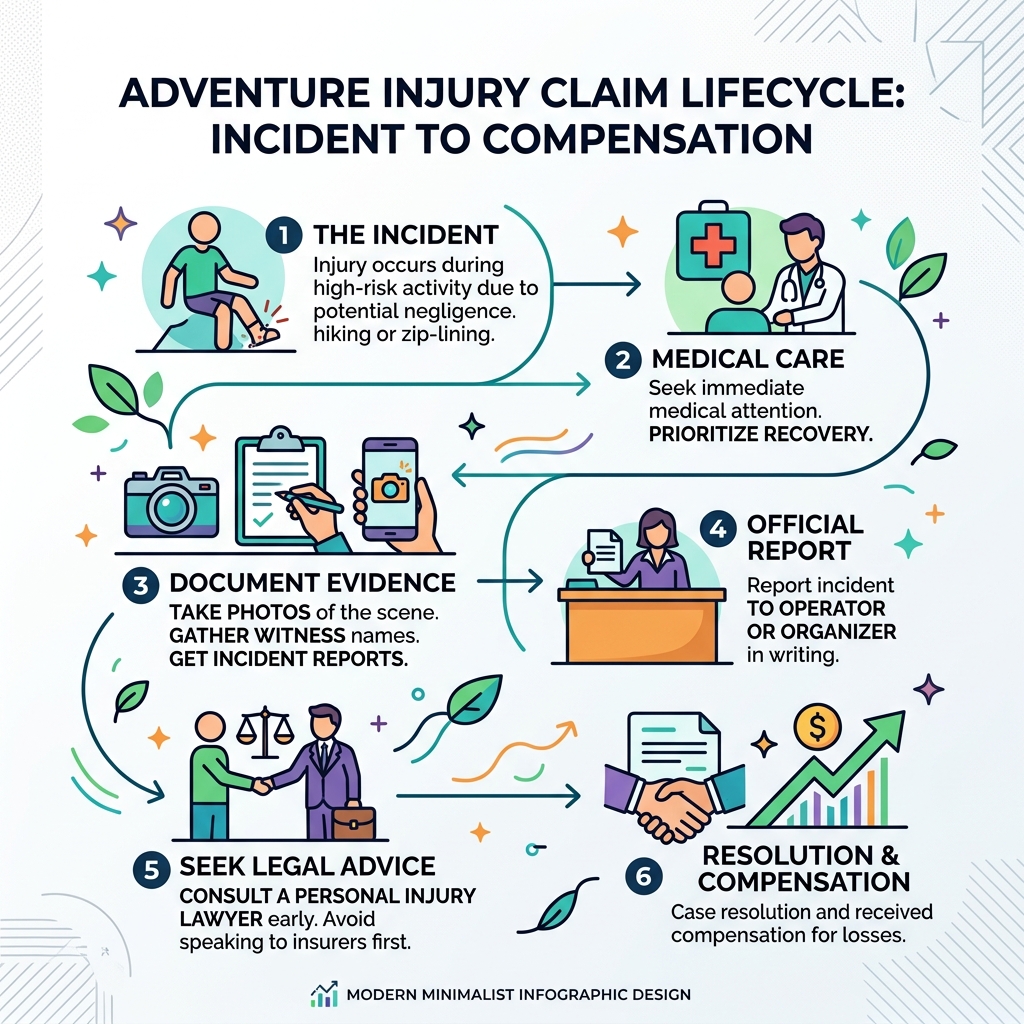
Here’s a quick overview of how to file one:
- Get medical care immediately after the injury
- Document everything — photos, witness names, incident reports
- Report the incident to the operator or organizer in writing
- Check your travel insurance to see if adventure sports are covered
- Consult a personal injury lawyer before speaking to insurers
- File within the time limit — typically 3 years, but this varies by country
Signing a waiver does NOT automatically end your right to claim. If an operator was negligent, you may still have a valid case.
Adventure activities are thrilling. They’re also genuinely risky.
But there’s a big difference between accepting the inherent danger of rock climbing and being injured because an operator skipped safety checks, gave poor instructions, or used faulty equipment.
As a student traveling abroad, this distinction matters even more. You may be in an unfamiliar country, dealing with a language barrier, unsure of your rights — and facing real medical costs with no clear path to recovery.
The good news? You likely have more legal options than you think.
This guide walks you through exactly how an adventure activity injury claim works — from understanding waivers to gathering evidence to knowing your deadlines — so you can take the right steps even when you’re far from home.
Common High-Risk Activities and the Reality of Adventure Injuries
We all love that rush of blood to the head when we’re standing at the edge of a bungee platform or paddling into a Grade IV rapid. In Australia, we are blessed with some of the most spectacular landscapes for these thrills. However, “adventure” and “injury” are often two sides of the same coin.
According to Law Insider, a recreational activity is broadly defined as any outdoor activity undertaken for exercise, relaxation, or pleasure. This covers everything from a quiet afternoon of birdwatching to the heart-stopping moment you jump out of a plane.
The Usual Suspects: Activities Leading to Claims
While any sport carries risk, certain activities frequently appear in an adventure activity injury claim. These include:
- White-water Rafting: Often involves unpredictable river conditions. Injuries can occur from capsizing or being struck by paddles.
- Bungee Jumping and Skydiving: While highly regulated, equipment failure or human error during the “hook-up” phase can lead to catastrophic results.
- ATV and Quad Bike Tours: These are notorious for rollovers, especially when tourists are given powerful machines with minimal training.
- Horseback Riding: Animals have minds of their own. Falls are common, but they often stem from an operator providing a horse that doesn’t match the rider’s skill level.
- Mountain Biking and Rock Climbing: These often involve perilous terrain where a single loose bolt or a poorly maintained trail can lead to a long stay in the hospital.
- Obstacle Courses and Survival Races: High-intensity events like survival races have seen participants suffer serious injuries on specific obstacles—sometimes even after previous participants were injured on the exact same equipment earlier in the day.
Statistics from the National Safety Council highlight that recreational injuries are a significant concern, often occurring when participants least expect them. Whether it’s a “jungle tour” where a guide fails to spot a venomous snake or a zip-line where the braking system fails, the transition from “fun” to “emergency room” happens in a heartbeat.

Navigating the Legal Maze: Waivers and the Adventure Activity Injury Claim
We’ve all been there: standing at a check-in desk, scribbling our signature on a three-page document while the guide taps their watch. You probably didn’t read it. Most people don’t. That document is a liability waiver, and its goal is to make you “assume the risk.”
Understanding “Assumption of Risk”
In Australia, the legal doctrine of “assumption of risk” is a major factor in any adventure activity injury claim. Essentially, it means that if you voluntarily participate in an activity that has obvious, inherent risks (like the risk of falling while rock climbing), you may be barred from seeking compensation if that specific risk manifests.
However, this is not a “get out of jail free” card for operators. You assume the inherent risks, not the risks created by an operator’s incompetence. For example:
- Inherent Risk: You trip while hiking on a marked, well-maintained trail.
- Negligent Risk: The tour guide leads you off-trail into a known landslide zone without warning.
The Truth About Waivers
Many students believe that once they sign a waiver, they’ve signed away their right to sue. This is a myth. Under Australian law, and specifically within various state Civil Liability Acts, waivers are often scrutinized. A waiver might be considered unenforceable if:
- It is overly broad or vague.
- The operator engaged in “gross negligence” (a conscious and voluntary disregard of the need to use reasonable care).
- The participant was pressured or misled into signing it.
Before you head out on your next excursion, it’s a smart move to check your travel insurance plans with adventure sports coverage. A good policy can provide a safety net that works alongside your legal rights.
Circumstances for a Valid Adventure Activity Injury Claim
To move forward with a claim, we generally need to prove that the operator breached their “duty of care.” This duty requires them to take reasonable steps to ensure your safety.
| Scenario | Inherent Risk (Likely No Claim) | Operator Negligence (Valid Claim) |
|---|---|---|
| Skydiving | A hard landing due to sudden wind change. | Parachute fails due to improper packing by staff. |
| Biking | A small stone causing a minor slip. | The bike’s brakes fail because they weren’t serviced. |
| Ziplining | Feeling dizzy or scared from the height. | The harness snaps because it was frayed and old. |
| Scuba | Mild ear pressure issues. | Being given a tank with contaminated air. |
As noted by Injury Facts, the law usually covers the inherent risks, but it does not protect others from acting recklessly. If an equipment manufacturer or a tour operator acts negligently, leading to your injury, you still have legal recourse.
The Role of Jurisdiction in Your Adventure Activity Injury Claim
Jurisdiction is just a fancy legal word for “which court gets to decide.” This becomes incredibly tricky for students on holiday. If you are an Australian student injured on a cruise ship excursion in Fiji, which laws apply?
- Vacation Injuries: Generally, the law of the place where the injury occurred applies.
- Cruise Ship Excursions: Often, these activities are run by third-party operators. Determining if the cruise line or the local operator is liable requires a deep dive into the “fine print” of your ticket contract.
- Time Limits: In Australia, you generally have a three-year statute of limitations to file a personal injury claim. If you wait too long, you lose your right to seek compensation forever.
Proving Negligence: When “Assumption of Risk” Isn’t Enough
To win an adventure activity injury claim, we have to move beyond the fact that you got hurt. We have to prove why it was their fault. This usually boils down to a failure in their safety systems.
Equipment Maintenance and Gear Standards
One of the most common grounds for a claim is faulty equipment. Whether it’s a climbing rope that should have been retired three years ago or a helmet that doesn’t fit, substandard gear is a recipe for disaster. Research from Johns Hopkins Medicine emphasizes that receiving adequate training and using proper equipment are the two most critical factors in preventing sports injuries. If an operator fails to provide these, they are likely liable.
Staff Supervision and Inadequate Instruction
If you’ve never been white-water rafting before, you rely entirely on the guide’s briefing. If that briefing is rushed, omits key safety maneuvers, or if the guide is distracted (perhaps checking their phone while you’re navigating a rapid), their negligence is clear.
In some legal cases, such as those involving adventure races, courts have looked at whether the instructions provided were “reasonably practicable.” If an operator knows an obstacle is dangerous—perhaps because two people were already injured on it that morning—and they fail to change their instructions or close the obstacle, they are on very thin ice legally.
Risk Assessments and Misrepresentation
Reputable companies must conduct regular risk assessments. They need to look at the weather, the terrain, and the physical fitness of the participants. If they misrepresent the difficulty of an activity—telling a beginner that a “black diamond” trail is “easy”—they have breached their duty of care.
Essential Steps to Take After an Adventure Activity Injury
The moments immediately following an accident are chaotic. You’re in pain, you’re likely in a remote location, and you might be in shock. However, what you do in these first few hours will make or break your adventure activity injury claim.
1. Seek Immediate Medical Care
Your health is the priority. Even if you think you’re “fine,” adrenaline can mask serious internal injuries or concussions. Getting a medical report creates an official record of your injuries and links them directly to the accident.
2. Document the Incident
If you are physically able (or can ask a friend), start gathering evidence. According to specialists in sports injuries, you should:
- Take photos of the scene, the equipment involved, and your visible injuries.
- Collect contact information from any witnesses.
- Write down your account of what happened as soon as possible, while the details are fresh.
3. Report the Incident
Notify the operator or the property owner in writing. Ask for a copy of their incident report, but be careful—don’t sign anything that admits fault or waives your rights further.
4. File Your Insurance Claim
For students, this is where things get specific. You need to know how to file a travel insurance claim as a student effectively. Make sure you have all the necessary documents students need for claims, such as your policy number, medical receipts, and the incident report.
5. Legal Consultation
Before you accept a “goodwill” settlement from an insurance company or the operator, talk to a specialized lawyer. They can help determine the true value of your claim, which is often much higher than the first offer you’ll receive.
Maximizing Your Claim: Compensation and Evidence
What exactly can you recover in an adventure activity injury claim? It’s not just about the hospital bill. Compensation is generally split into two categories:
General Damages
This is money for the “non-financial” impact of the injury. It includes:
- Pain and Suffering: The physical pain you endured.
- Loss of Amenities: If you can no longer enjoy your hobbies (like surfing or playing footy) because of the injury.
- Emotional Distress: The psychological impact, such as PTSD following a near-death experience.
Special Damages
These are the quantifiable financial losses you’ve incurred:
- Medical Expenses: Surgeries, medication, and ongoing physical therapy.
- Lost Wages: If your injury prevents you from working your part-time job or delayed your entry into the workforce after graduation.
- Travel Costs: Expenses for getting to and from medical appointments.
- Rehabilitation: Costs for long-term care or modifications to your home if the injury is permanent.
The Power of Evidence
To maximize these amounts, you need expert testimony. This might include a doctor explaining your long-term prognosis or an industry expert testifying that the operator’s safety protocols were below standard.
Many personal injury lawyers in Australia operate on a Conditional Fee Agreement (CFA), often called “No Win, No Fee.” This is particularly helpful for students, as it means you don’t have to pay legal fees upfront. You only pay if your claim is successful, usually as a percentage of the settlement.
Frequently Asked Questions about Adventure Injuries
Can I still sue if I signed a liability waiver?
Yes. As we discussed, a waiver does not protect an operator from gross negligence or a failure to provide a basic duty of care. If the equipment was faulty or the staff was untrained, that waiver might not hold up in court.
What is the time limit for filing a claim?
In most Australian jurisdictions, you have three years from the date of the accident. However, if you are a minor (under 18) at the time of the injury, the “clock” might not start ticking until you turn 18. Regardless, you should always act as quickly as possible.
Does my student travel insurance cover extreme sports?
Not always! Many standard policies exclude “high-risk” activities. You must check if your plan has specific adventure sports coverage. If you’re unsure, we recommend looking into travel insurance plans with adventure sports coverage specifically designed for active travelers.
Conclusion
Adventure is a vital part of the student experience, especially when exploring the rugged beauty of Australia or venturing abroad. But when a thrill turns into a tragedy due to someone else’s carelessness, you shouldn’t have to bear the financial and physical burden alone.
Filing an adventure activity injury claim can be a complex journey, but it is often the only way to secure the resources you need for a full recovery. From understanding the nuances of “assumption of risk” to navigating the specifics of student insurance, being informed is your best defense.
At RecipesGuard, we are dedicated to helping students navigate these tough situations with step-by-step tutorials and expert advice. If you’ve been injured, don’t let a signed waiver or a complicated insurance policy discourage you. Your rights are worth protecting.
For more information on staying safe and covered during your travels, visit us at RecipesGuard to explore our student-focused guides and claim tutorials. Stay adventurous, but stay protected!
