
When Theft Strikes on Your Gap Year: What You Actually Need to Know
Backpacker insurance claim tips can mean the difference between getting your money back quickly and watching your reimbursement disappear into a pile of rejected paperwork.
Here’s a quick answer if you need it now:
Top backpacker insurance claim tips at a glance:
- Call your insurer’s emergency line immediately – before you do almost anything else
- File a police report within 24 hours – most insurers require this for theft or loss
- Keep every receipt, photo, and document – even ones that seem minor
- Submit your claim within 30-60 days – missing this window can void your claim entirely
- Check your policy covers your specific activity – adventure sports and hostel theft have special rules
- Use your insurer’s app or online portal – it’s faster and creates a clear paper trail
- Follow up if you hear nothing within 30 days – don’t wait passively
Imagine this: you wake up in a hostel dorm and your camera is gone. Your heart sinks. Then comes the second wave of panic — how do I actually claim this?
Most first-time backpackers have no idea what to do in that moment. And the mistakes made in the first few hours after an incident are often the exact reasons claims get delayed or denied later.
The good news? The process is much simpler when you know the steps ahead of time.
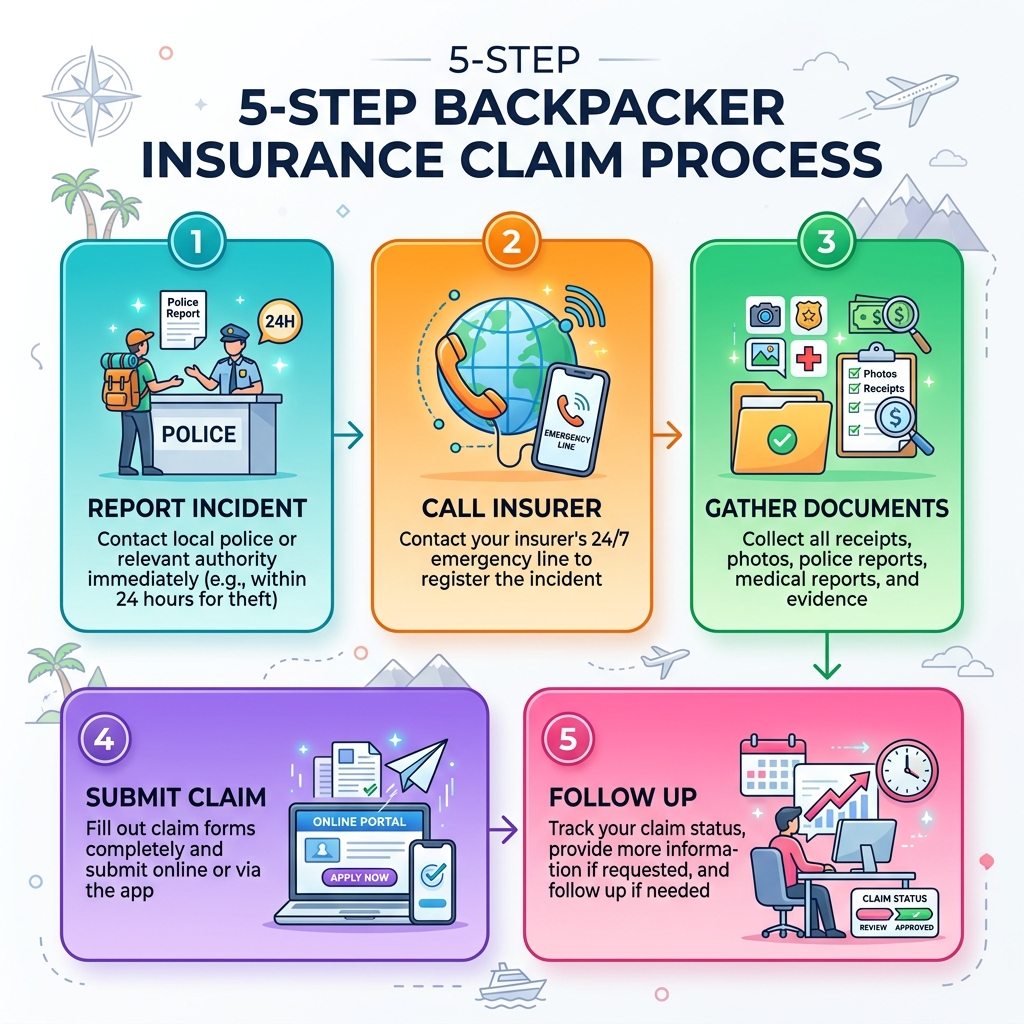
Immediate Steps to Take After a Backpacking Incident

When something goes wrong—whether it’s a stolen bag in a Sydney hostel or a medical emergency after a surfing accident—the first hour is critical. Your priority is always personal safety, but once you are out of harm’s way, you need to switch into “evidence mode.”
One of the most vital backpacker insurance claim tips is to understand the 24-hour rule. Most insurance providers require you to report theft, loss, or significant accidents to local authorities or your insurer within 24 hours of the incident. If you wait three days because you were “too stressed,” your claim might be denied before you even fill out the form.
Contacting Your Insurer’s Emergency Line
Before you pay for a private hospital bed or book a flight home, call your insurer’s 24/7 emergency assistance line. These teams provide more than just a sympathetic ear; they offer:
- Pre-authorization: For medical claims, they can often coordinate directly with the hospital so you aren’t stuck paying thousands of dollars upfront.
- Global Support: They can help find the nearest approved clinic or even assist with language barriers.
- Incident Reporting: Getting your incident on their radar early creates a time-stamped record that supports your official claim later.
Filing a Local Police Report Abroad
If you’ve been a victim of theft, you must get a police report. This is non-negotiable for almost every backpacker policy. If you are in a country where the local police are difficult to reach or there is a language barrier, do not give up.
- Ask your hostel or hotel staff to help translate.
- Ensure the report includes the date, time, and a specific list of what was stolen.
- If the police refuse to provide a full report, get a “logged incident number” at the very least.
Immediate Contacts List:
- Your Insurer’s 24/7 Emergency Number (Save this in your phone now!)
- Local Emergency Services (000 in Australia)
- Your Embassy or Consulate (Essential for lost passports)
- Your Bank (To freeze stolen cards)
Essential Backpacker Insurance Claim Tips for Success
The biggest hurdle backpackers face isn’t usually the “event” itself, but the lack of paperwork. Insurers cannot take your word for it; they require independent verification. This is where many student travelers struggle, as keeping paper receipts in a damp backpack isn’t exactly easy.
Gathering Proof for Medical and Theft Claims
To ensure your claim isn’t part of the “incomplete paperwork” pile, you need to be a digital hoarder.
- Medical Claims: You need a doctor’s diagnosis, itemized hospital invoices, and receipts for any prescriptions. If you were injured during an activity, the insurer will check if that specific sport was covered.
- Theft Claims: You need proof of ownership. This can be original store receipts, credit card statements showing the purchase, or even dated photos of you using the item.
- Travel Documents: Keep your boarding passes and booking confirmations. These prove you were actually on the trip when the incident occurred.
For more detailed guidance on the specific paperwork required for younger travelers, we recommend checking out what documents students need for travel insurance claims.
How to Use Digital Tools for Backpacker Insurance Claim Tips
We live in a digital age, and your claims process should reflect that. Using mobile apps like Gigasure or your insurer’s dedicated portal can shave weeks off your reimbursement time.
- Scan as you go: Use a document scanning app to take high-quality PDFs of receipts the moment you get them.
- Cloud Storage: Upload everything to a secure folder (Google Drive, Dropbox) so you can access it even if your phone is stolen later.
- Real-Time Updates: Apps often allow you to track your claim status without having to wait on hold for an hour.
If you are feeling overwhelmed by the technical side of things, our step-by-step guide to filing a travel insurance claim as a student can walk you through the digital submission process.
Navigating the Filing Process and Timelines
Timing is everything. Most backpacker insurance claims are processed within 2 to 4 weeks, but that clock only starts once the insurer has everything they need. If you forget one receipt, they’ll email you, you’ll find it three days later, and the process resets.
Understanding Claim Submission Windows
Every policy has a “statute of limitations.”
- 30-Day Notice: Many providers, like Redpoint or various Australian insurers, require “written notice” of a claim within 30 days of the incident.
- 60-Day Filing Window: Generally, you must submit your full claim form and all evidence within 60 days of your return home.
Don’t wait until you get home to start the process. If you are on a year-long trip and get robbed in month two, file the claim while the details are fresh. For those still in school or on a university break, you can find specific advice on how to file a travel insurance claim as a student.
Tracking Your Claim Status Online
Once you hit submit, you should receive a claim reference number. Keep this safe! Use the online portal to check for status notifications. If the status says “Pending Documents,” call them immediately to find out what is missing.
Avoiding Common Pitfalls and Policy Denials
Why do claims get denied? It’s rarely because the insurer is “evil”—it’s usually because the traveler didn’t read the fine print.
| Feature | Single-Trip Policy | Annual Multi-Trip Policy |
|---|---|---|
| Best For | One long gap year journey | Multiple short trips in a year |
| Duration | Up to 12-18 months typically | Usually max 31-90 days per trip |
| Claims | One policy, one main claim period | Must select the specific trip for each claim |
| Cost | Fixed for the duration | Can be cheaper if traveling 3+ times |
Reviewing Your Policy Before You File
Before you submit your claim, look at your Schedule of Benefits.
- Sub-limits: Your policy might cover $5,000 in baggage, but have a “single item limit” of $500. If your $2,000 laptop is stolen, you’re only getting $500 back unless you paid for a “gadget cover” add-on.
- The Excess/Deductible: This is the amount you pay out of pocket. If your stolen headphones are worth $100 and your excess is $150, it’s not worth filing the claim.
- Adventure Sports: Did you get hurt while skydiving? Check Safety Wing’s list or your own policy’s list of covered activities. Many standard plans exclude “high-risk” activities like scooter riding or scuba diving without an extra rider.
Why Choosing the Right Plan Prevents Future Headaches
Choosing the right plan upfront is the ultimate backpacker insurance claim tip. If you are heading to Australia for a year, a standard 30-day holiday policy won’t cut it. You need long-stay insurance. Furthermore, if you plan on working in a hostel or on a farm, ensure your policy covers “manual labor” or “working holidays.”
What to Do if Your Claim is Delayed or Denied
A denial isn’t necessarily the end of the road. Insurers are required to give you a specific reason for the rejection.
How to Appeal a Denied Claim Effectively
If your claim is rejected:
- Read the rejection letter carefully. Is it a simple lack of evidence? Or a policy exclusion?
- Gather new evidence. If they denied a medical claim because they didn’t think it was an emergency, get a letter from the treating doctor explaining why the treatment couldn’t wait.
- Write a formal appeal. Reference your policy wording and explain why the denial is incorrect.
- Escalate. If you are still getting nowhere, you can contact the Financial Ombudsman Service (or the equivalent authority in Australia) for an independent review.
Taking Action on Delayed Reimbursements
If you haven’t heard back within 30 days, it’s time to be the “squeaky wheel.” Send a polite follow-up email asking for an update on your claim reference number. Sometimes claims get stalled because a specific adjuster is away or a document didn’t upload correctly.
Frequently Asked Questions about Backpacker Insurance Claim Tips
How long does it typically take to receive a reimbursement?
Most straightforward claims are processed and paid within 2 to 4 weeks. However, if your case is complex (like a multi-day hospital stay or a disputed theft), it can take 30 days or longer. Providing all documents upfront is the best way to speed this up.
What should I do if I lost my original receipts while traveling?
Don’t panic! While original receipts are best, insurers may accept credit card statements, bank records, or even high-quality photos of the item taken before it was stolen as proof of ownership.
Does my insurance cover theft from a shared hostel dorm?
This depends on your policy’s “duty of care” clause. Most insurers will only cover hostel theft if your gear was in a locked locker and there is evidence of “forcible entry” (like a broken padlock). If you left your iPhone on your pillow while you went to the shower, the claim will likely be denied due to “reckless behavior.”
Conclusion
At RecipesGuard, we know that a gap year is a once-in-a-lifetime experience, and we don’t want a single incident to ruin it. By following these backpacker insurance claim tips—staying organized, acting fast, and knowing your policy limits—you can travel with the peace of mind that you’re protected.
Whether you’re exploring the Outback or trekking through the rainforest, the best insurance is the one you know how to use. For more student-focused advice and step-by-step tutorials, visit https://www.recipesguard.com/ and let us help you navigate your journey safely. Safe travels!
