
What to Do With an Insurance Claim After Accident (Quick Answer)
Filing an insurance claim after accident doesn’t have to be overwhelming — even if it’s your first time.
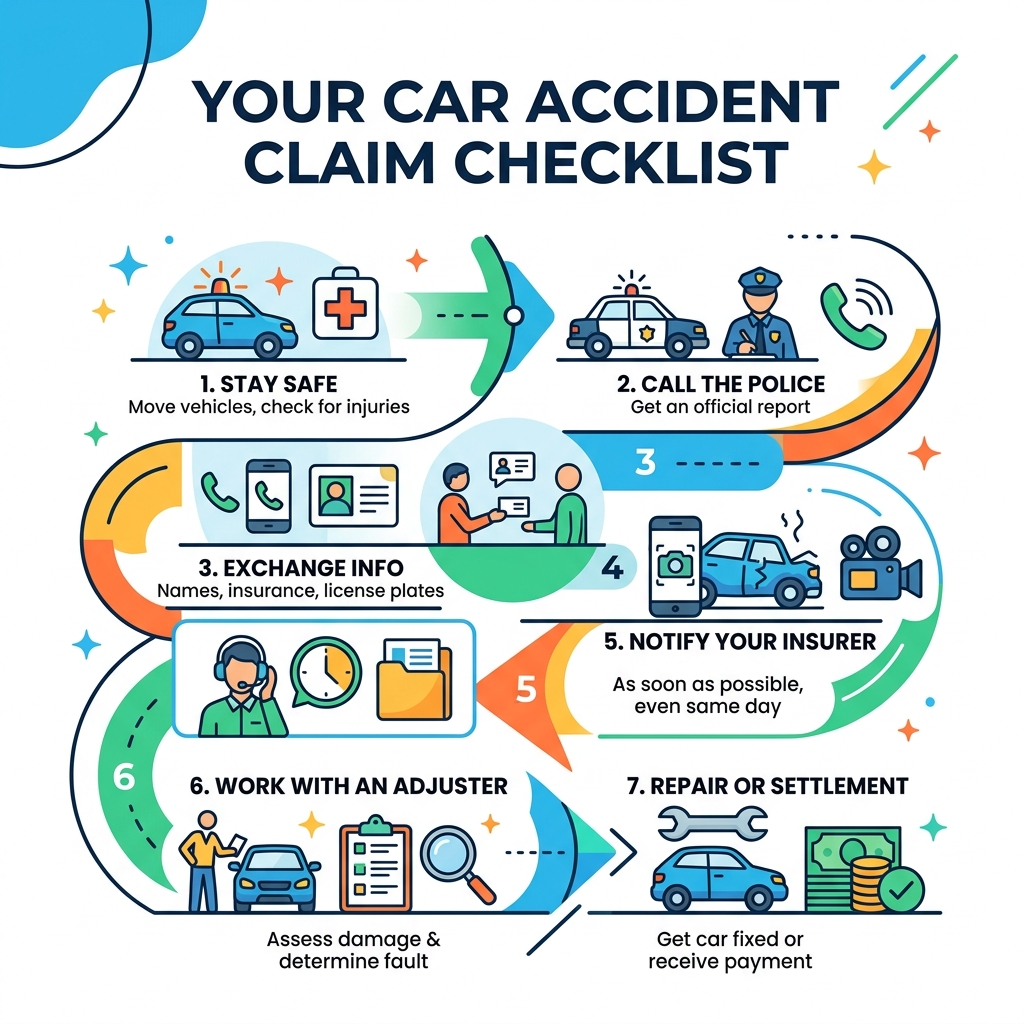
Here are the key steps at a glance:
- Stay safe — move to the side of the road and check for injuries
- Call the police — get an official report on record
- Exchange information — names, insurance details, license plates, phone numbers
- Document the scene — photos and videos of all damage
- Notify your insurer — as soon as possible, even the same day
- Work with an adjuster — they assess damage and determine fault
- Get your car repaired or receive a settlement — based on your coverage
Most insurers expect you to report promptly — often within 24–72 hours. The sooner you act, the smoother the process.
A car accident is stressful enough on its own. Add an unfamiliar insurance system — especially in a country you’re studying in — and it can feel completely overwhelming.
The good news? The process is more manageable than it looks once you understand the steps.
Whether the accident was your fault or someone else’s, whether there was minor damage or major injury, what you do in the first hours matters most. The right moves protect your safety, your finances, and your claim.
This guide walks you through everything — from the scene of the accident to getting your settlement — in plain, simple language.
Immediate Steps to Take at the Scene

The moments immediately following a collision are often a blur of adrenaline and confusion. However, taking the right actions here is the foundation of a successful insurance claim after accident. We recommend keeping a “crash card” in your glove box to remind you of these steps when your brain feels like scrambled eggs.
First and foremost: Safety Check. Before you even think about insurance, check yourself and your passengers for injuries. If anyone is hurt, or if there is a significant hazard (like a leaking fuel tank or a blocked highway), call emergency services (000 in Australia) immediately.
If the vehicles are drivable and it is safe to do so, move them to the shoulder or a nearby parking lot. Leaving cars in the middle of a busy intersection is a recipe for a second accident. Turn on your hazard lights and, if you have them, set up flares or a warning triangle.
Information to Exchange
Once everyone is safe, it’s time to play “detective.” You need to gather specific details from the other driver(s). Be polite but brief. We suggest collecting:
- Full name and contact details: Phone number and email address.
- Insurance information: The name of their insurance provider and, if possible, their policy number.
- Vehicle details: Make, model, color, and license plate number.
- Driver’s license: Take a photo of their license if they allow it.
- Witnesses: If anyone saw the accident, grab their name and phone number. Their neutral account can be “gold” during a fault dispute.
Documenting the Scene
In the age of smartphones, there is no excuse for poor documentation. Take more photos than you think you need. Capture:
- Close-ups of the damage on all vehicles involved.
- Wide shots showing the position of the cars relative to the road, signs, and traffic lights.
- Skid marks, broken glass, or damaged property (like fences or poles).
- The weather and road conditions.
When to Call the Police
In Australia, the rules for calling the police vary slightly by state, but the general rule of thumb is that you must report the accident if:
- Anyone is injured or killed.
- A driver refuses to provide their details.
- You suspect a driver is under the influence of drugs or alcohol.
- A vehicle needs to be towed.
- There is damage to property other than the vehicles (like a government-owned sign).
Even for a minor “fender bender,” having a police report number can significantly speed up your insurance claim after accident. It provides an official, third-party account of the event that adjusters find very hard to argue with.
How to File an Insurance Claim After Accident
Once you’ve left the scene and the dust has settled, it’s time to look at your paperwork. Understanding your policy is the first step toward getting your car back on the road.
Before you call anyone, check your coverage. In Australia, you likely have one of three types of cover:
- Comprehensive: Covers damage to your car and others, regardless of fault.
- Third Party Property: Only covers damage you cause to other people’s cars or property.
- Compulsory Third Party (CTP): Also known as a “Green Slip,” this is mandatory and covers personal injury to others, but not vehicle damage.
You should also check your excess (the Australian term for a deductible). This is the amount you have to pay out of pocket before the insurance company kicks in. For students or young drivers, this excess is often higher. For more information on navigating these complexities, you might find Filing Claims Under Your Own Policy helpful for understanding general principles of first-party claims.
Notifying Your Insurer and Starting the Insurance Claim After Accident Process
Most insurance companies have a “prompt notification” clause. This means you should tell them about the accident as soon as possible—ideally within 24 hours. Even if you don’t think you’ll file a claim (perhaps the damage is minor), notifying them protects you in case the other driver decides to sue you or claims an injury later.
Many modern insurers offer mobile apps that allow you to start the insurance claim after accident process right from your phone. You can upload photos, voice notes, and the police report number directly. If you are a student traveling or studying abroad, documentation is even more critical. We’ve put together a guide on what-documents-students-need-for-travel-insurance-claims which highlights how maintaining a clear paper trail is essential for any insurance-related matter.
First-Party vs. Third-Party Claims
When you file a claim, you generally have two paths depending on who was at fault.
| Feature | First-Party Claim | Third-Party Claim |
|---|---|---|
| Who you file with | Your own insurance company | The other driver’s insurance company |
| When to use it | If you were at fault, or if you want your car fixed quickly regardless of fault | If the other driver was clearly at fault |
| Excess/Deductible | You usually have to pay your excess upfront | You do not pay an excess |
| Speed | Generally faster; your insurer takes care of you | Can be slower as the other insurer investigates their client |
| Subrogation | Your insurer pays you, then chases the other party | Not applicable |
If you have comprehensive insurance and the accident wasn’t your fault, we often recommend filing with your own insurer first. They will pay for your repairs (minus the excess, which they might waive if the other driver is identified and at fault) and then use a process called subrogation to get their money back from the other driver’s insurance. It’s much less of a headache for you!
Navigating Fault and the Adjuster Investigation
After you report the claim, the insurance company will assign an adjuster. Think of the adjuster as the “judge and jury” of your claim. Their job is to determine the extent of the damage and, crucially, who was at fault.
In Australia, fault isn’t always 100% one way or 0% the other. We use a concept called comparative negligence. This means that if you were 20% responsible for the accident (perhaps you were speeding slightly when someone pulled out in front of you), your payout might be reduced by 20%. For a deeper dive into how this works across different jurisdictions, see Contributory and Comparative Negligence by State.
The adjuster will look at:
- The police report.
- Photos of the scene and damage.
- Statements from both drivers and any witnesses.
- State traffic laws.
Avoiding Common Mistakes in Your Insurance Claim After Accident
We see people make the same mistakes over and over again. To keep your claim on track, follow these “golden rules”:
- Never admit fault at the scene: Even if you think you messed up, don’t say “I’m sorry” or “It was my fault.” Fault is a legal determination based on facts you might not see in the heat of the moment.
- Watch your social media: Insurance adjusters are tech-savvy. If you claim you have a back injury but post a video of yourself doing “the worm” at a party two days later, your claim will be denied faster than you can say “busted.”
- Avoid recorded statements early on: You are required to cooperate with your own insurer, but you are not required to give a recorded statement to the other driver’s insurer. They are looking for ways to trip you up.
- Be careful with “I’m fine”: Adrenaline masks pain. If you say you aren’t injured at the scene but wake up the next day unable to move your neck, it’s much harder to claim medical expenses. Instead, say “I’m going to get checked out by a doctor.”
For students specifically, the stakes can be high if a claim is handled poorly. Our step-by-step-guide-to-filing-a-travel-insurance-claim-as-a-student offers additional tips on avoiding common pitfalls when dealing with insurance companies.
Vehicle Repairs and Total Loss
Once fault is determined, the adjuster will provide a repair estimate. In Australia, many policies give you the “choice of repairer,” meaning you can take your car to a mechanic you trust. Others might require you to use one of their “preferred” shops. Always check this in your Product Disclosure Statement (PDS).
If the cost to fix your car is more than the car is worth (usually around 70-80% of its market value), the insurer will declare it a total loss or a “write-off.” In this case:
- They will pay you the Actual Cash Value (ACV) of the car. This is what the car was worth just before the accident, not what you paid for it three years ago.
- If you have a car loan and the payout is less than what you owe, Gap Insurance (if you have it) will cover the difference.
- If you need a car while yours is being fixed, check if your policy includes Rental Reimbursement. This is often an optional add-on in Australia.
Frequently Asked Questions about Car Accident Claims
How long do I have to file a car insurance claim?
While the legal “statute of limitations” for property damage in Australia can be several years, your insurance policy usually requires you to report the accident “promptly” or “as soon as reasonably possible.” Waiting weeks or months can give the insurer a reason to deny the claim, as it becomes harder to prove the damage happened during that specific accident. Aim for 24 to 72 hours.
Will filing a claim increase my insurance rates?
It depends. If the accident wasn’t your fault, your premiums usually won’t go up. However, if you are found at fault, you will likely lose your “No Claims Bonus,” which can lead to a price hike at renewal. Some insurers offer Accident Forgiveness, where they “ignore” your first at-fault accident, but this is usually a premium feature you pay extra for.
What should I do if the other driver is uninsured?
This is a nightmare scenario, but not a hopeless one. If you have Comprehensive Insurance, your own insurer will cover your repairs and then try to recover the money from the other driver personally (though this is often difficult). If you only have Third Party insurance, some policies include a small amount of “Uninsured Motorist Extension” (usually up to $3,000–$5,000) to help fix your car if the other driver is at fault and uninsured.
Conclusion
Navigating an insurance claim after accident is a marathon, not a sprint. It requires patience, meticulous documentation, and a clear understanding of your rights. Whether you are a local driver or an international student trying to make sense of the Australian system, you don’t have to do this alone.
At RecipesGuard, we specialize in providing student-focused advice for the insurance industry. We know that as a student, your budget is tight and your time is precious. Our mission is to simplify the complex world of insurance advisory so you can focus on your studies, not on paperwork.
If you’re still feeling unsure about your situation, or if you’re looking for more specialized guides, check out our other resources:
- How to file a travel insurance claim as a student
- How to effectively file a travel insurance claim as a student
For More info about insurance advisory services, visit our homepage. We are here to help you protect your journey, one step at a time. Safe driving!
